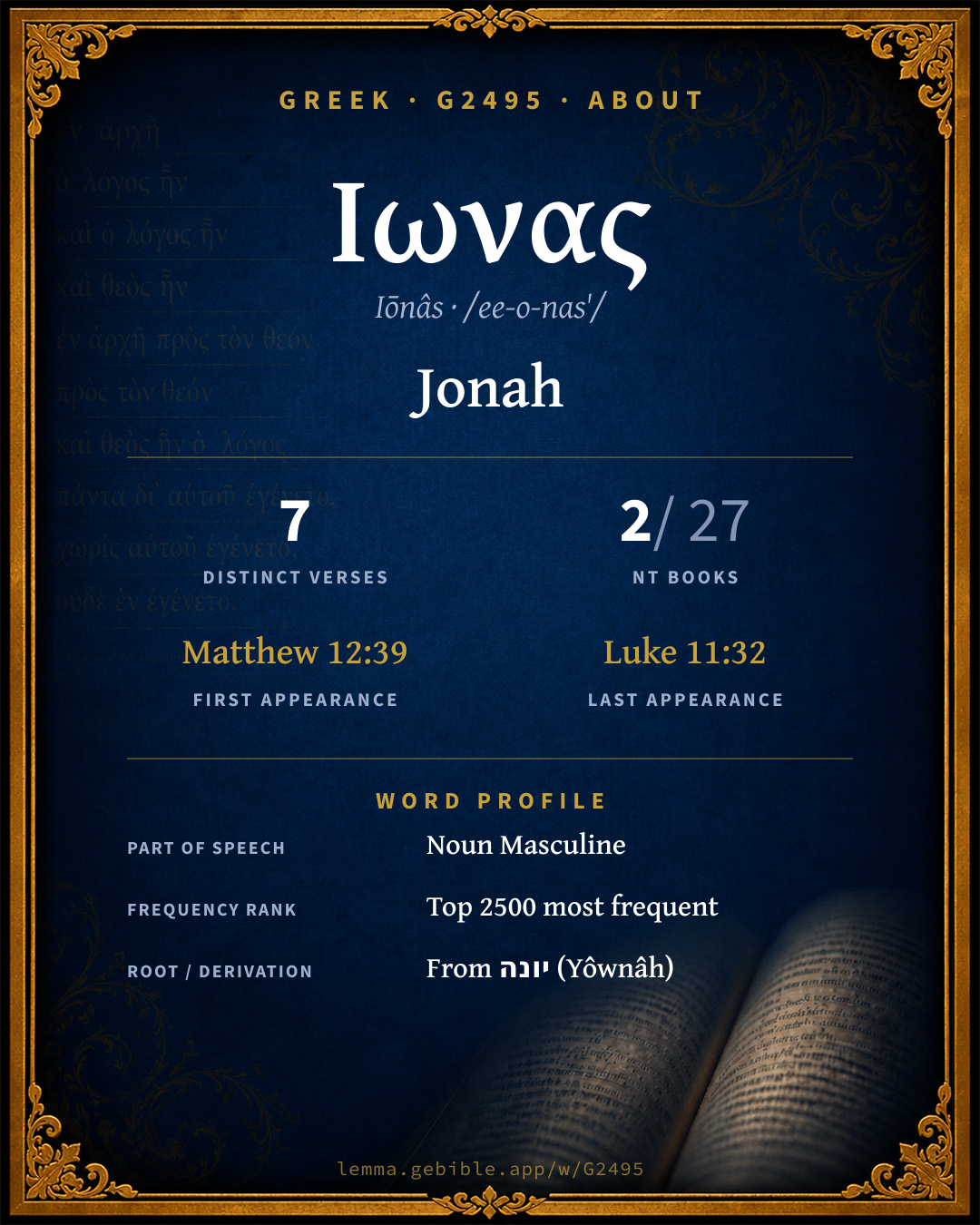
Ἰωνᾶς
Jonah
Thayer's lists 3 entries for ‘Jonah’ fuller range ↓
Full lexicon entry — Thayer's Greek Lexicon
From Thayer's Greek Lexicon
Where this word appears
See every Genitive-case word in the Greek New Testament →
Grammar key — what these labels mean
Part of speech
- Noun
- A naming word — a person, place, thing, or idea.
Case
- Genitive
- The case of source, possession, or “of” — answers “whose / from what.”
- Nominative
- The case of the subject (and the predicate nominative).
Gender
- Masculine
- Grammatically masculine.
Number
- Singular
- One.
Grammatical forms
- Noun, Genitive, Singular, Masculine 7 times (78%)
- Noun, Nominative, Singular, Masculine 2 times (22%)
Parsed forms decoded from the imported morphology (Robinson–Tischendorf, public domain), counted across 9 parsed occurrences — not distinct verses.
Every verse where G2495 appears — 7 distinct verses across 2 books. Click any verse to open its interlinear word-by-word view. Verse text shown in the World English Bible for context — . Each verse’s Greek form is shown with its reference; the English is not keyword-highlighted, since the data carries no word-level English alignment. Use “Compare translations” on any verse to read it across multiple English versions. This concordance covers the Greek New Testament; Septuagint (Greek Old Testament) occurrences of this word are not indexed here.
Matthew 4 verses
- Matthew 12:39 Ἰωνᾶ n gen sg masc But he answered them, "An evil and adulterous generation seeks after a sign, but no sign will be given it but the sign of Jonah the prophet.
- Matthew 12:40 Ἰωνᾶς n nom sg masc For as Jonah was three days and three nights in the belly of the whale, so will the Son of Man be three days and three nights in the heart of the earth.
- Matthew 12:41 Ἰωνᾶ Ἰωνᾶ n gen sg masc n gen sg masc The men of Nineveh will stand up in the judgment with this generation, and will condemn it, for they repented at the preaching of Jonah; and behold, someone greater than Jonah is here.
- Matthew 16:4 Ἰωνᾶ n gen sg masc An evil and adulterous generation seeks after a sign, and there will be no sign given to it, except the sign of the prophet Jonah." He left them, and departed.
Luke 3 verses
- Luke 11:29 Ἰωνᾶ n gen sg masc When the multitudes were gathering together to him, he began to say, "This is an evil generation. It seeks after a sign. No sign will be given to it but the sign of Jonah, the prophet.
- Luke 11:30 Ἰωνᾶς n nom sg masc For even as Jonah became a sign to the Ninevites, so will also the Son of Man be to this generation.
- Luke 11:32 Ἰωνᾶ Ἰωνᾶ n gen sg masc n gen sg masc The men of Nineveh will stand up in the judgment with this generation, and will condemn it: for they repented at the preaching of Jonah, and behold, one greater than Jonah is here.
About this entry
At a glance — auto-summarized from this page’s data, not written by a person. Every figure links to its source below. This summary describes the numbers; it doesn’t interpret them.
The Greek name Ιωνας centers on the idea of “Jonah.” The word gravitates to Matthew (57%), then Luke. It appears 7 verses across 2 books of the Greek New Testament, among its uncommon vocabulary. Debuting at Matthew 12:39, it then recurs through the corpus. Dig into 7-verse concordance and the renderings breakdown below.
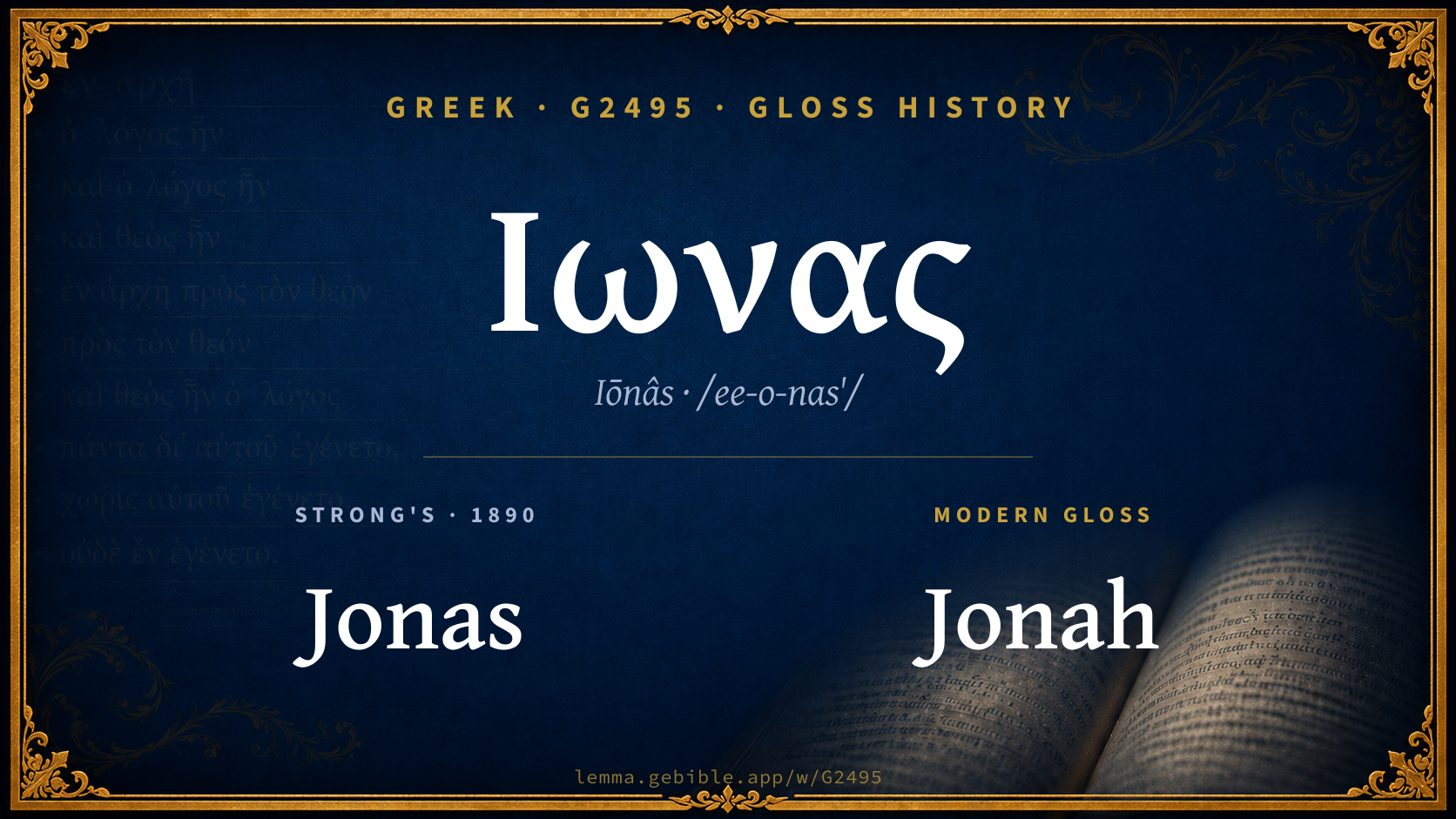
Gloss history
Strong's 1890 vs modern scholarship
About this word
Strong's G2495 catalogs a Greek word from the Greek New Testament.
These counts are not copied from any lexicon or concordance. They are computed here, from the morphology-tagged Greek New Testament. What Lemma adds →
- 7
- distinct verses
- The word appears in 7 distinct verses.
- 2 / 27
- NT books
- The word appears in 2 of 27 New Testament books.
- #1,140
- by frequency
- Top 2500 most frequent Greek words (rank 1,140 of 5,347 Greek words by occurrence).
View all 7 occurrences in the concordance →
By traditional corpus
Conventional, traditional groupings — biblical authorship is debated, so this is a traditional corpus grouping, not an authorship claim. Some books belong to more than one corpus (Luke is in both the Gospels and the Lukan corpus, and so on), so these shares overlap and need not total 100%. Each figure is a share of the word’s 7 distinct verses.
- Gospels 7 verses · 100%
- Lukan (Luke–Acts) 3 verses · 43%
How translations render this word
Counts come from each version’s own published word-to-Strong’s tagging or interlinear alignment — an approximate guide to how each version renders this word, not a word-level alignment the data otherwise carries. Because each total is that version’s own tagged count, the per-version totals vary from one another and need not match the appearance or distinct-verse counts above. These counts may also differ from a printed concordance because Lemma counts each distinctly tagged rendering and does not collapse phrase taggings into a single head-word total. This is a fixed set of word-tagged versions (KJV, ASV, BSB, ULT) and does not change with the reading translation you choose elsewhere. Each version’s license is shown beside its name below (and on Sources).
- King James Version: Jonas 9×, Son of jonas 3×
- American Standard Version: Jonah 7×, Son of john 3×, Than jonah 2×
- Berean Standard Bible: Jonah 8×
- unfoldingWord Literal Text: Jonah 9×
King James Version Public Domain
Renders G2495 across 13 tagged occurrences — most commonly:
Plus 1 rendering that appears only once — usually multi-word phrases or single function words the recovered tagging swept in, not distinct renderings.
American Standard Version Public Domain
Renders G2495 across 14 tagged occurrences — most commonly:
Plus 2 renderings that appear only once — usually multi-word phrases or single function words the recovered tagging swept in, not distinct renderings.
Berean Standard Bible Public Domain
Renders G2495 across 9 tagged occurrences — most commonly:
Plus 1 rendering that appears only once — usually multi-word phrases or single function words the recovered tagging swept in, not distinct renderings.
unfoldingWord Literal Text CC BY-SA 4.0
Renders G2495 across 9 tagged occurrences — most commonly:
Senses in Thayer's
The 3 senses Thayer's distinguishes for this word, in lexicon order (not ranked by frequency or importance). The full entry — with sub-senses — is in the Lexicon Entry tab.
- Jonah or Jonas = "dove"
- the fifth minor prophet…
- Jonas, the father of Peter
Word origin
Derived from יונה (Yôwnâh) (H3124) — Jonah.
Of hebrew origin [ H3124 ]; Jonas (that is Jonah ) the name of two Israelites : - Jonas.
— Strong’s Exhaustive Concordance (1890), public domain.
Forms in the corpus
The 2 distinct written forms G2495 takes in the Greek New Testament, most frequent first — each parse links to that case’s occurrences in the concordance.
| Form | Parsing | Example | Uses |
|---|---|---|---|
| Ἰωνᾶ Iōnâ | Noun, Genitive, Singular, Masculine | Matthew 12:39 | 7 |
| Ἰωνᾶς Iōnâs | Noun, Nominative, Singular, Masculine | Matthew 12:40 | 2 |
Bible dictionary
Public-domain dictionary articles matched to this entry by name (Jonah). A biblical name can be shared by more than one person or place, so an article may treat several.
Easton's Bible Dictionary · M. G. Easton, 1897
A dove, the son of Amittai of Gath-hepher. He was a prophet of Israel, and predicted the restoration of the ancient boundaries (2 Kings 14:25-27) of the kingdom. He exercised his ministry very early in the reign of Jeroboam II., and thus was contemporary with Hosea and Amos; or possibly he preceded them, and consequently may have been the very oldest of all the prophets whose writings we possess. His personal history is mainly to be gathered from the book which bears his name. It is chiefly interesting from the two-fold character in which he appears, (1) as a missionary to heathen Nineveh, and (2) as a type of the "Son of man."
Smith's Bible Dictionary · William Smith, 1863
(dove), the fifth of the minor prophets, was the son of Amittai, and a native of Gath-hepher. (2 Kings 14:25) He flourished in or before the reign of Jeroboam II., about B.C. 820. Having already, as it seems, prophesied to Israel, he was sent to Nineveh. The time was one of political revival in Israel; but ere long the Assyrians were to be employed by God as a scourge upon them. The prophet shrank from a commission which he felt sure would result, (Jonah 4:2) in the sparing of a hostile city. He attempted therefore to escape to Tarshish. The providence of God, however, watched over him, first in a storm, and then in his being swallowed by a large fish (a sea monster, probably the white shark) for the space of three days and three nights. [On this subject see article Whale] After his deliverance, Jonah executed his commission; and the king, "believing him to be a minister form the supreme deity of the nation," and having heard of his miraculous deliverance, ordered a general fast, and averted the threatened judgment. But the prophet, not from personal but national feelings, grudged the mercy shown to a heathen nation. He was therefore taught by the significant lesson of the "gourd," whose growth and decay brought the truth at once home to him, that he was sent to testify by deed, as other prophets would afterward testify by word, the capacity of Gentiles for salvation, and the design of God to make them partakers of it. This was "the sign of the prophet Jonas." (Luke 11:29,30) But the resurrection of Christ itself was also shadowed forth in the history of the prophet. (Matthew 12:39,41; 16:4) The mission of Jonah was highly symbolical. The facts contained a concealed prophecy. The old tradition made the burial-place of Jonah to be Gath-hepher; the modern tradition places it at Nebi-Yunus, opposite Mosul.
Hitchcock's Bible Names Dictionary · Roswell D. Hitchcock, 1869
or Jonas, a dove; he that oppresses; destroyer
Classic public-domain reference works; full attribution on Sources.
Septuagint usage
The same Greek word Ιωνας appears 20 times in the Greek Old Testament (Septuagint), across 18 verses in 1 book.
- 20
- LXX occurrences
- Tagged occurrences of this Greek word in the Septuagint.
- 18
- verses
- Distinct Septuagint verses containing this word.
- 1 / 39
- OT books
- The word appears in 1 of the 39 Old Testament books.
Sample Septuagint occurrences
- Jonah 1:1 ιωνας
Septuagint occurrences (same lexeme)
Every verse where the same Strong’s number (G2495) appears in the Greek Septuagint. Verse text shown in the World English Bible for context; the Greek form is the matched word — the English is not keyword-highlighted.
- Jonah 1:1 ιωνας Now the word of Yahweh came to Jonah the son of Amittai, saying,
- Jonah 1:3 ιωνας But Jonah rose up to flee to Tarshish from the presence of Yahweh. He went down to Joppa, and found a ship going to Tarshish; so he paid its fare, and went down into it, to go with them to Tarshish from the presence of Yahweh.
- Jonah 1:5 ιωνας Then the mariners were afraid, and cried every man to his god. They threw the cargo that was in the ship into the sea, to lighten it. But Jonah had gone down into the innermost parts of the ship, and he was laying down, and was fast asleep.
- Jonah 1:7 ιωνας They all said to each other, "Come, let us cast lots, that we may know for whose cause this evil is on us." So they cast lots, and the lot fell on Jonah.
- Jonah 1:12 ιωνας He said to them, "Take me up, and throw me into the sea. Then the sea will be calm for you; for I know that because of me this great tempest is on you."
- Jonah 1:15 ιωνας So they took up Jonah, and threw him into the sea; and the sea ceased its raging.
- Jonah 2:1 ιωνας Then Jonah prayed to Yahweh, his God, out of the fish's belly.
- Jonah 2:2 ιωνας He said, "I called because of my affliction to Yahweh. He answered me. Out of the belly of Sheol I cried. You heard my voice.
- Jonah 2:11 ιωνας
- Jonah 3:1 ιωνας The word of Yahweh came to Jonah the second time, saying,
- Jonah 3:3 ιωνας So Jonah arose, and went to Nineveh, according to the word of Yahweh. Now Nineveh was an exceedingly great city, three days' journey across.
- Jonah 3:4 ιωνας Jonah began to enter into the city a day's journey, and he cried out, and said, "Yet forty days, and Nineveh shall be overthrown!"
- Jonah 4:1 ιωνας But it displeased Jonah exceedingly, and he was angry.
- Jonah 4:4 ιωνας Yahweh said, "Is it right for you to be angry?"
- Jonah 4:5 ιωνας Then Jonah went out of the city, and sat on the east side of the city, and there made himself a booth, and sat under it in the shade, until he might see what would become of the city.
- Jonah 4:6 ιωνας Yahweh God prepared a vine, and made it to come up over Jonah, that it might be a shade over his head, to deliver him from his discomfort. So Jonah was exceedingly glad because of the vine.
- Jonah 4:8 ιωνας It happened, when the sun arose, that God prepared a sultry east wind; and the sun beat on Jonah's head, so that he fainted, and requested for himself that he might die, and said, "It is better for me to die than to live."
- Jonah 4:9 ιωνας God said to Jonah, "Is it right for you to be angry about the vine?" He said, "I am right to be angry, even to death."
These are occurrences of the same Greek lexeme (G2495) in the Septuagint — not a translation of any one Hebrew word. The store carries no word-level Hebrew↔Greek alignment, so no Hebrew original is asserted here. Counts come from the recovered LXX Strong's tagging — high-frequency vocabulary is well covered, while rare or late forms may be untagged — so they reflect tagged occurrences and may slightly undercount.