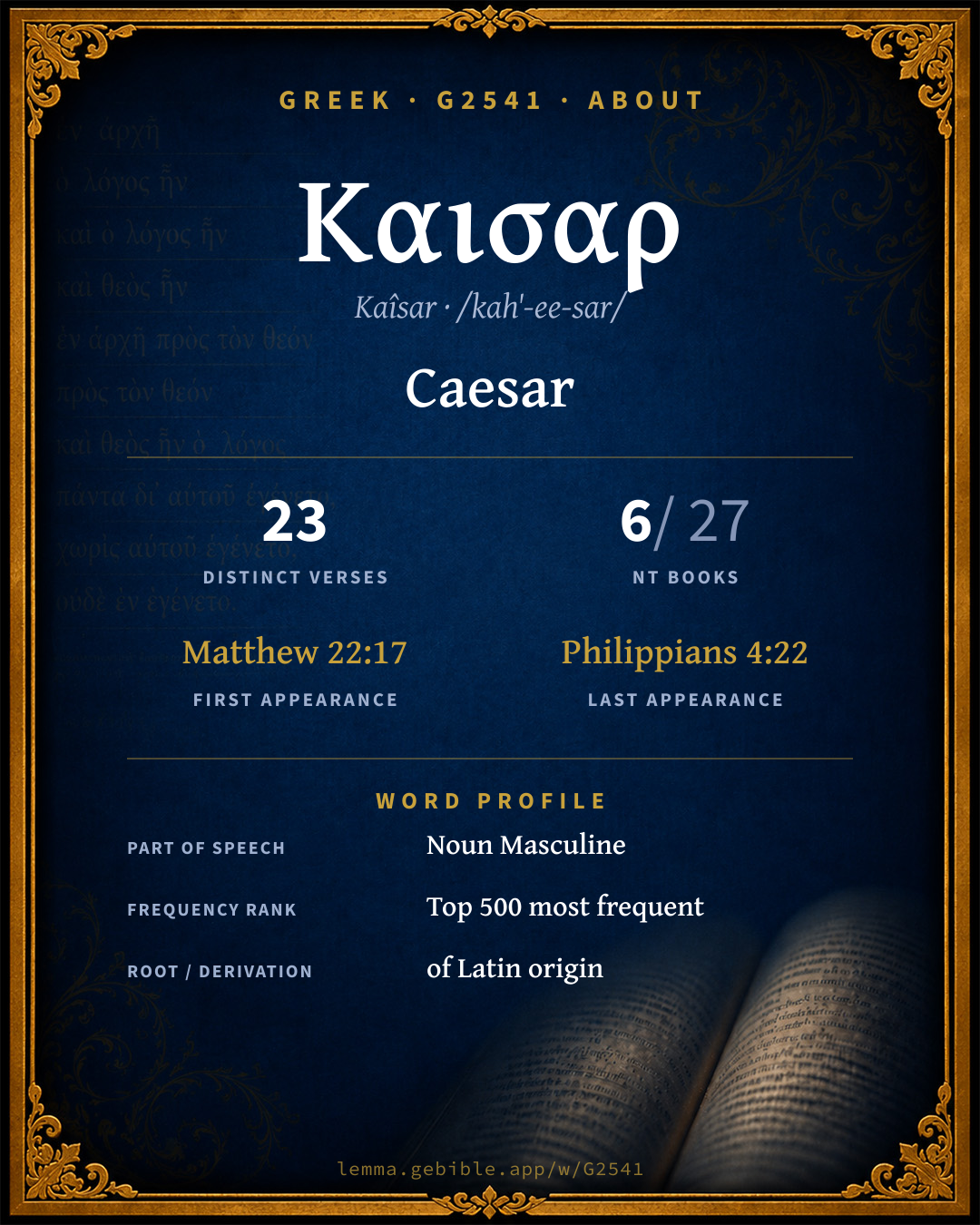
Καῖσαρ
Caesar
Thayer's lists 2 entries for ‘Caesar’ fuller range ↓
Full lexicon entry — Thayer's Greek Lexicon
From Thayer's Greek Lexicon
Where this word appears
See every Genitive-case word in the Greek New Testament →
Grammar key — what these labels mean
Part of speech
- Noun
- A naming word — a person, place, thing, or idea.
Case
- Genitive
- The case of source, possession, or “of” — answers “whose / from what.”
- Dative
- The case of the indirect object, means, or location — “to / for / with / in.”
- Accusative
- The case of the direct object and of extent.
Gender
- Masculine
- Grammatically masculine.
Number
- Singular
- One.
Grammatical forms
- Noun, Genitive, Singular, Masculine 12 times (41%)
- Noun, Dative, Singular, Masculine 9 times (31%)
- Noun, Accusative, Singular, Masculine 8 times (28%)
Parsed forms decoded from the imported morphology (Robinson–Tischendorf, public domain), counted across 29 parsed occurrences — not distinct verses.
Every verse where G2541 appears — 23 distinct verses across 6 books. Click any verse to open its interlinear word-by-word view. Verse text shown in the World English Bible for context — . Each verse’s Greek form is shown with its reference; the English is not keyword-highlighted, since the data carries no word-level English alignment. Use “Compare translations” on any verse to read it across multiple English versions. This concordance covers the Greek New Testament; Septuagint (Greek Old Testament) occurrences of this word are not indexed here.
Matthew 2 verses
- Matthew 22:17 Καίσαρι n dat sg masc Tell us therefore, what do you think? Is it lawful to pay taxes to Caesar, or not?"
- Matthew 22:21 Καίσαρος Καίσαρος Καίσαρι n gen sg masc n gen sg masc n dat sg masc They said to him, "Caesar's." Then he said to them, "Give therefore to Caesar the things that are Caesar's, and to God the things that are God's."
Mark 3 verses
- Mark 12:14 Καίσαρι n dat sg masc When they had come, they asked him, "Teacher, we know that you are honest, and don't defer to anyone; for you aren't partial to anyone, but truly teach the way of God. Is it lawful to pay taxes to Caesar, or not?
- Mark 12:16 Καίσαρος n gen sg masc They brought it. He said to them, "Whose is this image and inscription?" They said to him, "Caesar's."
- Mark 12:17 Καίσαρος Καίσαρι n gen sg masc n dat sg masc Jesus answered them, "Render to Caesar the things that are Caesar's, and to God the things that are God's." They marveled greatly at him.
Luke 6 verses
- Luke 2:1 Καίσαρος n gen sg masc Now it happened in those days, that a decree went out from Caesar Augustus that all the world should be enrolled.
- Luke 3:1 Καίσαρος n gen sg masc Now in the fifteenth year of the reign of Tiberius Caesar, Pontius Pilate being governor of Judea, and Herod being tetrarch of Galilee, and his brother Philip tetrarch of the region of Ituraea and Trachonitis, and Lysanias tetrarch of Abilene,
- Luke 20:22 Καίσαρι n dat sg masc Is it lawful for us to pay taxes to Caesar, or not?"
- Luke 20:24 Καίσαρος n gen sg masc Show me a denarius. Whose image and inscription are on it?" They answered, "Caesar's."
- Luke 20:25 Καίσαρος Καίσαρι n gen sg masc n dat sg masc He said to them, "Then give to Caesar the things that are Caesar's, and to God the things that are God's."
- Luke 23:2 Καίσαρι n dat sg masc They began to accuse him, saying, "We found this man perverting the nation, forbidding paying taxes to Caesar, and saying that he himself is Christ, a king."
John 2 verses
- John 19:12 Καίσαρος Καίσαρι n gen sg masc n dat sg masc At this, Pilate was seeking to release him, but the Jews cried out, saying, "If you release this man, you aren't Caesar's friend! Everyone who makes himself a king speaks against Caesar!"
- John 19:15 Καίσαρα n acc sg masc They cried out, "Away with him! Away with him! Crucify him!" Pilate said to them, "Shall I crucify your King?" The chief priests answered, "We have no king but Caesar!"
Acts 9 verses
- Acts 17:7 Καίσαρος n gen sg masc whom Jason has received. These all act contrary to the decrees of Caesar, saying that there is another king, Jesus!"
- Acts 25:8 Καίσαρά n acc sg masc while he said in his defense, "Neither against the law of the Jews, nor against the temple, nor against Caesar, have I sinned at all."
- Acts 25:10 Καίσαρός n gen sg masc But Paul said, "I am standing before Caesar's judgment seat, where I ought to be tried. I have done no wrong to the Jews, as you also know very well.
- Acts 25:11 Καίσαρα n acc sg masc For if I have done wrong, and have committed anything worthy of death, I don't refuse to die; but if none of those things is true that they accuse me of, no one can give me up to them. I appeal to Caesar!"
- Acts 25:12 Καίσαρα Καίσαρα n acc sg masc n acc sg masc Then Festus, when he had conferred with the council, answered, "You have appealed to Caesar. To Caesar you shall go."
- Acts 25:21 Καίσαρα n acc sg masc But when Paul had appealed to be kept for the decision of the emperor, I commanded him to be kept until I could send him to Caesar."
- Acts 26:32 Καίσαρα n acc sg masc Agrippa said to Festus, "This man might have been set free if he had not appealed to Caesar."
- Acts 27:24 Καίσαρί n dat sg masc saying, 'Don't be afraid, Paul. You must stand before Caesar. Behold, God has granted you all those who sail with you.'
- Acts 28:19 Καίσαρα n acc sg masc But when the Jews spoke against it, I was constrained to appeal to Caesar, not that I had anything about which to accuse my nation.
Philippians 1 verse
About this entry
At a glance — auto-summarized from this page’s data, not written by a person. Every figure links to its source below. This summary describes the numbers; it doesn’t interpret them.
Καισαρ — transliterated Kaîsar — is a Greek name carrying the sense “Caesar.” It first appears in Matthew 22:17. With 23 verses in 6 books, it is an uncommon word in the Greek New Testament. Its uses concentrate in Acts (39% of all occurrences). See 23-verse concordance and the renderings breakdown below.
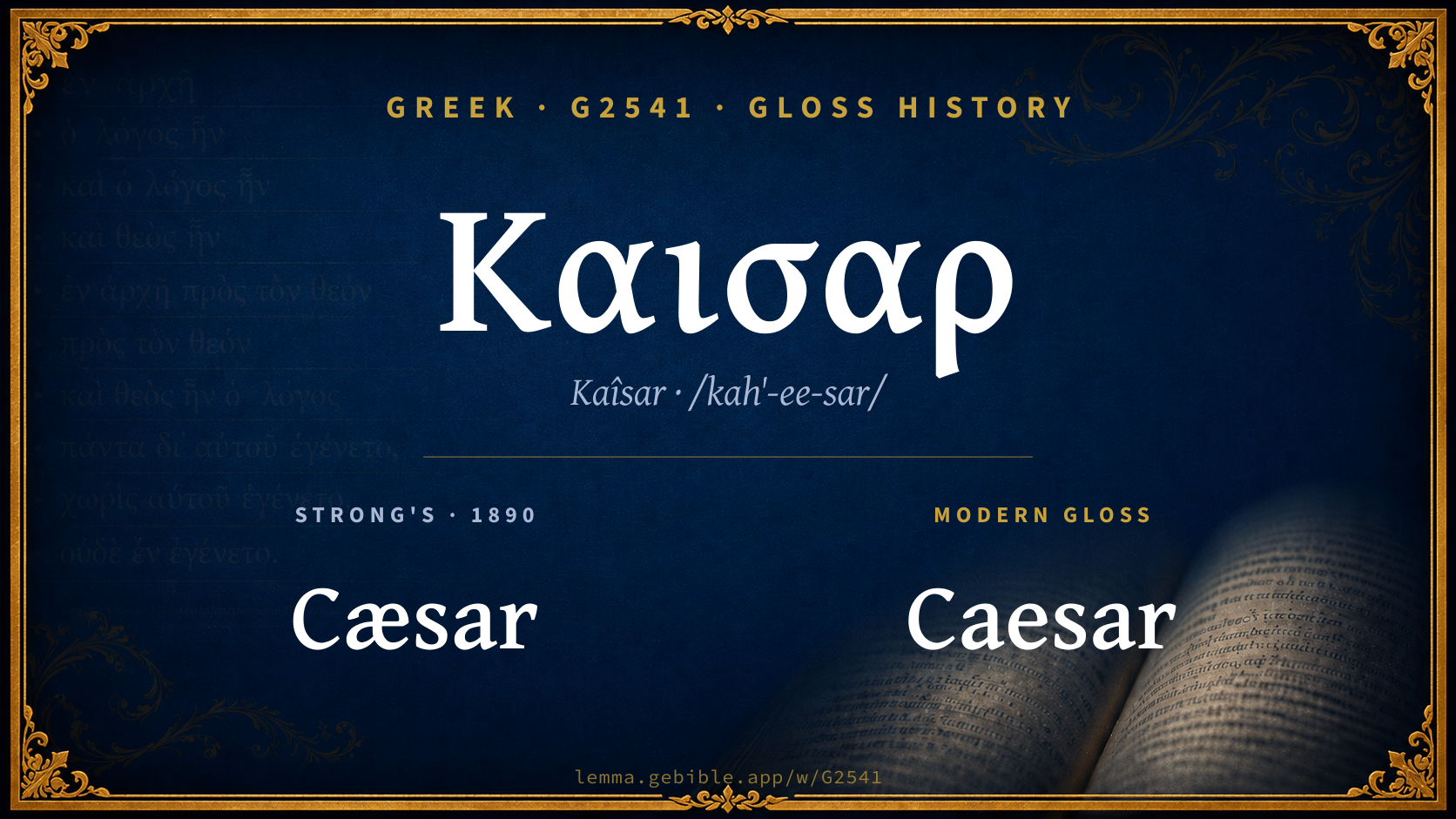
Gloss history
Strong's 1890 vs modern scholarship
About this word
Strong's G2541 catalogs a Greek word from the Greek New Testament.
These counts are not copied from any lexicon or concordance. They are computed here, from the morphology-tagged Greek New Testament. What Lemma adds →
- 23
- distinct verses
- The word appears in 23 distinct verses.
- 6 / 27
- NT books
- The word appears in 6 of 27 New Testament books.
- #471
- by frequency
- Top 500 most frequent Greek words (rank 471 of 5,347 Greek words by occurrence).
View all 23 occurrences in the concordance →
By section of the New Testament
By traditional corpus
Conventional, traditional groupings — biblical authorship is debated, so this is a traditional corpus grouping, not an authorship claim. Some books belong to more than one corpus (Luke is in both the Gospels and the Lukan corpus, and so on), so these shares overlap and need not total 100%. Each figure is a share of the word’s 23 distinct verses.
- Lukan (Luke–Acts) 15 verses · 65%
- Gospels 13 verses · 57%
- Johannine 2 verses · 9%
- Pauline corpus 1 verse · 4%
How translations render this word
Counts come from each version’s own published word-to-Strong’s tagging or interlinear alignment — an approximate guide to how each version renders this word, not a word-level alignment the data otherwise carries. Because each total is that version’s own tagged count, the per-version totals vary from one another and need not match the appearance or distinct-verse counts above. These counts may also differ from a printed concordance because Lemma counts each distinctly tagged rendering and does not collapse phrase taggings into a single head-word total. This is a fixed set of word-tagged versions (KJV, ASV, BSB, ULT) and does not change with the reading translation you choose elsewhere. Each version’s license is shown beside its name below (and on Sources).
- King James Version: Caesar 21×, Caesar's 9×
- American Standard Version: Caesar 27×
- Berean Standard Bible: Caesar 22×, Caesar’s 7×
- unfoldingWord Literal Text: Caesar 25×, Caesar s 3×
King James Version Public Domain
Renders G2541 across 30 tagged occurrences — most commonly:
American Standard Version Public Domain
Renders G2541 across 30 tagged occurrences — most commonly:
Plus 3 renderings that appear only once — usually multi-word phrases or single function words the recovered tagging swept in, not distinct renderings.
Berean Standard Bible Public Domain
Renders G2541 across 29 tagged occurrences — most commonly:
unfoldingWord Literal Text CC BY-SA 4.0
Renders G2541 across 30 tagged occurrences — most commonly:
Plus 2 renderings that appear only once — usually multi-word phrases or single function words the recovered tagging swept in, not distinct renderings.
Senses in Thayer's
The 2 senses Thayer's distinguishes for this word, in lexicon order (not ranked by frequency or importance). The full entry — with sub-senses — is in the Lexicon Entry tab.
- Caesar = "severed"
- the surname of Julius Caesar…
Word origin
Origin: of Latin origin
Of Latin origin; Caesa r a title of the Roman emperor : - Csar.
— Strong’s Exhaustive Concordance (1890), public domain.
Forms in the corpus
The 6 distinct written forms G2541 takes in the Greek New Testament, most frequent first — each parse links to that case’s occurrences in the concordance.
| Form | Parsing | Example | Uses |
|---|---|---|---|
| Καίσαρος Kaísaros | Noun, Genitive, Singular, Masculine | Matthew 22:21 | 11 |
| Καίσαρι Kaísari | Noun, Dative, Singular, Masculine | Matthew 22:17 | 8 |
| Καίσαρα Kaísara | Noun, Accusative, Singular, Masculine | John 19:15 | 7 |
| Καίσαρά Kaísará | Noun, Accusative, Singular, Masculine | Acts 25:8 | 1 |
| Καίσαρί Kaísarí | Noun, Dative, Singular, Masculine | Acts 27:24 | 1 |
| Καίσαρός Kaísarós | Noun, Genitive, Singular, Masculine | Acts 25:10 | 1 |
Same root — word family
Other Thayer's entries built from the same root as G2541, grouped by Strong’s listed origin. These share a root / origin per the lexicon — not necessarily a shared meaning. Each links to that word’s own entry.
Proper names from this root
People and places named from this root — a name, not an additional meaning of the word.
Compare all same-root words → 1 of the same-root words is a proper name (a person or place). They share a root, not necessarily a meaning.
Bible dictionary
Public-domain dictionary articles matched to this entry by name (Caesar). A biblical name can be shared by more than one person or place, so an article may treat several.
Easton's Bible Dictionary · M. G. Easton, 1897
The title assumed by the Roman emperors after Julius Caesar. In the New Testament this title is given to various emperors as sovereigns of Judaea without their accompanying distinctive proper names (John 19:15; Acts 17:7). The Jews paid tribute to Caesar (Matt. 22:17), and all Roman citizens had the right of appeal to him (Acts 25:11). The Caesars referred to in the New Testament are Augustus (Luke 2:1), Tiberius (3:1; 20:22), Claudius (Acts 11:28), and Nero (Acts 25:8; Phil. 4:22).
Smith's Bible Dictionary · William Smith, 1863
always in the New Testament the Roman emperor, the sovereign of Judea. (John 19:12,15; Acts 17:7)
Classic public-domain reference works; full attribution on Sources.