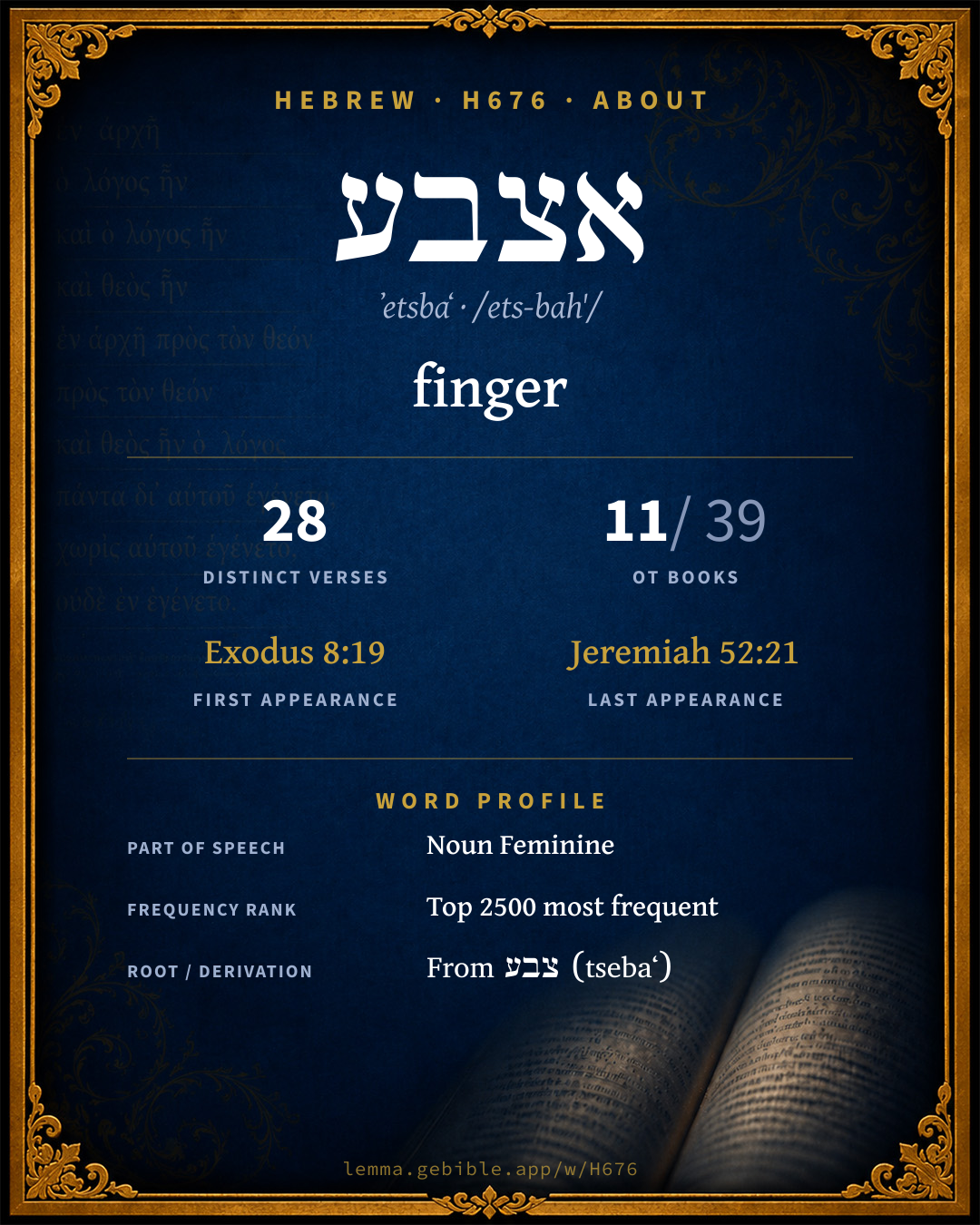
אֶצְבַּע
finger
Full lexicon entry — Brown-Driver-Briggs (BDB)
From Brown-Driver-Briggs (BDB)
Where this word appears
See every Construct-state word in the Hebrew Bible →
Grammar key — what these labels mean
Part of speech
- Noun
- A naming word — a person, place, thing, or idea.
Noun type
- Common
- A common noun — a general class of person, place, or thing (“king,” “city,” “water”), not a specific name.
State
- Construct
- A noun bound to a following noun in a possessive / “of” relationship (the construct chain).
- Absolute
- The independent form of a noun, not bound to a following word.
Gender
- Feminine
- Grammatically feminine.
Number
- Singular
- One.
- Plural
- More than one (in Hebrew, generally three or more).
Grammatical forms
- Noun, Common, Feminine, Singular, Construct 18 times (58%)
- Noun, Common, Feminine, Plural, Construct 11 times (35%)
- Noun, Common, Feminine, Plural, Absolute 1 time (3%)
- Noun, Common, Feminine, Singular, Absolute 1 time (3%)
Parsed forms decoded from the imported morphology (morphhb / Westminster Leningrad Codex — WLC text public domain, morphhb tagging CC BY 4.0), counted across 31 parsed occurrences — not distinct verses.
Every verse where H676 appears — 28 distinct verses across 11 books. Click any verse to open its interlinear word-by-word view. Verse text shown in the World English Bible for context — . Each verse’s Hebrew form is shown with its reference; the English is not keyword-highlighted, since the data carries no word-level English alignment. Use “Compare translations” on any verse to read it across multiple English versions. This concordance covers the Hebrew Bible; Septuagint (Greek Old Testament) occurrences are not indexed here.
Exodus 3 verses
- Exodus 8:19 אֶצְבַּ֥ע n c fs cs Then the magicians said to Pharaoh, "This is the finger of God:" and Pharaoh's heart was hardened, and he didn't listen to them; as Yahweh had spoken.
- Exodus 29:12 בְּ/אֶצְבָּעֶ֑/ךָ prep + n c fs cs + sfx pers 2ms You shall take of the blood of the bull, and put it on the horns of the altar with your finger; and you shall pour out all the blood at the base of the altar.
- Exodus 31:18 בְּ/אֶצְבַּ֥ע prep + n c fs cs He gave to Moses, when he finished speaking with him on Mount Sinai, the two tablets of the testimony, stone tablets, written with God's finger.
Leviticus 11 verses
- Leviticus 4:6 אֶצְבָּע֖/וֹ n c fs cs + sfx pers 3ms The priest shall dip his finger in the blood, and sprinkle some of the blood seven times before Yahweh, before the veil of the sanctuary.
- Leviticus 4:17 אֶצְבָּע֖/וֹ n c fs cs + sfx pers 3ms and the priest shall dip his finger in the blood, and sprinkle it seven times before Yahweh, before the veil.
- Leviticus 4:25 בְּ/אֶצְבָּע֔/וֹ prep + n c fs cs + sfx pers 3ms The priest shall take some of the blood of the sin offering with his finger, and put it on the horns of the altar of burnt offering. He shall pour out the rest of its blood at the base of the altar of burnt offering.
- Leviticus 4:30 בְּ/אֶצְבָּע֔/וֹ prep + n c fs cs + sfx pers 3ms The priest shall take some of its blood with his finger, and put it on the horns of the altar of burnt offering; and the rest of its blood he shall pour out at the base of the altar.
- Leviticus 4:34 בְּ/אֶצְבָּע֔/וֹ prep + n c fs cs + sfx pers 3ms The priest shall take some of the blood of the sin offering with his finger, and put it on the horns of the altar of burnt offering; and all the rest of its blood he shall pour out at the base of the altar.
- Leviticus 8:15 בְּ/אֶצְבָּע֔/וֹ prep + n c fs cs + sfx pers 3ms He killed it; and Moses took the blood, and put it on the horns of the altar round about with his finger, and purified the altar, and poured out the blood at the base of the altar, and sanctified it, to make atonement for it.
- Leviticus 9:9 אֶצְבָּע/וֹ֙ n c fs cs + sfx pers 3ms The sons of Aaron presented the blood to him; and he dipped his finger in the blood, and put it on the horns of the altar, and poured out the blood at the base of the altar:
- Leviticus 14:16 אֶצְבָּע֣/וֹ בְּ/אֶצְבָּע֛/וֹ n c fs cs + sfx pers 3ms prep + n c fs cs + sfx pers 3ms The priest shall dip his right finger in the oil that is in his left hand, and shall sprinkle some of the oil with his finger seven times before Yahweh.
- Leviticus 14:27 בְּ/אֶצְבָּע֣/וֹ prep + n c fs cs + sfx pers 3ms and the priest shall sprinkle with his right finger some of the oil that is in his left hand seven times before Yahweh.
- Leviticus 16:14 בְ/אֶצְבָּע֛/וֹ בְּ/אֶצְבָּעֽ/וֹ prep + n c fs cs + sfx pers 3ms prep + n c fs cs + sfx pers 3ms He shall take some of the blood of the bull, and sprinkle it with his finger on the mercy seat on the east; and before the mercy seat he shall sprinkle some of the blood with his finger seven times.
- Leviticus 16:19 בְּ/אֶצְבָּע֖/וֹ prep + n c fs cs + sfx pers 3ms He shall sprinkle some of the blood on it with his finger seven times, and cleanse it, and make it holy from the uncleanness of the children of Israel.
Numbers 1 verse
Deuteronomy 1 verse
2 Samuel 1 verse
1 Chronicles 1 verse
Psalms 2 verses
Proverbs 2 verses
Song of Solomon 1 verse
Isaiah 4 verses
- Isaiah 2:8 אֶצְבְּעֹתָֽי/ו n c fp cs + sfx pers 3ms Their land also is full of idols. They worship the work of their own hands, That which their own fingers have made.
- Isaiah 17:8 אֶצְבְּעֹתָי/ו֙ n c fp cs + sfx pers 3ms They shall not look to the altars, the work of their hands; neither shall they have respect to that which their fingers have made, either the Asherim, or the sun-images.
- Isaiah 58:9 אֶצְבַּ֖ע n c fs Then shall you call, and Yahweh will answer; you shall cry, and he will say, Here I am. If you take away from the midst of you the yoke, the putting forth of the finger, and speaking wickedly;
- Isaiah 59:3 וְ/אֶצְבְּעוֹתֵי/כֶ֖ם conj + n c fp cs + sfx pers 2mp For your hands are defiled with blood, and your fingers with iniquity; your lips have spoken lies, your tongue mutters wickedness.
Jeremiah 1 verse
About this entry
At a glance — auto-summarized from this page’s data, not written by a person. Every figure links to its source below. This summary describes the numbers; it doesn’t interpret them.
At its core, אצבע (ʼetsbaʻ) means “finger.” Scripture first uses it in Exodus 8:19. With 28 verses in 11 books, it is a moderately common word in the Hebrew Bible. Its uses concentrate in Leviticus (39% of all occurrences). Sharing its root, it stands alongside צבע, צבוע and צבע. Each statement above links to its evidence; the full detail follows below.
Gloss history
Strong's 1890 vs modern scholarship
About this word
Strong's H676 catalogs a Hebrew word from the Hebrew Old Testament.
These counts are not copied from any lexicon or concordance. They are computed here, from the morphology-tagged Hebrew Old Testament. What Lemma adds →
- 28
- distinct verses
- The word appears in 28 distinct verses.
- 11 / 39
- OT books
- The word appears in 11 of 39 Old Testament books.
- #1,120
- by frequency
- Top 2500 most frequent Hebrew words (rank 1,120 of 8,640 Hebrew words by occurrence).
View all 28 occurrences in the concordance →
By section of the Old Testament
By traditional corpus
Conventional, traditional groupings — biblical authorship is debated, so this is a traditional corpus grouping, not an authorship claim. Each share is this word’s portion of its verses in that division of the Hebrew canon. Each figure is a share of the word’s 28 distinct verses.
- Torah (Pentateuch) 16 verses · 57%
- Prophets (Nevi'im) 6 verses · 21%
- Writings (Ketuvim) 6 verses · 21%
How translations render this word
Counts come from each version’s own published word-to-Strong’s tagging or interlinear alignment — an approximate guide to how each version renders this word, not a word-level alignment the data otherwise carries. Because each total is that version’s own tagged count, the per-version totals vary from one another and need not match the appearance or distinct-verse counts above. These counts may also differ from a printed concordance because Lemma counts each distinctly tagged rendering and does not collapse phrase taggings into a single head-word total. This is a fixed set of word-tagged versions (KJV, ASV, BSB, ULT) and does not change with the reading translation you choose elsewhere. Each version’s license is shown beside its name below (and on Sources).
BDB lists this Strong’s number as 2 distinct words (homographs). Each count above pools all of them and is not split by sense — see the Senses section below. A low-frequency rendering may belong to a different one of those words, not the primary meaning.
- King James Version†: Finger 17×, Fingers 10×, Toes 2×
- American Standard Version†: Finger 16×, Fingers 9×, Toes 2×
- Berean Standard Bible†: Finger 16×, Fingers 10×, Forefinger 2×
- unfoldingWord Literal Text†: Finger 16×, Fingers 8×, Finger of 3×
King James Version Public Domain
Renders H676 across 32† tagged occurrences — most commonly:
Plus 3 renderings that appear only once — usually multi-word phrases or single function words the recovered tagging swept in, not distinct renderings.
American Standard Version Public Domain
Renders H676 across 32† tagged occurrences — most commonly:
Plus 5 renderings that appear only once — usually multi-word phrases or single function words the recovered tagging swept in, not distinct renderings.
Berean Standard Bible Public Domain
Renders H676 across 31† tagged occurrences — most commonly:
Plus 3 renderings that appear only once — usually multi-word phrases or single function words the recovered tagging swept in, not distinct renderings.
unfoldingWord Literal Text CC BY-SA 4.0
Renders H676 across 33† tagged occurrences — most commonly:
Plus 2 renderings that appear only once — usually multi-word phrases or single function words the recovered tagging swept in, not distinct renderings.
Senses in the full BDB
What do BDB’s symbols mean?
BDB uses these scholarly abbreviations:
| Symbol | Meaning |
|---|---|
| 𝔊 | the Septuagint (the ancient Greek translation, LXX) |
| 𝔙 | the Vulgate (the Latin translation) |
| 𝔖 | the Syriac version (the Peshitta) |
| 𝔗 | the Targum (the Aramaic translation) |
| ψ | the Psalms |
| √ | root (the underlying root or stem) |
| ‖ | parallel passage (a synonymous or contrasted parallel) |
| † | the dagger: every passage where the word occurs is cited |
The 6 senses and sub-senses the full Brown-Driver-Briggs lexicon distinguishes for this word, in lexicon order (not ranked by frequency), with BDB’s own verbatim wording and sub-sense lettering. Shown in Hebrew script with BDB’s own scholarly abbreviations. The condensed entry is in the Lexicon Entry tab. See also the Forms in the corpus table below.
- 1. finger, especially
- a. forefinger, of priest, applying blood (P), Ex 29:12; Lv 4:6, 17, 25 + 8 times; applying oil 14:16(×2), 27. e.g. Exodus 29:12
- b. שְׁלַח א׳ of any one Is 58:9, sign of contempt. e.g. Isaiah 58:9
- c. of God, as writing Ex 31:18 (E) Dt 9:10; = act of God Ex 8:15 (J). e.g. Exodus 31:18
- d. pl. of all the fingers 2 S 21:20a; fingers in gen. Is 2:8; 17:8; 59:3 ψ 144:1, Pr 7:3 Ct 5:5; of י׳ ψ 8:4; מֹרֶה בְא׳ Pr 6:13 (of contempt. gesture); as measure of thickness, Je 52:21 four fingers. e.g. 2 Samuel 21:20
- 2. toes: אֶצְבְּעֹת רַגְלָיו 2 S 21:20b, lit. fingers of his feet, cf. א״ ‖ 1 Ch 20:6 = fingers and toes. e.g. 2 Samuel 21:20
Senses from the full Brown-Driver-Briggs lexicon (Brown, Driver, Briggs; Oxford 1906 — public domain), digitized via Sefaria, supplemented by the OpenScriptures HebrewLexicon (CC BY 4.0). Full attribution on Sources.
Word origin
n.f.Lv 14:6 finger;—א׳ abs. Is 58:9, cstr. Ex 8:15 +; sf. אֶצְבָּעוֹ Lv 4:6 +; pl. אֶצְבָּעוֹת Je 52:21, cstr. אֶצְבְּעֹת 2 S 21:20 +, etc.;—
— Brown-Driver-Briggs (Oxford 1906, public domain), digitized via Sefaria, supplemented by the OpenScriptures HebrewLexicon (CC BY 4.0). See Sources.
Derived from צבע (tsebaʻ) (H6648) — dyed cloth.
Jastrow Dictionary
A second Hebrew/Aramaic lexicon for comparison, covering Aramaic and post-biblical (Talmudic, Targumic, Midrashic) usage that the biblical-Hebrew BDB does not. Matched by lemma rather than by Strong’s number, so a lemma may carry more than one Jastrow headword (shown separately below), and the entries cover usage well beyond the Bible.
אֶצְבַּע
- (b. h.; = עצבע; עצב,
- 1. finger, esp. index-finger. Men. 11ᵃ זו א׳ with this (the fourth from the little finger) the measure of ‘a finger’ is taken; Keth. 5ᵇ. Y. Taan. IV, 68ᵈ bot.; Lam. R. to II, 2 (מטיפי) מקוטעי א׳ who had their finger cut off (in evidence of devotion to the cause). Yoma I, 7 א׳ צרדה; Tosef. ib. I, 9 explained א׳ גדולה middle finger; cmp. Tanḥ. Bo, end, expl. אמצעית.—Keth. 71ᵃ הוא נותן א׳ וכ׳ he (the husband) puts his finger between her teeth (and must expect to be bitten), i.e. has to take the consequences of not interfering with her vow in due time.
- 2. any projecting limb resembling the shape of a finger. Ḥull. 61ᵃ א׳ יתירה the projecting toe on a bird’s claw. Tam. IV, 3 (31ᵃ) א׳ הכבד the lobe of the liver.—Fig. (like יד) share, part. Y. Pes. IV, 31ᵃ top; Y. Ab. Zar. I, 40ᵃ top, v. אֶמְצַע.—Pl. אֶצְבָּעוֹת. Ḥag. 15ᵃ; a. fr. (mostly in the sense of finger’s length).—Pes. 112ᵇ; Nidd. 66ᵃ euphem. for membra virilia.—Dual אֶצְבְּעַיִּם, אֶצְבְּעַיִּים, Cant. R. to VIII, 11 גידם א׳ one whose (index) fingers were lopped (stump-like). Ib. that whole trade of mine אינה נקנית אלא בא׳ cannot be acquired except by learning how to use the index-fingers.—Pes. 109ᵃ, a. e. two finger lengths
A Dictionary of the Targumim, the Talmud Babli and Yerushalmi, and the Midrashic Literature (Marcus Jastrow; London, Luzac, 1903) — Public Domain. Digitized via Sefaria. Digitized via Sefaria. Full attribution on Sources.
Forms in the corpus
The 26 distinct written forms H676 takes in the Hebrew Bible, most frequent first — each parse links to that state’s occurrences in the concordance. Hebrew forms include their vowel points and cantillation, so a single lemma takes many written forms.
Same root — word family
Other BDB entries built from the same root as H676, grouped by Strong’s listed origin. These share a root / origin per the lexicon — not necessarily a shared meaning. Each links to that word’s own entry.
Derives from
Shares the same root
Derived from this word
Proper names from this root
People and places named from this root — a name, not an additional meaning of the word.
Compare all same-root words → Showing 4 of 6 — not the complete family. 1 of the same-root words is a proper name (a person or place). They share a root, not necessarily a meaning.
Septuagint verse parallels
This word appears in 28 verses that also exist in the Greek Old Testament (Septuagint), out of the 28 Hebrew verses it occurs in. You can read those verses in Greek by switching the Old Testament edition to the Septuagint.
Read these verses in the Septuagint
- Exodus 8:19
- Leviticus 4:6
- Numbers 19:4
- Deuteronomy 9:10
- 2 Samuel 21:20
- 1 Chronicles 20:6
- Psalms 8:3
- Proverbs 6:13
- Song of Solomon 5:5
- Isaiah 2:8
- Jeremiah 52:21
This is a verse-level parallel only — the same verses exist in both the Hebrew and Greek Old Testaments. No word-level Hebrew↔Greek correspondence is claimed: the data carries no such alignment, so no Greek word is shown as this Hebrew word’s translation. Coverage is not total — the Septuagint omits the deuterocanon and renumbers the Psalms, so some Hebrew verses have no direct Greek parallel.