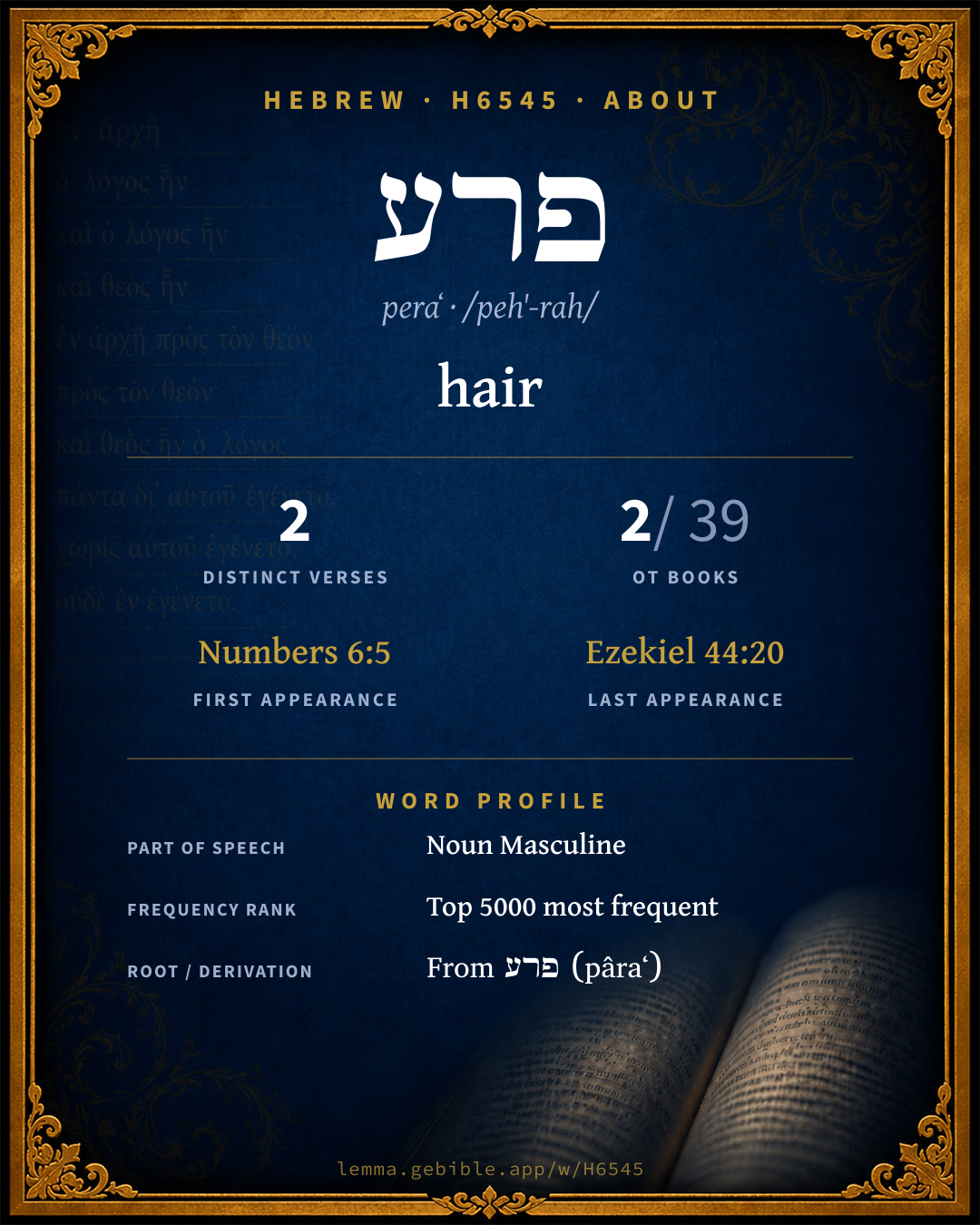
פֶּ֫רַע
hair
also: long hair, locks fuller range ↓
Full lexicon entry — Brown-Driver-Briggs (BDB)
From Brown-Driver-Briggs (BDB)
Where this word appears
See every Absolute-state word in the Hebrew Bible →
Grammar key — what these labels mean
Part of speech
- Noun
- A naming word — a person, place, thing, or idea.
Noun type
- Common
- A common noun — a general class of person, place, or thing (“king,” “city,” “water”), not a specific name.
State
- Absolute
- The independent form of a noun, not bound to a following word.
- Construct
- A noun bound to a following noun in a possessive / “of” relationship (the construct chain).
Gender
- Masculine
- Grammatically masculine.
Number
- Singular
- One.
Grammatical forms
- Noun, Common, Masculine, Singular, Absolute 1 time (50%)
- Noun, Common, Masculine, Singular, Construct 1 time (50%)
Parsed forms decoded from the imported morphology (morphhb / Westminster Leningrad Codex — WLC text public domain, morphhb tagging CC BY 4.0), counted across 2 parsed occurrences — not distinct verses.
Every verse where H6545 appears — 2 distinct verses across 2 books. Click any verse to open its interlinear word-by-word view. Verse text shown in the World English Bible for context — . Each verse’s Hebrew form is shown with its reference; the English is not keyword-highlighted, since the data carries no word-level English alignment. Use “Compare translations” on any verse to read it across multiple English versions. This concordance covers the Hebrew Bible; Septuagint (Greek Old Testament) occurrences are not indexed here.
Numbers 1 verse
Ezekiel 1 verse
About this entry
At a glance — auto-summarized from this page’s data, not written by a person. Every figure links to its source below. This summary describes the numbers; it doesn’t interpret them.
פרע — transliterated peraʻ — is a Hebrew noun carrying the sense “hair.” With only 2 verses it sits in the long tail of Hebrew Bible vocabulary. More than half of its appearances fall in Numbers. Its earliest occurrence is Numbers 6:5. BDB distinguishes 2 senses; alongside “hair” it spans “long hair” and “locks”. See the sense tree, 2-verse concordance, and the renderings breakdown below.
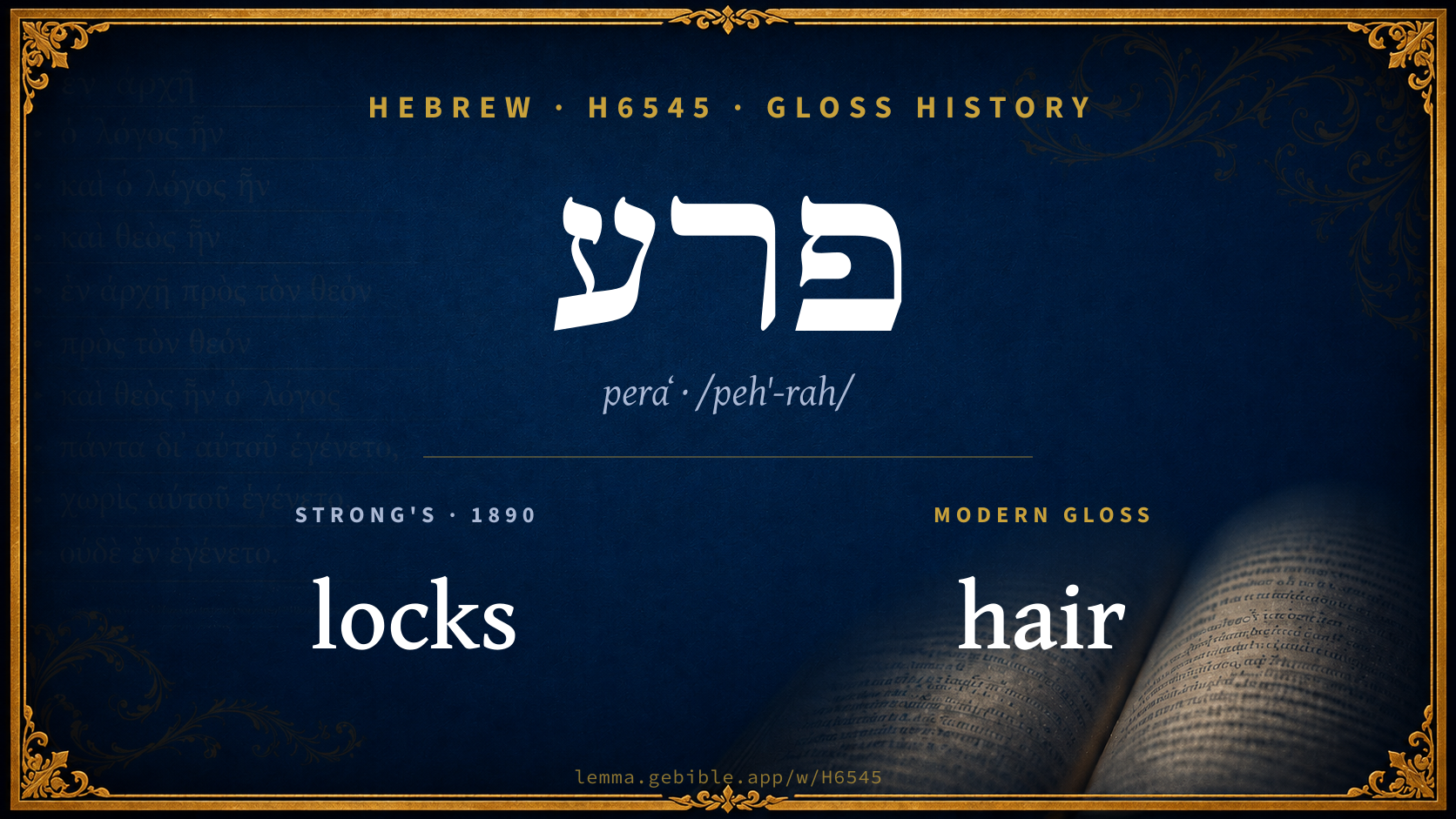
Gloss history
Strong's 1890 vs modern scholarship
About this word
Strong's H6545 catalogs a Hebrew word from the Hebrew Old Testament.
These counts are not copied from any lexicon or concordance. They are computed here, from the morphology-tagged Hebrew Old Testament. What Lemma adds →
- 2
- distinct verses
- The word appears in 2 distinct verses.
- 2 / 39
- OT books
- The word appears in 2 of 39 Old Testament books.
- #4,807
- by frequency
- Top 5000 most frequent Hebrew words (rank 4,807 of 8,640 Hebrew words by occurrence).
View all 2 occurrences in the concordance →
By traditional corpus
Conventional, traditional groupings — biblical authorship is debated, so this is a traditional corpus grouping, not an authorship claim. Each share is this word’s portion of its verses in that division of the Hebrew canon. Each figure is a share of the word’s 2 distinct verses.
- Torah (Pentateuch) 1 verse · 50%
- Prophets (Nevi'im) 1 verse · 50%
How translations render this word
Counts come from each version’s own published word-to-Strong’s tagging or interlinear alignment — an approximate guide to how each version renders this word, not a word-level alignment the data otherwise carries. Because each total is that version’s own tagged count, the per-version totals vary from one another and need not match the appearance or distinct-verse counts above. These counts may also differ from a printed concordance because Lemma counts each distinctly tagged rendering and does not collapse phrase taggings into a single head-word total. This is a fixed set of word-tagged versions (KJV, ASV, BSB, ULT) and does not change with the reading translation you choose elsewhere. Each version’s license is shown beside its name below (and on Sources).
BDB lists this Strong’s number as 2 distinct words (homographs). Each count above pools all of them and is not split by sense — see the Senses section below. A low-frequency rendering may belong to a different one of those words, not the primary meaning.
- King James Version†: Shall let the locks 1×, Suffer their locks 1×
- American Standard Version†: Cut off the hair 1×, He shall let the locks 1×, Suffer their locks 1×
- Berean Standard Bible†: Leaders 1×, Long 1×, Or let their hair 1×
- unfoldingWord Literal Text†: Allow their hair 1×, Locks of 1×
King James Version Public Domain
Renders H6545 across 2† tagged occurrences — most commonly:
American Standard Version Public Domain
Renders H6545 across 3† tagged occurrences — most commonly:
Berean Standard Bible Public Domain
Renders H6545 across 3† tagged occurrences — most commonly:
unfoldingWord Literal Text CC BY-SA 4.0
Renders H6545 across 2† tagged occurrences — most commonly:
Senses in the full BDB
What do BDB’s symbols mean?
BDB uses these scholarly abbreviations:
| Symbol | Meaning |
|---|---|
| 𝔊 | the Septuagint (the ancient Greek translation, LXX) |
| 𝔙 | the Vulgate (the Latin translation) |
| 𝔖 | the Syriac version (the Peshitta) |
| 𝔗 | the Targum (the Aramaic translation) |
| ψ | the Psalms |
| √ | root (the underlying root or stem) |
| ‖ | parallel passage (a synonymous or contrasted parallel) |
| † | the dagger: every passage where the word occurs is cited |
The 0 senses and sub-senses the full Brown-Driver-Briggs lexicon distinguishes for this word, in lexicon order (not ranked by frequency), with BDB’s own verbatim wording and sub-sense lettering. Shown in Hebrew script with BDB’s own scholarly abbreviations. The condensed entry is in the Lexicon Entry tab. See also the Forms in the corpus table below.
פרע I [m.] leader (?)
פרע II [m.] long hair of head, locks
Senses from the full Brown-Driver-Briggs lexicon (Brown, Driver, Briggs; Oxford 1906 — public domain), digitized via Sefaria, supplemented by the OpenScriptures HebrewLexicon (CC BY 4.0). Full attribution on Sources.
Word origin
I. n.[m.] leader (?);—pl. abs. בִּפְרֹעַ פְּרָעוֹת Ju 5:2 for the leading of the leaders (𝔊A Be Bu al., but uncertain; 𝔊B Symm, cf. WeIsr. u. Jüd. Gesch. (2), 97; Heid. (2), 123 al., for the loosing of locks [ii. פֶּרַע], in vow of war; on these and other views v. especially GFMad loc.; conj. also by LambertRÉJ xxiv. 140 GrimmeZMG 1 (1896), 572 CheJQ, July 1899, 561 [reading ברכו]); cstr. מֵרֹאשׁ פַּרְעוֹת אוֹיֵב Dt 32:42 from the head of leaders of the foe 𝔊 Di Steuern al.; Kn Ke Dr al. from the long-haired heads of the foe.
II. n.[m.] long hair of head, locks;—פ׳ abs. Ez 44:20; cstr. פ׳ שְׂעַר רֹאשׁוֹ Nu 6:5 (P).—Ju 5:2 Dt 32:42, v. i. פֶּרַע.
— Brown-Driver-Briggs (Oxford 1906, public domain), digitized via Sefaria, supplemented by the OpenScriptures HebrewLexicon (CC BY 4.0). See Sources.
Derived from פרע (pâraʻ) (H6544) — to let loose.
Jastrow Dictionary
A second Hebrew/Aramaic lexicon for comparison, covering Aramaic and post-biblical (Talmudic, Targumic, Midrashic) usage that the biblical-Hebrew BDB does not. Matched by lemma rather than by Strong’s number, so a lemma may carry more than one Jastrow headword (shown separately below), and the entries cover usage well beyond the Bible.
פָּרַע
- (b. h; cmp. פרם, פרס)
- 1. to tear, destroy; to loosen, disarrange; to neglect the hair. Pesik. R. s. 29-30-30 (ed. Fr. p. 139ᵇ), v. רָפָא. Sot. III, 8 האיש פּוֹרַעַ … פּוֹרַעַת Sifra Emor, ch. I, Par. 2 כדרך שבני אדם פּוֹרְעִים וכ׳ in the same way that ordinary men (in mourning) neglect their hair and tear their garments; a. fr.
- 2. to uncover. Ib. (ref. to Lev. XXI, 10) [read:] אילו אמר ראש לא יפרע ובגד לא יפרוס יכול לא יִפְרַע ולא יפרום של סוטה ת"ל ראשו if the text read, the head … and the garment …, I might have thought it meant, he shall not uncover the head &c., in the sense in which parʿa is used in connection with the faithless wife (Num. V, 18); v. Hor. 12ᵇ. Pesik. Shor, p. 77ᵃ פּוֹרְעִין את ראשיהם וכ׳ they uncovered their heads (when the royal proclamation was read, v. פְּרוֹסְטַגְמָא); Lev. R. s. 27 ופָרְעוּ את וכ׳. Ib. לא הטרחתי … ולא פורעין וכ׳ I have not put you to trouble, I have not ordered you to read the Sh’mʿa standing on your feet and uncovering your heads, but ‘when thou sittest &c.’ (Deut. VI, 7). Ḥull. 91ᵃ פְּרַע להן בית השחיטה uncover the place of cutting for them (show them that the animal has been cut according to the ritual); a. e.—Part. pass. פָּרוּעַ; f. פְּרוּעָה; pl. פְּרוּעִים, פְּרוּעִין; פְּרוּעוֹת. Cant. R. to VIII, 4 (ref. to פָּרֻעַ, Ex. XXXII, 25) אין פ׳ אלא נקוב paruʿa means hollowed (made void); Num. R. s. 7 אין פ׳ אלא לשון צרוע paruʿa is a figurative expression for leprous (v. Lev. XIII, 45). Ib. פְּרוּעַ ראש, פְּרוּעֵי ראש bareheaded. Num. R. s. 19 ונראו כאשה פ׳ and they appeared like a woman with uncovered head; a. fr.—Trnsf. to uncover one’s self for a human need. Yoma 77ᵃ (ref. to Ez. VIII, 16) שהיו פורעין עצמן והיו … כלפי מטה (מטה euphem. for מעלה) they uncovered themselves and committed a nuisance towards heaven; Kidd. 72ᵇ מפְרִיעִין Hif. Gen. R. s. 86 שהיה פורע עצמו לע"ז (Yalk. ib. 145 פוער), v. פּוֹטִינוֹס; a. e. e.g. Leviticus 21:10
- 3. to uncover the corona, to split the membrane and pull it down. Sabb. XIX, 2. Num. R. s. 11; a. fr.
- 4. [to solve a connection (Lat. solvo; cmp. לָוָה),] a) to pay a debt. B. Bath. 5ᵃ הקובע … פְּרַעְתִּיךָ בתוך זמני וכ׳ if a person fixes a time (in a note) for his neighbor, and the latter says, I have paid thee within the term assigned to me, he is disbelieved (he is not admitted to an oath); ולואי שיפרע בזמנו (for we say,) would that a man paid his debt when it is due! Ib. 6ᵃ כאומר לא פָרַעְתִּי דמי, v. לָוָה; a. v. fr.—Part. pass. as ab. Keth. 19ᵇ אסור … שטר פ׳ בתוך ביתו a man should not keep a satisfied document of indebtedness in his house. Shebu. VII, 7 ועד אחד מעידה שהיא פ׳ and if there is one witness against her testifying that it (her dowry) has been paid. B. Bath. X, 7; a. fr.—Gen. R. s. 78 (play on פ̇ר̇ת עלי עין, Gen. XLIX, 22) עלי לִפְ֗ר̇ו̇עַ לך מן אותה העין it is for me to pay thee for that eye (for protecting thy mother from Esau’s lustful eye); ib. s. 98 עלי לפרוע לך אותה וכ׳; Yalk. ib. 133 עלי לפרוע אותו עין.—b) פ׳ מן to settle with; to punish. Num. R. s. 11 כשפ׳ הקב"ה … לא פ׳ אלא יחידי when the Lord punished the generation of the flood, he punished singlehanded (not through several angels). B. Mets. IV, 2 מי שפ׳ מאנשי … הוא עתיד להִפָּרַע וכ׳ he who punished the men of the generation of …, will punish him who does not stand by his word (although the court cannot compel him); Tosef. ib. III, 14; B. Mets. 47ᵇ, sq. לִפָּרַע וכ׳. Ex. R. s. 10, beg. Cant. R. to VIII, 14 אין הקב"ה פורע מֵאוּמָּה וכ׳ the Lord punishes no nation here below before degrading its genius above; a. fr. e.g. Genesis 49:22
- 1. to uncover one’s self (for a human need). Ber. 62ᵃ אין נִפְרָעִין מעומד וכ׳ you must not uncover yourself standing, but only after you are seated (Ms. F. יִפָּרַע עד שישב), v. Pi.
- 2. with מן, to collect payment from; trnsf. to call to account, punish. B. Bath. 5ᵇ, a. e. הבא לִיפָּרַע … לא יִפָּרַע אלא בשבועה he who comes to collect from heirs, cannot collect except on oath. Shebu. l. c. הנִפְרַעַת שלא בפניו לא תִפָּרַע אלא וכ׳ she who claims (her dowry) in the husband’s absence (suing the estate), can get it only on oath; וכן היתומים לא יִפָּרְעוּ וכ׳ and so heirs cannot collect (from heirs) &c. Ber. l. c. כשם שנִפְרָעִין וכ׳, v. סַפְדָּן. B. Mets. l. c., v. supra. Sifra Aḥăré, ch. XII, Par. 9 אני דיין להִיפָּרֵעַ וכ׳ I am the judge (having the power) to punish, and can be relied upon to pay reward; אני הוא שפרעתי … ועתיד לִיפָּרַע וכ׳ I am he that punished …, and that shall punish you &c.; a. fr.
- 1. to disarrange, esp. to mutilate, unman. Sot. 13ᵇ בא … ופֵירְעוֹ Gabriel came and unmanned him (used as play on פטיפ̇ר̇ע̇); Yalk. Gen. 145 בא … וסרסו ופֵרְעוֹ.
- 2. to uncover. Y. Ber. IX, 14ᶜ top לא פי׳ עד שישב he did not uncover (himself) &c., v. supra. Midr. Sam. ch. XXXII פֵּירְעָה את עצמה וכ׳ she uncovered herself and sat down &c.—Part. pass. מְפוֹרָע; f. מְפוֹרַעַת. Ib. Ḥull. 30ᵃ, a. e. שחיטה מפ׳ an open (gaping) cut.
- to uncover, v. supra.
פְּרַע I
- 1. to disarrange; to tear open, uncover. Targ. Y. Gen. XLIII, 16 (v. Ḥull. 91ᵃ quot. in preced.). Targ. Num. V, 18; a. e.—Part. pass. פְּרִיעַ; pl. פְּרִיעִין, פְּרִיעֵי. Targ. O. Lev. XIII, 45. Targ. Y. Ex. XXXII, 25; a. e., v. פְּרִיעַ I.—Ḥull. 50ᵇ היכא דפַרְעֵי טבחי where the butchers tear open, v. מַפְרַעְתָּא; ib. 76ᵃ היכא דפרעי טבחי the place which the butchers strike when they begin to flay; a. e.
- 2. to pay, retribute. Targ. Y. I Deut. XXIV, 15. Targ. Prov. VI, 31. Ib. XXII, 27 דתִפְרַע Ms. (ed. דפריע, corr. acc.). Targ. Ps. VII, 5. Ib. 9; a. fr.—Shebu. 41ᵇ כי פְּרַעְתִּין פַּרְעִין לי באפי וכ׳ (Ms. M. כי פַרְעַת לי פַּרְעָן) when you pay it (the money, v. פְּרִיטָא), pay me in the presence of &c.; אזל ופַרְעֵיה באפי תרי וכ׳ he went and paid him in the presence of two outsiders. Ib. כי פרעת לי פּוֹרְעָן לי וכ׳; a. fr.
- 1. to be paid; to be paid back. Targ. Prov. XII, 14; a. e.
- 2. = preced. Nif., to collect, call to account; to be revenged, take revenge. Ib. XXII, 23. Targ. Jud. XVI, 28. Targ. I Sam. VIII, 20 (h. text ושפט׳). Targ. Jer. II, 9; a. fr.—Sot. 22ᵇ לִיתְפְּרַע, גּוּנְדָּא II.—B. Mets. 16ᵃ זוזי … אִפָּרוּעֵי (Ms. H. אִתְפָּרוּעֵי) all he wants is to collect the money (debt). Yoma 22ᵇ אִפַּרְעוּ מיניה (Tosaf. אִיפָּרוּעֵי אִיפָּרְעֵי) they (in heaven) punished him; ib. אפרעו מגופיה, v. לַאי; Yalk. Sam. 121; a. e.
פְּרַע II
- (cmp. פרח) [to break through,] to fly. V. פְּרִיעַ II.
- to cause to bloom. Targ. Prov. XIV, 11 מפריע ed. Lag. Var. (ed. מפריח).
פֶּרַע
- 1. long, entangled hair. Num. R. s. 11 נוזרים … ומגדלים פ׳ abstain from wine and grow long hair. Sifra Thazr., Par. 5, ch. XII (ref. to פרוע, Lev. XIII, 45) לגדל פ׳ that means, to let the hair grow (as against R. ʿĂḳiba who explains פרוע uncovered, v. פָּרַע); a. e. e.g. Leviticus 13:45
- 2. thick growth of bushes. Tosef. Ohol. IX, 3, v. next w.
A Dictionary of the Targumim, the Talmud Babli and Yerushalmi, and the Midrashic Literature (Marcus Jastrow; London, Luzac, 1903) — Public Domain. Digitized via Sefaria. Digitized via Sefaria. Full attribution on Sources.
Forms in the corpus
The 2 distinct written forms H6545 takes in the Hebrew Bible, most frequent first — each parse links to that state’s occurrences in the concordance. Hebrew forms include their vowel points and cantillation, so a single lemma takes many written forms.
| Form | Parsing | Example | Uses |
|---|---|---|---|
| וּ/פֶ֖רַע | Noun, Common, Masculine, Singular, Absolute | Ezekiel 44:20 | 1 |
| פֶּ֖רַע | Noun, Common, Masculine, Singular, Construct | Numbers 6:5 | 1 |
Same root — word family
Other BDB entries built from the same root as H6545, grouped by Strong’s listed origin. These share a root / origin per the lexicon — not necessarily a shared meaning. Each links to that word’s own entry.
Derives from
Shares the same root
Derived from this word
Compare all same-root words → They share a root, not necessarily a meaning.
Septuagint verse parallels
This word appears in 2 verses that also exist in the Greek Old Testament (Septuagint), out of the 2 Hebrew verses it occurs in. You can read those verses in Greek by switching the Old Testament edition to the Septuagint.
Read these verses in the Septuagint
This is a verse-level parallel only — the same verses exist in both the Hebrew and Greek Old Testaments. No word-level Hebrew↔Greek correspondence is claimed: the data carries no such alignment, so no Greek word is shown as this Hebrew word’s translation. Coverage is not total — the Septuagint omits the deuterocanon and renumbers the Psalms, so some Hebrew verses have no direct Greek parallel.