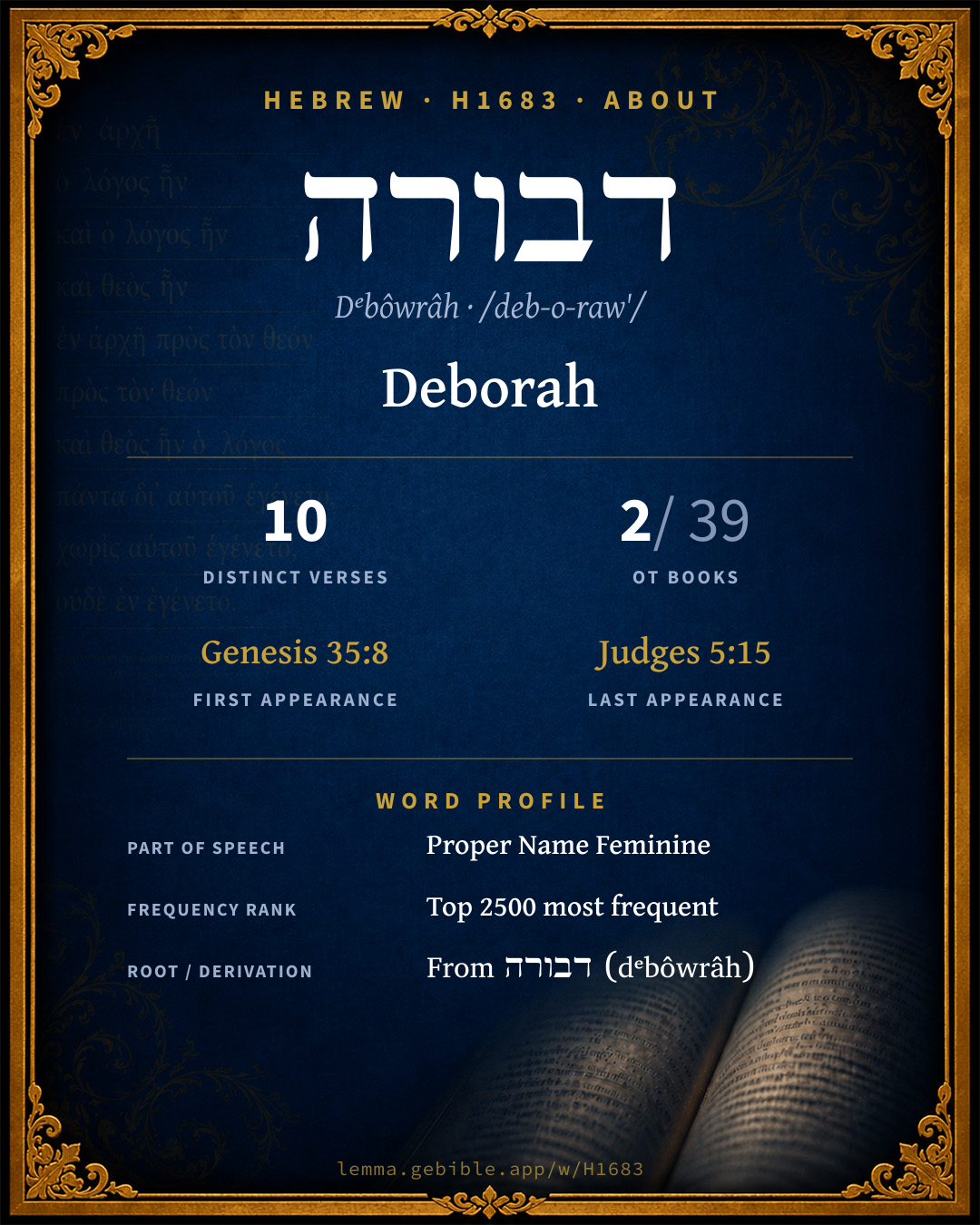
דְּבוֹרָה
Deborah
BDB lists 3 entries for ‘Deborah’ fuller range ↓
Full lexicon entry — Brown-Driver-Briggs (BDB)
From Brown-Driver-Briggs (BDB)
Where this word appears
Grammar key — what these labels mean
Part of speech
- Noun
- A naming word — a person, place, thing, or idea.
Noun type
- Proper
- A name of a specific person, place, or people (e.g. Abraham, Zion, Israel).
Every verse where H1683 appears — 10 distinct verses across 2 books. Click any verse to open its interlinear word-by-word view. Verse text shown in the World English Bible for context — . Each verse’s Hebrew form is shown with its reference; the English is not keyword-highlighted, since the data carries no word-level English alignment. Use “Compare translations” on any verse to read it across multiple English versions. This concordance covers the Hebrew Bible; Septuagint (Greek Old Testament) occurrences are not indexed here.
Genesis 1 verse
Judges 9 verses
- Judges 4:4 וּ/דְבוֹרָה֙ conj + n Proper Now Deborah, a prophetess, the wife of Lappidoth, she judged Israel at that time.
- Judges 4:5 דְּבוֹרָ֗ה n Proper She lived under the palm tree of Deborah between Ramah and Bethel in the hill-country of Ephraim: and the children of Israel came up to her for judgment.
- Judges 4:9 דְּבוֹרָ֛ה n Proper She said, I will surely go with you: notwithstanding, the journey that you take shall not be for your honor; for Yahweh will sell Sisera into the hand of a woman. Deborah arose, and went with Barak to Kedesh.
- Judges 4:10 דְּבוֹרָֽה n Proper Barak called Zebulun and Naphtali together to Kedesh; and there went up ten thousand men at his feet: and Deborah went up with him.
- Judges 4:14 דְּבֹרָ֨ה n Proper Deborah said to Barak, Up; for this is the day in which Yahweh has delivered Sisera into your hand; hasn't Yahweh gone out before you? So Barak went down from Mount Tabor, and ten thousand men after him.
- Judges 5:1 דְּבוֹרָ֔ה n Proper Then sang Deborah and Barak the son of Abinoam on that day, saying,
- Judges 5:7 דְּבוֹרָ֔ה n Proper The rulers ceased in Israel, they ceased, Until that I Deborah arose, That I arose a mother in Israel.
- Judges 5:12 דְּבוֹרָ֔ה n Proper Awake, awake, Deborah; Awake, awake, utter a song: Arise, Barak, and lead away your captives, you son of Abinoam.
- Judges 5:15 דְּבֹרָ֔ה n Proper The princes of Issachar were with Deborah; As was Issachar, so was Barak; Into the valley they rushed forth at his feet. By the watercourses of Reuben There were great resolves of heart.
About this entry
At a glance — auto-summarized from this page’s data, not written by a person. Every figure links to its source below. This summary describes the numbers; it doesn’t interpret them.
דבורה (Dᵉbôwrâh) is a Hebrew name most often rendered “Deborah.” Judges dominates its distribution — 9 of 10 verses. The Hebrew Bible uses it across 10 verses — uncommon. Debuting at Genesis 35:8, it then recurs through the corpus. The sections below give every occurrence and version rendering.
Gloss history
Strong's 1890 vs modern scholarship
About this word
Strong's H1683 catalogs a Hebrew word from the Hebrew Old Testament.
These counts are not copied from any lexicon or concordance. They are computed here, from the morphology-tagged Hebrew Old Testament. What Lemma adds →
- 10
- distinct verses
- The word appears in 10 distinct verses.
- 2 / 39
- OT books
- The word appears in 2 of 39 Old Testament books.
- #2,342
- by frequency
- Top 2500 most frequent Hebrew words (rank 2,342 of 8,640 Hebrew words by occurrence).
View all 10 occurrences in the concordance →
By traditional corpus
Conventional, traditional groupings — biblical authorship is debated, so this is a traditional corpus grouping, not an authorship claim. Each share is this word’s portion of its verses in that division of the Hebrew canon. Each figure is a share of the word’s 10 distinct verses.
- Prophets (Nevi'im) 9 verses · 90%
- Torah (Pentateuch) 1 verse · 10%
How translations render this word
Counts come from each version’s own published word-to-Strong’s tagging or interlinear alignment — an approximate guide to how each version renders this word, not a word-level alignment the data otherwise carries. Because each total is that version’s own tagged count, the per-version totals vary from one another and need not match the appearance or distinct-verse counts above. These counts may also differ from a printed concordance because Lemma counts each distinctly tagged rendering and does not collapse phrase taggings into a single head-word total. This is a fixed set of word-tagged versions (KJV, ASV, BSB, ULT) and does not change with the reading translation you choose elsewhere. Each version’s license is shown beside its name below (and on Sources).
BDB lists this Strong’s number as 2 distinct words (homographs). Each count above pools all of them and is not split by sense — see the Senses section below. A low-frequency rendering may belong to a different one of those words, not the primary meaning.
- King James Version†: Deborah 8×
- American Standard Version†: Deborah 7×
- Berean Standard Bible†: Deborah 7×, Now deborah 2×
- unfoldingWord Literal Text†: Deborah 9×
King James Version Public Domain
Renders H1683 across 10† tagged occurrences — most commonly:
Plus 2 renderings that appear only once — usually multi-word phrases or single function words the recovered tagging swept in, not distinct renderings.
American Standard Version Public Domain
Renders H1683 across 10† tagged occurrences — most commonly:
Plus 3 renderings that appear only once — usually multi-word phrases or single function words the recovered tagging swept in, not distinct renderings.
Berean Standard Bible Public Domain
Renders H1683 across 10† tagged occurrences — most commonly:
Plus 1 rendering that appears only once — usually multi-word phrases or single function words the recovered tagging swept in, not distinct renderings.
unfoldingWord Literal Text CC BY-SA 4.0
Renders H1683 across 10† tagged occurrences — most commonly:
Plus 1 rendering that appears only once — usually multi-word phrases or single function words the recovered tagging swept in, not distinct renderings.
Senses in the full BDB
What do BDB’s symbols mean?
BDB uses these scholarly abbreviations:
| Symbol | Meaning |
|---|---|
| 𝔊 | the Septuagint (the ancient Greek translation, LXX) |
| 𝔙 | the Vulgate (the Latin translation) |
| 𝔖 | the Syriac version (the Peshitta) |
| 𝔗 | the Targum (the Aramaic translation) |
| ψ | the Psalms |
| √ | root (the underlying root or stem) |
| ‖ | parallel passage (a synonymous or contrasted parallel) |
| † | the dagger: every passage where the word occurs is cited |
The 2 senses and sub-senses the full Brown-Driver-Briggs lexicon distinguishes for this word, in lexicon order (not ranked by frequency), with BDB’s own verbatim wording and sub-sense lettering. Shown in Hebrew script with BDB’s own scholarly abbreviations. The condensed entry is in the Lexicon Entry tab. See also the Forms in the corpus table below.
דבורה I bee (cf. Arabic دِبْرٌ, swarm of bees, Aramaic דַּבַּרְתָּא, Syriac ܕܶܒܘܽܪܝܺܬܳܐ ) Is 7
דבורה II f. (bee)
- 1. the nurse of Rebekah Gn 35:8. e.g. Genesis 35:8
- 2. the prophetess Ju 4:4, 5, 9, 10, 14; 5:1, 7, 12, 15. e.g. Judges 4:4
Senses from the full Brown-Driver-Briggs lexicon (Brown, Driver, Briggs; Oxford 1906 — public domain), digitized via Sefaria, supplemented by the OpenScriptures HebrewLexicon (CC BY 4.0). Full attribution on Sources.
Word origin
I. n.f. bee (cf. Arabic دِبْرٌ, swarm of bees, Aramaic דַּבַּרְתָּא, Syriac ܕܶܒܘܽܪܝܺܬܳܐ ) Is 7:18; pl. דְּבֹרִים Dt 1:44 Ju 14:8 ψ 118:12. Read also דְּבֹרוֹ its bees 1 S 14:26 for MT דְּבַשׁ cf. 𝔊 We Dr.
II. n.pr.f. (bee)—
— Brown-Driver-Briggs (Oxford 1906, public domain), digitized via Sefaria, supplemented by the OpenScriptures HebrewLexicon (CC BY 4.0). See Sources.
Derived from דבורה (dᵉbôwrâh) (H1682) — bee.
Jastrow Dictionary
A second Hebrew/Aramaic lexicon for comparison, covering Aramaic and post-biblical (Talmudic, Targumic, Midrashic) usage that the biblical-Hebrew BDB does not. Matched by lemma rather than by Strong’s number, so a lemma may carry more than one Jastrow headword (shown separately below), and the entries cover usage well beyond the Bible.
דְּבוֹרָה
- דְּבֹרָה; דבר to lead, join)
- 1. [swarm,] bee. Yalk. Deut. 795 (play on הדברים, Deut. I, 1) מה הד׳ הזו בניה מתנהגין וכ׳ as the bee is followed by the young, so are the Israelites led by the righteous &c.; (Deut. R. s. 1 כדְּבוֹרִים היו וכ׳ like bees my children were guided &c.). Ib. מה הד׳ הזו וכ׳ as the bee whose honey &c.; a. fr.—Pl. דְּבוֹרִים. Kel. XVI, 7 מדף של ד׳ the vessel used for smoking the bees out. Bekh. 7ᵇ דבש ד׳ bee-honey. Deut. R. l. c., v. supra. e.g. Deuteronomy 1:1
- 2. pr. n. f. Deborah, the heroine and prophetess. Meg. 14ᵃ; a. fr.—שִׁירַת ד׳ the song of Deborah (Jud. V). Y. Meg. III, 74ᵇ bot.; Treat. Sof’rim XII, 10; a. e. e.g. Judges 5:12
A Dictionary of the Targumim, the Talmud Babli and Yerushalmi, and the Midrashic Literature (Marcus Jastrow; London, Luzac, 1903) — Public Domain. Digitized via Sefaria. Digitized via Sefaria. Full attribution on Sources.
Forms in the corpus
The 8 distinct written forms H1683 takes in the Hebrew Bible, most frequent first — each parse links to that state’s occurrences in the concordance. Hebrew forms include their vowel points and cantillation, so a single lemma takes many written forms.
| Form | Parsing | Example | Uses |
|---|---|---|---|
| דְּבוֹרָ֔ה | Noun, Proper | Judges 5:1 | 3 |
| דְּבֹרָ֔ה | Noun, Proper | Judges 5:15 | 1 |
| דְּבֹרָ֨ה | Noun, Proper | Judges 4:14 | 1 |
| דְּבֹרָה֙ | Noun, Proper | Genesis 35:8 | 1 |
| דְּבוֹרָ֗ה | Noun, Proper | Judges 4:5 | 1 |
| דְּבוֹרָ֛ה | Noun, Proper | Judges 4:9 | 1 |
| דְּבוֹרָֽה | Noun, Proper | Judges 4:10 | 1 |
| וּ/דְבוֹרָה֙ | Noun, Proper | Judges 4:4 | 1 |
Bible dictionary
Public-domain dictionary articles matched to this entry by name (Deborah). A biblical name can be shared by more than one person or place, so an article may treat several.
Easton's Bible Dictionary · M. G. Easton, 1897
A bee. (1.) Rebekah's nurse. She accompanied her mistress when she left her father's house in Padan-aram to become the wife of Isaac (Gen. 24:59). Many years afterwards she died at Bethel, and was buried under the "oak of weeping", Allon-bachuth (35:8).
(2.) A prophetess, "wife" (woman?) of Lapidoth. Jabin, the king of Hazor, had for twenty years held Israel in degrading subjection. The spirit of patriotism seemed crushed out of the nation. In this emergency Deborah roused the people from their lethargy. Her fame spread far and wide. She became a "mother in Israel" (Judg. 4:6, 14; 5:7), and "the children of Israel came up to her for judgment" as she sat in her tent under the palm tree "between Ramah and Bethel." Preparations were everywhere made by her direction for the great effort to throw off the yoke of bondage. She summoned Barak from Kadesh to take the command of 10,000 men of Zebulun and Naphtali, and lead them to Mount Tabor on the plain of Esdraelon at its north-east end. With his aid she organized this army. She gave the signal for attack, and the Hebrew host rushed down impetuously upon the army of Jabin, which was commanded by Sisera, and gained a great and decisive victory. The Canaanitish army almost wholly perished. That was a great and ever-memorable day in Israel. In Judg. 5 is given the grand triumphal ode, the "song of Deborah," which she wrote in grateful commemoration of that great deliverance. (See LAPIDOTH, JABIN .)
Smith's Bible Dictionary · William Smith, 1863
(a bee). (B.C. 1857.)
+ The nurse of Rebekah. (Genesis 35:8) Deborah accompanied Rebekah from the house of Bethuel, (Genesis 24:59) and is only mentioned by name on the occasion of her burial under the oak tree of Bethel, which was called in her honor Allon-bachuth. + A prophetess who judged Israel. Judges 4,5. (B.C, 1316.) She lived under the palm tree of Deborah between Ramah and Bethel in Mount Ephraim, (Judges 4:5) which, as palm trees were rare in Palestine, "is mentioned as a well-known and solitary landmark." She was probably a woman of Ephraim. Lapidoth was probably her husband, and not Barak as some say. She was not so much a judge as one gifted with prophetic command (Judges 4:6,14; 5:7) and by virtue of her inspiration "a mother in Israel." The tyranny of Jabin, a Canaanitish king, was peculiarly felt in the northern tribes, who were near his capital and under her jurisdiction. Under her direction Barak encamped on the broad summit of Tabor. Deborah's prophecy was fulfilled, (Judges 4:9) and the enemy's general perished among the "oaks of the wanderers" (Zaanaim), in the tent of the Bedouin Kenite's wife, (Judges 4:21) in the northern mountains. Deborah's title of "prophetess" includes the notion of inspired poetry, as in (Exodus 15:20) and in this sense the glorious triumphal ode, Judges 5, well vindicates her claim to the office.
Hitchcock's Bible Names Dictionary · Roswell D. Hitchcock, 1869
word; thing; a bee
Classic public-domain reference works; full attribution on Sources.
Septuagint verse parallels
This word appears in 10 verses that also exist in the Greek Old Testament (Septuagint), out of the 10 Hebrew verses it occurs in. You can read those verses in Greek by switching the Old Testament edition to the Septuagint.
Read these verses in the Septuagint
This is a verse-level parallel only — the same verses exist in both the Hebrew and Greek Old Testaments. No word-level Hebrew↔Greek correspondence is claimed: the data carries no such alignment, so no Greek word is shown as this Hebrew word’s translation. Coverage is not total — the Septuagint omits the deuterocanon and renumbers the Psalms, so some Hebrew verses have no direct Greek parallel.