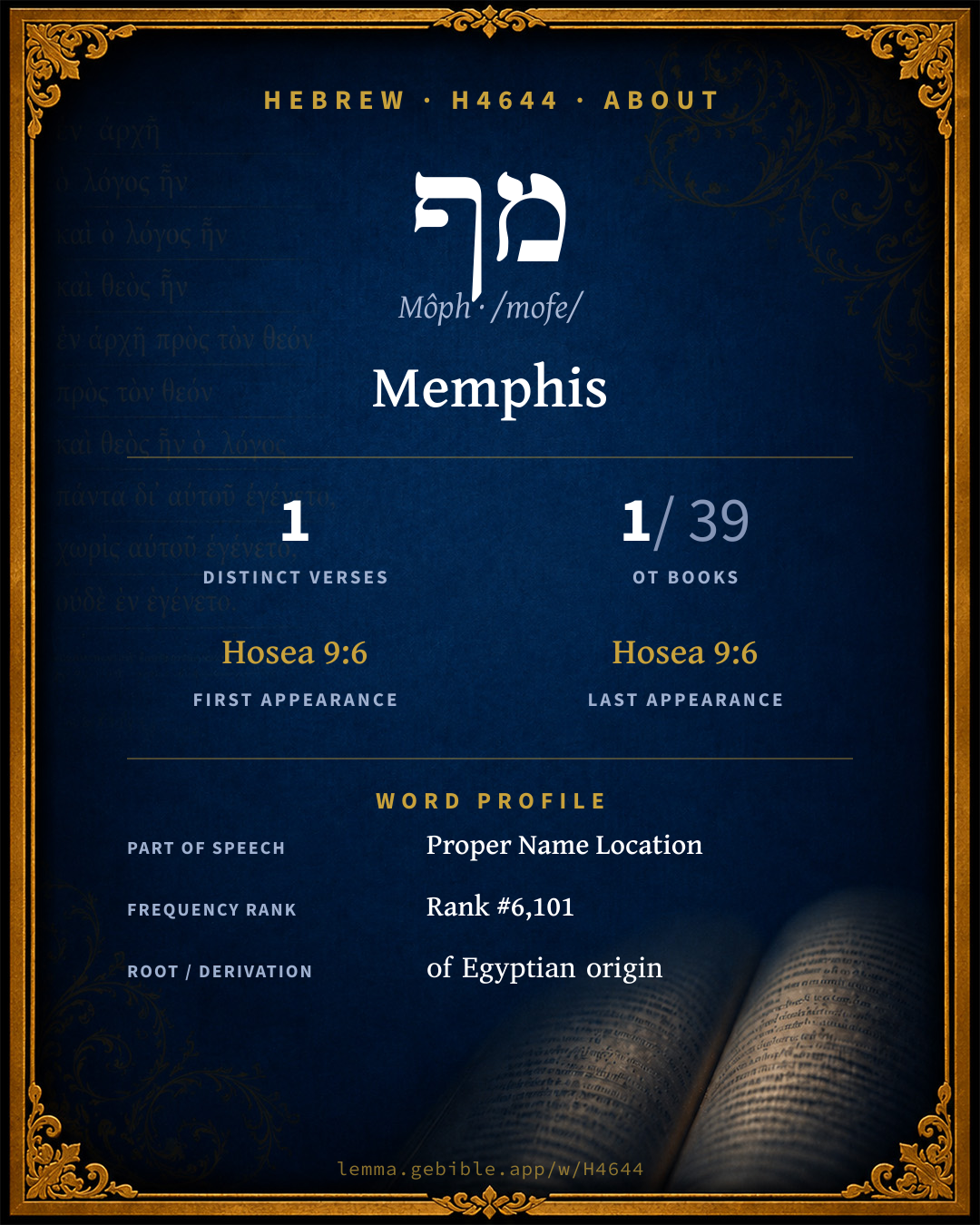
מֹף
Memphis
BDB lists 2 entries for ‘Memphis’ fuller range ↓
Full lexicon entry — Brown-Driver-Briggs (BDB)
From Brown-Driver-Briggs (BDB)
Where this word appears
Grammar key — what these labels mean
Part of speech
- Noun
- A naming word — a person, place, thing, or idea.
Noun type
- Proper
- A name of a specific person, place, or people (e.g. Abraham, Zion, Israel).
Every verse where H4644 appears — 1 distinct verse across 1 book. Click any verse to open its interlinear word-by-word view. Verse text shown in the World English Bible for context — . Each verse’s Hebrew form is shown with its reference; the English is not keyword-highlighted, since the data carries no word-level English alignment. Use “Compare translations” on any verse to read it across multiple English versions. This concordance covers the Hebrew Bible; Septuagint (Greek Old Testament) occurrences are not indexed here.
Hosea 1 verse
About this entry
At a glance — auto-summarized from this page’s data, not written by a person. Every figure links to its source below. This summary describes the numbers; it doesn’t interpret them.
The Hebrew name מף centers on the idea of “Memphis.” With only 1 verse it sits in the long tail of Hebrew Bible vocabulary. Hosea dominates its distribution — 1 of 1 verses. Its lone occurrence is Hosea 9:6. The sections below give every occurrence and version rendering.
Gloss history
Strong's 1890 vs modern scholarship
About this word
Strong's H4644 catalogs a Hebrew word from the Hebrew Old Testament.
These counts are not copied from any lexicon or concordance. They are computed here, from the morphology-tagged Hebrew Old Testament. What Lemma adds →
- 1
- distinct verses
- The word appears in 1 distinct verse.
- 1 / 39
- OT books
- The word appears in 1 of 39 Old Testament books.
- #6,101
- by frequency
- Rank #6,101 (rank 6,101 of 8,640 Hebrew words by occurrence).
View all 1 occurrence in the concordance →
Most concentrated in
- Hosea 1 verse 100%
By section of the Old Testament
By traditional corpus
Conventional, traditional groupings — biblical authorship is debated, so this is a traditional corpus grouping, not an authorship claim. Each share is this word’s portion of its verses in that division of the Hebrew canon. Each figure is a share of the word’s 1 distinct verse.
- Prophets (Nevi'im) 1 verse · 100%
How translations render this word
Counts come from each version’s own published word-to-Strong’s tagging or interlinear alignment — an approximate guide to how each version renders this word, not a word-level alignment the data otherwise carries. Because each total is that version’s own tagged count, the per-version totals vary from one another and need not match the appearance or distinct-verse counts above. These counts may also differ from a printed concordance because Lemma counts each distinctly tagged rendering and does not collapse phrase taggings into a single head-word total. This is a fixed set of word-tagged versions (KJV, ASV, BSB, ULT) and does not change with the reading translation you choose elsewhere. Each version’s license is shown beside its name below (and on Sources).
- King James Version: Memphis 1×
- American Standard Version: Memphis 1×
- Berean Standard Bible: Memphis 1×
- unfoldingWord Literal Text: Memphis 1×
King James Version Public Domain
Renders H4644 across 1 tagged occurrence — most commonly:
American Standard Version Public Domain
Renders H4644 across 1 tagged occurrence — most commonly:
Berean Standard Bible Public Domain
Renders H4644 across 1 tagged occurrence — most commonly:
unfoldingWord Literal Text CC BY-SA 4.0
Renders H4644 across 1 tagged occurrence — most commonly:
Senses in BDB
The 2 senses BDB distinguishes for this word, in lexicon order (not ranked by frequency or importance). The full entry — with sub-senses — is in the Lexicon Entry tab.
- Memphis = "haven of the good"
- a capital of Lower Egypt located on the western bank of the Nile about 9 miles (15 kilometers) south of Cairo
Word origin
n.pr.loc. Memphis (Egyptian Mr-nfr, i.e. Mĕnnūfĕr, Mĕnnū́fĕ, SteindorffBAS i. 594 f.; Assyrian Mêmpi, Mimpi, SchrCOT Is 19, 13 DlPar 314; cf. ErmanÆgypten 48, 243 EbCicerone i. 114 f.; 𝔊 (and Gk) Μεμφις, on coins Μενφι(ς) Steind.l.c.);—מ׳ Ho 9:6=נֹף Is 19:13 Je 2:16; 44:1; 46:14, 19 Ez 30:13, and וְנֹף צָרֵי יוֹמָם v 16 (without clear meaning, prob. textual error Siegfrin Kau; 𝔊 (appar.) וְנָפֹצוּ מֵימֵיהֶם and their waters shall be dispersed (cf. Na 3:8); Co ונפרצו חומותיה and its walls shall be torn down); נֹף also v 15 (for MT נא) 𝔊 Co.
— Brown-Driver-Briggs (Oxford 1906, public domain), digitized via Sefaria, supplemented by the OpenScriptures HebrewLexicon (CC BY 4.0). See Sources.
Origin: of Egyptian origin
Same root — word family
Other BDB entries built from the same root as H4644, grouped by Strong’s listed origin. These share a root / origin per the lexicon — not necessarily a shared meaning. Each links to that word’s own entry.
Proper names from this root
People and places named from this root — a name, not an additional meaning of the word.
Compare all same-root words → 1 of the same-root words is a proper name (a person or place). They share a root, not necessarily a meaning.
Bible dictionary
Public-domain dictionary articles matched to this entry by name (Memphis). A biblical name can be shared by more than one person or place, so an article may treat several.
Easton's Bible Dictionary · M. G. Easton, 1897
Only in Hos. 9:6, Hebrew Moph. In Isa. 19:13; Jer. 2:16; 46:14, 19; Ezek. 30:13, 16, it is mentioned under the name Noph. It was the capital of Lower, i.e., of Northern Egypt. From certain remains found half buried in the sand, the site of this ancient city has been discovered near the modern village of Minyet Rahinch, or Mitraheny, about 16 miles above the ancient head of the Delta, and 9 miles south of Cairo, on the west bank of the Nile. It is said to have been founded by Menes, the first king of Egypt, and to have been in circumference about 19 miles. "There are few remains above ground," says Manning (The Land of the Pharaohs), "of the splendour of ancient Memphis. The city has utterly disappeared. If any traces yet exist, they are buried beneath the vast mounds of crumbling bricks and broken pottery which meet the eye in every direction. Near the village of Mitraheny is a colossal statue of Rameses the Great. It is apparently one of the two described by Herodotus and Diodorus as standing in front of the temple of Ptah. They were originally 50 feet in height. The one which remains, though mutilated, measures 48 feet. It is finely carved in limestone, which takes a high polish, and is evidently a portrait. It lies in a pit, which, during the inundation, is filled with water. As we gaze on this fallen and battered statue of the mighty conqueror who was probably contemporaneous with Moses, it is impossible not to remember the words of the prophet Isaiah, 19:13; 44:16-19, and Jeremiah, 46:19."
Smith's Bible Dictionary · William Smith, 1863
(haven, of the good), a city of ancient Egypt, situated on that western bank of the Nile, about nine miles south of Cairo and five from the great pyramids and the sphinx. It is mentioned by (Isaiah 40:14,19) and Ezekiel, (Ezekiel 30:13,16) under the name of Noph. Though some regard Thebes as the more ancient city, the monuments of Memphis are of higher antiquity than those of Thebus. The city is said to have had a circumference of about 10 miles. The temple of Apis was one of the most noted structures of Memphis. It stood opposite the southern portico of the temple of Ptah; and Psammetichus, who built that gateway, also erected in front of the sanctuary of Apis a magnificent colonnade, supported by colossal statues or Osiride pillars, such as may still be seen at the temple of Medeenet Habou at Thebes. Herod. ii, 153. Through this colonnade the Apis was led with great pomp upon state occasions. At Memphis was the reputed burial-place of Isis; it has also a temple to that "myriad-named" divinity. Memphis had also its Serapeium, which probably stood in the western quarter of the city. The sacred cubit until other symbols used in measuring the rise of the Nile were deposited in the temple of Serapis. The Necropolis, adjacent to Memphis, was on a scale of grandeur corresponding with the city itself. The "city of the pyramids" is a title of Memphis in the hieroglyphics upon the monuments. Memphis long held its place as a capital; and for centuries a Memphite dynasty ruled over all Egypt. Lepsius, Bunsen and Brugsch agree in regarding the third, fourth, sixth, seventh and eighth dynasties of the old empire as Memphite, reaching through a period of about 1000 years. The city's overthrow was distinctly predicted by the Hebrew prophets. (Isaiah 19:13; Jeremiah 46:19) The latest of these predictions was uttered nearly 600 years before Christ, and a half a century before the invasion of Egypt by Cambyses (cir, B.C. 525). Herodotus informs us that Cambyses, engaged at the opposition he encountered at Memphis, committed many outrages upon the city. The city never recovered from the blow inflicted by Cambyses. The rise of Alexandria hastened its decline. The caliph conquerors founded Fostat (old Cairo) upon the opposite bank of the Nile, a few miles north of Memphis, and brought materials from the old city to build their new capital, A.D. 638. At length so complete was the ruin of Memphis that for a long time its very site was lost. Recent explorations have brought to light many of its antiquities.
Hitchcock's Bible Names Dictionary · Roswell D. Hitchcock, 1869
abode of the good
Classic public-domain reference works; full attribution on Sources.
Septuagint verse parallels
This word appears in 1 verse that also exists in the Greek Old Testament (Septuagint), out of the 1 Hebrew verse it occurs in. You can read those verses in Greek by switching the Old Testament edition to the Septuagint.
Read these verses in the Septuagint
This is a verse-level parallel only — the same verses exist in both the Hebrew and Greek Old Testaments. No word-level Hebrew↔Greek correspondence is claimed: the data carries no such alignment, so no Greek word is shown as this Hebrew word’s translation. Coverage is not total — the Septuagint omits the deuterocanon and renumbers the Psalms, so some Hebrew verses have no direct Greek parallel.