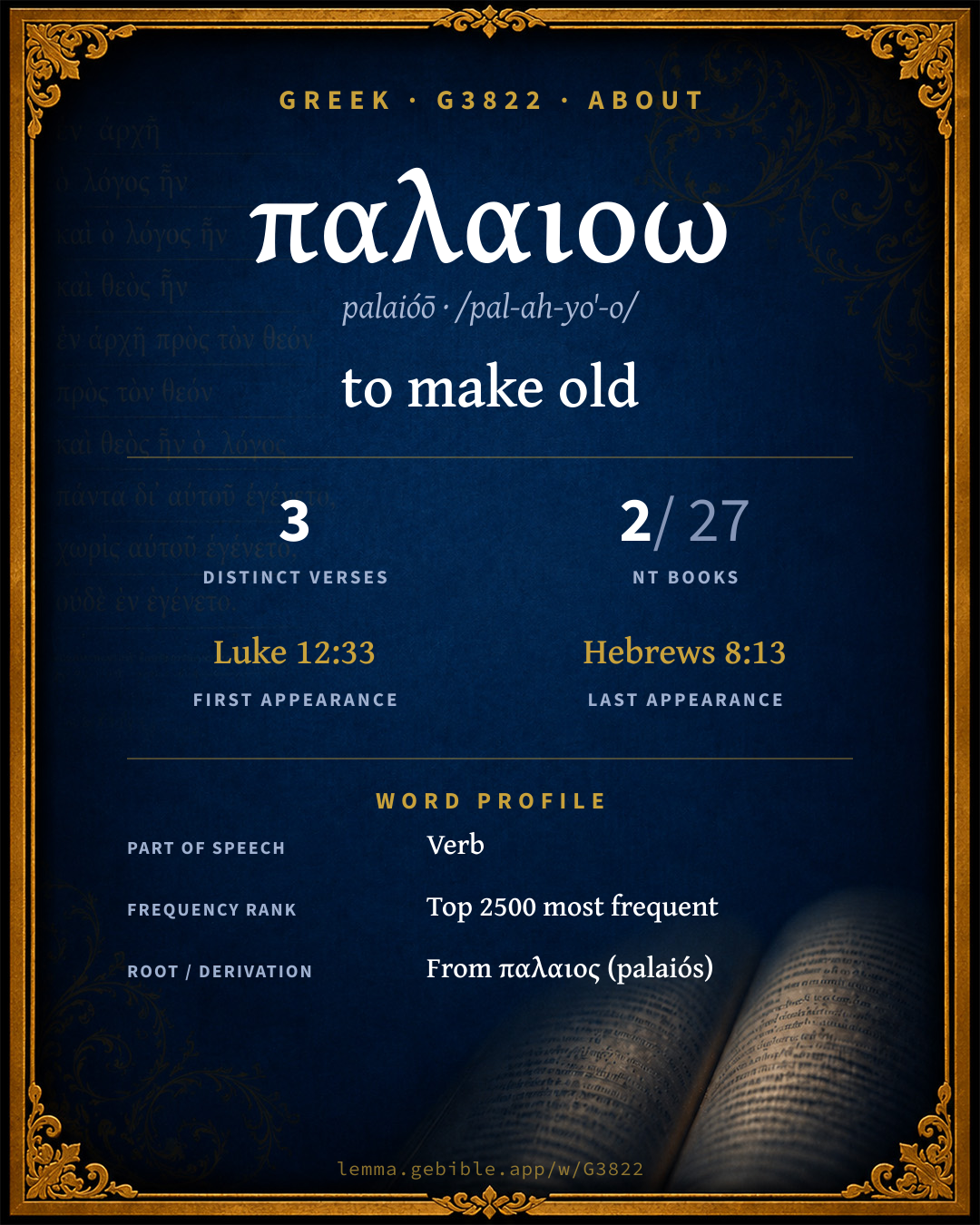
παλαιόω
to make old
‘to make old’ is one of 3 main senses fuller range ↓
Full lexicon entry — Thayer's Greek Lexicon
From Thayer's Greek Lexicon
Where this word appears
See every Present-tense verb in the Greek New Testament →
Grammar key — what these labels mean
Part of speech
- Verb
- An action or state-of-being word.
Tense
- Future
- Action expected in future time.
- Present
- Ongoing or general action in present time (imperfective aspect).
- Perfect
- A completed past action with continuing present results.
Voice
- Passive
- The subject receives the action.
- Active
- The subject performs the action.
Mood
- Indicative
- States a fact or asks a factual question (the mood of reality).
- Participle
- A verbal adjective (“writing,” “having written”).
Case
- Accusative
- The case of the direct object and of extent.
- Nominative
- The case of the subject (and the predicate nominative).
Person
- 3rd person
- The one spoken about (“he / she / it / they”).
Gender
- Neuter
- Grammatically neuter.
Number
- Plural
- More than one.
- Singular
- One.
Grammatical forms
- Verb, Future, Passive, Indicative, 3rd person, Plural 1 time (25%)
- Verb, Present, Passive, Participle, Accusative, Plural, Neuter 1 time (25%)
- Verb, Present, Passive, Participle, Nominative, Singular, Neuter 1 time (25%)
- Verb, Perfect, Active, Indicative, 3rd person, Singular 1 time (25%)
Parsed forms decoded from the imported morphology (Robinson–Tischendorf, public domain), counted across 4 parsed occurrences — not distinct verses.
Every verse where G3822 appears — 3 distinct verses across 2 books. Click any verse to open its interlinear word-by-word view. Verse text shown in the World English Bible for context — . Each verse’s Greek form is shown with its reference; the English is not keyword-highlighted, since the data carries no word-level English alignment. Use “Compare translations” on any verse to read it across multiple English versions. This concordance covers the Greek New Testament; Septuagint (Greek Old Testament) occurrences of this word are not indexed here.
Luke 1 verse
Hebrews 2 verses
- Hebrews 1:11 παλαιωθήσονται fut pass ind 3pl They will perish, but you continue. They all will grow old like a garment does.
- Hebrews 8:13 πεπαλαίωκεν παλαιούμενον perf act ind 3sg pres pass ptcp nom sg neut In that he says, "A new covenant," he has made the first old. But that which is becoming old and grows aged is near to vanishing away.
About this entry
At a glance — auto-summarized from this page’s data, not written by a person. Every figure links to its source below. This summary describes the numbers; it doesn’t interpret them.
“to make old” is the headline sense of the Greek verb παλαιοω (palaióō). The Greek New Testament uses it only 3 verses. It clusters heavily in Hebrews, which alone accounts for 67% of its uses. Scripture first uses it in Luke 12:33. Catalogued under 3 senses, its meaning is not single-sense. The sections below give every sense, occurrence, and version rendering.
Gloss history
Strong's 1890 vs modern scholarship

About this word
Strong's G3822 catalogs a Greek word from the Greek New Testament.
These counts are not copied from any lexicon or concordance. They are computed here, from the morphology-tagged Greek New Testament. What Lemma adds →
- 3
- distinct verses
- The word appears in 3 distinct verses.
- 2 / 27
- NT books
- The word appears in 2 of 27 New Testament books.
- #1,877
- by frequency
- Top 2500 most frequent Greek words (rank 1,877 of 5,347 Greek words by occurrence).
View all 3 occurrences in the concordance →
By traditional corpus
Conventional, traditional groupings — biblical authorship is debated, so this is a traditional corpus grouping, not an authorship claim. Some books belong to more than one corpus (Luke is in both the Gospels and the Lukan corpus, and so on), so these shares overlap and need not total 100%. Each figure is a share of the word’s 3 distinct verses.
- Hebrews 2 verses · 67%
- Gospels 1 verse · 33%
- Lukan (Luke–Acts) 1 verse · 33%
How translations render this word
Counts come from each version’s own published word-to-Strong’s tagging or interlinear alignment — an approximate guide to how each version renders this word, not a word-level alignment the data otherwise carries. Because each total is that version’s own tagged count, the per-version totals vary from one another and need not match the appearance or distinct-verse counts above. These counts may also differ from a printed concordance because Lemma counts each distinctly tagged rendering and does not collapse phrase taggings into a single head-word total. This is a fixed set of word-tagged versions (KJV, ASV, BSB, ULT) and does not change with the reading translation you choose elsewhere. Each version’s license is shown beside its name below (and on Sources).
- King James Version: Old 2×
- American Standard Version: Old 2×
- Berean Standard Bible: He has made 1×, Is obsolete 1×, They will all wear out 1×
- unfoldingWord Literal Text: Wear out 2×
King James Version Public Domain
Renders G3822 across 6 tagged occurrences — most commonly:
Plus 4 renderings that appear only once — usually multi-word phrases or single function words the recovered tagging swept in, not distinct renderings.
American Standard Version Public Domain
Renders G3822 across 6 tagged occurrences — most commonly:
Plus 4 renderings that appear only once — usually multi-word phrases or single function words the recovered tagging swept in, not distinct renderings.
Berean Standard Bible Public Domain
Renders G3822 across 4 tagged occurrences — most commonly:
unfoldingWord Literal Text CC BY-SA 4.0
Renders G3822 across 7 tagged occurrences — most commonly:
Plus 5 renderings that appear only once — usually multi-word phrases or single function words the recovered tagging swept in, not distinct renderings.
Senses in Thayer's
The 3 senses Thayer's distinguishes for this word, in lexicon order (not ranked by frequency or importance). The full entry — with sub-senses — is in the Lexicon Entry tab.
- to become old, to be worn out
- of things worn out by time and use
- to declare a thing to be old and so about to be abrogated
Word origin
Derived from παλαιος (palaiós) (G3820) — old.
From G3820 ; to make (passively become ) worn out or declare obsolete : - decay make (wax) old.
— Strong’s Exhaustive Concordance (1890), public domain.
Forms in the corpus
The 4 distinct written forms G3822 takes in the Greek New Testament, most frequent first — each parse links to that tense’s occurrences in the concordance.
| Form | Parsing | Example | Uses |
|---|---|---|---|
| παλαιούμενα palaioúmena | Verb, Present, Passive, Participle, Accusative, Plural, Neuter | Luke 12:33 | 1 |
| παλαιούμενον palaioúmenon | Verb, Present, Passive, Participle, Nominative, Singular, Neuter | Hebrews 8:13 | 1 |
| παλαιωθήσονται palaiōthḗsontai | Verb, Future, Passive, Indicative, 3rd person, Plural | Hebrews 1:11 | 1 |
| πεπαλαίωκεν pepalaíōken | Verb, Perfect, Active, Indicative, 3rd person, Singular | Hebrews 8:13 | 1 |
Same root — word family
Other Thayer's entries built from the same root as G3822, grouped by Strong’s listed origin. These share a root / origin per the lexicon — not necessarily a shared meaning. Each links to that word’s own entry.
Derives from
Shares the same root
Compare all same-root words → They share a root, not necessarily a meaning.
Septuagint usage
The same Greek word παλαιοω appears 21 times in the Greek Old Testament (Septuagint), across 21 verses in 10 books.
- 21
- LXX occurrences
- Tagged occurrences of this Greek word in the Septuagint.
- 21
- verses
- Distinct Septuagint verses containing this word.
- 10 / 39
- OT books
- The word appears in 10 of the 39 Old Testament books.
Sample Septuagint occurrences
- Leviticus 13:11 παλαιόω
- Deuteronomy 29:4 παλαιόω
- Joshua 9:5 παλαιόω
- Ezra 19:21 παλαιόω
- Job 9:5 παλαιόω
- Psalms 6:8 παλαιόω
- Isaiah 50:9 παλαιόω
- Lamentations 3:4 παλαιόω
- Ezekiel 47:12 παλαιόω
- Daniel 11:33 παλαιόω
Septuagint occurrences (same lexeme)
Every verse where the same Strong’s number (G3822) appears in the Greek Septuagint. Verse text shown in the World English Bible for context; the Greek form is the matched word — the English is not keyword-highlighted.
- Leviticus 13:11 παλαιόω it is a chronic leprosy in the skin of his body, and the priest shall pronounce him unclean. He shall not isolate him, for he is unclean.
- Deuteronomy 29:4 παλαιόω but Yahweh has not given you a heart to know, and eyes to see, and ears to hear, to this day.
- Joshua 9:5 παλαιόω and old and patched shoes on their feet, and old garments on them; and all the bread of their provision was dry and was become moldy.
- Joshua 9:13 παλαιόω and these wine-skins, which we filled, were new; and, behold, they are torn: and these our garments and our shoes are become old by reason of the very long journey.
- Ezra 19:21 παλαιόω
- Job 9:5 παλαιόω Who removes the mountains, and they don't know it, When he overturns them in his anger
- Job 13:28 παλαιόω Though I am decaying like a rotten thing, Like a garment that is moth-eaten.
- Job 14:18 παλαιόω "But the mountain falling comes to nothing; The rock is removed out of its place;
- Job 21:7 παλαιόω "Why do the wicked live, Become old, yes, and grow mighty in power?
- Job 32:15 παλαιόω "They are amazed. They answer no more. They don't have a word to say.
- Psalms 6:8 παλαιόω Depart from me, all you workers of iniquity, For Yahweh has heard the voice of my weeping.
- Psalms 17:46 παλαιόω
- Psalms 31:3 παλαιόω For you are my rock and my fortress, Therefore for your name's sake lead me and guide me.
- Psalms 48:15 παλαιόω
- Psalms 101:27 παλαιόω
- Isaiah 50:9 παλαιόω Behold, the Lord Yahweh will help me; who is he who shall condemn me? Behold, all they shall wax old as a garment, the moth shall eat them up.
- Isaiah 51:6 παλαιόω Lift up your eyes to the heavens, and look on the earth beneath; for the heavens shall vanish away like smoke, and the earth shall wax old like a garment; and those who dwell therein shall die in like manner: but my salvation shall be forever, and my righteousness shall not be abolished.
- Isaiah 65:22 παλαιόω They shall not build, and another inhabit; they shall not plant, and another eat: for as the days of a tree shall be the days of my people, and my chosen shall long enjoy the work of their hands.
- Lamentations 3:4 παλαιόω My flesh and my skin has he made old; he has broken my bones.
- Ezekiel 47:12 παλαιόω By the river on the bank of it, on this side and on that side, shall grow every tree for food, whose leaf shall not wither, neither shall the fruit of it fail: it shall bring forth new fruit every month, because the waters of it issue out of the sanctuary; and the fruit of it shall be for food, and the leaf of it for healing.
- Daniel 11:33 παλαιόω Those who are wise among the people shall instruct many; yet they shall fall by the sword and by flame, by captivity and by spoil, [many] days.
These are occurrences of the same Greek lexeme (G3822) in the Septuagint — not a translation of any one Hebrew word. The store carries no word-level Hebrew↔Greek alignment, so no Hebrew original is asserted here. Counts come from the recovered LXX Strong's tagging — high-frequency vocabulary is well covered, while rare or late forms may be untagged — so they reflect tagged occurrences and may slightly undercount.