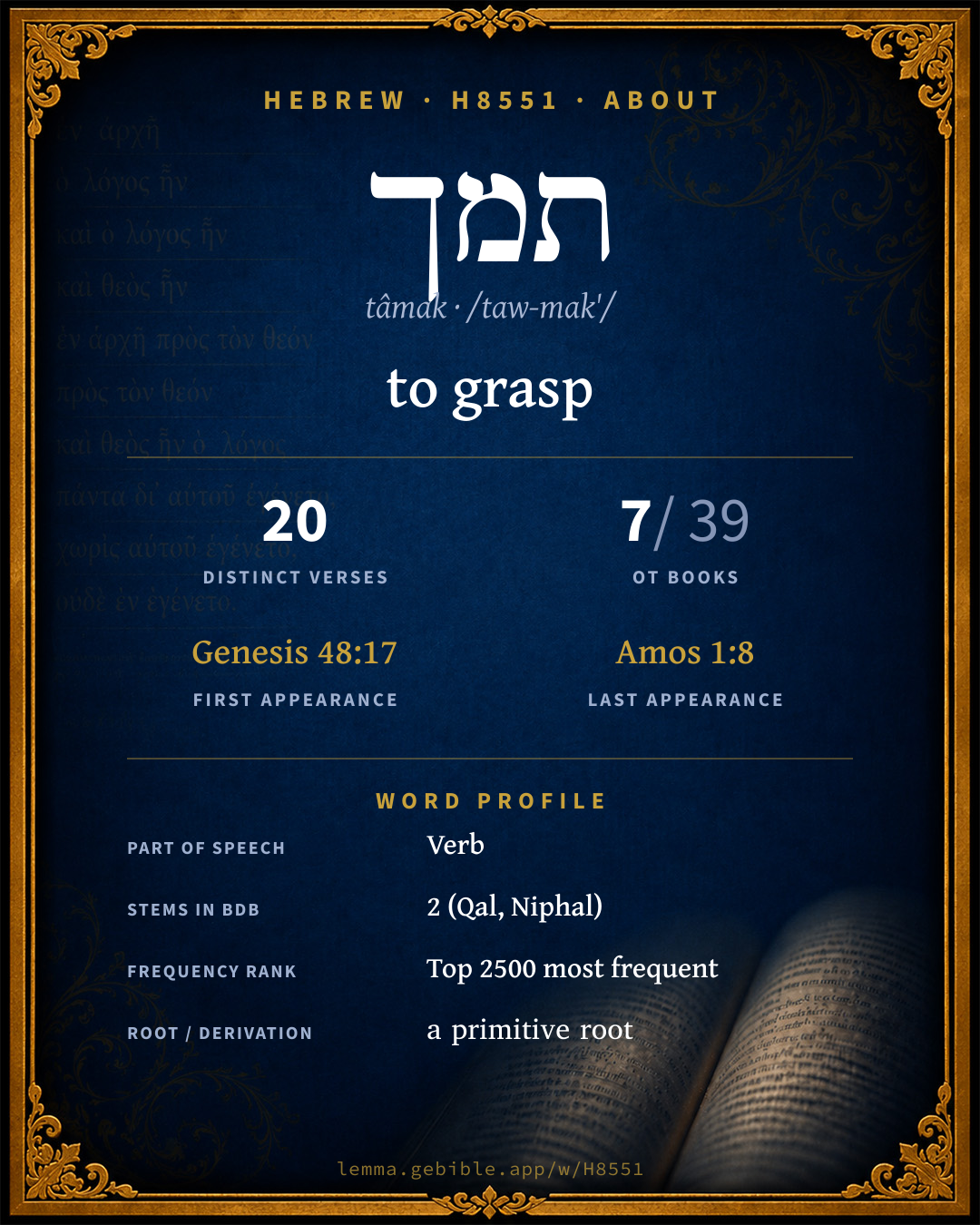
תָּמַךְ
to grasp
also: hold, support, attain, lay hold of fuller range ↓
Full lexicon entry — Brown-Driver-Briggs (BDB)
From Brown-Driver-Briggs (BDB)
Where this word appears
See every Qal verb in the Hebrew Bible →
Grammar key — what these labels mean
Part of speech
- Verb
- An action or state-of-being word.
Stem
- Qal
- The basic, simple active stem — the plain form of the verb (“he wrote”). Here: ‘grasp’
- Niphal
- Usually the simple passive or reflexive of the Qal (“he was written”).
Form
- Imperfect
- An incomplete, ongoing, or future action (“he will / would write”).
- Participle Active
- A verbal adjective expressing ongoing or characteristic action (“writing / one who writes”).
- Perfect
- A completed action or state — Hebrew marks aspect (completeness) more than strict tense (“he wrote”).
- Sequential Imperfect
- An imperfect with prefixed waw — the standard past-narrative form (waw-consecutive imperfect).
- Infinitive Construct
- A bound verbal noun, frequently with prepositions (“to write / in writing”).
- Infinitive Absolute
- An unbound verbal noun, often intensifying or standing in for a finite verb.
- Jussive
- A third- or second-person volitional form expressing wish or command (“let him write”).
State
- Construct
- A noun bound to a following noun in a possessive / “of” relationship (the construct chain).
- Absolute
- The independent form of a noun, not bound to a following word.
Person
- 3rd Person
- The one spoken about (“he / she / it / they”).
- 1st Person
- The speaker (“I / we”).
- 2nd Person
- The one addressed (“you”).
Gender
- Masculine
- Grammatically masculine.
- Common
- Either gender — not distinguished for this form.
- Feminine
- Grammatically feminine.
Number
- Plural
- More than one (in Hebrew, generally three or more).
- Singular
- One.
Grammatical forms 17 distinct
- Verb, Qal, Imperfect, 3rd Person, Masculine, Plural 3 times (14%)
- Verb, Qal, Participle Active, Masculine, Singular, Construct 2 times (10%)
- Verb, Qal, Perfect, 3rd Person, Common, Plural 2 times (10%)
- Verb, Qal, Participle Active, Masculine, Plural, Construct 1 time (5%)
- Verb, Qal, Sequential Imperfect, 3rd Person, Masculine, Singular 1 time (5%)
- Verb, Qal, Infinitive Construct 1 time (5%)
- Verb, Niphal, Imperfect, 3rd Person, Masculine, Singular 1 time (5%)
- Verb, Qal, Infinitive Absolute 1 time (5%)
+9 more forms (9 occurrences)
Parsed forms decoded from the imported morphology (morphhb / Westminster Leningrad Codex — WLC text public domain, morphhb tagging CC BY 4.0), counted across 21 parsed occurrences — not distinct verses.
Every verse where H8551 appears — 20 distinct verses across 7 books. Click any verse to open its interlinear word-by-word view. Verse text shown in the World English Bible for context — . Each verse’s Hebrew form is shown with its reference; the English is not keyword-highlighted, since the data carries no word-level English alignment. Use “Compare translations” on any verse to read it across multiple English versions. This concordance covers the Hebrew Bible; Septuagint (Greek Old Testament) occurrences are not indexed here.
Genesis 1 verse
Exodus 1 verse
Job 1 verse
Psalms 4 verses
- Psalms 16:5 תּוֹמִ֥יךְ Qal ptcp.act ms Yahweh assigned my portion and my cup. You made my lot secure.
- Psalms 17:5 תָּמֹ֣ךְ Qal inf.abs My steps have held fast to your paths, My feet have not slipped.
- Psalms 41:12 תָּמַ֣כְתָּ Qal pf 2ms As for me, you uphold me in my integrity, And set me in your presence forever.
- Psalms 63:8 תָּמְכָ֥ה Qal pf 3fs My soul stays close to you. Your right hand holds me up.
Proverbs 8 verses
- Proverbs 3:18 וְֽ/תֹמְכֶ֥י/הָ conj + Qal ptcp.act mp cs + sfx pers 3fs She is a tree of life to those who lay hold of her. Happy is everyone who retains her.
- Proverbs 4:4 יִֽתְמָךְ Qal juss 3ms He taught me, and said to me: "Let your heart retain my words. Keep my commandments, and live.
- Proverbs 5:5 יִתְמֹֽכוּ Qal impf 3mp Her feet go down to death. Her steps lead straight to Sheol.
- Proverbs 5:22 יִתָּמֵֽךְ Niphal impf 3ms The evil deeds of the wicked ensnare him. The cords of his sin hold him firmly.
- Proverbs 11:16 תִּתְמֹ֣ךְ יִתְמְכוּ Qal impf 3fs Qal impf 3mp A gracious woman obtains honor, But violent men obtain riches.
- Proverbs 28:17 יִתְמְכוּ Qal juss 3mp A man who is tormented by life blood will be a fugitive until death; No one will support him.
- Proverbs 29:23 יִתְמֹ֥ךְ Qal impf 3ms A man's pride brings him low, But one of lowly spirit gains honor.
- Proverbs 31:19 תָּ֣מְכוּ Qal pf 3cp She lays her hands to the distaff, And her hands hold the spindle.
Isaiah 3 verses
- Isaiah 33:15 מִ/תְּמֹ֣ךְ prep + Qal inf.cs He who walks righteously, and speaks blamelessly; he who despises the gain of oppressions, who shakes his hands from taking a bribe, who stops his ears from hearing of blood, and shuts his eyes from looking on evil:
- Isaiah 41:10 תְּמַכְתִּ֖י/ךָ Qal pf 1cs + sfx pers 2ms Don't you be afraid, for I am with you; don't be dismayed, for I am your God; I will strengthen you; yes, I will help you; yes, I will uphold you with the right hand of my righteousness.
- Isaiah 42:1 אֶתְמָךְ Qal impf 1cs Behold, my servant, whom I uphold; my chosen, in whom my soul delights: I have put my Spirit on him; he will bring forth justice to the Gentiles.
Amos 2 verses
- Amos 1:5 וְ/תוֹמֵ֥ךְ conj + Qal ptcp.act ms cs I will break the bar of Damascus, And cut off the inhabitant from the valley of Aven, And him who holds the scepter from the house of Eden; And the people of Syria shall go into captivity to Kir," says Yahweh.
- Amos 1:8 וְ/תוֹמֵ֥ךְ conj + Qal ptcp.act ms cs I will cut off the inhabitant from Ashdod, And him who holds the scepter from Ashkelon; And I will turn my hand against Ekron; And the remnant of the Philistines will perish," says the Lord Yahweh.
About this entry
At a glance — auto-summarized from this page’s data, not written by a person. Every figure links to its source below. This summary describes the numbers; it doesn’t interpret them.
תמך — transliterated tâmak — is a Hebrew verb carrying the sense “to grasp.” It first appears in Genesis 48:17. The Hebrew Bible uses it across 20 verses — uncommon. More than a third of its appearances fall in Proverbs. Across 2 stems, its meaning turns on the binyan (Qal, Niphal). See the sense tree, 20-verse concordance, and the renderings breakdown below.
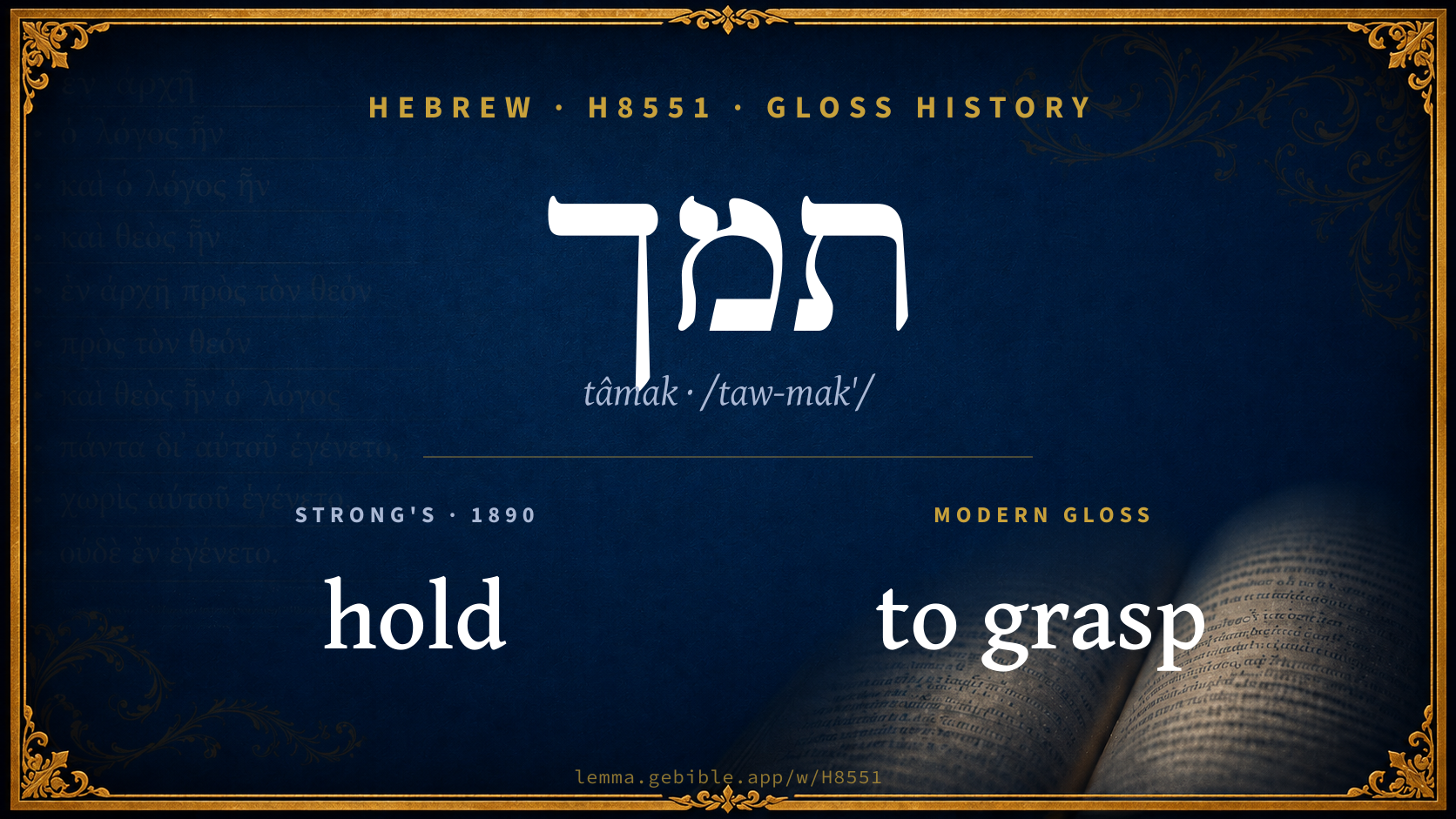
Gloss history
Strong's 1890 vs modern scholarship
About this word
Strong's H8551 catalogs a Hebrew word from the Hebrew Old Testament.
These counts are not copied from any lexicon or concordance. They are computed here, from the morphology-tagged Hebrew Old Testament. What Lemma adds →
- 20
- distinct verses
- The word appears in 20 distinct verses.
- 7 / 39
- OT books
- The word appears in 7 of 39 Old Testament books.
- #1,462
- by frequency
- Top 2500 most frequent Hebrew words (rank 1,462 of 8,640 Hebrew words by occurrence).
View all 20 occurrences in the concordance →
By section of the Old Testament
By traditional corpus
Conventional, traditional groupings — biblical authorship is debated, so this is a traditional corpus grouping, not an authorship claim. Each share is this word’s portion of its verses in that division of the Hebrew canon. Each figure is a share of the word’s 20 distinct verses.
- Writings (Ketuvim) 13 verses · 65%
- Prophets (Nevi'im) 5 verses · 25%
- Torah (Pentateuch) 2 verses · 10%
How translations render this word
Counts come from each version’s own published word-to-Strong’s tagging or interlinear alignment — an approximate guide to how each version renders this word, not a word-level alignment the data otherwise carries. Because each total is that version’s own tagged count, the per-version totals vary from one another and need not match the appearance or distinct-verse counts above. These counts may also differ from a printed concordance because Lemma counts each distinctly tagged rendering and does not collapse phrase taggings into a single head-word total. This is a fixed set of word-tagged versions (KJV, ASV, BSB, ULT) and does not change with the reading translation you choose elsewhere. Each version’s license is shown beside its name below (and on Sources).
- King James Version: Holdeth 2×, Take hold 2×
- American Standard Version: Holdeth 2×
- Berean Standard Bible: One who wields 2×
- unfoldingWord Literal Text: Will grasp 3×, Grasp 2×, One who holds 2×
King James Version Public Domain
Renders H8551 across 21 tagged occurrences — most commonly:
Plus 17 renderings that appear only once — usually multi-word phrases or single function words the recovered tagging swept in, not distinct renderings.
American Standard Version Public Domain
Renders H8551 across 21 tagged occurrences — most commonly:
Plus 19 renderings that appear only once — usually multi-word phrases or single function words the recovered tagging swept in, not distinct renderings.
Berean Standard Bible Public Domain
Renders H8551 across 21 tagged occurrences — most commonly:
Plus 19 renderings that appear only once — usually multi-word phrases or single function words the recovered tagging swept in, not distinct renderings.
unfoldingWord Literal Text CC BY-SA 4.0
Renders H8551 across 24 tagged occurrences — most commonly:
Plus 17 renderings that appear only once — usually multi-word phrases or single function words the recovered tagging swept in, not distinct renderings.
Senses in the full BDB
Hebrew verbs can shift meaning by stem (binyan): Qal is the basic action, Niphal is often passive or reflexive, Piel often intensifies or makes it factitive, and Hiphil is typically causative. The senses below are grouped under the stem BDB assigns to each.
What do BDB’s symbols mean?
BDB uses these scholarly abbreviations:
| Symbol | Meaning |
|---|---|
| 𝔊 | the Septuagint (the ancient Greek translation, LXX) |
| 𝔙 | the Vulgate (the Latin translation) |
| 𝔖 | the Syriac version (the Peshitta) |
| 𝔗 | the Targum (the Aramaic translation) |
| ψ | the Psalms |
| √ | root (the underlying root or stem) |
| ‖ | parallel passage (a synonymous or contrasted parallel) |
| † | the dagger: every passage where the word occurs is cited |
The 5 senses and sub-senses the full Brown-Driver-Briggs lexicon distinguishes for this word, in lexicon order (not ranked by frequency), with BDB’s own verbatim wording and sub-sense lettering. Shown in Hebrew script with BDB’s own scholarly abbreviations. The condensed entry is in the Lexicon Entry tab. See also the Forms in the corpus table below.
Qal
- Pf. 3 fs. תָּֽמְכָה ψ 63:9, etc.; Impf. 3 ms. יִתְמֹךְ Pr 29:23, 3 mpl. יִתְמֹ֑כוּ Jb 36:17; Pr 5:5, etc.; Inf. abs. תָּמֹךְ ψ 17:5; cstr. תְּמֹךְ Is 33:15; Pt. תּוֹמֵךְ Am 1:5, 8, תּוֹמִיךְ ψ 16:5 (? read -מֵיךְ Ges§ 50 e, or תֹּמֵךְ, cf. Vrss Du; > Ol תּוֹסִיף, Bi Che תָּמִיד), etc.;— e.g. Psalms 63:9
- 1. grasp, lay hold of, c. acc. rei Gn 48:17 (E), Pr 31:19 (‖ שׁלּח יד בְּ); acc. pers. (wisdom) Pr 3:18 (‖ מַחֲזִיק); acc. rei (grasp and) wield Am 1:5, 8; ψ 16:5 (v. supr.) thou dost grasp my lot (i.e. take and cast it for me, cf. mod. Pal. بجَرَلي الله يَقُوم may Allah uphold my lot, BergheimPEF 1894, 194); fig., Jb 36:17 judgment and justice seize (thee; but v. obscure and doubtful); Pr 5:5 her steps lay hold of Sheʾôl (keep the path to it); lit. c. ב rei Is 33:15, ב pers. Pr 28:17 (or sub 3; meaning dub.); lay hold of, attain, honour, wealth (acc.) Pr 11:16(×2). e.g. Genesis 48:17
- 2. hold up, support, c. בְּיָדָיו Ex 17:12 (E); fig., ב pers. Is 42:1 ψ 41:13; 63:9; acc. pers. Is 41:10 (ב instr.), Pr 29:23 (opp. הִשְׁפִּיל). e.g. Exodus 17:12
- 3. hold, keep, c. acc. rei Pr 4:4 let thy heart keep my words (‖ שָׁמַר); hold firmly ψ 17:5 (ב loc.; opp. נָמ֫וֹטוּ). e.g. Proverbs 4:4
Niphal
- Impf. וּבְחַבְלֵי חַטָאתוֹ יִתָּמֵ֑ךְ Pr 5:22 in the cords of his sin is he seized (‖ לָכַד). e.g. Proverbs 5:22
Senses from the full Brown-Driver-Briggs lexicon (Brown, Driver, Briggs; Oxford 1906 — public domain), digitized via Sefaria, supplemented by the OpenScriptures HebrewLexicon (CC BY 4.0). Full attribution on Sources.
Word origin
vb. grasp, support, attain (Aramaic תְּמַךְ Pa. hold fast; cf. Ph. and OAramaic תמבאל Ēl hath sustained Lzb386 SAC121 Cooke361);—
— Brown-Driver-Briggs (Oxford 1906, public domain), digitized via Sefaria, supplemented by the OpenScriptures HebrewLexicon (CC BY 4.0). See Sources.
Origin: a primitive root
Jastrow Dictionary
A second Hebrew/Aramaic lexicon for comparison, covering Aramaic and post-biblical (Talmudic, Targumic, Midrashic) usage that the biblical-Hebrew BDB does not. Matched by lemma rather than by Strong’s number, so a lemma may carry more than one Jastrow headword (shown separately below), and the entries cover usage well beyond the Bible.
תָּמַךְ
- [to lie under,] to support; [to make to lie under,] to rest upon, lay upon, press. Midr. Till. to Ps. XVI, 5 (ref. to תומיך, ib.) הגורל הזה תְּמָכַנִי בסיני this lot (martyrdom) was laid on me at Sinai; Yalk. ib. 667. Num. R. s. 133 (ref. to Prov. XXIX, 23) ת׳ הקב"ה כבודו עליו וכ׳ the Lord rested his glory upon it (Sinai), and on it he gave the Law. Pesik. R. s. 3 ת׳ ידו … להעבירה וכ׳ he (Joseph) held up Jacob’s hand to remove it &c.; a. e. e.g. Proverbs 29:23
תְּמַךְ
- Pa. תַּמֵּךְ same. Targ. Prov. V, 5 מתמכן Ms. (ed. מסמכן).
A Dictionary of the Targumim, the Talmud Babli and Yerushalmi, and the Midrashic Literature (Marcus Jastrow; London, Luzac, 1903) — Public Domain. Digitized via Sefaria. Digitized via Sefaria. Full attribution on Sources.
Forms in the corpus
The 18 distinct written forms H8551 takes in the Hebrew Bible, most frequent first — each parse links to that stem’s occurrences in the concordance. Hebrew forms include their vowel points and cantillation, so a single lemma takes many written forms.
Septuagint verse parallels
This word appears in 20 verses that also exist in the Greek Old Testament (Septuagint), out of the 20 Hebrew verses it occurs in. You can read those verses in Greek by switching the Old Testament edition to the Septuagint.
Read these verses in the Septuagint
This is a verse-level parallel only — the same verses exist in both the Hebrew and Greek Old Testaments. No word-level Hebrew↔Greek correspondence is claimed: the data carries no such alignment, so no Greek word is shown as this Hebrew word’s translation. Coverage is not total — the Septuagint omits the deuterocanon and renumbers the Psalms, so some Hebrew verses have no direct Greek parallel.