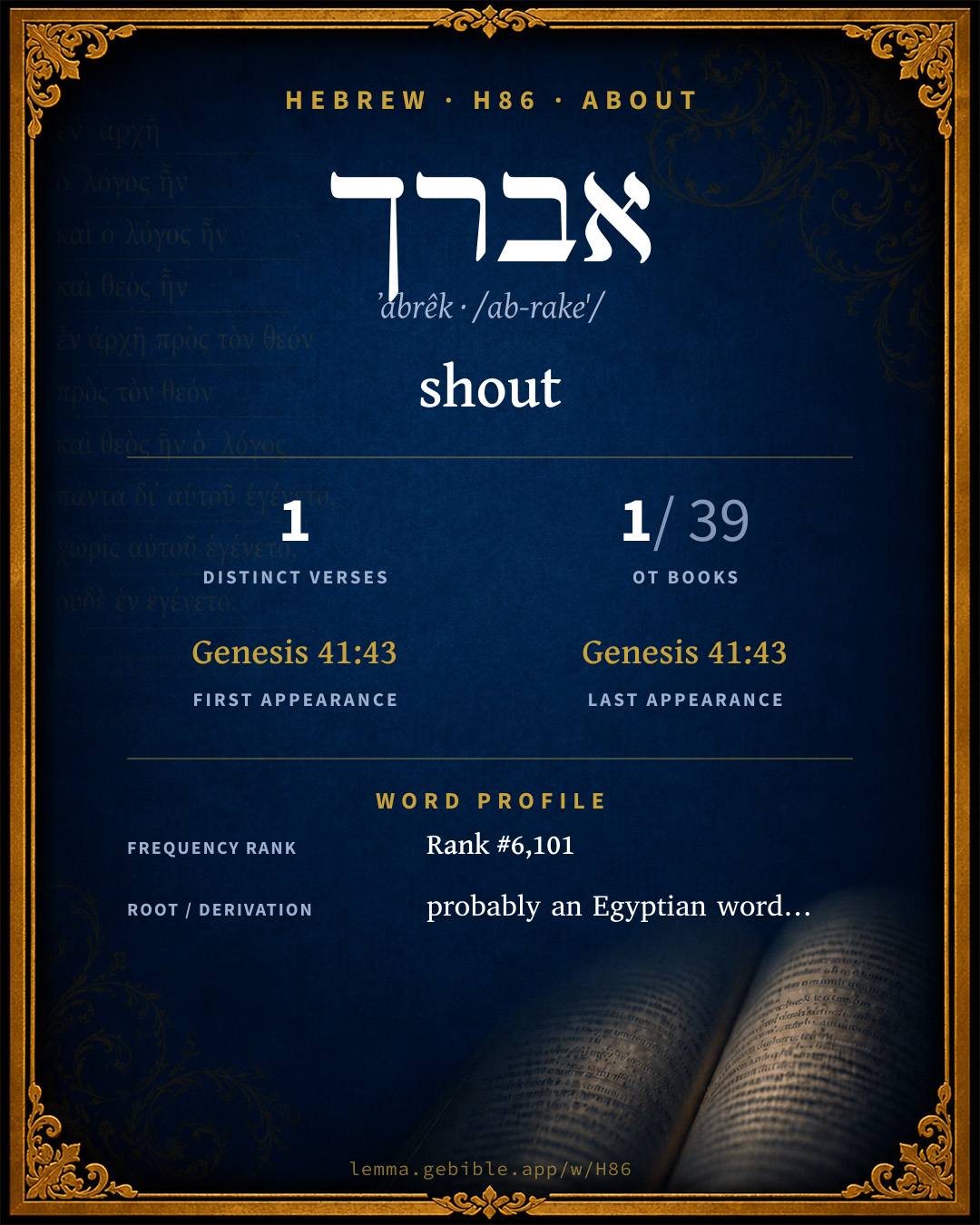
אַבְרֵךְ
shout
‘shout’ is one of 3 main senses fuller range ↓
Full lexicon entry — Brown-Driver-Briggs (BDB)
From Brown-Driver-Briggs (BDB)
Where this word appears
Grammar key — what these labels mean
Part of speech
- Adverb
- A word that modifies a verb, adjective, or other adverb.
Every verse where H86 appears — 1 distinct verse across 1 book. Click any verse to open its interlinear word-by-word view. Verse text shown in the World English Bible for context — . Each verse’s Hebrew form is shown with its reference; the English is not keyword-highlighted, since the data carries no word-level English alignment. Use “Compare translations” on any verse to read it across multiple English versions. This concordance covers the Hebrew Bible; Septuagint (Greek Old Testament) occurrences are not indexed here.
Genesis 1 verse
About this entry
At a glance — auto-summarized from this page’s data, not written by a person. Every figure links to its source below. This summary describes the numbers; it doesn’t interpret them.
“shout” is the headline sense of the Hebrew word אברך (ʼabrêk). A scarce word — 1 verse in all of the Hebrew Bible. It clusters heavily in Genesis, which alone accounts for 100% of its uses. A true hapax — its single appearance is Genesis 41:43. Lexicons map it across 3 senses. See the sense tree, 1-verse concordance, and the renderings breakdown below.
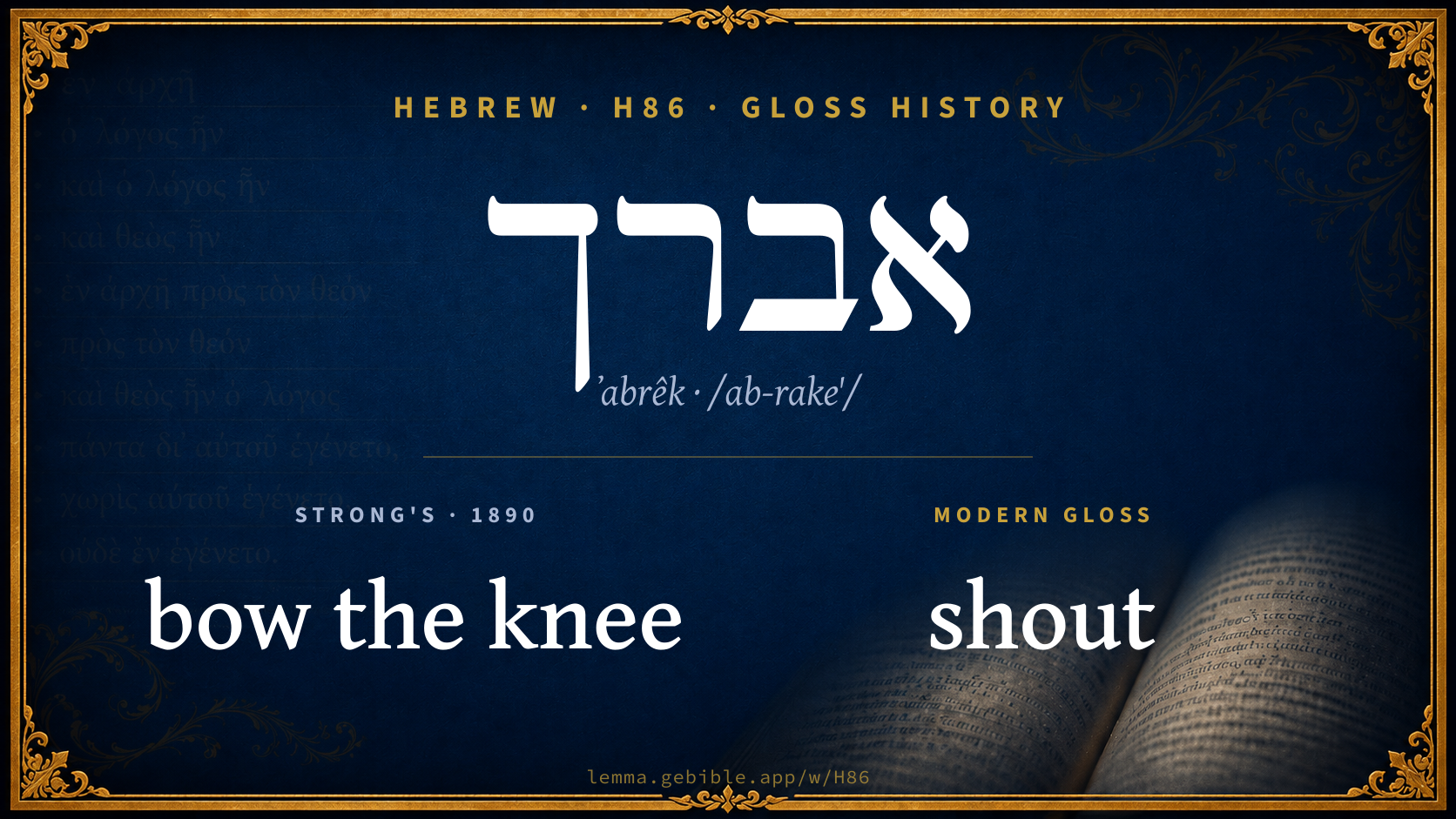
Gloss history
Strong's 1890 vs modern scholarship
About this word
Strong's H86 catalogs a Hebrew word from the Hebrew Old Testament.
These counts are not copied from any lexicon or concordance. They are computed here, from the morphology-tagged Hebrew Old Testament. What Lemma adds →
- 1
- distinct verses
- The word appears in 1 distinct verse.
- 1 / 39
- OT books
- The word appears in 1 of 39 Old Testament books.
- #6,101
- by frequency
- Rank #6,101 (rank 6,101 of 8,640 Hebrew words by occurrence).
View all 1 occurrence in the concordance →
Most concentrated in
- Genesis 1 verse 100%
By section of the Old Testament
By traditional corpus
Conventional, traditional groupings — biblical authorship is debated, so this is a traditional corpus grouping, not an authorship claim. Each share is this word’s portion of its verses in that division of the Hebrew canon. Each figure is a share of the word’s 1 distinct verse.
- Torah (Pentateuch) 1 verse · 100%
How translations render this word
Counts come from each version’s own published word-to-Strong’s tagging or interlinear alignment — an approximate guide to how each version renders this word, not a word-level alignment the data otherwise carries. Because each total is that version’s own tagged count, the per-version totals vary from one another and need not match the appearance or distinct-verse counts above. These counts may also differ from a printed concordance because Lemma counts each distinctly tagged rendering and does not collapse phrase taggings into a single head-word total. This is a fixed set of word-tagged versions (KJV, ASV, BSB, ULT) and does not change with the reading translation you choose elsewhere. Each version’s license is shown beside its name below (and on Sources).
- King James Version: Bow the knee 1×
- American Standard Version: Bow the knee 1×
- Berean Standard Bible: Bow the knee 1×
- unfoldingWord Literal Text: Bow down 1×
King James Version Public Domain
Renders H86 across 1 tagged occurrence — most commonly:
American Standard Version Public Domain
Renders H86 across 1 tagged occurrence — most commonly:
Berean Standard Bible Public Domain
Renders H86 across 1 tagged occurrence — most commonly:
unfoldingWord Literal Text CC BY-SA 4.0
Renders H86 across 1 tagged occurrence — most commonly:
Senses in BDB
The 3 senses BDB distinguishes for this word, in lexicon order (not ranked by frequency or importance). The full entry — with sub-senses — is in the Lexicon Entry tab.
- (meaning dubious) - a shout made to announce Joseph's chariot
- command
- bow
Word origin
proclaimed before Joseph Gn 41:43 (mng. dub.; many Egypt. deriv. proposed; e.g. a-bor-k, Copt. = prostrate thyself! BenfeyVerh. d. äg. Spr. z. Sem. 302 f; āprek, = head bowed! ChabasRA I—but ā = ע, v. also WiedemannAltäg. Wörter 1883, 8; aprex-u, head of the wise, HarkavyBerl. äg. Zeftschr. 1869; ȧb-rek, rejoice thou! CookSpeaker’s Comm. Gn. ad loc. and p. 482; Lepage RenoufPSBA Nov. 1888, 5 f ȧb(u)-rek, thy command is our desire, i.e. we are at thy service; SayRel. Bab. 183 As. abrikku = Ak. abrik, vizier (unpub. tabl.), v. already DlW; L 134 c., 1. 11. 12 who cp. As. abarakku = title, perh. grand vizier; against Dl, v. COT & NöZMG 1886, 734). SpiegelbergRandglossen 14 ff. expl. as Egyptian ʾbrk = give attention!).
— Brown-Driver-Briggs (Oxford 1906, public domain), digitized via Sefaria, supplemented by the OpenScriptures HebrewLexicon (CC BY 4.0). See Sources.
Origin: probably an Egyptian word meaning kneel
Jastrow Dictionary
A second Hebrew/Aramaic lexicon for comparison, covering Aramaic and post-biblical (Talmudic, Targumic, Midrashic) usage that the biblical-Hebrew BDB does not. Matched by lemma rather than by Strong’s number, so a lemma may carry more than one Jastrow headword (shown separately below), and the entries cover usage well beyond the Bible.
אַבְרֵךְ
- (Gen. XLI, 43) Abhrekh, a title; homiletically defined א̇ב̇ בחכמה ורַ֗ךְ֗ בשנים father in wisdom, tender in years. Gen. R. s. 90. e.g. Genesis 41:43
A Dictionary of the Targumim, the Talmud Babli and Yerushalmi, and the Midrashic Literature (Marcus Jastrow; London, Luzac, 1903) — Public Domain. Digitized via Sefaria. Digitized via Sefaria. Full attribution on Sources.
Septuagint verse parallels
This word appears in 1 verse that also exists in the Greek Old Testament (Septuagint), out of the 1 Hebrew verse it occurs in. You can read those verses in Greek by switching the Old Testament edition to the Septuagint.
Read these verses in the Septuagint
This is a verse-level parallel only — the same verses exist in both the Hebrew and Greek Old Testaments. No word-level Hebrew↔Greek correspondence is claimed: the data carries no such alignment, so no Greek word is shown as this Hebrew word’s translation. Coverage is not total — the Septuagint omits the deuterocanon and renumbers the Psalms, so some Hebrew verses have no direct Greek parallel.