
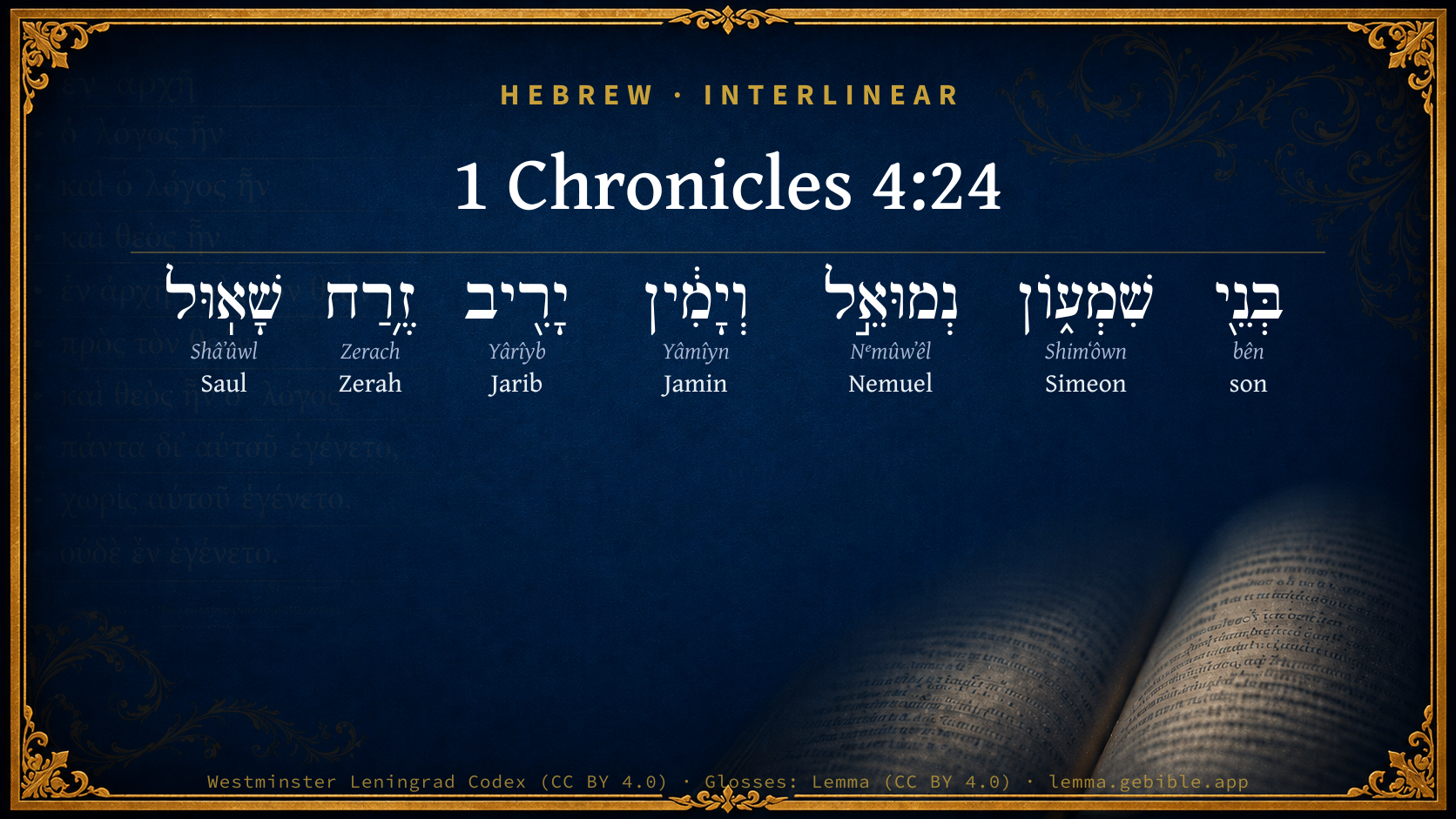
1 Chronicles 4:24

Hebrew (Westminster Leningrad Codex) 1 Chronicles 4:24 appears in the Hebrew Old Testament. The text above is from the Westminster Leningrad Codex. Each word links to its Strong’s number, a concise gloss, and parsing drawn from the Open Scriptures Hebrew Bible morphology. Click any word for its full Brown-Driver-Briggs (BDB) entry.
Download image
Cite this verse

1 Chronicles 4:24 (World English Bible). Public Domain. Lemma interlinear Bible study tool, https://lemma.gebible.app/v/1-chronicles/4/24.

Show BibTeX & RIS
BibTeX
RIS
English Translation
The sons of Simeon: Nemuel, and Jamin, Jarib, Zerah, Shaul;
World English Bible · Public Domain
Highlights
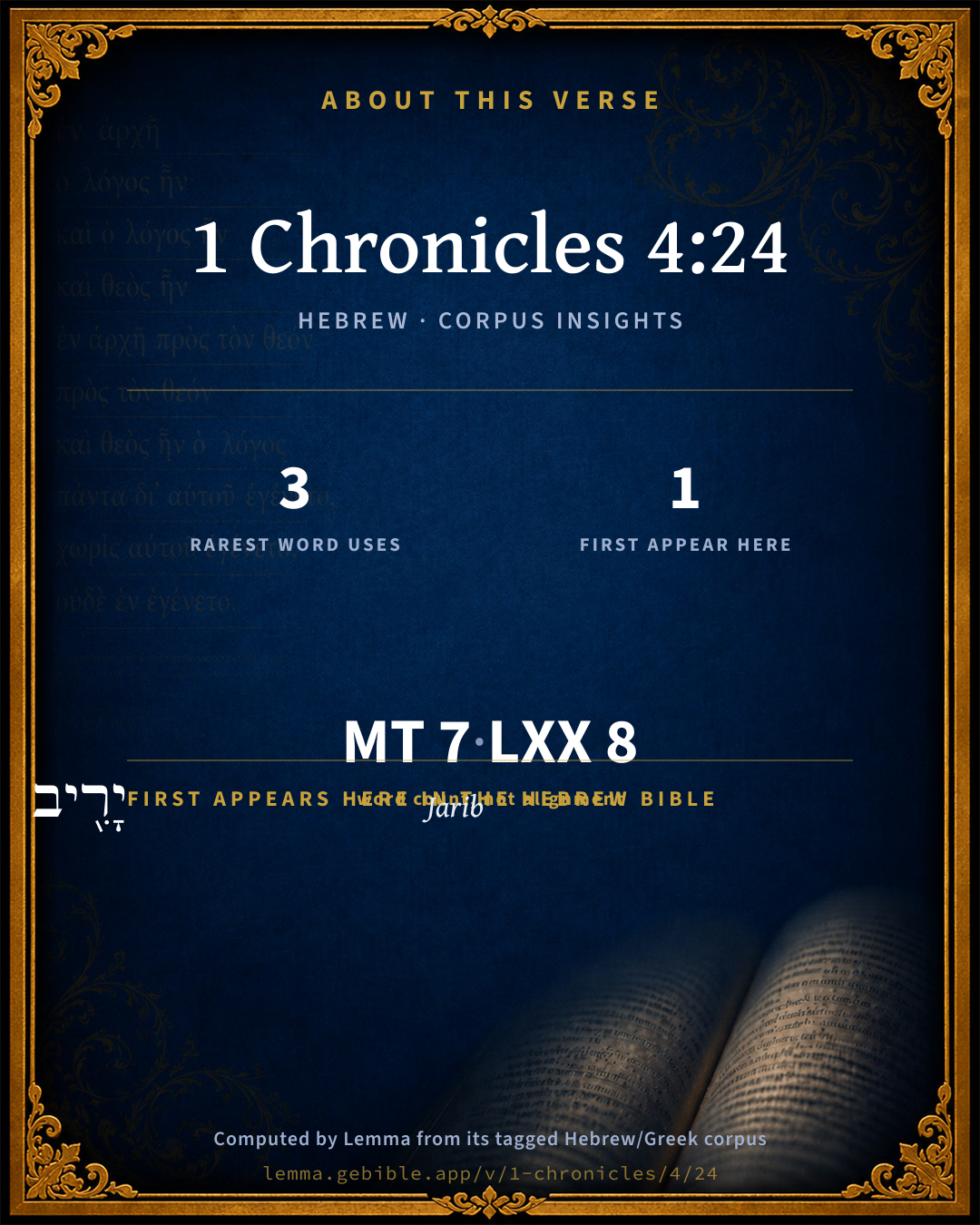
  • 1 first appearance in the Hebrew Bible
Full analysis ↓
Download a study sheet

One document with this verse’s original text, its word-by-word gloss line, the meaning frame, cross-references with their text, attributed commentary, and full source and license credits — printable, and it pastes into notes with its structure intact.

This verse Autodidact and up

Study sheet (.html) Plain text (.txt)

A passage Seminary Student

Up to 50 verses in one chapter. A passage sheet keeps up to 6 commentary sources and 12 cross-references per verse, in the order this page ranks them, and says so on the sheet whenever that leaves anything out. Ask for a single verse and you get the Autodidact verse sheet above.

Everything on this page stays free to read, with no account — the sheet is a download of what is already on screen, not access to it.

Want to remove ads? Support Godless Engineer
Compare translations 3

The same verse in 3 English versions, stacked beneath the original-language interlinear above. Click any original word for its lexicon entry.

Each is an independent rendering of the whole verse — the interlinear is not word-aligned to these translations.

Highlighted words mark where these versions differ — a whole-verse word diff, not a word-by-word alignment.

  • World English Bible Public Domain
    The sons of Simeon: Nemuel, and Jamin, Jarib, Zerah, Shaul;
  • King James Version Public Domain
    The sons of Simeon were, Nemuel, and Jamin, Jarib, Zerah, and Shaul:
  • unfoldingWord Literal Text CC BY-SA 4.0
    The sons of Simeon: Nemuel and Jamin, Jarib, Zerah, Shaul;

unfoldingWord Literal Text — © unfoldingWord, licensed CC BY-SA 4.0. Word-aligned USFM3 via Door43 (git.door43.org/unfoldingWord/en_ult).

Versions to compare (up to 4)

3 of 4 selected

Show all 18 translations

Every available English version of this verse, each an independent rendering of the whole verse.

  • World English Bible Public Domain
    The sons of Simeon: Nemuel, and Jamin, Jarib, Zerah, Shaul;
  • Berean Standard Bible Public Domain
    The descendants of Simeon: Nemuel, Jamin, Jarib, Zerah, and Shaul.
  • Majority Standard Bible Public Domain
    The descendants of Simeon: Nemuel, Jamin, Jarib, Zerah, and Shaul.
  • King James Version Public Domain
    The sons of Simeon were, Nemuel, and Jamin, Jarib, Zerah, and Shaul:
  • American Standard Version (1901) Public Domain
    The sons of Simeon: Nemuel, and Jamin, Jarib, Zerah, Shaul;
  • Revised Version (1885) Public Domain
    The sons of Simeon; Nemuel, and Jamin, Jarib, Zerah, Shaul:
  • Geneva Bible (1599) Public Domain
    The sonnes of Simeon were Nemuel, and Iamin, Iarib, Zerah, and Shaul,
  • Douay-Rheims (1899) Public Domain
    The sons of Simeon: Namuel, and Jamin, Jarib, Zara, Saul:
  • Young's Literal Translation Public Domain
    Sons of Simeon: Nemuel, and Jamin, Jarib, Zerah, Shaul;
  • Literal Standard Version CC BY-SA 4.0
    Sons of Simeon: Nemuel, and Jamin, Jarib, Zerah, Shaul;
  • Unlocked Literal Bible CC BY-SA 4.0
    Simeon's descendants were Nemuel, Jamin, Jarib, Zerah, and Shaul.
  • unfoldingWord Literal Text CC BY-SA 4.0
    The sons of Simeon: Nemuel and Jamin, Jarib, Zerah, Shaul;
  • Darby Bible Public Domain
    The sons of Simeon: Nemuel and Jamin, Jarib, Zerah, [and] Saul;
  • World Messianic Bible Public Domain
    The sons of Simeon: Nemuel, Jamin, Jarib, Zerah, Shaul;
  • Webster's Bible Public Domain
    The sons of Simeon were Nemuel, and Jamin, Jarib, Zerah, and Shaul:
  • Free Bible Version CC BY-SA 4.0
    The sons of Simeon: Nemuel, Jamin, Jarib, Zerah, and Shaul.
  • Bible in Basic English Public Domain
    The sons of Simeon: Nemuel and Jamin, Jarib, Zerah, Shaul;
  • JPS Tanakh (1917) Public Domain
    The sons of Simeon: Nemuel, and Jamim, Jarib, Zerah, Shaul;

Literal Standard Version (2020), Covenant Press — licensed CC BY-SA 4.0. Text via the HelloAO Bible API (eBible.org). Unlocked Literal Bible (unfoldingWord) — licensed CC BY-SA 4.0. Text via the HelloAO Bible API (eBible.org). unfoldingWord Literal Text — © unfoldingWord, licensed CC BY-SA 4.0. Word-aligned USFM3 via Door43 (git.door43.org/unfoldingWord/en_ult). Free Bible Version, Dr. Jonathan Gallagher — licensed CC BY-SA 4.0. Text via the HelloAO Bible API (eBible.org).

Word by word

More ways to search: Search by grammar → Find every occurrence → Compare this word →

Practice this passage: Drill this verse → Learn its vocabulary →

About this verse

These counts appear in no published source. They are computed here, from the morphology-tagged text and Lemma’s own curated glosses. What Lemma adds →

7
words
7
distinct lemmas
Historical
section

Notable vocabulary

The rarest word here is נְמוּאֵ֣ל Nemuel H5241 — appearing just 3 times in the whole Hebrew Bible.

First appearance in Scripture

This word makes its first canonical appearance in the Hebrew Bible here:

  • יָרִ֖יב Jarib H3402

Shared distinctive vocabulary

נְמוּאֵ֣ל Nemuel H5241 occurs in 3 verses of the Hebrew Bible. Also found in:

Grammatical profile

  • 7 nouns

Hebrew & Septuagint length

In English translation the verse runs 10 words from the Hebrew and 10 from the Septuagint (LXX English) — the same length.

A rough comparison of the two English renderings, which tokenize alike — not a word-level alignment.

Word counts can differ between the Hebrew and the Greek without any difference in meaning — e.g. the Hebrew direct-object marker אֵת has no separate Greek word, and Greek often adds the article ὁ.

In the original languages it is 7 Hebrew tokens and 8 Greek tokens — but the two are counted differently (Hebrew bundles its prefixes and suffixes into one token; the Greek is in lemma form), so that isn’t a like-for-like length.

Cross-references

3

Topical passages linked to 1 Chronicles 4:24 in the Treasury of Scripture Knowledge — connected by theme and wording, ordered by reader-vote popularity; previews shown in the World English Bible.

  • Genesis 46:10 The sons of Simeon: Jemuel, Jamin, Ohad, Jachin, Zohar, and Shaul the son of a Canaanite woman.
  • Exodus 6:15 The sons of Simeon: Jemuel, and Jamin, and Ohad, and Jachin, and Zohar, and Shaul the son of a Canaanite woman; these are the families of Simeon.
  • Numbers 26:12–14 The sons of Simeon after their families: of Nemuel, the family of the Nemuelites; of Jamin, the family of the Jaminites; of Jachin, the family of the Jachinites;

Cross-references courtesy of OpenBible.info (CC BY 4.0).

Hebrew and Greek witnesses Masoretic Hebrew ↔ Greek Septuagint

The same verse in the two great witnesses to the Old Testament, shown verse-for-verse.

These are two independent witnesses, not word-aligned to each other, and the Septuagint is shown in lemma (dictionary) form.

Hebrew 1 Chronicles 4:24 Masoretic · Westminster Leningrad Codex

בְּנֵ֖י שִׁמְע֑וֹן נְמוּאֵ֣ל וְיָמִ֔ין יָרִ֖יב זֶ֥רַח שָׁאֽוּל

The sons of Simeon: Nemuel, and Jamin, Jarib, Zerah, Shaul;

World English Bible · Public Domain

Greek LXX 1 Chronicles 4:24 Septuagint · lemma form

υἱός συμεων ναμουηλ καί ιαμιν ιαριβ ζαρε σαούλ

The sons of Semeon; Namuel, and Jamin, Jarib, Zares, Saul:

LXX2012 (modern English Septuagint) · Public Domain

Hebrew: Westminster Leningrad Codex (CC BY 4.0). Greek: Septuagint (public domain); English from LXX2012 (modern English Septuagint) (Public Domain). How the Septuagint differs from the Hebrew →

Commentary

Notes on 1 Chronicles 4:24 from classic Christian and Jewish commentators (each source and its license shown beneath its notes). The classic Christian expositions comment on the surrounding passage and are grouped to its opening verse, so a note may address several verses; the Jewish commentaries on the Tanakh (Rashi and others) are per-verse, so they appear only where the commentator wrote on this verse.

Lemma curates 59 commentaries, every one of them public domain or Creative Commons licensed, each selected and text-cleaned for this edition rather than reprinted as found. About our sources →

Jamieson, Fausset & Brown

Robert Jamieson, A. R. Fausset & David Brown

OF SIMEON. (1Ch. 4:24-43)

The sons of Simeon--They are classed along with those of Judah, as their possession was partly taken out of the extensive territory of the latter (Jos 19:1). The difference in several particulars of the genealogy given here from that given in other passages is occasioned by some of the persons mentioned having more than one name [compare Gen 46:10; Exo 6:15; Num 26:12].

Jamieson, Fausset & Brown — Commentary Critical and Explanatory on the Whole Bible (1871) — public domain (CC PDM 1.0). Text via the HelloAO Bible API.

Ellicott's Commentary for English Readers

III.—THE TRIBE OF SIMEON: ITS CLANS, AND THEIR SETTLEMENTS AND CONQUESTS (1Ch_4:24-43).

(24) The sons of Simeon.—The Pentateuch contains three lists of sons of Simeon, viz., Gen_46:10, Exo_6:15, and Num_26:12. Genesis and Exodus name six sons; Numbers agrees with the Chronicles in naming five, the Ohad of Genesis and Exodus being omitted. In place of our Jarib Numbers has Jachin; the other names are the same. Genesis and Exodus read Jemuel and Zohar for Nemuel and Zerah. Exo_6:15 calls Shaul “son of a Canaanitess.” The mixed race of Shaul was the only Simeonite clan that became populous (1Ch_4:25-27). The other clans are not further noticed by this genealogy.

A Bible Commentary for English Readers, edited by Charles John Ellicott (1878–1897) — public domain. Text from a community e-Sword module.

Trapp's Complete Commentary

John Trapp

1Ch 4:24 The sons of Simeon [were], Nemuel, and Jamin, Jarib, Zerah, [and] Shaul:

Ver. 24. And the sons of Simeon.] His genealogy is set down next to that of Judah, because his lot fell out to be in the tribe of Judah, for most part, {Jos 19:1} though his posterity took part with the other nine tribes in the revolt from Judah and Benjamin, who clave still to the house of David. Of this tribe was that shameless fornicator, Zimri, {Num 25:14} as also Judas Iscariot, as Jerome affirmeth.

John Trapp, A Commentary or Exposition upon All the Books of the Old and New Testament (1647–1656) — public domain. Text from a community e-Sword module.

Joseph Benson's Commentary

1Ch 4:24. The sons of Simeon were Nemuel, &c. — These are here joined with Judah, because their possession was taken out of Judah’s portion, Jos 19:1. This account seems to differ from that in Gen 46:10, both in the number and names of the persons; which is not strange, considering how customary it was among the Hebrews for one person to have two or three names given to him upon different occasions. And for Ohad, he may be omitted here, because he left no posterity after him as the rest did.

Joseph Benson's Commentary on the Old and New Testaments (1811–1818) — public domain. Text from a community e-Sword module.

The Annotated Bible

Arno C. Gaebelein

3. Simeon, Reuben, Gad, and Manasseh

CHAPTERS 4:24-5:26

1. The sons of Simeon (1Ch 4:24-43)

2. The sons of Reuben (1Ch 5:1-10)

3. The children of Gad and half Manasseh (1Ch 5:11-26)

The account of the Simeonites is interesting. Some of their families had increased so much that they had no pasture for their flocks. Some went then to Gedor and found fat pasture and quietness. Others went to Mount Seir, and five hundred of them smote the Amalekites.

Reuben was the firstborn, and the Chronicles state briefly why Reuben was not mentioned first in these genealogies. His birthright was given to the sons of Joseph. Judah, however, had the preeminence, “of him came the prince.” This refers to David and to Him who came from him after the flesh, Messiah the Prince. The Syriac version makes this paraphrase, “of Judah is the King, the Messiah.” In verse 6 Tiglath-pileser is mentioned. (Not Tiglath-pilneser; it is an erroneous spelling.) He carried away Beerah, the Prince of the Reubenites.

The Hagarites, mentioned in verse 10, were no doubt the descendants of Hagar through Ishmael. They were nomads, who wandered over the desert lands of the trans-Jordan territory. The tribe of Gad occupied the lands north of Reuben and eastward from the Jordan to the desert. The genealogies of the chiefs mentioned here were compiled during the reign of Jotham of Judah and Jeroboam of Israel (verse 17). Another war with the Hagarites is recorded in verses 18-22. (Some take that this is the same war mentioned in verse 10.) Here prayer is mentioned again. “They cried to God in the battle, and He was entreated of them; because they put their trust in Him.” The Lord delights to record those who trust in Him.

Arno C. Gaebelein, The Annotated Bible (1913–1922) — public domain. Text from a community e-Sword module.

Tyndale Open Study Notes

Tyndale Open Resources

4:24–8:40 After completing the genealogy of Judah’s descendants (2:3–4:23), the Chronicler turns to the records for the rest of the sons of Israel (cp. 2:1-2).

4:24-43 Simeon was Jacob’s second son; his tribe’s territory was in the southern part of Judah (Josh 19:1-9).

Tyndale Open Study Notes — © Tyndale Open Resources, licensed CC BY-SA 4.0. Text via the HelloAO Bible API.

Geneva Bible (1599)

Geneva Bible translators

His son Ohad is here omitted.

Geneva Bible (1599) marginal notes — public domain. Text via Bolls.life.

Matthew Henry's Commentary

We have here some of the genealogies of the tribe of Simeon (though it was not a tribe of great note), especially the princes of that tribe, Ch1 4:38. Of this tribe it is said that they increased greatly, but not like the children of Judah, Ch1 4:27. Those whom God increases ought to be thankful, though they see others that are more increased. Here observe, 1. The cities allotted them (Ch1 4:28), of which see Jos 19:1, etc. When it is said that they were theirs unto the reign of David (Ch1 4:31) intimation is given that when the ten tribes revolted from the house of David many of the Simeonites quitted these cities, because they lay within Judah, and seated themselves elsewhere. 2. The ground they got elsewhere. When those of this tribe that revolted from the house of David were carried captive with the rest into Assyria those that adhered to Judah were remarkably owned of God and prospered in their endeavours to enlarge their coasts. It was in the days of Hezekiah that a generation of Simeonites, whose tribe had long crouched and truckled, was animated to make these bold efforts. (1.) Some of them attacked a place in Arabia, as it should seem, called the entrance of Gedor, inhabited by the posterity of accursed Ham (Ch1 4:40), made themselves masters of it, and dwelt there. This adds to the glory of Hezekiah's pious reign, that, as his kingdom in general prospered, so did particular families. It is said that they found fat pastures, and yet the land was quiet; even when the kings of Assyria were giving disturbance to all their neighbours this land escaped their alarms. The inhabitants being shepherds, who molested none, were not themselves molested, till the Simeonites came and drove them out and succeeded them, not only in the plenty, but in the peace, of their land. Those who dwell (as we do) in a fruitful country, and whose land is wide, and quiet, and peaceable, have reason to own themselves indebted to that God who appoints the bounds of our habitation. (2.) Others of them, to the number of 500, under the command of four brethren here named, made a descent upon Mount Seir, and smote the remainder of the devoted Amalekites, and took possession of their country, Ch1 4:42, Ch1 4:43. Now the curses on Ham and Amalek had a further accomplishment, when they seemed dormant, if not dead; as had also the curse on Simeon, that he should be divided and scattered (Gen 49:7): yet to him it was turned into a blessing, for the families of Simeon, which thus transplanted themselves into those distant countries, are said to dwell there unto this day (Ch1 4:43), by which it should seem they escaped the calamities of the captivity. Providence sometimes sends those out of trouble that are designed for preservation.

Matthew Henry's Commentary on the Whole Bible (1708–1710) — public domain (CC PDM 1.0). Text via the HelloAO Bible API.

Adam Clarke's Commentary

Verse 24. The sons of Simeon] This genealogy is very different from that given in Ge 46:10, and Nu 26:12. This may be occasioned by the same person having several names, one list taking one name, another list some other, and so on: to reconcile is impossible; to attempt it, useless.

Adam Clarke's Commentary on the Bible (1810–1826) — public domain. Text from a community e-Sword/MySword module.

The Cambridge Bible for Schools and Colleges

gen. ed. J. J. S. Perowne

24–27. The Genealogy of Simeon

24. The sons of Simeon] in Gen_46:10 and Exo_6:15 we have six sons of Simeon named as against five here;—Jemuel (here Nemuel), Jamin (as here), Ohad (not mentioned here), Jachin (here Jarib), Zohar (here Zerah), and Shaul (as here). In Num_26:12-13 the same list is given as here (except that Jachin stands for Jarib), and descendants are ascribed to the five. Ohad is omitted from Num. and Chron., perhaps as having no children.

The Cambridge Bible for Schools and Colleges (gen. ed. J. J. S. Perowne; Cambridge University Press, 1878–1918) — public domain. Text from a community e-Sword module.

John Gill's Exposition

The sons of Simeon,.... The account of whom, next to the tribe of Judah, is given before Reuben, because its inheritance lay in the tribe of Judah, Jos 19:1 his sons were Nemuel, the same with Jemuel, Gen 46:10.

and Jamin, Jarib, Zerah, and Shaul; who, in the place referred to, is said to be the son of a Canaanitish woman; and Jarib and Zerah are the same with Jachin and Zohar there: and Obed is here omitted, it may be because he died without issue; see Num 26:12.

John Gill's Exposition of the Whole Bible (1746–1763) — public domain (CC PDM 1.0). Text via the HelloAO Bible API.

Haydock's Catholic Bible Commentary

CHAPTER IV.

Namuel, or Jamuel, Genesis xlvi. 10. --- Jarib; perhaps the same with Sohar, (Menochius) unless the latter be Zara, or Zare, Numbers xxvi. 12. These genealogies seem different; but the same person (Calmet) might have many names. (Du Hamel)

George Leo Haydock (1774–1849), Haydock's Catholic Family Bible and Commentary, 1859 edition — public domain. Excludes Psalms (Douay-Rheims chapter numbering differs from Protestant) and Deuterocanonical books (Catholic canon only).

Matthew Poole's English Annotations

The sons of Simeon: these are here joined with Judah, because their possession was taken out of Judah’s portion, Jos 19:1. This account seems to differ from that Ge 46, both in the number and names of the persons, which is not strange, considering how customary it was amongst the Hebrews for one person to have two or three names given to him upon several occasions. And for Ohad, Gen 46:10, he may be omitted here, because he left no posterity or family after him, as the rest did.

Matthew Poole's English Annotations on the Holy Bible (1683–1685) — public domain. Text from a community e-Sword/MySword module.

The Pulpit Commentary

Vers. 24-27. The second of the twelve tribes is now taken, and occupies but small space as compared with Judah preceding, or Levi and Benjamin when their turn comes. The comparison of the enumeration of the sons of Simeon here with that in Gen_46:10, Exo_6:15, is helpful in detaching the idea that the compiler of Chronicles copied direct from Genesis and Exodus, or that he depended exclusively on identical sources of information. That comparison shows six names in both of those passages for only five here, and it shows also difference in three of the names, viz. Jemuel, Zohar, and Jachin, for Nemuel, Zeta, and Jarib. On the other hand, the list of, Num_26:12 is in exact agreement with our list here (the omission of Ohad in both being sufficiently accounted for by one and the same reason) with the exception of Jarib here for Jachin still there; and this solitary difference may justly be suspected to be nothing but an early corruption of resh for caph and beth for nun (see Kennicott, "Diss.," 1:178; Barrington"s "Genealogies," 1:55). Ver. 25 contains three descents from one of these Shaul. Of Shallum, the first, it may be noted that there are fourteen others of the same name in the Old Testament; and of Mibsam and Mishma (whom some call brothers, surely in error), that there were others of the same name (and certainly given as brothers), viz. the sons of Ishmael. (Gen_25:13 1Ch_1:29) Ver. 26 adds apparently another three descents, viz. from Mishma. Of the first-named of these, Hamuel, it may be noted that the name appears in many Hebrew manuscripts as Chammuel; of the second-named, Zacchur, that six others of the same name (though the Authorized Version gives them Zaccur) are found in Numbers, the First Book of Chronicles, and Nehemiah; while on the third, Shimei (of which name the Old Testament contains fifteen others), our attention is especially detained as father of sixteen sons and six daughters, though it is observed that his brethren (query Hammuel and Zacchur) had not large families. The smallness of the whole tribe relatively to Judah, was only saved from being smaller by him. With this agrees the census of Num_1:23, 27 2:4, 13 26:14. It is possible that this Shimei is the same with Shemaiah of ver. 37.

The Pulpit Commentary (1880–1919), ed. H.D.M. Spence-Jones & Joseph S. Exell — public domain. Text from a community e-Sword module.

Keil & Delitzsch

C. F. Keil & F. Delitzsch

The sons of Simeon,.... The account of whom, next to the tribe of Judah, is given before Reuben, because its inheritance lay in the tribe of Judah, Jos 19:1 his sons were Nemuel, the same with Jemuel, Gen 46:10.

and Jamin, Jarib, Zerah, and Shaul; who, in the place referred to, is said to be the son of a Canaanitish woman; and Jarib and Zerah are the same with Jachin and Zohar there: and Obed is here omitted, it may be because he died without issue; see Num 26:12.

Keil & Delitzsch — Biblical Commentary on the Old Testament (1861–1891) — public domain (CC PDM 1.0). Text via the HelloAO Bible API. (Old Testament only.)

Kretzmann's Popular Commentary

Paul E. Kretzmann

The Family of Simeon

v. 24. The sons of Simeon, who were classed together with those of Judah, because they had their possessions within the boundaries of Judah, were Nemuel (or Jerouel), and Jamin, Jareb, Zerah, and Shaul;

v. 25. Shallum, his son; Mibsam, his son; Mishma, his son.

v. 26. And the sons of Mishma: Hamuel, his son; Zacchur, his son; Shimei, his son.

v. 27. And Shimei had sixteen sons and six daughters, his large family being brought out very prominently; but his brethren had not many children, neither did all their family multiply like to the children of Judah. This fact, which in those days was looked upon as a special visitation of the Lord, hindered the Simeonites from becoming a large and powerful tribe, Num 1:22; Num 26:14. Cf Jacob’s curse, Gen 49:7.

v. 28. And they dwelt at Beersheba, and Moladah, and Hazar-shual,

v. 29. and at Bilhah (or Balah), and at Ezem, and at Tolad,

v. 30. and at Bethuel, and at Hormah, and at Ziklag,

v. 31. and at Beth-maraboth, and Hazarsusim, and at Beth-birei, and at Shaaraim, these being the towns allotted to their tribe in the distribution of the land. These were their cities unto the reign of David, who, because the Simeonites had been too cowardly to drive the heathen from some of the towns allotted to them, took these cities from the hands of their enemies and gave them to his own tribe of Judah.

v. 32. And their villages were Etam (or Ether) and Ain, Rimmon, and Tochen, and Ashan, five cities;

v. 33. and all their villages that were round about the same cities, unto Baal. These were their habitations and their genealogy; according to these cities they were entered into their genealogical lists.

v. 34. And Meshobab, and Jamlech, and Joshah, the son of Amaziah,

v. 35. and Joel, and Jehu, the son of Josibiah, the son of Seraiah, the son of Asiel,

v. 36. and Elioenai, and Jaakobah, and Jeshohaiah, and Asaiah, and Adiel, and Jesimiel, and Benaiah,

v. 37. and Ziza, the son of Shiphi, of the son of Allon, the son of Jedaiah, the son of Shimri, the son of Shemaiah.

v. 38. These mentioned by their names, thirteen leaders and heads of families, were princes in their families; and the house of their fathers increased greatly, in numbers and strength,

v. 39. And they, in a first expedition or migration, went to the entrance of Gedor, or Gederah, a district noted for its fertility, even unto the east side of the valley, to seek pasture for their flocks.

v. 40. And they found fat pasture and good, and the land was wide and quiet and peaceable; for they of Ham, probably a tribe of the Canaanitish branch of the children of Ham, had dwelt there of old.

v. 41. And these written by name, the above. mentioned princes, came in the days of Hezekiah, king of Judah, and smote their tents, namely, those of the heathen inhabitants, and the habitations that were found there, and destroyed them utterly unto this day, and dwelt in their rooms, because there was pasture there for their flocks, both the Hamites and the Meunites dwelling with them being exterminated, whereupon the Simeonites occupied their land until the exile,

v. 42. And some of them, even of the sons of Simeon, in a second expedition, five hundred men, went to Mount Seir, in the country of Edom, having for their captains Pelatiah, and Neariah, and Rephaiah, and Uzziel, the sons of Ishi.

v. 43. And they smote the rest of the Amalekites that were escaped, namely, after the victories of Saul and David over their hereditary enemies, which had forced them into the mountains of Edom, where they mingled with the Edomites, and dwelt there unto this day. So the wrath of God finally did exterminate the Amalekites, as He had threatened on account of their trespasses, 1Sa 15:3.

Paul E. Kretzmann, Popular Commentary of the Bible (1921–1924) — public domain. Text from a community e-Sword module.

unfoldingWord translationNotes

Door43 World Missions Community

Nemuel ... Jamin ... Jarib ... Zerah ... Shaul ... Shallum ... Mibsam ... Mishma ... Hammuel ... Zakkur ... Shimei

These are the names of men. (See: How to Translate Names)

Zakkur his grandson

the son of Mishma's son

great-grandson

the son of Mishma's grandson

translationWords

Simeon

descend

unfoldingWord translationNotes — © Distant Shores Media and the Door43 World Missions Community, licensed CC BY-SA 4.0. Source: git.door43.org/Door43/en_tn.

Rashi

Rabbi Shlomo Yitzchaki (Rashi)

The sons of Simeon Since Simeon dwelt in Judah’s territory, he traces his lineage first and mentions his towns before those of Reuben.

Rashi on the Tanakh — English translations: “The Judaica Press complete Tanach with Rashi, translated by A. J. Rosenberg” (CC BY 4.0); “Pentateuch with Rashi's commentary by M. Rosenbaum and A.M. Silbermann, 1929-1934” (public domain); “The Metsudah Tanach series, Lakewood, N.J” (CC BY 4.0); and “The Book of Joshua, Metsudah Publications, 1997” (CC BY 4.0). Text via Sefaria.

Lesson kit

Teaching starters — assembled from the data on this page, not authored interpretation. Every prompt links to the verse data it draws on. Edit before teaching.

1 Chronicles, in the Historical, opens this verse with 7 words (7 distinct Hebrew lemmas). Its most distinctive word is Nᵉmûwʼêl (“Nemuel”). A historical commentator’s framing appears above. Read the whole chapter for the surrounding context.

Discussion questions

  1. The word Nᵉmûwʼêl carries the sense “Nemuel.” How does it shape the verse?
  2. This is the first place “Jarib” appears in Scripture (first appears here). What does its debut here establish?
  3. How does Numbers 26:9, which shares the word «Nemuel», read alongside this verse?
  4. Compare how Jamieson, Fausset & Brown and Ellicott's Commentary for English Readers read this verse. Where do they agree or differ?

Things to notice

Reading settings

Reading text

Shown beneath each verse's original-language words.

Old Testament
Old Testament edition

Read the OT as the Masoretic Hebrew (MT) or the Greek Septuagint (LXX).

English shown for the Greek Septuagint (in the Hebrew ↔ Greek comparison).

Comparing translations? Open the Compare panel on any verse page to stack up to four side by side.