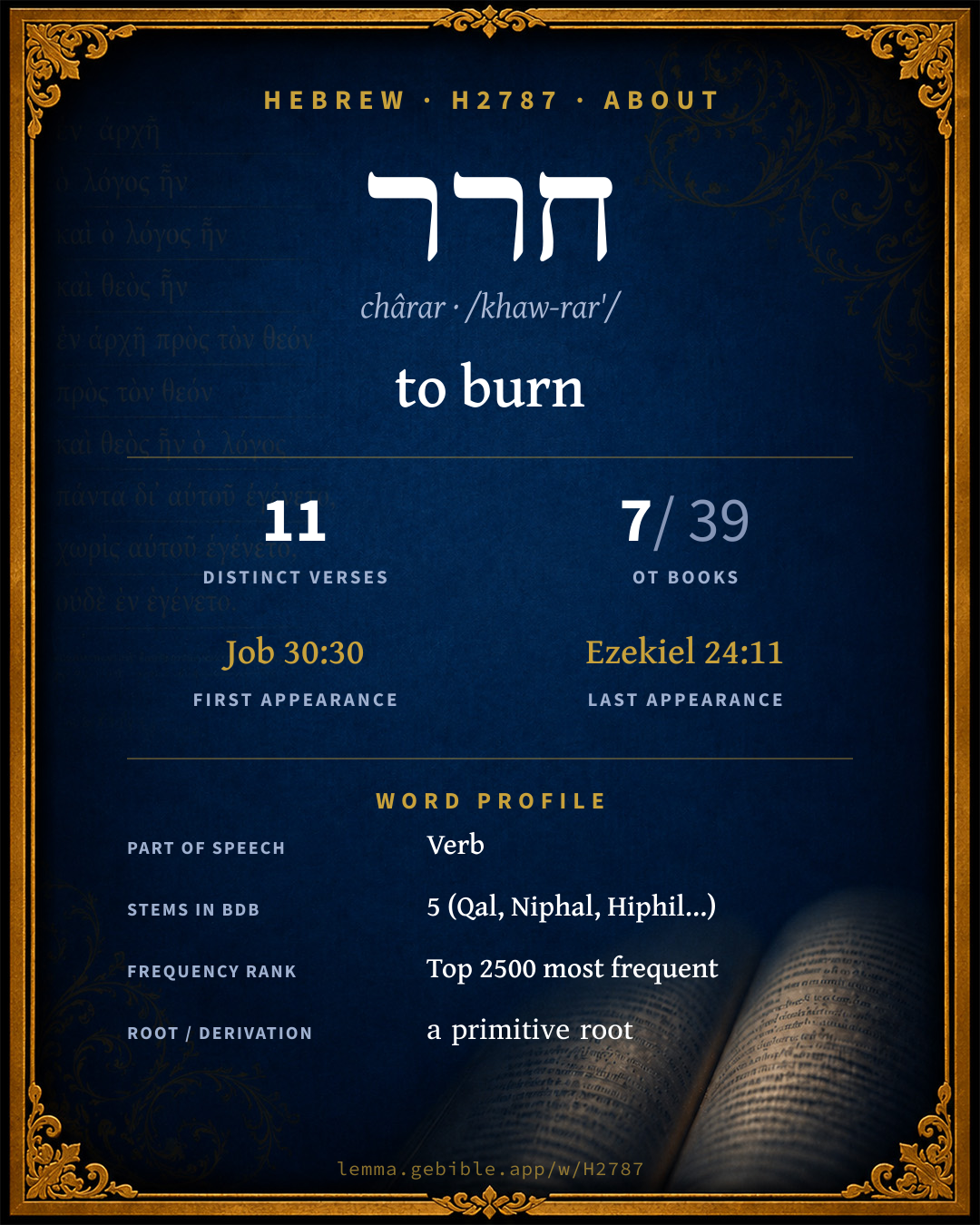
חָרַר
to burn
also: be hot, be scorched, be charred fuller range ↓
Full lexicon entry — Brown-Driver-Briggs (BDB)
From Brown-Driver-Briggs (BDB)
Where this word appears
See every Niphal verb in the Hebrew Bible →
Grammar key — what these labels mean
Part of speech
- Verb
- An action or state-of-being word.
Stem
- Niphal
- Usually the simple passive or reflexive of the Qal (“he was written”). Here: ‘be scorched’
- Qal
- The basic, simple active stem — the plain form of the verb (“he wrote”). Here: ‘of man’
- Pilpel
- A reduplicated intensive stem of two-letter or hollow roots.
Form
- Perfect
- A completed action or state — Hebrew marks aspect (completeness) more than strict tense (“he wrote”).
- Sequential Imperfect
- An imperfect with prefixed waw — the standard past-narrative form (waw-consecutive imperfect).
- Sequential Perfect
- A perfect with prefixed waw continuing a preceding imperfect or command (waw-consecutive perfect).
- Infinitive Construct
- A bound verbal noun, frequently with prepositions (“to write / in writing”).
- Imperfect
- An incomplete, ongoing, or future action (“he will / would write”).
Person
- 3rd Person
- The one spoken about (“he / she / it / they”).
Gender
- Common
- Either gender — not distinguished for this form.
- Masculine
- Grammatically masculine.
- Feminine
- Grammatically feminine.
Number
- Plural
- More than one (in Hebrew, generally three or more).
- Singular
- One.
Grammatical forms 9 distinct
- Verb, Niphal, Perfect, 3rd Person, Common, Plural 2 times (18%)
- Verb, Niphal, Perfect, 3rd Person, Masculine, Singular 2 times (18%)
- Verb, Niphal, Sequential Imperfect, 3rd Person, Masculine, Singular 1 time (9%)
- Verb, Qal, Sequential Perfect, 3rd Person, Feminine, Singular 1 time (9%)
- Verb, Pilpel, Infinitive Construct 1 time (9%)
- Verb, Niphal, Imperfect, 3rd Person, Masculine, Plural 1 time (9%)
- Verb, Qal, Perfect, 3rd Person, Common, Plural 1 time (9%)
- Verb, Qal, Perfect, 3rd Person, Feminine, Singular 1 time (9%)
+1 more form (1 occurrence)
Parsed forms decoded from the imported morphology (morphhb / Westminster Leningrad Codex — WLC text public domain, morphhb tagging CC BY 4.0), counted across 11 parsed occurrences — not distinct verses.
Every verse where H2787 appears — 11 distinct verses across 7 books. Click any verse to open its interlinear word-by-word view. Verse text shown in the World English Bible for context — . Each verse’s Hebrew form is shown with its reference; the English is not keyword-highlighted, since the data carries no word-level English alignment. Use “Compare translations” on any verse to read it across multiple English versions. This concordance covers the Hebrew Bible; Septuagint (Greek Old Testament) occurrences are not indexed here.
Job 1 verse
Psalms 2 verses
Proverbs 1 verse
Song of Solomon 1 verse
Isaiah 1 verse
Jeremiah 1 verse
Ezekiel 4 verses
- Ezekiel 15:4 נָחָ֔ר Niphal pf 3ms Behold, it is cast into the fire for fuel; the fire has devoured both the ends of it, and the midst of it is burned: is it profitable for any work?
- Ezekiel 15:5 וַ/יֵּחָ֔ר conj + Niphal wimpf 3ms Behold, when it was whole, it was meet for no work: how much less, when the fire has devoured it, and it is burned, shall it yet be meet for any work!
- Ezekiel 24:10 יֵחָֽרוּ Niphal impf 3mp Heap on the wood, make the fire hot, boil well the flesh, and make thick the broth, and let the bones be burned.
- Ezekiel 24:11 וְ/חָ֣רָה conj + Qal wpf 3fs Then set it empty on the coals of it, that it may be hot, and the brass of it may burn, and that the filthiness of it may be molten in it, that the rust of it may be consumed.
About this entry
At a glance — auto-summarized from this page’s data, not written by a person. Every figure links to its source below. This summary describes the numbers; it doesn’t interpret them.
חרר (chârar) is a Hebrew verb most often rendered “to burn.” As a verb its force shifts by stem, across 5 stems (Qal, Niphal, and more). The Hebrew Bible uses it across 11 verses — uncommon. Ezekiel dominates its distribution — 4 of 11 verses. Debuting at Job 30:30, it then recurs through the corpus. For the data behind this summary, explore the sense tree and the renderings breakdown below.
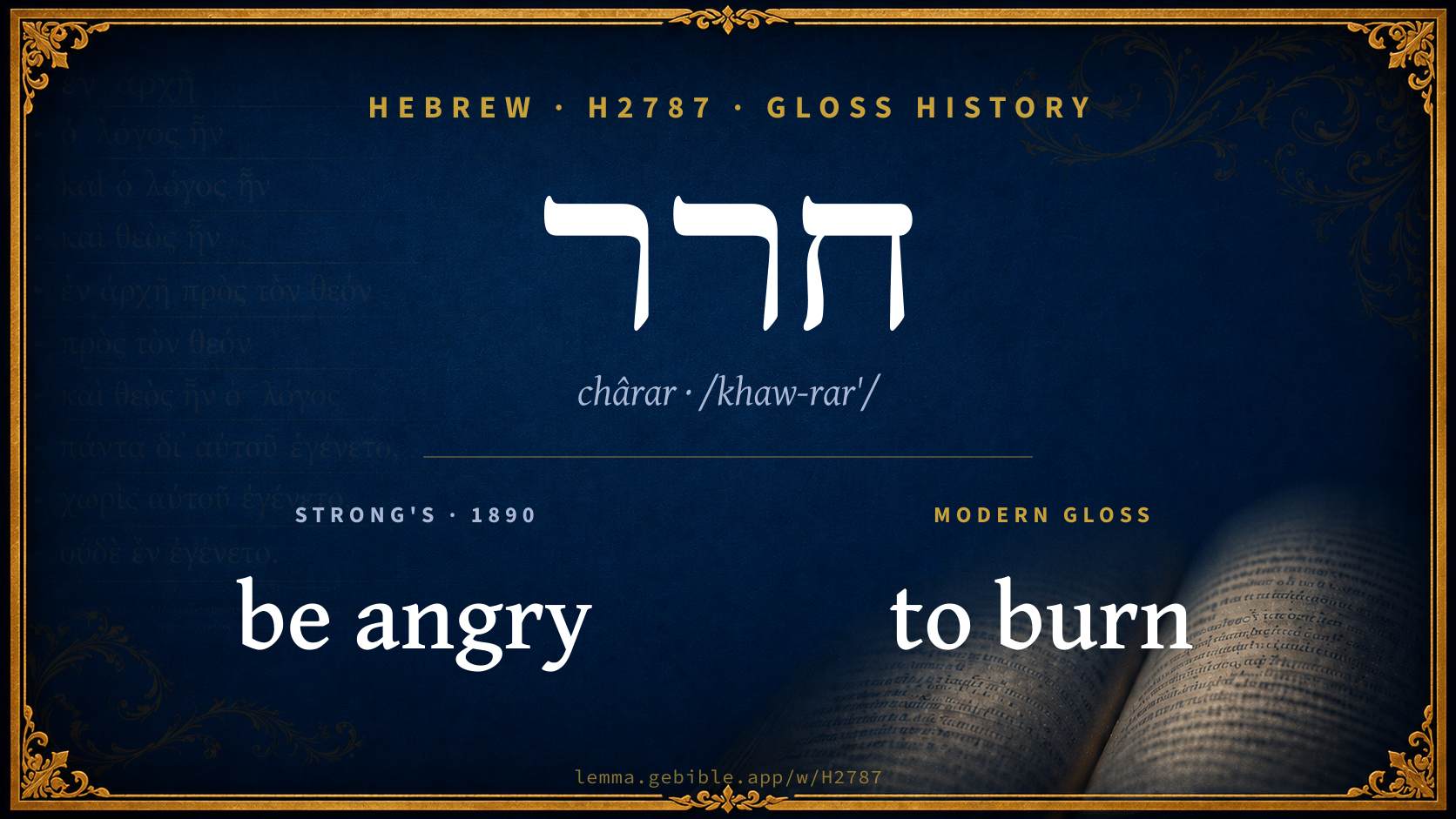
Gloss history
Strong's 1890 vs modern scholarship
About this word
Strong's H2787 catalogs a Hebrew word from the Hebrew Old Testament.
These counts are not copied from any lexicon or concordance. They are computed here, from the morphology-tagged Hebrew Old Testament. What Lemma adds →
- 11
- distinct verses
- The word appears in 11 distinct verses.
- 7 / 39
- OT books
- The word appears in 7 of 39 Old Testament books.
- #2,210
- by frequency
- Top 2500 most frequent Hebrew words (rank 2,210 of 8,640 Hebrew words by occurrence).
View all 11 occurrences in the concordance →
By section of the Old Testament
By traditional corpus
Conventional, traditional groupings — biblical authorship is debated, so this is a traditional corpus grouping, not an authorship claim. Each share is this word’s portion of its verses in that division of the Hebrew canon. Each figure is a share of the word’s 11 distinct verses.
- Prophets (Nevi'im) 6 verses · 55%
- Writings (Ketuvim) 5 verses · 45%
How translations render this word
Counts come from each version’s own published word-to-Strong’s tagging or interlinear alignment — an approximate guide to how each version renders this word, not a word-level alignment the data otherwise carries. Because each total is that version’s own tagged count, the per-version totals vary from one another and need not match the appearance or distinct-verse counts above. These counts may also differ from a printed concordance because Lemma counts each distinctly tagged rendering and does not collapse phrase taggings into a single head-word total. This is a fixed set of word-tagged versions (KJV, ASV, BSB, ULT) and does not change with the reading translation you choose elsewhere. Each version’s license is shown beside its name below (and on Sources).
BDB lists this Strong’s number as 3 distinct words (homographs). Each count above pools all of them and is not split by sense — see the Senses section below. A low-frequency rendering may belong to a different one of those words, not the primary meaning.
- King James Version†: Are burned 4×, Is burned 2×
- American Standard Version†: Are burned 2×
- Berean Standard Bible†: Burn 2×
- unfoldingWord Literal Text†: Has burned 2×
King James Version Public Domain
Renders H2787 across 11† tagged occurrences — most commonly:
Plus 5 renderings that appear only once — usually multi-word phrases or single function words the recovered tagging swept in, not distinct renderings.
American Standard Version Public Domain
Renders H2787 across 11† tagged occurrences — most commonly:
Plus 9 renderings that appear only once — usually multi-word phrases or single function words the recovered tagging swept in, not distinct renderings.
Berean Standard Bible Public Domain
Renders H2787 across 10† tagged occurrences — most commonly:
Plus 8 renderings that appear only once — usually multi-word phrases or single function words the recovered tagging swept in, not distinct renderings.
unfoldingWord Literal Text CC BY-SA 4.0
Renders H2787 across 11† tagged occurrences — most commonly:
Plus 9 renderings that appear only once — usually multi-word phrases or single function words the recovered tagging swept in, not distinct renderings.
20 senses and sub-senses in the full BDB
Hebrew verbs can shift meaning by stem (binyan): Qal is the basic action, Niphal is often passive or reflexive, Piel often intensifies or makes it factitive, and Hiphil is typically causative. The senses below are grouped under the stem BDB assigns to each. This entry also uses Hithpael (reflexive or reciprocal) and one or more reduplicated stems (the Pōlēl/Pilpēl type), which for hollow or geminate roots behave much like Piel — often intensive or iterative.
What do BDB’s symbols mean?
BDB uses these scholarly abbreviations:
| Symbol | Meaning |
|---|---|
| 𝔊 | the Septuagint (the ancient Greek translation, LXX) |
| 𝔙 | the Vulgate (the Latin translation) |
| 𝔖 | the Syriac version (the Peshitta) |
| 𝔗 | the Targum (the Aramaic translation) |
| ψ | the Psalms |
| √ | root (the underlying root or stem) |
| ‖ | parallel passage (a synonymous or contrasted parallel) |
| † | the dagger: every passage where the word occurs is cited |
The 20 senses and sub-senses the full Brown-Driver-Briggs lexicon distinguishes for this word, in lexicon order (not ranked by frequency), with BDB’s own verbatim wording and sub-sense lettering. Shown in Hebrew script with BDB’s own scholarly abbreviations. The condensed entry is in the Lexicon Entry tab. See also the Forms in the corpus table below.
חרר I burn, be kindled, of anger (Aramaic חרי Pa. cause fire to burn (rare)
Qal
- Pf. ח׳ Gn 4:6 + 20 times; Impf. יֶחֱרֶה Ex 32:11 + 2 times; יִ֫חַר Gn 18:30 + 7 times; וַיִּ֫חַר Gn 4:5 + 46 times; Inf. abs. חָרֹה 1 S 20:7; cstr. חֲרוֹת 2 S 24:1 ψ 124:3;— e.g. Genesis 4:6
- 1. of man:
- a. חרה אף (one’s) anger was kindled, burned Gn 39:19 Nu 22:27 (J), Ex 32:19, 22 (JE), Ju 9:30; 14:19 1 S 11:6 Jb 32:2, 5; c. בְּ against Gn 30:2 (E), 44:18 (J), 1 S 17:28; 20:30 2 S 12:5 2 Ch 25:10 ψ 124:3 Jb 32:2, 3; c. אֶל Nu 24:10 (E). e.g. Genesis 39:19
- b. impers., אף omitted; חרה לְ it was kindled for (him) he burned with anger Gn 31:36 (E), 4:5, 6; 34:7 Nu 16:15 (J), 1 S 15:11 (read perhaps וַיֵּצֶר, Weir in Dr), 18:8; 20:7(×2) 2 S 3:8; 6:8 = 1 Ch 13:11, 2 S 13:21; 19:43 Ne 3:33; 4:1; 5:6 Jon 4:1, 4, 9(×2); ins. ויחר לדוד 2 S 11:22 𝔊 We Dr; ח׳ בְּעֵינֵי Gn 31:35; 45:5 (E). e.g. Genesis 31:36
- 2. of God:
- a. ח׳ אף Ex 22:23 Nu 22:22 (E), Nu 11:1, 10; 32:10 (J); c. בְּ Ex 4:14; 32:10 Nu 12:9 Dt 31:17 (J), 6:15; 7:4; 11:17; 29:26 Jos 23:16 (D), Ju 6:39 2 S 6:7 = 1 Ch 13:10, Ho 8:5 2 K 23:26 2 Ch 25:15 Jb 42:7; בְּעַם Ex 32:11 Nu 11:33 (J), Is 5:25 ψ 106:40; בישׂראל Nu 25:3; 32:13 (JE); Ju 2:14, 20; 3:8; 10:7 2 S 24:1 2 K 13:3; בבני ישׂראל Jos 7:1 (R); בנהרים, אף omitted, Hb 3:8; c. עַל Zc 10:3. e.g. Exodus 22:23
- b. חרה לְ Gn 18:30, 32 (J) 2 S 22:8 = ψ 18:8.— e.g. Genesis 18:30
- חרה not in HP (who use קצף); nor in Je Ez Is 2 Pr or poetry of Jb.
Niphal
- Pf. נִחֲרוּ־ sq. בְּ Ct 1:6 (according to Bö ii. 379 De Köi. 551) be angry with; Pt. כֹּל הַנֶּחֱרִים בְּ׳ all that are incensed against (thee) Is 41:11, so 45:24. e.g. Song of Solomon 1:6
Hiphil
- Pf. הֶחֱרָה הֶחֱזִיק Ne 3:20 burned with zeal (?) in repairing, but 𝔊 om. החרה; prob. dittogr.; Impf. וַיַּחַר עָלַי אַפּוֹ Jb 19:11 and kindled his anger against me. e.g. Nehemiah 3:20
Hithpael
- Impf. אַל תִּתְחַר ψ 37:1, 7, 8 Pr 24:19 heat oneself in vexation.—The foll. forms are somewhat dub.: Impf. 2 ms. אֵיךְ תְּתַחֲרֶה אֶת־הַסּוּסִים Je 12:5 how canst thou hotly contend (in a race) with the horses? Pt. כִּי אַתָּה מְתַחֲרֶה בָאָ֑רֶז Je 22:15 because thou strivest eagerly (to excel) in cedar; expl. as Tiphʿēl by Thes Ges§ 55, 5 Ew§ 122 a Ol§ 255 a Sta§ 159 b Köi. p. 557 al., and regarded by most as a rare causative stem; but ag. existence of Tiphʿēl v. BaNB § 180 a; ZMG 1894, 20; Ba regards the form as denom. (from a noun formed by ת preform., cf. Aramaic ܬܰܚܪܘܽܬܳܐ contention); SS would point as Hithp. [cf. Syriac ܐܶܬܚܪܺܝ contend with, ܚܶܪܝܳܢ contention], although meaning of Hithp. is diff., v. supr. e.g. Psalms 37:1
חרר II be or grow white, pale (Arabic حَوِرَ be white, حَوَرٌ whiteness, Aramaic ܚܘܰܪ, חֲוַר be white)
Qal
- Impf. 3 mpl. וְלֹא עַתָּה פָּנָיו יֶחֱוָ֑רוּ Is 29:22 (‖ לֹא עַתָּה יֵבוֹשׁ יַעֲקֹב). e.g. Isaiah 29:22
חרר III be hot, scorched, burn, poet. & late (Arabic حَرٌّ be hot, burn, thirst
Qal
- Pf. 3 fs. חָ֫רָה Jb 30:30, וְחָ֫רָה consec. Ez 24:11, חָ֫רוּ Is 24:6;— e.g. Job 30:30
- 1. be hot, scorched, Jerus., under fig. of caldron Ez 24:11. e.g. Ezekiel 24:11
- 2. burn = be burned, fig. of men, in י׳’s judgment, Is 24:6. e.g. Isaiah 24:6
- 3. burn, of bones of sick men in fever ח׳ מִנִּי־חֹרֶב Jb 30:30. e.g. Job 30:30
Niphal
- Pf. 3 ms. נָחָ֑ר Ez 15:4, נִחַר ψ 69:4; 3 pl. נִחָ֑רוּ ψ 102:4 (Köi. 368); Impf. וַיֵּחָ֑ר Ez 15:5 יֵח֑רוּ Ez 24:10 (del. Co B al.) e.g. Ezekiel 15:4
- 1. be scorched, of bellows מַפֻּחַ in fierce fire Je 6:29 (fig.); scorched, charred, of the vine (as fuel) Ez 15:4, 5 middle part charred, the ends devoured (אכל) by fire (sim. of inhab. of Jerus.); bones (sim. id.) Ez 24:10 (v. supr.). e.g. Jeremiah 6:29
- 2. burn, of bones in fever ψ 102:4 (כְּמוֹקֵד, cf. Qal Jb 30:30); be parched, of throat נח׳ גרוני 69:4.—Is 41:11; 45:24 Ct 1:6 v. חרה. Niph. 1. נָחַר Je 6:29 from √ נחר snort, puff, according to Mich Ew Gf Gie al.,—not Du. e.g. Psalms 102:4
Pilp
- Inf. לְחַרְחַר־רִיב Pr 26:21 to kindle strife. e.g. Proverbs 26:21
Senses from the full Brown-Driver-Briggs lexicon (Brown, Driver, Briggs; Oxford 1906 — public domain), digitized via Sefaria, supplemented by the OpenScriptures HebrewLexicon (CC BY 4.0). Full attribution on Sources.
Word origin
I. vb. burn, be kindled, of anger (Aramaic חרי Pa. cause fire to burn (rare); Zinj. חרא anger, NöZMG 1893, 98. 103; Arabic حَرْوَةٌ burning sensation, in throat, etc., from rage and pain)—
I. vb. be or grow white, pale (Arabic حَوِرَ be white, حَوَرٌ whiteness, Aramaic ܚܘܰܪ, חֲוַר be white)—only
I. vb. be hot, scorched, burn, poet. & late (Arabic حَرٌّ be hot, burn, thirst; Ethiopic ሐረረ Aramaic חַר; cf. Assyrian arâru, glow, SASmAsrb. i, p. 97 BelserBAS ii, 155)—
— Brown-Driver-Briggs (Oxford 1906, public domain), digitized via Sefaria, supplemented by the OpenScriptures HebrewLexicon (CC BY 4.0). See Sources.
Origin: a primitive root
Jastrow Dictionary
A second Hebrew/Aramaic lexicon for comparison, covering Aramaic and post-biblical (Talmudic, Targumic, Midrashic) usage that the biblical-Hebrew BDB does not. Matched by lemma rather than by Strong’s number, so a lemma may carry more than one Jastrow headword (shown separately below), and the entries cover usage well beyond the Bible.
חוּר I
- (cmp. preced. wds.) to bore. Sabb. 103ᵃ חָר חורתא he bored a hole.
חָרַר I
- , Pi. חֵרֵר (v. חוֹר I) to break through, to cave. Ohol. III, 7; Succ. 20ᵇ חור שחֵרְרוּהוּ מים (or שחֲרָרוּהוּ) a cavity made by water, by animals &c.
חֲרַר
- , to perforate.—Part. pass. חֲרִיר discharging (v. חָרַיָּא). Targ. Y. Lev. XV, 3 חֲ׳ … ית וכ׳ (some ed. חָרֵיר part. act.) his membrum discharges &c.
חָרַר II
- , Pi. חֵרֵר (denom. of חוֹר II) to set free.—Part. pass. מְחוֹרָר freed, free. Gen. R. s. 14, end (ref. to Gen. II, 7 נפש חיה) עבד מח׳ בפני עצמו וכ׳ (Var. מכודן, v. כָּדַן) a freed slave left to himself for a living.—Keth. 51ᵇ; B. Kam. 95ᵃ המְחוֹרָרִין (נכסים) unencumbered property. [Shaf. שִׁחֲרֵר.] e.g. Genesis 2:7
חֲרַר ²
- , to set free. Targ. Y. Gen. XVI, 2 אַחְרְרִינָהּ I will liberate her. Ib. 3 חֲרַרְתָּהּ (not … תא). Ib. 5.
- to be set free. Targ. Lev. XIX, 20.
חָרַר III
- [to be rough, excited,] to glow. Pilp. חִרְחֵר, q. v.
חֲרַר ³
- , to burn, to be blackened, charred. Targ. Ps. II, 12 יֵיחוֹר. Ib. CII, 4. Targ. Ez. XV, 4, sq. חַר; a. e.
- to stir the fire. Ab. Zar. 38ᵇ חָרוּרֵי, v. חֲרֵי.]
- to be heated, dried up. Targ. II Esth. V, 1.
- same. Targ. Ps. LXIX, 4.
חָרַר IV
- (cmp. חרר I) to heap up, round. Denom. חֲרָרָה, חוֹרָר.
חֲרַר ⁴
- same.—Pa. חָרֵיר to round, make a חֲרָרָא. Targ. Ez. IV, 12 (some ed. תַּחְרְ׳ Af.; h. text תעגינה).
חֵרַר
- freedom, v. חֵירַר.
חָרָר
- 1. needle-eye, v. חוֹר 1. 1.
- 2. pile, v. חוֹרָר.—pl. חֲרָרִין, v. חֲרָרָה.
חֲרָר
- c. = next w.,
- 1. a cake. Targ. Jud. VII, 13 (h. text צליל). Targ. I Kings XVII, 13 (h. text עגה); a. fr.—Pesik. R. s. 18 [read:] תמן אמרין עבדין מיניה ח׳ לכלבא ולא טעמיה there (in Babylonia) they say, they made out of it a cake for a dog, but he would not taste it (v. Erub. 81ᵃ); Pesik. Haomer, p. 71ᵇ חֲרָרָה.—Pl. חֲרָרָן. Targ. Y. I Num. XI, 8. Targ. Y. Ex. XII, 39 (some ed. חֲרִירָן; חרידן, corr. acc.).
- 2. clot. Lev. R. s. 24 ח׳ דדמא (ed. חרדא, חרדה, corr. acc.) a clot of blood.
A Dictionary of the Targumim, the Talmud Babli and Yerushalmi, and the Midrashic Literature (Marcus Jastrow; London, Luzac, 1903) — Public Domain. Digitized via Sefaria. Digitized via Sefaria. Full attribution on Sources.
Forms in the corpus
The 11 distinct written forms H2787 takes in the Hebrew Bible, most frequent first — each parse links to that stem’s occurrences in the concordance. Hebrew forms include their vowel points and cantillation, so a single lemma takes many written forms.
Same root — word family
Other BDB entries built from the same root as H2787, grouped by Strong’s listed origin. These share a root / origin per the lexicon — not necessarily a shared meaning. Each links to that word’s own entry.
Derived from this word
- חר chôr H2715 noble
- חרה chârâh H2734 to be angry
- חרחר charchur H2746 fever
- חרך chărak H2761 to singe
- חרר chârêr H2788 parched place
Proper names from this root
People and places named from this root — a name, not an additional meaning of the word.
Compare all same-root words → Showing 4 of 7 — not the complete family. 1 of the same-root words is a proper name (a person or place). They share a root, not necessarily a meaning.
Septuagint verse parallels
This word appears in 11 verses that also exist in the Greek Old Testament (Septuagint), out of the 11 Hebrew verses it occurs in. You can read those verses in Greek by switching the Old Testament edition to the Septuagint.
Read these verses in the Septuagint
This is a verse-level parallel only — the same verses exist in both the Hebrew and Greek Old Testaments. No word-level Hebrew↔Greek correspondence is claimed: the data carries no such alignment, so no Greek word is shown as this Hebrew word’s translation. Coverage is not total — the Septuagint omits the deuterocanon and renumbers the Psalms, so some Hebrew verses have no direct Greek parallel.