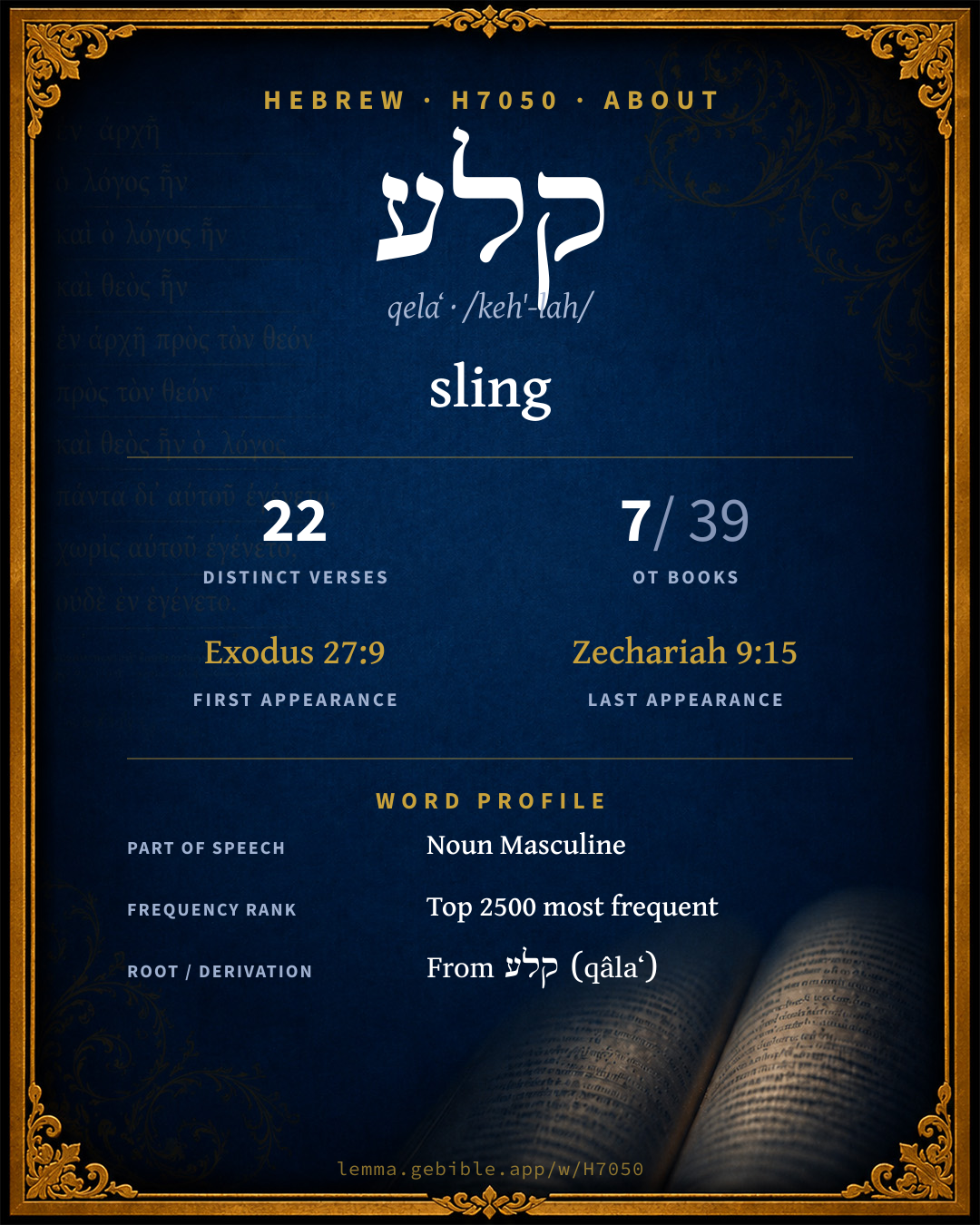
קֶ֫לַע
sling
‘sling’ is one of 2 main senses fuller range ↓
Full lexicon entry — Brown-Driver-Briggs (BDB)
From Brown-Driver-Briggs (BDB)
Where this word appears
See every Absolute-state word in the Hebrew Bible →
Grammar key — what these labels mean
Part of speech
- Noun
- A naming word — a person, place, thing, or idea.
Noun type
- Common
- A common noun — a general class of person, place, or thing (“king,” “city,” “water”), not a specific name.
State
- Absolute
- The independent form of a noun, not bound to a following word.
- Construct
- A noun bound to a following noun in a possessive / “of” relationship (the construct chain).
Gender
- Masculine
- Grammatically masculine.
Number
- Plural
- More than one (in Hebrew, generally three or more).
- Singular
- One.
Grammatical forms
- Noun, Common, Masculine, Plural, Absolute 10 times (45%)
- Noun, Common, Masculine, Plural, Construct 7 times (32%)
- Noun, Common, Masculine, Singular, Absolute 4 times (18%)
- Noun, Common, Masculine, Singular, Construct 1 time (5%)
Parsed forms decoded from the imported morphology (morphhb / Westminster Leningrad Codex — WLC text public domain, morphhb tagging CC BY 4.0), counted across 22 parsed occurrences — not distinct verses.
Every verse where H7050 appears — 22 distinct verses across 7 books. Click any verse to open its interlinear word-by-word view. Verse text shown in the World English Bible for context — . Each verse’s Hebrew form is shown with its reference; the English is not keyword-highlighted, since the data carries no word-level English alignment. Use “Compare translations” on any verse to read it across multiple English versions. This concordance covers the Hebrew Bible; Septuagint (Greek Old Testament) occurrences are not indexed here.
Exodus 13 verses
- Exodus 27:9 קְלָעִ֨ים n c mp "You shall make the court of the tent: for the south side southward there shall be hangings for the court of fine twined linen one hundred cubits long for one side:
- Exodus 27:11 קְלָעִ֖ים n c mp Likewise for the north side in length there shall be hangings one hundred cubits long, and the pillars of it twenty, and their sockets twenty, of brass; the hooks of the pillars, and their fillets, of silver.
- Exodus 27:12 קְלָעִ֖ים n c mp For the breadth of the court on the west side shall be hangings of fifty cubits; their pillars ten, and their sockets ten.
- Exodus 27:14 קְלָעִ֖ים n c mp The hangings for the one side of the gate shall be fifteen cubits; their pillars three, and their sockets three.
- Exodus 27:15 קְלָעִ֑ים n c mp For the other side shall be hangings of fifteen cubits; their pillars three, and their sockets three.
- Exodus 35:17 קַלְעֵ֣י n c mp cs the hangings of the court, its pillars, their sockets, and the screen for the gate of the court;
- Exodus 38:9 קַלְעֵ֤י n c mp cs He made the court: for the south side southward the hangings of the court were of fine twined linen, one hundred cubits;
- Exodus 38:12 קְלָעִים֙ n c mp For the west side were hangings of fifty cubits, their pillars ten, and their sockets ten; the hooks of the pillars, and their fillets, of silver.
- Exodus 38:14 קְלָעִ֛ים n c mp The hangings for the one side were fifteen cubits; their pillars three, and their sockets three;
- Exodus 38:15 קְלָעִ֕ים n c mp and so for the other side: on this hand and that hand by the gate of the court were hangings of fifteen cubits; their pillars three, and their sockets three.
- Exodus 38:16 קַלְעֵ֧י n c mp cs All the hangings around the court were of fine twined linen.
- Exodus 38:18 קַלְעֵ֥י n c mp cs The screen for the gate of the court was the work of the embroiderer, of blue, purple, scarlet, and fine twined linen. Twenty cubits was the length, and the height in the breadth was five cubits, like to the hangings of the court.
- Exodus 39:40 קַלְעֵ֨י n c mp cs the hangings of the court, its pillars, its sockets, the screen for the gate of the court, its cords, its pins, all the instruments of the service of the tent, for the tent of meeting,
Numbers 2 verses
- Numbers 3:26 וְ/קַלְעֵ֣י conj + n c mp cs and the hangings of the court, and the screen for the door of the court, which is by the tabernacle, and around the altar, and its cords for all of its service.
- Numbers 4:26 קַלְעֵ֨י n c mp cs and the hangings of the court, and the screen for the door of the gate of the court, which is by the tabernacle and around the altar, and their cords, and all the instruments of their service, and whatever shall be done with them. Therein shall they serve.
1 Samuel 3 verses
- 1 Samuel 17:40 וְ/קַלְּע֣/וֹ conj + n c ms cs + sfx pers 3ms He took his staff in his hand, and chose him five smooth stones out of the brook, and put them in the shepherd's bag which he had, even in his wallet; and his sling was in his hand: and he drew near to the Philistine.
- 1 Samuel 17:50 בַּ/קֶּ֣לַע prep det + n c ms So David prevailed over the Philistine with a sling and with a stone, and struck the Philistine, and killed him; but there was no sword in the hand of David.
- 1 Samuel 25:29 הַ/קָּֽלַע ptcl def.art + n c ms Though men be risen up to pursue you, and to seek your soul, yet the soul of my lord shall be bound in the bundle of life with Yahweh your God; and the souls of your enemies, them shall he sling out, as from the hollow of a sling.
1 Kings 1 verse
2 Chronicles 1 verse
Job 1 verse
Zechariah 1 verse
About this entry
At a glance — auto-summarized from this page’s data, not written by a person. Every figure links to its source below. This summary describes the numbers; it doesn’t interpret them.
קלע — transliterated qelaʻ — is a Hebrew noun carrying the sense “sling.” More than half of its appearances fall in Exodus. It appears 22 verses across 7 books of the Hebrew Bible, among its uncommon vocabulary. BDB distinguishes 2 senses for it. Older and newer Bibles part ways — “hangings” in the King James Version, “curtains” (Berean Standard Bible) in modern versions. See the renderings breakdown. Each statement above links to its evidence; the full detail follows below.
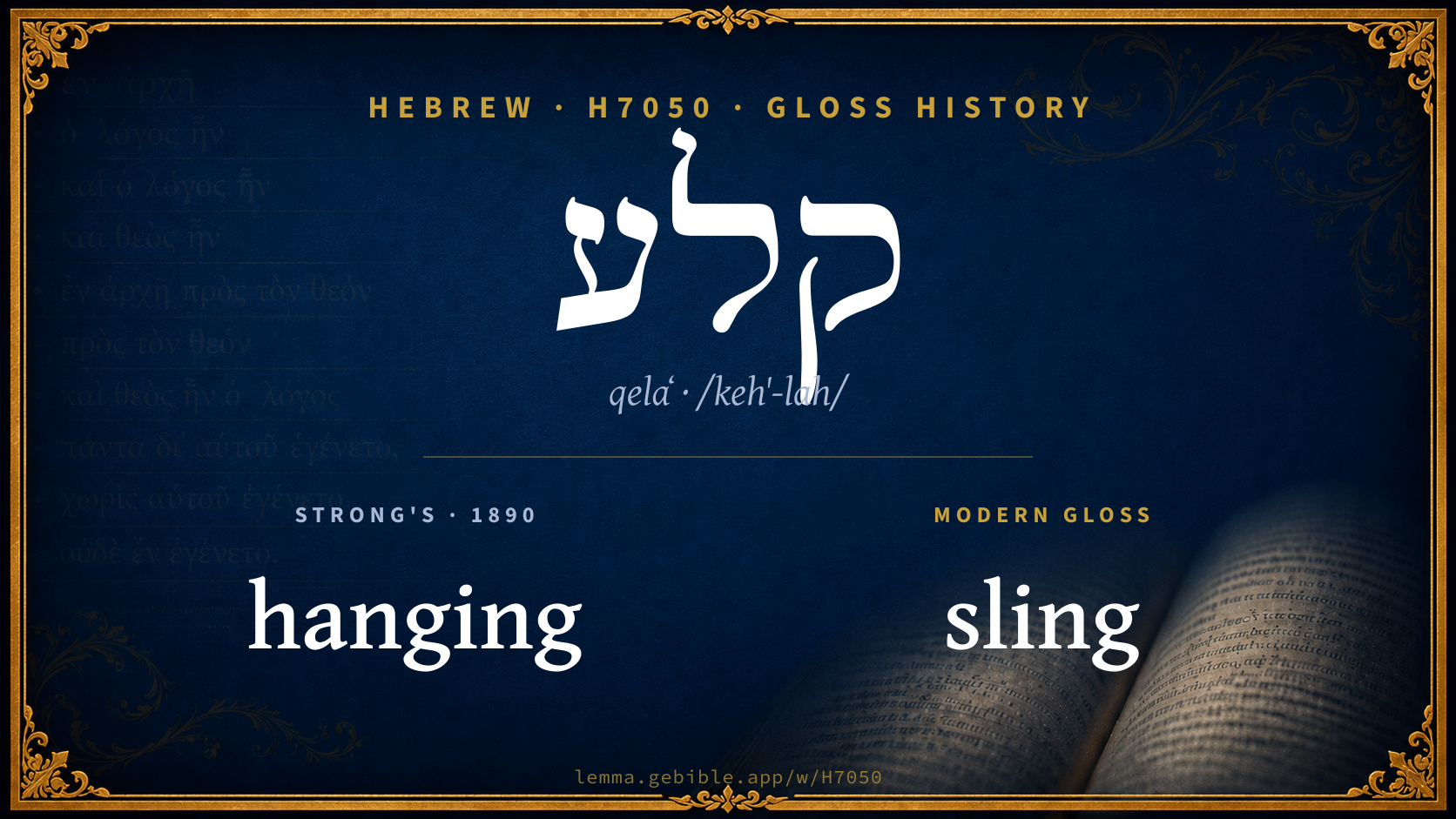
Gloss history
Strong's 1890 vs modern scholarship
About this word
Strong's H7050 catalogs a Hebrew word from the Hebrew Old Testament.
These counts are not copied from any lexicon or concordance. They are computed here, from the morphology-tagged Hebrew Old Testament. What Lemma adds →
- 22
- distinct verses
- The word appears in 22 distinct verses.
- 7 / 39
- OT books
- The word appears in 7 of 39 Old Testament books.
- #1,412
- by frequency
- Top 2500 most frequent Hebrew words (rank 1,412 of 8,640 Hebrew words by occurrence).
View all 22 occurrences in the concordance →
By section of the Old Testament
By traditional corpus
Conventional, traditional groupings — biblical authorship is debated, so this is a traditional corpus grouping, not an authorship claim. Each share is this word’s portion of its verses in that division of the Hebrew canon. Each figure is a share of the word’s 22 distinct verses.
- Torah (Pentateuch) 15 verses · 68%
- Prophets (Nevi'im) 5 verses · 23%
- Writings (Ketuvim) 2 verses · 9%
How translations render this word
Counts come from each version’s own published word-to-Strong’s tagging or interlinear alignment — an approximate guide to how each version renders this word, not a word-level alignment the data otherwise carries. Because each total is that version’s own tagged count, the per-version totals vary from one another and need not match the appearance or distinct-verse counts above. These counts may also differ from a printed concordance because Lemma counts each distinctly tagged rendering and does not collapse phrase taggings into a single head-word total. This is a fixed set of word-tagged versions (KJV, ASV, BSB, ULT) and does not change with the reading translation you choose elsewhere. Each version’s license is shown beside its name below (and on Sources).
BDB lists this Strong’s number as 2 distinct words (homographs). Each count above pools all of them and is not split by sense — see the Senses section below. A low-frequency rendering may belong to a different one of those words, not the primary meaning.
- King James Version†: Hangings 8×, Shall be hangings 4×, Sling 4×
- American Standard Version†: Hangings 8×, Shall be hangings 4×, Sling 3×
- Berean Standard Bible†: Curtains 13×, Sling 3×
- unfoldingWord Literal Text†: Curtains 7×, Curtains of 5×, Sling 4×
King James Version Public Domain
Renders H7050 across 21† tagged occurrences — most commonly:
Plus 5 renderings that appear only once — usually multi-word phrases or single function words the recovered tagging swept in, not distinct renderings. Not rendered by a distinct English word in 1 further occurrence.
American Standard Version Public Domain
Renders H7050 across 21† tagged occurrences — most commonly:
Plus 4 renderings that appear only once — usually multi-word phrases or single function words the recovered tagging swept in, not distinct renderings.
Berean Standard Bible Public Domain
Renders H7050 across 18† tagged occurrences — most commonly:
Plus 2 renderings that appear only once — usually multi-word phrases or single function words the recovered tagging swept in, not distinct renderings. Not rendered by a distinct English word in 4 further occurrences.
unfoldingWord Literal Text CC BY-SA 4.0
Renders H7050 across 25† tagged occurrences — most commonly:
Plus 5 renderings that appear only once — usually multi-word phrases or single function words the recovered tagging swept in, not distinct renderings.
Senses in the full BDB
What do BDB’s symbols mean?
BDB uses these scholarly abbreviations:
| Symbol | Meaning |
|---|---|
| 𝔊 | the Septuagint (the ancient Greek translation, LXX) |
| 𝔙 | the Vulgate (the Latin translation) |
| 𝔖 | the Syriac version (the Peshitta) |
| 𝔗 | the Targum (the Aramaic translation) |
| ψ | the Psalms |
| √ | root (the underlying root or stem) |
| ‖ | parallel passage (a synonymous or contrasted parallel) |
| † | the dagger: every passage where the word occurs is cited |
The 0 senses and sub-senses the full Brown-Driver-Briggs lexicon distinguishes for this word, in lexicon order (not ranked by frequency), with BDB’s own verbatim wording and sub-sense lettering. Shown in Hebrew script with BDB’s own scholarly abbreviations. The condensed entry is in the Lexicon Entry tab. See also the Forms in the corpus table below.
קלע I [m.] sling
קלע II [m.] curtain, hanging (P)
Senses from the full Brown-Driver-Briggs lexicon (Brown, Driver, Briggs; Oxford 1906 — public domain), digitized via Sefaria, supplemented by the OpenScriptures HebrewLexicon (CC BY 4.0). Full attribution on Sources.
Word origin
I. n.[m.] sling;—abs. ק׳ 1 S 17:50, כַּף הַקָּ֑לַע 25:29 hollow of the sling (fig.); sf. קַלְעוֹ 17:40; אַבְנֵי־קָ֑לַע Jb 41:20 2, so א׳ קְלָעִים 2 Ch 26:14; א׳־קֶלַע Zc 9:15 is difficult: MartiKau כְּא׳־ק׳; We Now בְּנֵי ק׳ sons of———?
II. n.[m.] curtain, hanging (P);—pl. abs. קְלָעִים Ex 27:9 + 7 times Ex; cstr. קַלְעֵי 35:17 + 4 times Ex, Nu 3:26; 4:26.—1 K 6:34 b read צְלָעִים.
— Brown-Driver-Briggs (Oxford 1906, public domain), digitized via Sefaria, supplemented by the OpenScriptures HebrewLexicon (CC BY 4.0). See Sources.
Derived from קלע (qâlaʻ) (H7049) — to sling.
Jastrow Dictionary
A second Hebrew/Aramaic lexicon for comparison, covering Aramaic and post-biblical (Talmudic, Targumic, Midrashic) usage that the biblical-Hebrew BDB does not. Matched by lemma rather than by Strong’s number, so a lemma may carry more than one Jastrow headword (shown separately below), and the entries cover usage well beyond the Bible.
קָלַע I
- (b. h.) [to swing,] to cast, sling.
- same. Sabb. 152ᵇ ומְקַלְּעִין נִשְׁמָתָן זה לזה and they (the angels) cast their (the sinners’) souls to one another (like washers) (with ref. to I Sam. XXV, 29, v. זוּם); Yalk. Sam. 134. e.g. 1 Samuel 25:29
קְלַע
- Af. אַקְלַע same. Targ. I Sam. XVII, 49. Targ. Y. Ex. X, 19 אקלע Ar. (ed. טלק).
- to be thrown; to happen to come, happen to fall (on a certain day). Ḥull. 110ᵃ א׳ לסורא וכ׳ happened to come to Sura on the eve of &c. Ib. אִיקְלְעוּ לבי וכ׳ happened to come to the house (were the guests) of &c. Pes. 46ᵇ הואיל ומִיקְלְעֵי וכ׳ since guests may happen to come to him. Ned. 8ᵃ עד דמִקְלְעֵי ליה וכ׳ until ten persons … pass by him. R. Hash. 20ᵃ דא׳ יום שלשים וכ׳ if the thirtieth day happens to fall on a Sabbath. Ber. 53ᵇ אי מִקְּלַע לי ממילא if I happen to get it. Sabb. 117ᵇ כי מיקלע להו וכ׳ if they by chance had bread that had been used for an ʿErub (עֵירוּב); a. fr.
קָלַע II
- to twist, plait; [b. h. to form a raised figure, cmp. גָּדַל II]. Yoma VI, 7 קְלָעָן, v. מַקֵּל. Sabb. 64ᵃ עני קוֹלֵעַ שלש וכ׳ a poor man twists three threads and hangs the cord around his daughter’s neck. Y. ib. X, 12ᶜ bot. הקולע שלש וכ׳ he that plaits three strings of hair on a person’s head. Tosef. Maasr. I, 6 היה עתיד לִקְלוֹעַ בשום ולאגוד וכ׳ (ed. Zuck. ליקָּלֵעַ … וליאגד, Nif.) if the intention was about the garlic crop to plait, and about the onions to tie them in bunches, אינו חייב עד שיִקְלַע ויאגד he is not bound to give the tithes until he plaits or ties (or עד שיִקָּלֵעַ ויֵאָגֵד until the things are plaited or bunched); a. e.—Trnsf. [to weave a wreath,] to adorn, praise. Midr. Till. to Ps. XCII, end; Yalk. Ps. 846 הוא קוֹלֵעַ על יריאיו … קוֹלְעִים לו וכ׳ he (God) praises those who fear him, and those who fear him praise him; you say (Ps. XCII, 16) &c., and I say, (Zeph. III, 13) &c. e.g. Psalms 92:16
- 1. same. Num. R. s. 9 היא קִילְּעָה לו וכ׳ (not קולעה) she plaited her hair to please him (her paramour), therefore the priest loosens her hair; Tosef. Sot. III, 3 ed. Zuck. note קלעה; a. e.
- 2. קִילְּעֶה or קִלְּעֶה (cmp. נתעלפה, s. v. עָלַף II) to plait a person’s hair, dress, adorn (v. supra). Ber. 61ᵃ; Koh. R. to VII, 2; Sabb. 95ᵃ; Erub. 18ᵃ; Nidd. 45ᵇ; Koh. R. to VII, 2 (ref. to ויבן, Gen. II, 22) מלמד שקילעה הקב"ה לחוה וכ׳ this intimates that the Lord dressed Eve &c., v. בִּנְיָיתָא. Y. Snh. II, 20ᵃ bot. (ref. to II Sam. XX, 3 ויכלכל, v. כִּלְכֵּל) מלמד שהיה דוד מְקַלַּעֲתָן וכ׳ this teaches that David had them dressed and adorned and made them come before him every day, and said to his evil inclination &c. e.g. Genesis 2:22
- to be plaited, v. supra.
קְלַע ²
- , to plait. Targ. Y. Num. V, 18 (v. Num. R. s. 9, quot. in preced.).
קֶלַע I
- sling. Sifra Sh’mini, Par. 6, ch. VIII כל כלי לרבות הק׳ וכ׳ ‘any receptacle’ (Lev. XI, 32), to include the sling &c. Eduy. III, 5 הק׳ שבית וכ׳ a sling the receptacle of which is of woven material. Sabb. 67ᵃ ק׳ נטושה (fem.), v. נָטַשׁ I. e.g. Leviticus 11:32
קֶלַע II
- c. (קָלַע II) twisted cord, rope; plait. Gen. R. s. 22 (ref. to Is. V, 18) כק׳ הזו של ספינה (prob. to be read עגלה) as the rope of a ship (a wagon), v. עֲבוֹת.—Pl. קְלָעִים. Yoma 47ᵃ מימי … קִלְעֵי שערי never did the beams of my house see the plaits of my hair (I always wear a cap in the house). e.g. Isaiah 5:18
קֶלַע III
- pl.; preced.)
- 1. curtain, sail. Tosef. B. Kam. VIII, 17 ובלבד שלא יפרוס את הק׳ וכ׳ provided one does not spread the sail and detain the boat (when fishing in the waters of a neighboring tribe).—Pl. קְלָעִים, קְלָעִין. Eduy. VIII, 6; Zeb. 107ᵇ; Meg. 10ᵃ, a. e. כשהיו … ק׳ להיכל וק׳ לעזרות when they were rebuilding the Temple, they made curtains for the Temple and curtains for the courts.—Esp. the curtains of the Tabernacle; trnsf. the partitions of the Temple corresponding to those of the Tabernacle. Zeb. V, 3 לפנים מן הק׳ inside of the enclosures (in the Temple court); a. e.
- 2. (pl.) tents at fairs, shops. Snh. 106ᵃ עֲשֵׂה להן ק׳ וכ׳ put up shops for them and place therein prostitutes &c.; עָשָׂה להן ק׳ וכ׳ (Ar. קעילין) he put up shops for them &c.; Sifré Num. 131 ק׳ Var. (ed. מקולין; Yalk. ib. 771 קעילין; Y. Snh. X, 28ᵈ top קנקלין).
קְלַע ³
- 1. sail, curtain. Targ. Is. XXXIII, 23.—Pl. קִלְעִין, קִי׳, קְלָעַיָּיא. Ib. XVIII, 1. Ib. LX, 9.—Y. Sabb. XX, beg. 17ᶜ הוון פרסין קִילְעַיָּה וכ׳ they spread the curtains a day before to the length of four cubits.
- 2. curtained enclosure. Erub. 63ᵇ (in Hebr. dict.) הישן בק׳ וכ׳ (Ms. M. a. Yalk. Mic. 551 הלן בכילה; Ar. a. En Yaăḳ. ed. pr. בקעילה; ed. Cost. בקליעא, v. Rabb. D. S. a. l. note) he that sleeps in a compartment in which husband and wife are. Ned. 22ᵇ זיל לקִילְעָךְ go to thy room (I cannot help thee).—Esp. ante-room, hall. Ber. 22ᵇ top בק׳ דרב וכ׳ in the anteroom of Rab O. M. Kat. 24ᵇ; a. e.—[Pl. קִלְעָתָא, v. קְלִיעֲתָא.]
A Dictionary of the Targumim, the Talmud Babli and Yerushalmi, and the Midrashic Literature (Marcus Jastrow; London, Luzac, 1903) — Public Domain. Digitized via Sefaria. Digitized via Sefaria. Full attribution on Sources.
Forms in the corpus
The 18 distinct written forms H7050 takes in the Hebrew Bible, most frequent first — each parse links to that state’s occurrences in the concordance. Hebrew forms include their vowel points and cantillation, so a single lemma takes many written forms.
Same root — word family
Other BDB entries built from the same root as H7050, grouped by Strong’s listed origin. These share a root / origin per the lexicon — not necessarily a shared meaning. Each links to that word’s own entry.
Derives from
Shares the same root
Proper names from this root
People and places named from this root — a name, not an additional meaning of the word.
Compare all same-root words → Showing 4 of 5 — not the complete family. 1 of the same-root words is a proper name (a person or place). They share a root, not necessarily a meaning.
Septuagint verse parallels
This word appears in 17 verses that also exist in the Greek Old Testament (Septuagint), out of the 22 Hebrew verses it occurs in. You can read those verses in Greek by switching the Old Testament edition to the Septuagint.
Read these verses in the Septuagint
This is a verse-level parallel only — the same verses exist in both the Hebrew and Greek Old Testaments. No word-level Hebrew↔Greek correspondence is claimed: the data carries no such alignment, so no Greek word is shown as this Hebrew word’s translation. Coverage is not total — the Septuagint omits the deuterocanon and renumbers the Psalms, so some Hebrew verses have no direct Greek parallel.