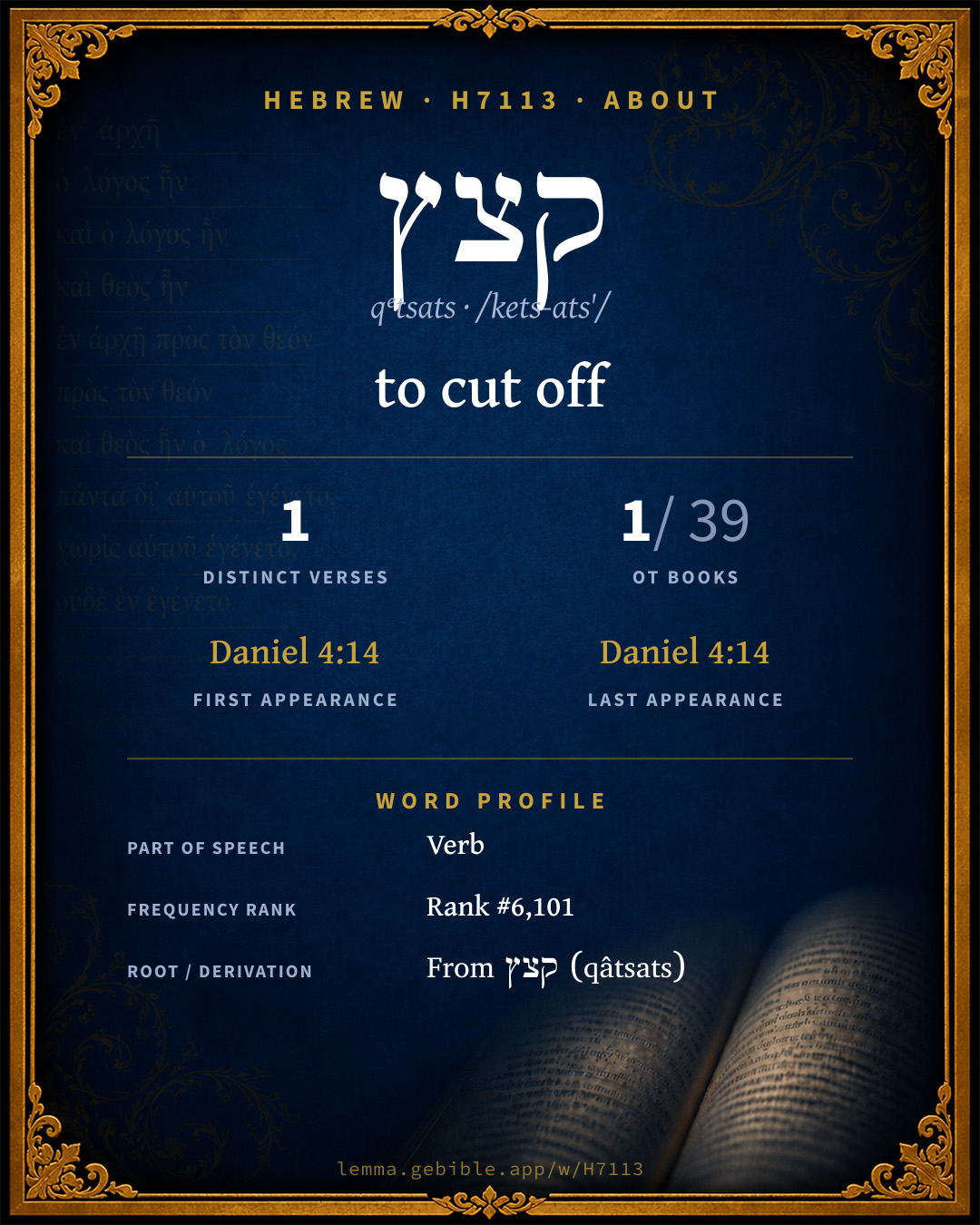
קְצַץ
to cut off
Full lexicon entry — Brown-Driver-Briggs (BDB)
From Brown-Driver-Briggs (BDB)
Where this word appears
Grammar key — what these labels mean
Stem
- Piel
- An intensive or resultative active stem.
Form
- Imperative
- A direct command (“write!”).
Person
- 2nd Person
- The one addressed (“you”).
Gender
- Masculine
- Grammatically masculine.
Number
- Plural
- More than one (in Hebrew, generally three or more).
Every verse where H7113 appears — 1 distinct verse across 1 book. Click any verse to open its interlinear word-by-word view. Verse text shown in the World English Bible for context — . Each verse’s Hebrew form is shown with its reference; the English is not keyword-highlighted, since the data carries no word-level English alignment. Use “Compare translations” on any verse to read it across multiple English versions. This concordance covers the Hebrew Bible; Septuagint (Greek Old Testament) occurrences are not indexed here.
Daniel 1 verse
About this entry
At a glance — auto-summarized from this page’s data, not written by a person. Every figure links to its source below. This summary describes the numbers; it doesn’t interpret them.
The Hebrew verb קצץ centers on the idea of “to cut off.” It is rare — just 1 verse in the entire Hebrew Bible. Daniel dominates its distribution — 1 of 1 verses. It occurs only once, in Daniel 4:14. Related forms include קצץ, קץ and מקץ. Dig into 1-verse concordance and the renderings breakdown below.
Gloss history
Strong's 1890 vs modern scholarship
About this word
Strong's H7113 catalogs a Hebrew word from the Hebrew Old Testament.
These counts are not copied from any lexicon or concordance. They are computed here, from the morphology-tagged Hebrew Old Testament. What Lemma adds →
- 1
- distinct verses
- The word appears in 1 distinct verse.
- 1 / 39
- OT books
- The word appears in 1 of 39 Old Testament books.
- #6,101
- by frequency
- Rank #6,101 (rank 6,101 of 8,640 Hebrew words by occurrence).
View all 1 occurrence in the concordance →
Most concentrated in
- Daniel 1 verse 100%
By section of the Old Testament
By traditional corpus
Conventional, traditional groupings — biblical authorship is debated, so this is a traditional corpus grouping, not an authorship claim. Each share is this word’s portion of its verses in that division of the Hebrew canon. Each figure is a share of the word’s 1 distinct verse.
- Writings (Ketuvim) 1 verse · 100%
How translations render this word
Counts come from each version’s own published word-to-Strong’s tagging or interlinear alignment — an approximate guide to how each version renders this word, not a word-level alignment the data otherwise carries. Because each total is that version’s own tagged count, the per-version totals vary from one another and need not match the appearance or distinct-verse counts above. These counts may also differ from a printed concordance because Lemma counts each distinctly tagged rendering and does not collapse phrase taggings into a single head-word total. This is a fixed set of word-tagged versions (KJV, ASV, BSB, ULT) and does not change with the reading translation you choose elsewhere. Each version’s license is shown beside its name below (and on Sources).
- King James Version: Cut off 1×
- American Standard Version: Cut off 1×
- Berean Standard Bible: Chop off 1×
- unfoldingWord Literal Text: Cut off 1×
King James Version Public Domain
Renders H7113 across 1 tagged occurrence — most commonly:
American Standard Version Public Domain
Renders H7113 across 1 tagged occurrence — most commonly:
Berean Standard Bible Public Domain
Renders H7113 across 1 tagged occurrence — most commonly:
unfoldingWord Literal Text CC BY-SA 4.0
Renders H7113 across 1 tagged occurrence — most commonly:
Senses in BDB
The 1 sense BDB distinguishes for this word, in lexicon order (not ranked by frequency or importance). The full entry — with sub-senses — is in the Lexicon Entry tab.
- (Pael) to cut off
Word origin
קצא (√ of following [ xs.ah.ab ]).
— Brown-Driver-Briggs (Oxford 1906, public domain), digitized via Sefaria, supplemented by the OpenScriptures HebrewLexicon (CC BY 4.0). See Sources.
Derived from קצץ (qâtsats) (H7112) — to cut off.
Jastrow Dictionary
A second Hebrew/Aramaic lexicon for comparison, covering Aramaic and post-biblical (Talmudic, Targumic, Midrashic) usage that the biblical-Hebrew BDB does not. Matched by lemma rather than by Strong’s number, so a lemma may carry more than one Jastrow headword (shown separately below), and the entries cover usage well beyond the Bible.
קָצַץ
- (b. h.)
- 1. to cut, fell. Shebi. IV, 10 מותר לקוֹצְצוֹ it is permitted to cut the tree down (in the Sabbatical year). Ib. כמה … ולא יְקוֹצֶּנּוּ (Y. ed. יקצונו, corr. acc.; Bab. ed. יְקוֹצְצוֹ; Ms. M. יִקְצְצֶנּוּ) how much must an olive tree bear so that one dare not cut it down (because it is an act of wilful destruction, Deut. XX, 19–20); B. Kam. 91ᵇ יקצצנו Ms. F. a. R. (later ed. יִקְצְצוֹ; v. Rabb. D. S. a. l. note 10). Ib. נטיעותי קָצַצְתָּ thou hast cut down my young trees; אתה אמרת לי לקוֹצְצָן (not לקוצצו, v. Rabb. D. S. a. l. note 7) thou hast told me to cut them. Y. Shebi. IV, 35ᵇ bot. לָקוֹץ … יָקוֹץ, v. נָתַק. Ib. הקוצץ בקורות he that cuts trunks for beams. Lev. R. s. 23, v. infra.—Sifré Deut. 212 (expl. ועשתה, Deut. XXI, 12) תָּקוֹץ let her cut (her nails). Macc. 22ᵃ הקוצץ את בהרתו he that cuts off a white spot (suspicious of leprosy, v. קְצִיצָה); Neg. VII, 5 קְצָצָהּ מתכוין if he cut it intentionally. Tosef. Sabb. XI (XII), 3; a. fr.—Gen. R. s. 85 (ref. to Dan. V, 1 a. VI, 1) והיכן הוא … קוצץ לקוצץ where is Evil Merodach?… (He is left out) in order to join a wicked man to a wicked man, a destroyer to a destroyer. Y. Yeb. II, 4ᵃ top קוצץ בן קוצץ a destroyer son of a destroyer (wicked by heredity); Pesik. S’liḥ. p. 167ᵇ אין בישראל קו׳ בן קו׳ there is no hereditary wickedness in Israel. Ex. R. s. 1 וקוץ … שק׳ עצת וכ׳ Koz (I Chr. IV, 8) is Caleb, for he destroyed the counsel of the spies; a. fr.—2) (cmp. קָצַב, גָּזַר) to stipulate, agree upon. Shebu. 45ᵇ אפי׳ ק׳ נמי let it be the same even if a stipulation has been made (and the amount is in litigation). Ib. אומן … קָצַצְתָּ … לא קָצַצְתִּי וכ׳ if the mechanic says, thou hast stipulated to pay me two (Zuz), and he (the employer) says, I have stipulated one only; a. e.—Part. pass. קָצוּץ; f. קְצוּצָה. B. Mets. 61ᵇ רבית ק׳ stipulated, direct usury, opp. אבק רבית, v. אָבָק. Ib. 62ᵇ; a. e. e.g. Deuteronomy 20:19
- 1. to be cut. Neg. l. c. מי … ונִקְצָצָה if one had a white spot, and it was cut off (accidentally). Nidd. II, 1 תִּקָּצֵץ let the hand be cut off. B. Kam. 91ᵇ, v. קְצִיצָה; a. fr.
- 2. to be cut off, excluded. Y. Kidd. I, 60ᶜ, a. e., v. קְצָצָה.
- 3. to be stipulated, definitely assigned. Lev. R. s. 30, beg. מראש השנה נִקְצָצִין וכ׳ from the beginning of the year the means of support are definitely assigned to men, except &c., v. קָצַב.
- 1. to scrape, cut off; to fell. Pes. 56ᵃ ק׳ דלתות וכ׳ (II Kings XVIII, 16) he took the gold off the Temple doors. Y. Ber. VIII, 12ᵃ bot. אפי׳ מְקַצֵּץ וכ׳ even when cutting lupines. Ib. II, 5ᶜ top היה מקצץ כל וכ׳ he cut down all he had planted. Pesik. R. s. 31 ומְקַצְּצִים, v. רָצַץ. Cant. R. to II, 2 לקַצְּצוֹ; Lev. R. s. 23 לָקוֹצּוֹ, v. קַצָּץ.—Esp. ק׳ בנט עות [to cut down the shoots in the garden of religion,] to be hostile to religion, corrupt the youths; to be a heretic. Ḥag. 14ᵇ; Y. ib. II, 77ᵇ top, v. נְטִיעָה. Cant. R. to I, 4 כיצד ק׳ בנ׳ in what way did he manifest his hostility to religion? Gen. R. s. 19 לא תעשה … וִיקַצֵּץ וכ׳ make not the fence (around the religious laws) more important than the essentials, lest it fall down and ruin the shoots. e.g. 2 Kings 18:16
- 2. to stipulate. Shebi. IV, 1 ואין … שיְקַצֵּץ להם מזונות (R. S. שיִקְצוֹץ) it is unnecessary to say, that he must not stipulate to give them their food (for their work).
- to cut off, deduct. Sifré Num. 8 ומֵקֵיץ מכתובתה he may deduct (his outlay for her) from her jointure.
קְצַץ
- 1. to cut &c. Targ. Jud. VI, 30. Targ. O. Deut. XIX, 5; a. fr.—Part. pass. קָצִיץ; f. קְצִיצָא; pl. קְצִיצִין; קְצִיצָן. Targ. Jud. VI, 28. Targ. I Sam. V, 4; a. e.—Snh. 58ᵇ רב הונא קץ ידא Rab Huna ordered the hand (of one in the habit of striking his neighbors) to be cut off; Nidd. 13ᵇ. B. Kam. 91ᵇ דקץ תאינתא וכ׳ he cut fig-trees down before their time; a. fr.
- 2. to stipulate. B. Mets. 67ᵃ לא קץ ליה he had not stipulated a fixed amount of interest; a. e.
- (קָצֵיץ) to cut; to mutilate. Targ. Ps. CVII, 16. Targ. Lam. II, 3 (ed. Lag. קיצץ, ed. Vien. קצף, corr. acc.). Targ. O. Deut. VII, 5 תְּקָצְצוּן ed. Berl. (oth. ed. תְּקוֹצְצוּן; Y. תְּקַצְּצוּן); a. e.—B. Kam. l. c. דיקלא … לִמְקַצְּצָה it is forbidden to fell a date-tree as long as it bears a Kab of dates. Gen. R. s. 6 (of the agony of death) כמא נפשיה … מְקַצְּצָא ארזין ומקצצא וכ׳ how the soul of this man’s (my) brother is cutting cedars and cutting trees, and you sit laughing and know it not; a. e.—[Lev. R. s. 5 שעריה מקצץ, v. קְוַץ.]
קַצָּץ
- (preced.) wood-cutter (cmp. קָצוֹעַ).—Pl. קַצָּצִים. Cant. R. to II, 2 הביא ק׳ לְקַצְּצוֹ he brought on cutters to raze the plantation; Lev. R. s. 23.
A Dictionary of the Targumim, the Talmud Babli and Yerushalmi, and the Midrashic Literature (Marcus Jastrow; London, Luzac, 1903) — Public Domain. Digitized via Sefaria. Digitized via Sefaria. Full attribution on Sources.
Same root — word family
Other BDB entries built from the same root as H7113, grouped by Strong’s listed origin. These share a root / origin per the lexicon — not necessarily a shared meaning. Each links to that word’s own entry.
Derives from
Shares the same root
Proper names from this root
People and places named from this root — a name, not an additional meaning of the word.
Compare all same-root words → Showing 4 of 5 — not the complete family. 2 of the same-root words are proper names (people or places). They share a root, not necessarily a meaning.
Septuagint verse parallels
This word appears in 1 verse that also exists in the Greek Old Testament (Septuagint), out of the 1 Hebrew verse it occurs in. You can read those verses in Greek by switching the Old Testament edition to the Septuagint.
Read these verses in the Septuagint
This is a verse-level parallel only — the same verses exist in both the Hebrew and Greek Old Testaments. No word-level Hebrew↔Greek correspondence is claimed: the data carries no such alignment, so no Greek word is shown as this Hebrew word’s translation. Coverage is not total — the Septuagint omits the deuterocanon and renumbers the Psalms, so some Hebrew verses have no direct Greek parallel.