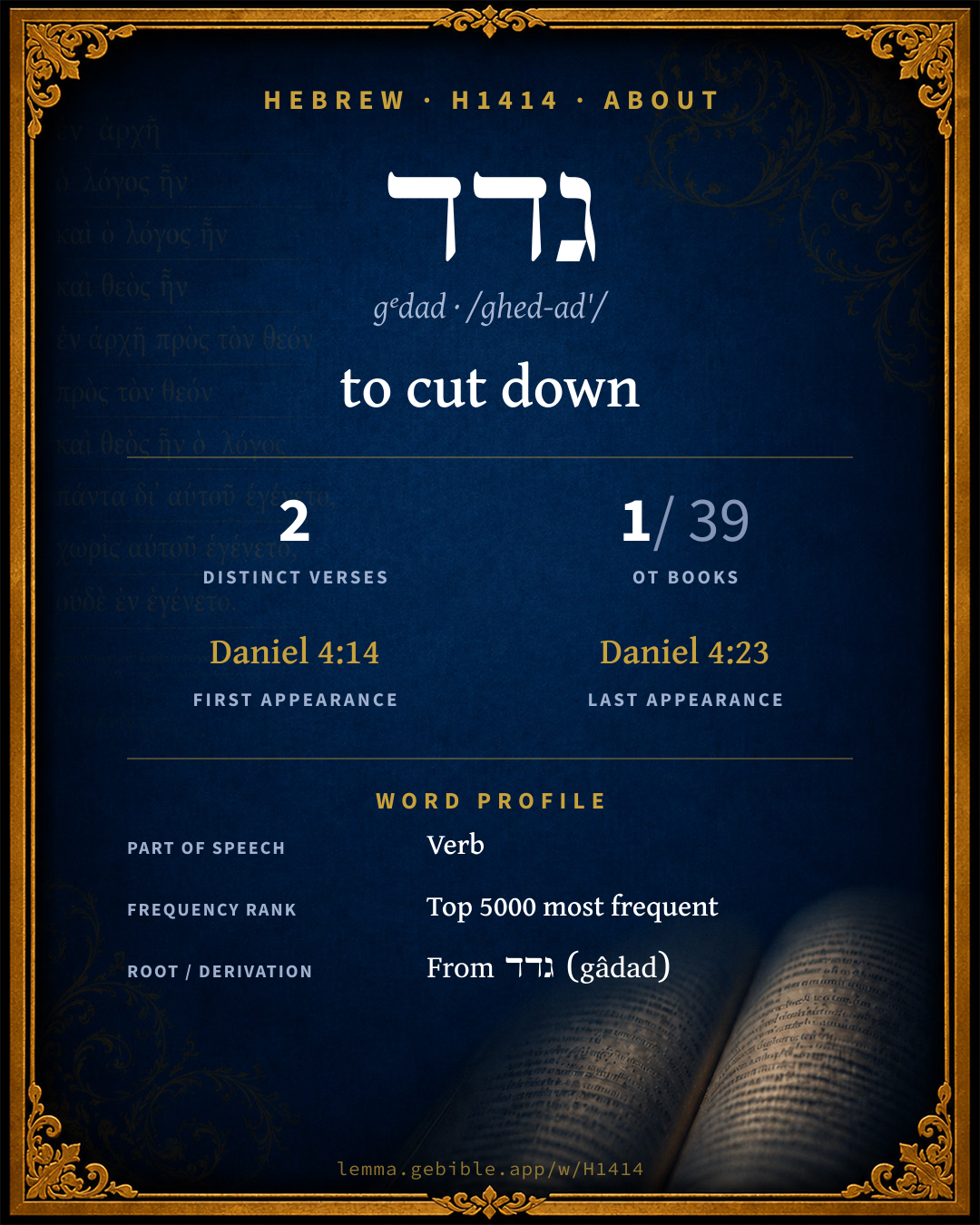
גְּדַד
to cut down
Full lexicon entry — Brown-Driver-Briggs (BDB)
From Brown-Driver-Briggs (BDB)
Where this word appears
Grammar key — what these labels mean
Part of speech
- Verb
- An action or state-of-being word.
Stem
- Qal
- The basic, simple active stem — the plain form of the verb (“he wrote”).
Form
- Imperative
- A direct command (“write!”).
Person
- 2nd Person
- The one addressed (“you”).
Gender
- Masculine
- Grammatically masculine.
Number
- Plural
- More than one (in Hebrew, generally three or more).
Every verse where H1414 appears — 2 distinct verses across 1 book. Click any verse to open its interlinear word-by-word view. Verse text shown in the World English Bible for context — . Each verse’s Hebrew form is shown with its reference; the English is not keyword-highlighted, since the data carries no word-level English alignment. Use “Compare translations” on any verse to read it across multiple English versions. This concordance covers the Hebrew Bible; Septuagint (Greek Old Testament) occurrences are not indexed here.
Daniel 2 verses
- Daniel 4:14 גֹּ֤דּוּ Qal impv 2mp He cried aloud, and said thus, Hew down the tree, and cut off its branches, shake off its leaves, and scatter its fruit: let the animals get away from under it, and the fowls from its branches.
- Daniel 4:23 גֹּ֨דּוּ Qal impv 2mp Whereas the king saw a watcher and a holy one coming down from the sky, and saying, Hew down the tree, and destroy it; nevertheless leave the stump of the roots of it in the earth, even with a band of iron and brass, in the tender grass of the field, and let it be wet with the dew of the sky: and let his portion be with the animals of the field, until seven times pass over him;
About this entry
At a glance — auto-summarized from this page’s data, not written by a person. Every figure links to its source below. This summary describes the numbers; it doesn’t interpret them.
“to cut down” is the headline sense of the Hebrew verb גדד (gᵉdad). It occurs a mere 2 verses across Scripture. More than three-quarters of its appearances fall in Daniel. Scripture first uses it in Daniel 4:14. It shares a root with גדד, גד and גדוד. See the sense tree, 2-verse concordance, and the renderings breakdown below.
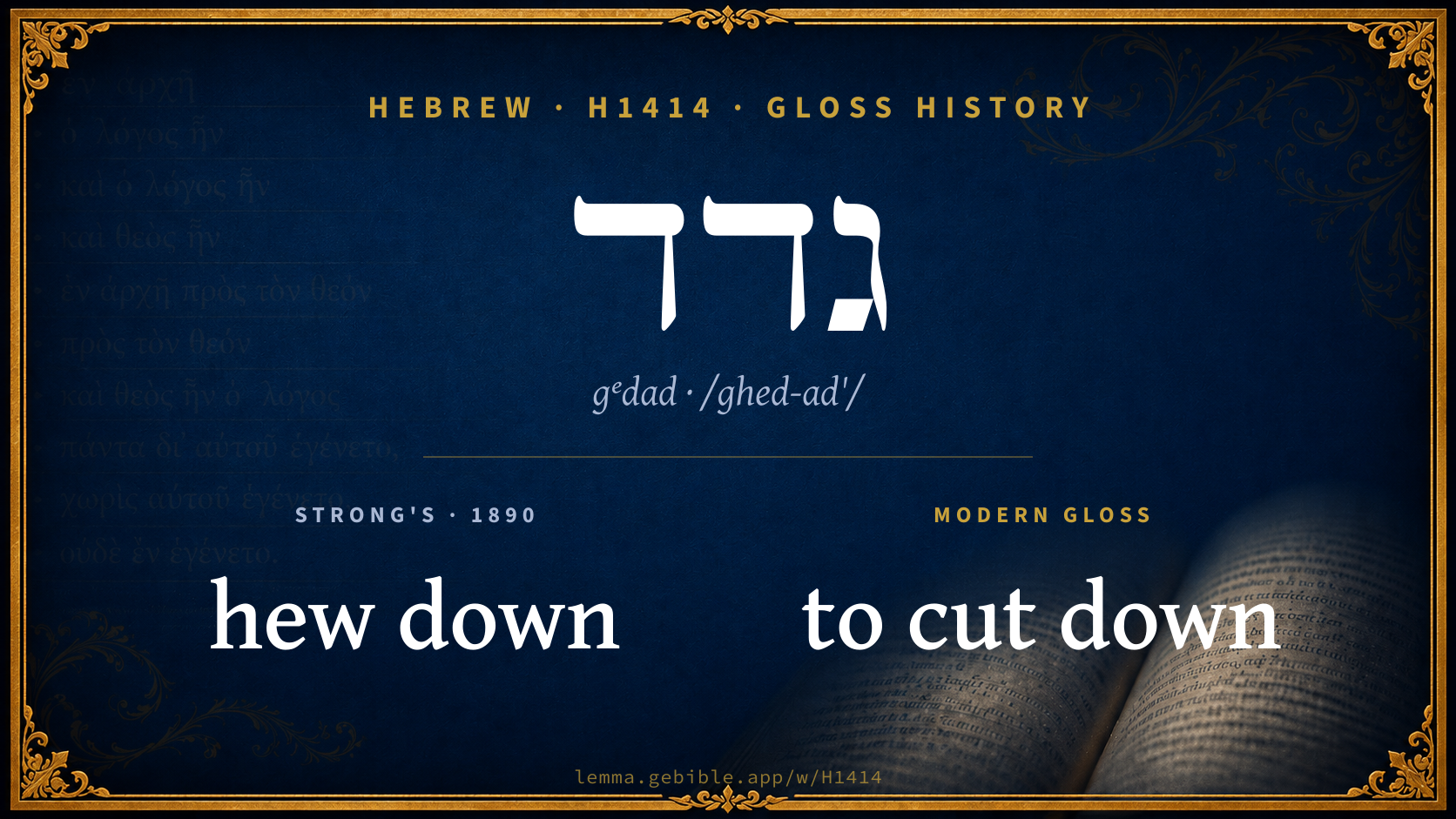
Gloss history
Strong's 1890 vs modern scholarship
About this word
Strong's H1414 catalogs a Hebrew word from the Hebrew Old Testament.
These counts are not copied from any lexicon or concordance. They are computed here, from the morphology-tagged Hebrew Old Testament. What Lemma adds →
- 2
- distinct verses
- The word appears in 2 distinct verses.
- 1 / 39
- OT books
- The word appears in 1 of 39 Old Testament books.
- #4,807
- by frequency
- Top 5000 most frequent Hebrew words (rank 4,807 of 8,640 Hebrew words by occurrence).
View all 2 occurrences in the concordance →
Most concentrated in
- Daniel 2 verses 100%
By section of the Old Testament
By traditional corpus
Conventional, traditional groupings — biblical authorship is debated, so this is a traditional corpus grouping, not an authorship claim. Each share is this word’s portion of its verses in that division of the Hebrew canon. Each figure is a share of the word’s 2 distinct verses.
- Writings (Ketuvim) 2 verses · 100%
How translations render this word
Counts come from each version’s own published word-to-Strong’s tagging or interlinear alignment — an approximate guide to how each version renders this word, not a word-level alignment the data otherwise carries. Because each total is that version’s own tagged count, the per-version totals vary from one another and need not match the appearance or distinct-verse counts above. These counts may also differ from a printed concordance because Lemma counts each distinctly tagged rendering and does not collapse phrase taggings into a single head-word total. This is a fixed set of word-tagged versions (KJV, ASV, BSB, ULT) and does not change with the reading translation you choose elsewhere. Each version’s license is shown beside its name below (and on Sources).
- King James Version: Down 1×, Hew 1×, Hew down 1×
- American Standard Version: Down 1×, Hew 1×, Hew down 1×
- Berean Standard Bible: Cut down 2×
- unfoldingWord Literal Text: Chop down 2×
King James Version Public Domain
Renders H1414 across 3 tagged occurrences — most commonly:
American Standard Version Public Domain
Renders H1414 across 3 tagged occurrences — most commonly:
Berean Standard Bible Public Domain
Renders H1414 across 2 tagged occurrences — most commonly:
unfoldingWord Literal Text CC BY-SA 4.0
Renders H1414 across 2 tagged occurrences — most commonly:
Senses in BDB
The 1 sense BDB distinguishes for this word, in lexicon order (not ranked by frequency or importance). The full entry — with sub-senses — is in the Lexicon Entry tab.
- to cut down, hew down
Word origin
[ גְּדַד ] vb. hew down
— Brown-Driver-Briggs (Oxford 1906, public domain), digitized via Sefaria, supplemented by the OpenScriptures HebrewLexicon (CC BY 4.0). See Sources.
Derived from גדד (gâdad) (H1413) — to penetrate.
Jastrow Dictionary
A second Hebrew/Aramaic lexicon for comparison, covering Aramaic and post-biblical (Talmudic, Targumic, Midrashic) usage that the biblical-Hebrew BDB does not. Matched by lemma rather than by Strong’s number, so a lemma may carry more than one Jastrow headword (shown separately below), and the entries cover usage well beyond the Bible.
גָּדַד I
- to cut, cut off. Par. II, 2; Bekh. 44ᵃ יָגוֹד let him lop off (the black tops of the horns or hoofs).—[V. גָּדַר.]—Trnsf. (cmp. קצץ) to fix the price. B. Bath. 13ᵃ גּוֹד או אָגוֹד either fix you a price for my share, or I shall do so (and buy your share); דינא דגוד או אגוד the right of settling by god o agod. Ib. אגוד איכא גוד ליכא the offer to buy is applicable in this case (the half-freed slave can offer to buy his other half), but the offer to sell cannot be made (since there is no price for a free man).—Part. pass. גָּדוּד stripped (of branches); trnsf. empty-handed. Gen. R. s. 68, beg. ג׳ שלחו (Yalk. ib. 117 גדודי) Isaac sent Jacob away without anything valuable.
- to cut off, level. Gen. R. s. 71 (play on בא גד, Gen. XXX, 11) בא מי שעתיד לגַדֵּד וכ׳ he has come who is destined to level the fastnesses of the nations (idolatry). Tanḥ. Ki Thissa 13 (play on מגדל גד, Josh. XV, 37) from there the Lord יוצא ומְגַדֵּד וכ׳ will proceed and level &c.; Ex. R. s. 40 ומגיד (corr. acc.). e.g. Genesis 30:11
- to be cut off. Keth. 51ᵃ כל העומד לִיגָּדֵד כְּגָדוּד דמי Ar. (ed. ליגזז, v. גָּזַז).
- to make incisions in one’s own body. Yeb. 13ᵇ, v. גּוּד. Tanḥ. Sh’laḥ. 15; Num. R. s. 17 קבר מת לא תִתְגּוֹדְדוּ when one buried a dead, the law says, Ye shall not &c. (Deut. XIV, 1). V. גְּדִידָה. e.g. Deuteronomy 14:1
- same. Yeb. l. c. א"כ לימא קרא לא תְּגוֹדְדוּ if it were so (that Deut. XIV, 1 meant only to forbid incisions in the body) it ought to read lo t’god’du, ye shall make no incisions. e.g. Deuteronomy 14:1
גְּדַד
- [Dan. IV, 11; 20.] Targ. Deut. XIV, 1 תְגוּדוּן, v. preced. Hithpol.—Bets. 6ᵃ אפי׳ למֵיגַד ליה וכ׳ Ar. a. Ms. M. (ed. למֵיגַז) even to cut a shroud for him (the dead, on the second Holy Day); Sabb. 150ᵇ, v. גְּזַז. e.g. Daniel 4:11
גָּדַד II
- v. גּוּד
גָּדָד
- acrid, v. גַּד I.
A Dictionary of the Targumim, the Talmud Babli and Yerushalmi, and the Midrashic Literature (Marcus Jastrow; London, Luzac, 1903) — Public Domain. Digitized via Sefaria. Digitized via Sefaria. Full attribution on Sources.
Forms in the corpus
The 2 distinct written forms H1414 takes in the Hebrew Bible, most frequent first — each parse links to that stem’s occurrences in the concordance. Hebrew forms include their vowel points and cantillation, so a single lemma takes many written forms.
| Form | Parsing | Example | Uses |
|---|---|---|---|
| גֹּ֤דּוּ | Verb, Qal, Imperative, 2nd Person, Masculine, Plural | Daniel 4:14 | 1 |
| גֹּ֨דּוּ | Verb, Qal, Imperative, 2nd Person, Masculine, Plural | Daniel 4:23 | 1 |
Same root — word family
Other BDB entries built from the same root as H1414, grouped by Strong’s listed origin. These share a root / origin per the lexicon — not necessarily a shared meaning. Each links to that word’s own entry.
Derives from
Shares the same root
- גד gad H1407 coriander
- גדוד gᵉdûwd H1416 troop
- גדוד gᵉdûwd H1417 furrow
- גדודה gᵉdûwdâh H1418 furrow
- גוד gûwd H1464 to attack
Proper names from this root
People and places named from this root — a name, not an additional meaning of the word.
Compare all same-root words → Showing 4 of 9 — not the complete family. 2 of the same-root words are proper names (people or places). They share a root, not necessarily a meaning.
Septuagint verse parallels
This word appears in 2 verses that also exist in the Greek Old Testament (Septuagint), out of the 2 Hebrew verses it occurs in. You can read those verses in Greek by switching the Old Testament edition to the Septuagint.
Read these verses in the Septuagint
This is a verse-level parallel only — the same verses exist in both the Hebrew and Greek Old Testaments. No word-level Hebrew↔Greek correspondence is claimed: the data carries no such alignment, so no Greek word is shown as this Hebrew word’s translation. Coverage is not total — the Septuagint omits the deuterocanon and renumbers the Psalms, so some Hebrew verses have no direct Greek parallel.