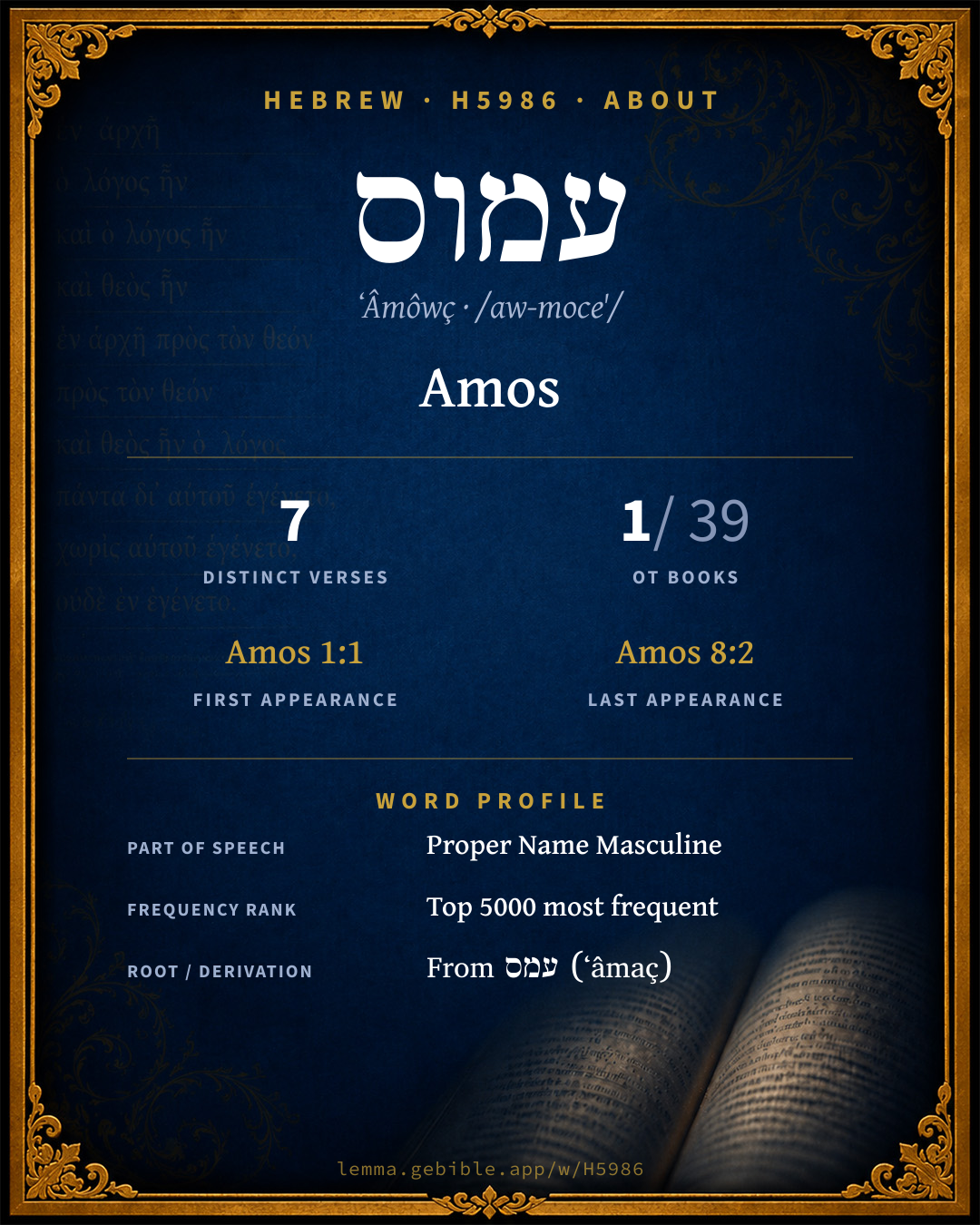
עָמוֹס
Amos
BDB lists 2 entries for ‘Amos’ fuller range ↓
Full lexicon entry — Brown-Driver-Briggs (BDB)
From Brown-Driver-Briggs (BDB)
Where this word appears
Grammar key — what these labels mean
Part of speech
- Noun
- A naming word — a person, place, thing, or idea.
Noun type
- Proper
- A name of a specific person, place, or people (e.g. Abraham, Zion, Israel).
Every verse where H5986 appears — 7 distinct verses across 1 book. Click any verse to open its interlinear word-by-word view. Verse text shown in the World English Bible for context — . Each verse’s Hebrew form is shown with its reference; the English is not keyword-highlighted, since the data carries no word-level English alignment. Use “Compare translations” on any verse to read it across multiple English versions. This concordance covers the Hebrew Bible; Septuagint (Greek Old Testament) occurrences are not indexed here.
Amos 7 verses
- Amos 1:1 עָמ֔וֹס n Proper The words of Amos, who was among the herdsmen of Tekoa, which he saw concerning Israel in the days of Uzziah king of Judah, and in the days of Jeroboam the son of Joash king of Israel, two years before the earthquake.
- Amos 7:8 עָמ֔וֹס n Proper Yahweh said to me, "Amos, what do you see?" I said, "A plumb line." Then the Lord said, "Behold, I will set a plumb line in the midst of my people Israel. I will not again pass by them any more.
- Amos 7:10 עָמ֗וֹס n Proper Then Amaziah the priest of Beth El sent to Jeroboam king of Israel, saying, "Amos has conspired against you in the midst of the house of Israel. The land is not able to bear all his words.
- Amos 7:11 עָמ֔וֹס n Proper For Amos says, 'Jeroboam will die by the sword, and Israel shall surely be led away captive out of his land.'"
- Amos 7:12 עָמ֔וֹס n Proper Amaziah also said to Amos, "You seer, go, flee away into the land of Judah, and there eat bread, and prophesy there:
- Amos 7:14 עָמוֹס֙ n Proper Then Amos answered Amaziah, "I was no prophet, neither was I a prophet's son; but I was a herdsman, and a farmer of sycamore trees;
- Amos 8:2 עָמ֔וֹס n Proper He said, "Amos, what do you see?" I said, "A basket of summer fruit." Then Yahweh said to me, "The end has come on my people Israel. I will not again pass by them any more.
About this entry
At a glance — auto-summarized from this page’s data, not written by a person. Every figure links to its source below. This summary describes the numbers; it doesn’t interpret them.
עמוס — transliterated ʻÂmôwç — is a Hebrew name carrying the sense “Amos.” Its uses cluster heavily in Amos (100% of all occurrences). Spanning 7 verses in 1 book, it ranks among the uncommon words of the Hebrew Bible. Debuting at Amos 1:1, it then recurs through the corpus. Each statement above links to its evidence; the full detail follows below.
Gloss history
Strong's 1890 vs modern scholarship
About this word
Strong's H5986 catalogs a Hebrew word from the Hebrew Old Testament.
These counts are not copied from any lexicon or concordance. They are computed here, from the morphology-tagged Hebrew Old Testament. What Lemma adds →
- 7
- distinct verses
- The word appears in 7 distinct verses.
- 1 / 39
- OT books
- The word appears in 1 of 39 Old Testament books.
- #2,835
- by frequency
- Top 5000 most frequent Hebrew words (rank 2,835 of 8,640 Hebrew words by occurrence).
View all 7 occurrences in the concordance →
Most concentrated in
- Amos 7 verses 100%
By section of the Old Testament
By traditional corpus
Conventional, traditional groupings — biblical authorship is debated, so this is a traditional corpus grouping, not an authorship claim. Each share is this word’s portion of its verses in that division of the Hebrew canon. Each figure is a share of the word’s 7 distinct verses.
- Prophets (Nevi'im) 7 verses · 100%
How translations render this word
Counts come from each version’s own published word-to-Strong’s tagging or interlinear alignment — an approximate guide to how each version renders this word, not a word-level alignment the data otherwise carries. Because each total is that version’s own tagged count, the per-version totals vary from one another and need not match the appearance or distinct-verse counts above. These counts may also differ from a printed concordance because Lemma counts each distinctly tagged rendering and does not collapse phrase taggings into a single head-word total. This is a fixed set of word-tagged versions (KJV, ASV, BSB, ULT) and does not change with the reading translation you choose elsewhere. Each version’s license is shown beside its name below (and on Sources).
- King James Version: Amos 7×
- American Standard Version: Amos 6×
- Berean Standard Bible: Amos 7×
- unfoldingWord Literal Text: Amos 7×
King James Version Public Domain
Renders H5986 across 7 tagged occurrences — most commonly:
American Standard Version Public Domain
Renders H5986 across 7 tagged occurrences — most commonly:
Plus 1 rendering that appears only once — usually multi-word phrases or single function words the recovered tagging swept in, not distinct renderings.
Berean Standard Bible Public Domain
Renders H5986 across 7 tagged occurrences — most commonly:
unfoldingWord Literal Text CC BY-SA 4.0
Renders H5986 across 7 tagged occurrences — most commonly:
Senses in BDB
The 2 senses BDB distinguishes for this word, in lexicon order (not ranked by frequency or importance). The full entry — with sub-senses — is in the Lexicon Entry tab.
- Amos = "burden"
- a prophet of the Lord who prophesied in the northern kingdom…
Word origin
n.pr.m. Amos the prophet;—Am 1:1; 7:8, 10, 11, 12, 14; 8:2, 𝔊 Αμως.
— Brown-Driver-Briggs (Oxford 1906, public domain), digitized via Sefaria, supplemented by the OpenScriptures HebrewLexicon (CC BY 4.0). See Sources.
Derived from עמס (ʻâmaç) (H6006) — to load.
Jastrow Dictionary
A second Hebrew/Aramaic lexicon for comparison, covering Aramaic and post-biblical (Talmudic, Targumic, Midrashic) usage that the biblical-Hebrew BDB does not. Matched by lemma rather than by Strong’s number, so a lemma may carry more than one Jastrow headword (shown separately below), and the entries cover usage well beyond the Bible.
עָמוּס
- , v. עָמַס
עָמוֹס
- (b. h.) pr. n. m. Amos, the prophet. Macc. 24ᵃ, v. עָמַד. Lev. R. s. 10, beg. שלחתי את ע׳ וכ׳ I sent Amos, and they named him Psellos (stammerer), v. עָמַס; Koh. R. to I, 1; Pesik. Naḥ., p. 125ᵇ; Yalk. Is. 307. Ned. 38ᵃ; a. e.
A Dictionary of the Targumim, the Talmud Babli and Yerushalmi, and the Midrashic Literature (Marcus Jastrow; London, Luzac, 1903) — Public Domain. Digitized via Sefaria. Digitized via Sefaria. Full attribution on Sources.
Forms in the corpus
The 3 distinct written forms H5986 takes in the Hebrew Bible, most frequent first — each parse links to that state’s occurrences in the concordance. Hebrew forms include their vowel points and cantillation, so a single lemma takes many written forms.
| Form | Parsing | Example | Uses |
|---|---|---|---|
| עָמ֔וֹס | Noun, Proper | Amos 1:1 | 5 |
| עָמ֗וֹס | Noun, Proper | Amos 7:10 | 1 |
| עָמוֹס֙ | Noun, Proper | Amos 7:14 | 1 |
Same root — word family
Other BDB entries built from the same root as H5986, grouped by Strong’s listed origin. These share a root / origin per the lexicon — not necessarily a shared meaning. Each links to that word’s own entry.
Derives from
Shares the same root
Proper names from this root
People and places named from this root — a name, not an additional meaning of the word.
- עמסיה ʻĂmaçyâh H6007 Amasiah
- עמשא ʻĂmâsâʼ H6021 Amasa
- עמשי ʻĂmâsay H6022 Amasai
- עמשסי ʻĂmashçay H6023 Amashai
Compare all same-root words → Showing 4 of 7 — not the complete family. 4 of the same-root words are proper names (people or places). They share a root, not necessarily a meaning.
Bible dictionary
Public-domain dictionary articles matched to this entry by name (Amos). A biblical name can be shared by more than one person or place, so an article may treat several.
Easton's Bible Dictionary · M. G. Easton, 1897
Borne; a burden, one of the twelve minor prophets. He was a native of Tekota, the modern Tekua, a town about 12 miles south-east of Bethlehem. He was a man of humble birth, neither a "prophet nor a prophet's son," but "an herdman and a dresser of sycomore trees," R.V. He prophesied in the days of Uzziah, king of Judah, and was contemporary with Isaiah and Hosea (Amos 1:1; 7:14, 15; Zech. 14:5), who survived him a few years. Under Jeroboam II. the kingdom of Israel rose to the zenith of its prosperity; but that was followed by the prevalence of luxury and vice and idolatry. At this period Amos was called from his obscurity to remind the people of the law of God's retributive justice, and to call them to repentance.
The Book of Amos consists of three parts:
(1.) The nations around are summoned to judgment because of their sins (1:1-2:3). He quotes Joel 3:16.
(2.) The spiritual condition of Judah, and especially of Israel, is described (2:4-6:14).
(3.) In 7:1-9:10 are recorded five prophetic visions. (a) The first two (7:1-6) refer to judgments against the guilty people. (b) The next two (7:7-9; 8:1-3) point out the ripeness of the people for the threatened judgements. 7:10-17 consists of a conversation between the prophet and the priest of Bethel. (c) The fifth describes the overthrow and ruin of Israel (9:1-10); to which is added the promise of the restoration of the kingdom and its final glory in the Messiah's kingdom.
The style is peculiar in the number of the allusions made to natural objects and to agricultural occupations. Other allusions show also that Amos was a student of the law as well as a "child of nature." These phrases are peculiar to him: "Cleanness of teeth" [i.e., want of bread] (4:6); "The excellency of Jacob" (6:8; 8:7); "The high places of Isaac" (7:9); "The house of Isaac" (7:16); "He that createth the wind" (4:13). Quoted, Acts 7:42.
Smith's Bible Dictionary · William Smith, 1863
(burden), native of Tekoa in Judah, about six miles south of Bethlehem, originally a shepherd and dresser of sycamore trees, who was called by God s Spirit to be a prophet, although not trained in any of the regular prophetic schools. (Amos 1:1; 7:14,15) He travelled from Judah into the northern kingdom of Israel or Ephraim, and there exercised his ministry, apparently not for any long time. (His date cannot be later than B.C. 808 for he lived in the reigns of Uzziah king of Judah and Jeroboam king of Israel; but his ministry probably took place at an earlier date, perhaps about the middle of Jeroboam's reign Nothing is known of the time or manner of his death.--ED.)
Hitchcock's Bible Names Dictionary · Roswell D. Hitchcock, 1869
loading; weighty
Classic public-domain reference works; full attribution on Sources.
Septuagint verse parallels
This word appears in 7 verses that also exist in the Greek Old Testament (Septuagint), out of the 7 Hebrew verses it occurs in. You can read those verses in Greek by switching the Old Testament edition to the Septuagint.
Read these verses in the Septuagint
This is a verse-level parallel only — the same verses exist in both the Hebrew and Greek Old Testaments. No word-level Hebrew↔Greek correspondence is claimed: the data carries no such alignment, so no Greek word is shown as this Hebrew word’s translation. Coverage is not total — the Septuagint omits the deuterocanon and renumbers the Psalms, so some Hebrew verses have no direct Greek parallel.