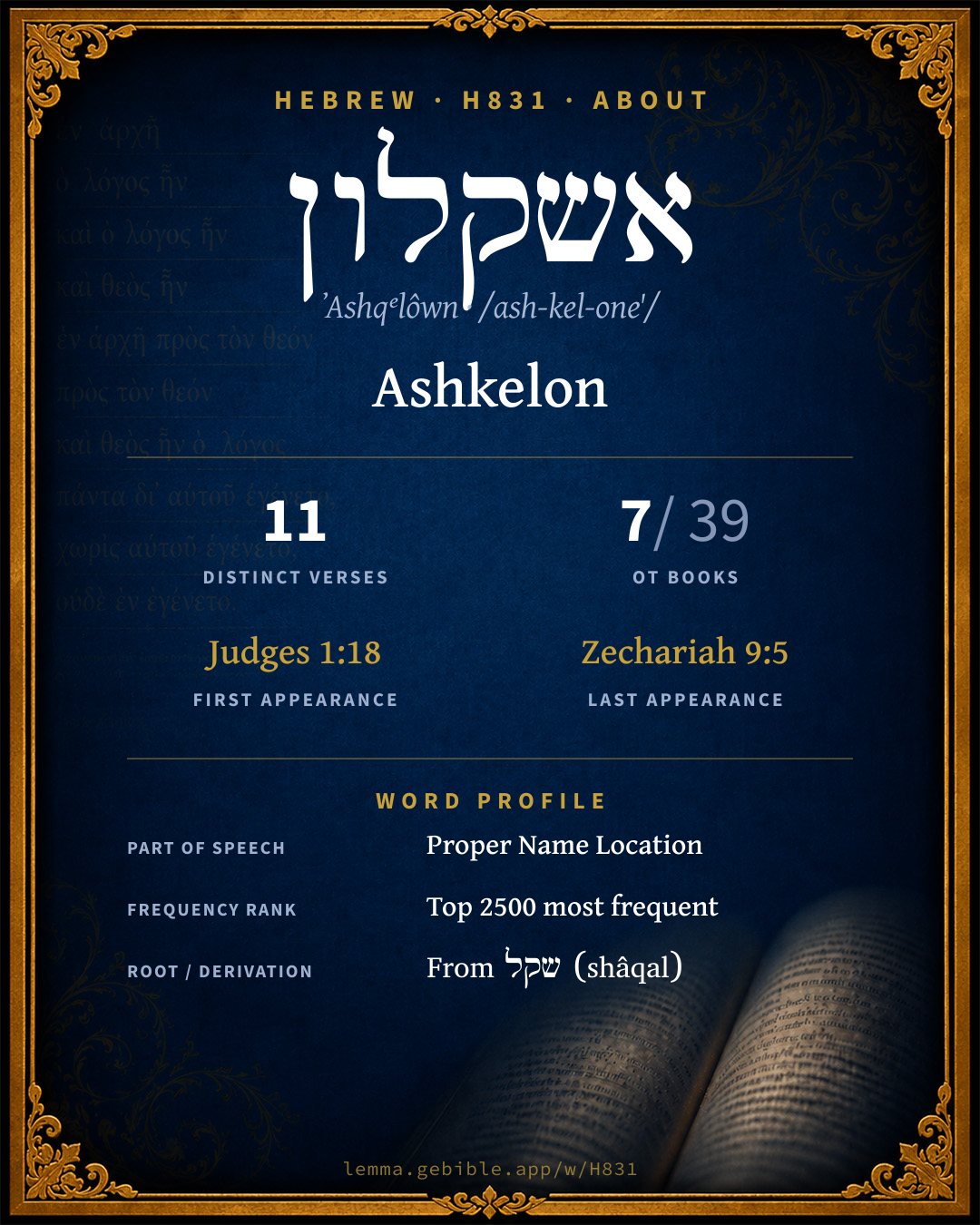
אַשְׁקְלוֹן
Ashkelon
BDB lists 2 entries for ‘Ashkelon’ fuller range ↓
Full lexicon entry — Brown-Driver-Briggs (BDB)
From Brown-Driver-Briggs (BDB)
Where this word appears
Grammar key — what these labels mean
Part of speech
- Noun
- A naming word — a person, place, thing, or idea.
Noun type
- Proper
- A name of a specific person, place, or people (e.g. Abraham, Zion, Israel).
Every verse where H831 appears — 11 distinct verses across 7 books. Click any verse to open its interlinear word-by-word view. Verse text shown in the World English Bible for context — . Each verse’s Hebrew form is shown with its reference; the English is not keyword-highlighted, since the data carries no word-level English alignment. Use “Compare translations” on any verse to read it across multiple English versions. This concordance covers the Hebrew Bible; Septuagint (Greek Old Testament) occurrences are not indexed here.
Judges 2 verses
- Judges 1:18 אַשְׁקְל֖וֹן n Proper Also Judah took Gaza with the border of it, and Ashkelon with the border of it, and Ekron with the border of it.
- Judges 14:19 אַשְׁקְל֜וֹן n Proper The Spirit of Yahweh came mightily on him, and he went down to Ashkelon, and struck thirty men of them, and took their spoil, and gave the changes [of clothing] to those who declared the riddle. His anger was kindled, and he went up to his father's house.
1 Samuel 1 verse
2 Samuel 1 verse
Jeremiah 3 verses
- Jeremiah 25:20 אַשְׁקְל֤וֹן n Proper and all the mixed people, and all the kings of the land of the Uz, and all the kings of the Philistines, and Ashkelon, and Gaza, and Ekron, and the remnant of Ashdod;
- Jeremiah 47:5 אַשְׁקְל֖וֹן n Proper Baldness is come on Gaza; Ashkelon is brought to nothing, the remnant of their valley: how long will you cut yourself?
- Jeremiah 47:7 אַשְׁקְל֛וֹן n Proper How can you be quiet, seeing Yahweh has given you a charge? Against Ashkelon, and against the sea-shore, there has he appointed it.
Amos 1 verse
Zephaniah 2 verses
- Zephaniah 2:4 וְ/אַשְׁקְל֖וֹן conj + n Proper For Gaza will be forsaken, and Ashkelon a desolation. They will drive out Ashdod at noonday, and Ekron will be rooted up.
- Zephaniah 2:7 אַשְׁקְל֗וֹן n Proper The coast will be for the remnant of the house of Judah. They will find pasture. In the houses of Ashkelon, they will lie down in the evening, for Yahweh, their God, will visit them, and restore them.
Zechariah 1 verse
About this entry
At a glance — auto-summarized from this page’s data, not written by a person. Every figure links to its source below. This summary describes the numbers; it doesn’t interpret them.
אשקלון (ʼAshqᵉlôwn) is a Hebrew name most often rendered “Ashkelon.” It first appears in Judges 1:18. The Hebrew Bible uses it across 11 verses — uncommon. Jeremiah dominates its distribution — 3 of 11 verses. The sections below give every occurrence and version rendering.
Gloss history
Strong's 1890 vs modern scholarship
About this word
Strong's H831 catalogs a Hebrew word from the Hebrew Old Testament.
These counts are not copied from any lexicon or concordance. They are computed here, from the morphology-tagged Hebrew Old Testament. What Lemma adds →
- 11
- distinct verses
- The word appears in 11 distinct verses.
- 7 / 39
- OT books
- The word appears in 7 of 39 Old Testament books.
- #2,101
- by frequency
- Top 2500 most frequent Hebrew words (rank 2,101 of 8,640 Hebrew words by occurrence).
View all 11 occurrences in the concordance →
By section of the Old Testament
By traditional corpus
Conventional, traditional groupings — biblical authorship is debated, so this is a traditional corpus grouping, not an authorship claim. Each share is this word’s portion of its verses in that division of the Hebrew canon. Each figure is a share of the word’s 11 distinct verses.
- Prophets (Nevi'im) 11 verses · 100%
How translations render this word
Counts come from each version’s own published word-to-Strong’s tagging or interlinear alignment — an approximate guide to how each version renders this word, not a word-level alignment the data otherwise carries. Because each total is that version’s own tagged count, the per-version totals vary from one another and need not match the appearance or distinct-verse counts above. These counts may also differ from a printed concordance because Lemma counts each distinctly tagged rendering and does not collapse phrase taggings into a single head-word total. This is a fixed set of word-tagged versions (KJV, ASV, BSB, ULT) and does not change with the reading translation you choose elsewhere. Each version’s license is shown beside its name below (and on Sources).
- King James Version: Ashkelon 8×, Askelon 2×
- American Standard Version: Ashkelon 8×
- Berean Standard Bible: Ashkelon 12×
- unfoldingWord Literal Text: Ashkelon 10×
King James Version Public Domain
Renders H831 across 12 tagged occurrences — most commonly:
Plus 2 renderings that appear only once — usually multi-word phrases or single function words the recovered tagging swept in, not distinct renderings.
American Standard Version Public Domain
Renders H831 across 12 tagged occurrences — most commonly:
Plus 4 renderings that appear only once — usually multi-word phrases or single function words the recovered tagging swept in, not distinct renderings.
Berean Standard Bible Public Domain
Renders H831 across 12 tagged occurrences — most commonly:
unfoldingWord Literal Text CC BY-SA 4.0
Renders H831 across 10 tagged occurrences — most commonly:
Senses in BDB
The 2 senses BDB distinguishes for this word, in lexicon order (not ranked by frequency or importance). The full entry — with sub-senses — is in the Lexicon Entry tab.
- Askelon or Ashkelon = "the fire of infamy: I shall be weighed"
- a maritime city of the Philistines, southwest of Jerusalem
Word origin
n.pr.loc. a city of the Philistines (Assyrian Isqaluna COTGloss DlPa 290; Ph. adj. gent. cf. infr.) Ju 1:18; 14:19 1 S 6:17 2 S 1:20 Je 25:20; 47:5, 7 Am 1:8 Zp 2:4, 7 Zc 9:5(×2); on the Medit. Sea, S. of W. from Jerusalem, mod. ʿAsqalân, Surveyiii. 237 f. (with plan); cf. also ZPV ii. 164 f.
— Brown-Driver-Briggs (Oxford 1906, public domain), digitized via Sefaria, supplemented by the OpenScriptures HebrewLexicon (CC BY 4.0). See Sources.
Derived from שקל (shâqal) (H8254) — to weigh.
Jastrow Dictionary
A second Hebrew/Aramaic lexicon for comparison, covering Aramaic and post-biblical (Talmudic, Targumic, Midrashic) usage that the biblical-Hebrew BDB does not. Matched by lemma rather than by Strong’s number, so a lemma may carry more than one Jastrow headword (shown separately below), and the entries cover usage well beyond the Bible.
אַשְׁקְלוֹן
- (b. h.) Ashkelon, a Philistian town. Y. Shebi. VI, 36ᶜ; Sifré Deut. 51, v. גִּינְּתָא; a. e.—Deriv. אַשְׁקְלוֹנִי m. Ashkelonian. Y. Peah I, 15ᶜ top.—Pl. אַשְׁקְלוֹנִים, נִין … Kel. XIII, 7 Ashk. levers; a. e.
A Dictionary of the Targumim, the Talmud Babli and Yerushalmi, and the Midrashic Literature (Marcus Jastrow; London, Luzac, 1903) — Public Domain. Digitized via Sefaria. Digitized via Sefaria. Full attribution on Sources.
Forms in the corpus
The 9 distinct written forms H831 takes in the Hebrew Bible, most frequent first — each parse links to that state’s occurrences in the concordance. Hebrew forms include their vowel points and cantillation, so a single lemma takes many written forms.
| Form | Parsing | Example | Uses |
|---|---|---|---|
| אַשְׁקְל֖וֹן | Noun, Proper | Jeremiah 47:5 | 2 |
| אַשְׁקְל֜וֹן | Noun, Proper | Judges 14:19 | 2 |
| וְ/אַשְׁקְל֖וֹן | Noun, Proper | Zechariah 9:5 | 2 |
| אַשְׁקְל֑וֹן | Noun, Proper | 2 Samuel 1:20 | 1 |
| אַשְׁקְל֗וֹן | Noun, Proper | Zephaniah 2:7 | 1 |
| אַשְׁקְל֛וֹן | Noun, Proper | Jeremiah 47:7 | 1 |
| אַשְׁקְל֤וֹן | Noun, Proper | Jeremiah 25:20 | 1 |
| לְ/אַשְׁקְל֣וֹן | Noun, Proper | 1 Samuel 6:17 | 1 |
| מֵֽ/אַשְׁקְל֑וֹן | Noun, Proper | Amos 1:8 | 1 |
Same root — word family
Other BDB entries built from the same root as H831, grouped by Strong’s listed origin. These share a root / origin per the lexicon — not necessarily a shared meaning. Each links to that word’s own entry.
Derives from
Shares the same root
- משקול mishqôwl H4946 weight
- משקל mishqâl H4948 weight
- שקל sheqel H8255 shekel
- תקל tᵉqal H8625 to weigh
Proper names from this root
People and places named from this root — a name, not an additional meaning of the word.
Compare all same-root words → Showing 4 of 7 — not the complete family. 1 of the same-root words is a proper name (a person or place). They share a root, not necessarily a meaning.
Bible dictionary
Public-domain dictionary articles matched to this entry by name (Ashkelon). A biblical name can be shared by more than one person or place, so an article may treat several.
Easton's Bible Dictionary · M. G. Easton, 1897
=Askelon=Ascalon, was one of the five cities of the Philistines (Josh. 13:3; 1 Sam. 6:17). It stood on the shore of the Mediterranean, 12 miles north of Gaza. It is mentioned on an inscription at Karnak in Egypt as having been taken by king Rameses II., the oppressor of the Hebrews. In the time of the judges (Judg. 1:18) it fell into the possession of the tribe of Judah; but it was soon after retaken by the Philistines (2 Sam. 1:20), who were not finally dispossessed till the time of Alexander the Great. Samson went down to this place from Timnath, and slew thirty men and took their spoil. The prophets foretold its destruction (Jer. 25:20; 47:5, 7). It became a noted place in the Middle Ages, having been the scene of many a bloody battle between the Saracens and the Crusaders. It was beseiged and taken by Richard the Lion-hearted, and "within its walls and towers now standing he held his court." Among the Tell Amarna tablets (see EGYPT) are found letters or official despatches from Yadaya, "captain of horse and dust of the king's feet," to the "great king" of Egypt, dated from Ascalon. It is now called Askalan.
Classic public-domain reference works; full attribution on Sources.
Septuagint verse parallels
This word appears in 11 verses that also exist in the Greek Old Testament (Septuagint), out of the 11 Hebrew verses it occurs in. You can read those verses in Greek by switching the Old Testament edition to the Septuagint.
Read these verses in the Septuagint
This is a verse-level parallel only — the same verses exist in both the Hebrew and Greek Old Testaments. No word-level Hebrew↔Greek correspondence is claimed: the data carries no such alignment, so no Greek word is shown as this Hebrew word’s translation. Coverage is not total — the Septuagint omits the deuterocanon and renumbers the Psalms, so some Hebrew verses have no direct Greek parallel.