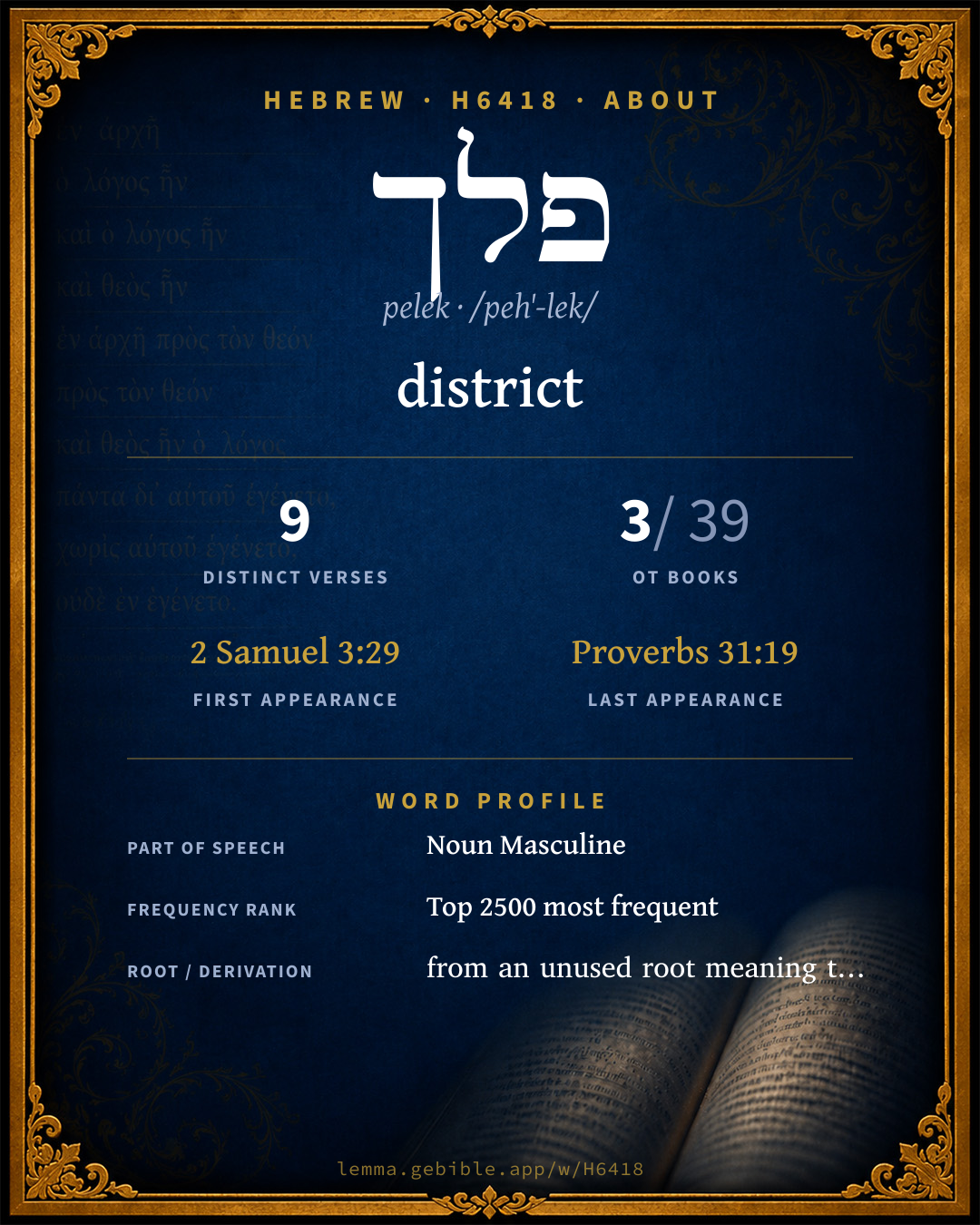
פֶּ֫לֶךְ
district
also: whirl of spindle, stick fuller range ↓
Full lexicon entry — Brown-Driver-Briggs (BDB)
From Brown-Driver-Briggs (BDB)
Where this word appears
See every Construct-state word in the Hebrew Bible →
Grammar key — what these labels mean
Part of speech
- Noun
- A naming word — a person, place, thing, or idea.
Noun type
- Common
- A common noun — a general class of person, place, or thing (“king,” “city,” “water”), not a specific name.
State
- Construct
- A noun bound to a following noun in a possessive / “of” relationship (the construct chain).
- Absolute
- The independent form of a noun, not bound to a following word.
Gender
- Masculine
- Grammatically masculine.
Number
- Singular
- One.
Grammatical forms
- Noun, Common, Masculine, Singular, Construct 8 times (80%)
- Noun, Common, Masculine, Singular, Absolute 2 times (20%)
Parsed forms decoded from the imported morphology (morphhb / Westminster Leningrad Codex — WLC text public domain, morphhb tagging CC BY 4.0), counted across 10 parsed occurrences — not distinct verses.
Every verse where H6418 appears — 9 distinct verses across 3 books. Click any verse to open its interlinear word-by-word view. Verse text shown in the World English Bible for context — . Each verse’s Hebrew form is shown with its reference; the English is not keyword-highlighted, since the data carries no word-level English alignment. Use “Compare translations” on any verse to read it across multiple English versions. This concordance covers the Hebrew Bible; Septuagint (Greek Old Testament) occurrences are not indexed here.
2 Samuel 1 verse
Nehemiah 7 verses
- Nehemiah 3:9 פֶּ֥לֶךְ n c ms cs Next to them repaired Rephaiah the son of Hur, the ruler of half the district of Jerusalem.
- Nehemiah 3:12 פֶּ֣לֶךְ n c ms cs Next to him repaired Shallum the son of Hallohesh, the ruler of half the district of Jerusalem, he and his daughters.
- Nehemiah 3:14 פֶּ֣לֶךְ n c ms cs The dung gate repaired Malchijah the son of Rechab, the ruler of the district of Beth Haccherem; he built it, and set up the doors of it, the bolts of it, and the bars of it.
- Nehemiah 3:15 פֶּ֣לֶךְ n c ms cs The spring gate repaired Shallun the son of Colhozeh, the ruler of the district of Mizpah; he built it, and covered it, and set up the doors of it, the bolts of it, and the bars of it, and the wall of the pool of Shelah by the king's garden, even to the stairs that go down from the city of David.
- Nehemiah 3:16 פֶּ֣לֶךְ n c ms cs After him repaired Nehemiah the son of Azbuk, the ruler of half the district of Beth Zur, to the place over against the tombs of David, and to the pool that was made, and to the house of the mighty men.
- Nehemiah 3:17 פֶ֥לֶךְ לְ/פִלְכּֽ/וֹ n c ms cs prep + n c ms cs + sfx pers 3ms After him repaired the Levites, Rehum the son of Bani. Next to him repaired Hashabiah, the ruler of half the district of Keilah, for his district.
- Nehemiah 3:18 פֶּ֥לֶךְ n c ms cs After him repaired their brothers, Bavvai the son of Henadad, the ruler of half the district of Keilah.
Proverbs 1 verse
About this entry
At a glance — auto-summarized from this page’s data, not written by a person. Every figure links to its source below. This summary describes the numbers; it doesn’t interpret them.
פלך (pelek) is a Hebrew noun most often rendered “district.” It clusters heavily in Nehemiah, which alone accounts for 78% of its uses. It turns up in 9 verses across 3 books, an uncommon footprint. Beyond its headline sense, its full sense range takes in “whirl of spindle” and “stick”. Older and newer Bibles part ways — “part” in the King James Version, “district of” (unfoldingWord Literal Text) in modern versions. See the renderings breakdown. The sections below give every sense, occurrence, and version rendering.
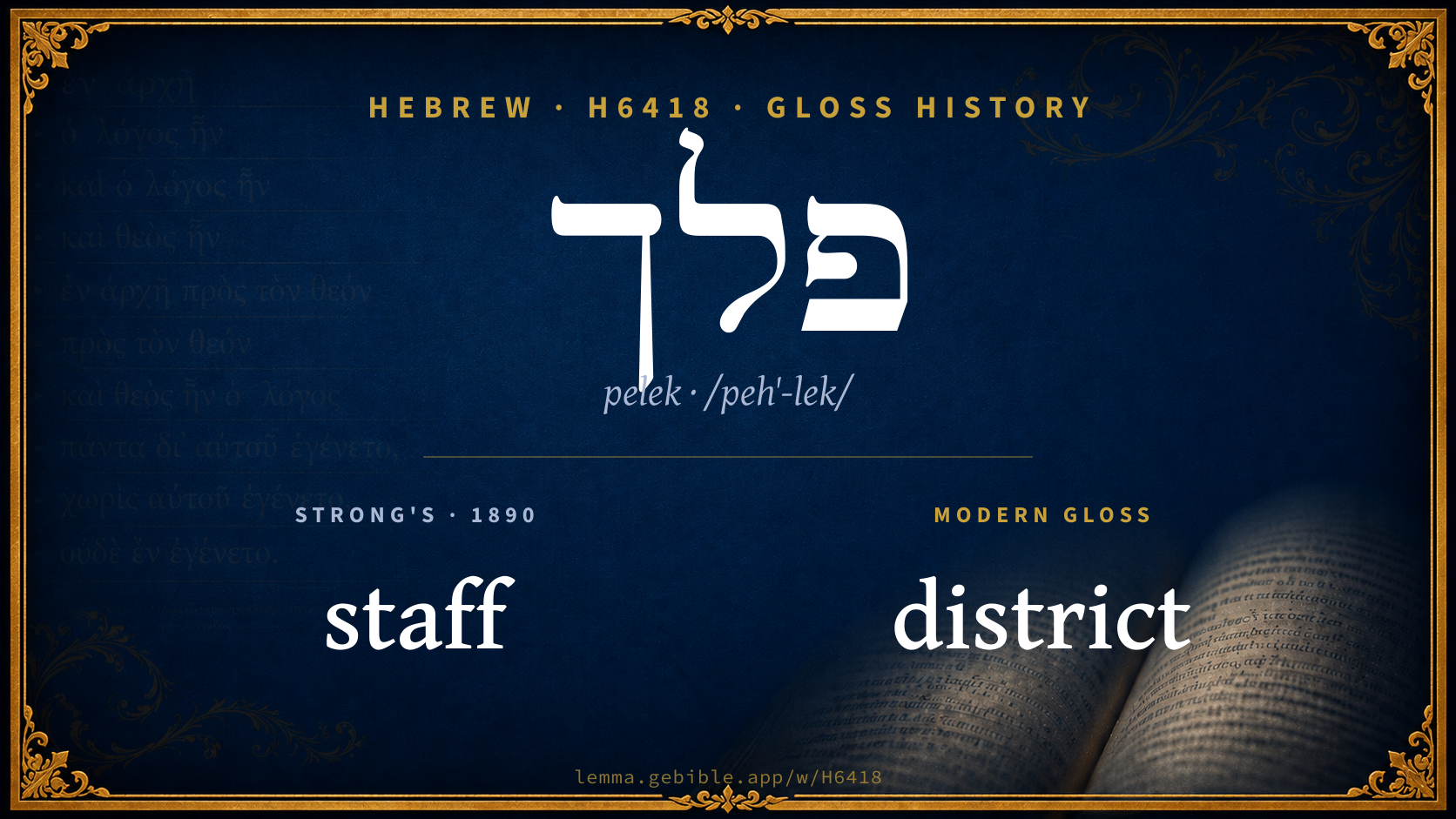
Gloss history
Strong's 1890 vs modern scholarship
About this word
Strong's H6418 catalogs a Hebrew word from the Hebrew Old Testament.
These counts are not copied from any lexicon or concordance. They are computed here, from the morphology-tagged Hebrew Old Testament. What Lemma adds →
- 9
- distinct verses
- The word appears in 9 distinct verses.
- 3 / 39
- OT books
- The word appears in 3 of 39 Old Testament books.
- #2,342
- by frequency
- Top 2500 most frequent Hebrew words (rank 2,342 of 8,640 Hebrew words by occurrence).
View all 9 occurrences in the concordance →
By section of the Old Testament
By traditional corpus
Conventional, traditional groupings — biblical authorship is debated, so this is a traditional corpus grouping, not an authorship claim. Each share is this word’s portion of its verses in that division of the Hebrew canon. Each figure is a share of the word’s 9 distinct verses.
- Writings (Ketuvim) 8 verses · 89%
- Prophets (Nevi'im) 1 verse · 11%
How translations render this word
Counts come from each version’s own published word-to-Strong’s tagging or interlinear alignment — an approximate guide to how each version renders this word, not a word-level alignment the data otherwise carries. Because each total is that version’s own tagged count, the per-version totals vary from one another and need not match the appearance or distinct-verse counts above. These counts may also differ from a printed concordance because Lemma counts each distinctly tagged rendering and does not collapse phrase taggings into a single head-word total. This is a fixed set of word-tagged versions (KJV, ASV, BSB, ULT) and does not change with the reading translation you choose elsewhere. Each version’s license is shown beside its name below (and on Sources).
- King James Version: Part 8×
- American Standard Version: District 8×
- Berean Standard Bible: District 3×
- unfoldingWord Literal Text: District of 7×
King James Version Public Domain
Renders H6418 across 10 tagged occurrences — most commonly:
Plus 2 renderings that appear only once — usually multi-word phrases or single function words the recovered tagging swept in, not distinct renderings.
American Standard Version Public Domain
Renders H6418 across 10 tagged occurrences — most commonly:
Plus 2 renderings that appear only once — usually multi-word phrases or single function words the recovered tagging swept in, not distinct renderings.
Berean Standard Bible Public Domain
Renders H6418 across 5 tagged occurrences — most commonly:
Plus 2 renderings that appear only once — usually multi-word phrases or single function words the recovered tagging swept in, not distinct renderings. Not rendered by a distinct English word in 5 further occurrences.
unfoldingWord Literal Text CC BY-SA 4.0
Renders H6418 across 10 tagged occurrences — most commonly:
Plus 3 renderings that appear only once — usually multi-word phrases or single function words the recovered tagging swept in, not distinct renderings.
Senses in the full BDB
What do BDB’s symbols mean?
BDB uses these scholarly abbreviations:
| Symbol | Meaning |
|---|---|
| 𝔊 | the Septuagint (the ancient Greek translation, LXX) |
| 𝔙 | the Vulgate (the Latin translation) |
| 𝔖 | the Syriac version (the Peshitta) |
| 𝔗 | the Targum (the Aramaic translation) |
| ψ | the Psalms |
| √ | root (the underlying root or stem) |
| ‖ | parallel passage (a synonymous or contrasted parallel) |
| † | the dagger: every passage where the word occurs is cited |
The 2 senses and sub-senses the full Brown-Driver-Briggs lexicon distinguishes for this word, in lexicon order (not ranked by frequency), with BDB’s own verbatim wording and sub-sense lettering. Shown in Hebrew script with BDB’s own scholarly abbreviations. The condensed entry is in the Lexicon Entry tab. See also the Forms in the corpus table below.
- 1. whirl of spindle, 2 S 3:29 (prob., v. Dr), Pr 31:19 (‖ כִּישׁוֹר). e.g. 2 Samuel 3:29
- 2. district, Ne 3:9, 12, 14, 15, 16, 17(×2), 18. e.g. Nehemiah 3:9
Senses from the full Brown-Driver-Briggs lexicon (Brown, Driver, Briggs; Oxford 1906 — public domain), digitized via Sefaria, supplemented by the OpenScriptures HebrewLexicon (CC BY 4.0). Full attribution on Sources.
Word origin
n.[m.] 1. whirl of spindle. 2. district (proposes circle, circuit);—abs. פ׳ 2 S 3:29, פָּ֑לֶךְ Pr 31:19; cstr. פֶּלֶךְ Ne 3:9 +; sf. פִּלְכּוֹ v 17;—
— Brown-Driver-Briggs (Oxford 1906, public domain), digitized via Sefaria, supplemented by the OpenScriptures HebrewLexicon (CC BY 4.0). See Sources.
Origin: from an unused root meaning to be round
Jastrow Dictionary
A second Hebrew/Aramaic lexicon for comparison, covering Aramaic and post-biblical (Talmudic, Targumic, Midrashic) usage that the biblical-Hebrew BDB does not. Matched by lemma rather than by Strong’s number, so a lemma may carry more than one Jastrow headword (shown separately below), and the entries cover usage well beyond the Bible.
פֶּלֶךְ
- פלך to cut out, round; cmp. פֶּלַח) [circle,]
- 1. district. B. Bath. 21ᵃ התקינו … בכל פ׳ ופ׳ they ordained that teachers must be appointed, one for each district. Macc. 7ᵃ. Ib. 12ᵇ בן לוי … גולה מפ׳ לפ׳ … לפִלְכוֹ פִּלְכוֹ קולט a Levite (native of a place of refuge) who has killed a person accidentally flees from one district to another, but if he flees to his own native (juridical) district, his district protects him; Zeb. 117ᵃ; Yalk. Ex. 323; a. fr.—Pl. פְּלָכִים, פְּלָכִין. Tosef. Bicc. II, 8 לא … יחידים אלא פ׳ פ׳ they did not go up (to Jerusalem, with the first-fruits) singly, but by districts.
- 2. [ball of tow, wool &c.,] distaff or spindle. Keth. IX, 4 (86ᵇ) על פִּילְכָהּ ועל עיסתה a husband may administer an oath to his wife on her distaff (on what she spins or weaves) and on her dough. Yoma 66ᵇ (in answer to a woman’s question) אין חכמה לאשה אלא בפ׳ there is no wisdom for woman except at the distaff. Gen. R. s. 56, end לאשה שנתעשרה מפִּלְכָהּ … ומן הפ׳ הזה וכ׳ (Ar. מפלחה … הפלח) like a woman that became rich through her distaff (or spindle, spinning or weaving), and she says, since I have become rich through this distaff (spindle), it shall not part from &c.; a. fr.—Trnsf. vocation, duty. Gen. R. s. 71, v. הוֹדָאָה; ib. רחל תפסה פ׳ שתיקה Rachel made silence her duty (not to betray her sister when she was substituted for her); Midr. Sam. ch. XXVIII; a. e.—מחזיק בפ׳ holding the distaff, being like a woman, forced to stay home, lame. Tanḥ. Masʿé 12 (expl. מחזיק בפ׳, II Sam. III, 29, among the curses that fell back on the house of David) שנעשה כאשה שאחזתו פודגרה he (Asa) became like a woman, for podagra seized him; Snh. 48ᵇ; Y. Kidd. I, 61ᵃ bot. ומחזיק בפ׳ זה יואש ‘and holding a distaff’, that means Joash (who was abused like a woman); a. e. e.g. 2 Samuel 3:29
פֶּלֶךְ ²
- 1. district. Targ. Deut. III, 4 constr. פְּלָךְ (O. ed. Berl. פַּלַךְ, ed. Vien. פָּלָךְ). Targ. Esth. I, 22; a. fr.—Pl. פִּלְכִין, פִּלְכַיָּא, פִּי׳. Ib. פִּילְכֵי מלכא ed. Lag. (ed. Vien. פַּלְחֵי, corr. acc.). Targ. Josh. XVII, 11 (ed. Wil. פַּלְ׳). Targ. Koh. I, 12. Targ. Cant. III, 11; a. fr.
- 2. distaff, spindle. Keth. 72ᵇ קא שדיא פִילְכָהּ וטווה וכ׳ casting the spindle and spinning &c. (v. וָרָד); פסיקתיה לפילכה וכ׳ she broke (the thread of) her spindle and threw it away (as if it had accidentally slipped); אמרה עולם הב לי פִילְכָאִי Ar. (ed. פלך) she said, young man, hand me my spindle; Snh. 95ᵃ; Yalk. Sam. 155; a. e.—Meg. 14ᵇ (prov.) אתתא בהדי שותא פילכא (sub. שדיא) a woman handles the shuttle while she talks, i.e. pursues two aims at a time; [Ar. s. v. שותא: פַּלְכָה spins.]
פְּלַךְ
- (denom. of preced.) to spin, v. preced.
A Dictionary of the Targumim, the Talmud Babli and Yerushalmi, and the Midrashic Literature (Marcus Jastrow; London, Luzac, 1903) — Public Domain. Digitized via Sefaria. Digitized via Sefaria. Full attribution on Sources.
Forms in the corpus
The 6 distinct written forms H6418 takes in the Hebrew Bible, most frequent first — each parse links to that state’s occurrences in the concordance. Hebrew forms include their vowel points and cantillation, so a single lemma takes many written forms.
| Form | Parsing | Example | Uses |
|---|---|---|---|
| פֶּ֣לֶךְ | Noun, Common, Masculine, Singular, Construct | Nehemiah 3:12 | 4 |
| פֶּ֥לֶךְ | Noun, Common, Masculine, Singular, Construct | Nehemiah 3:9 | 2 |
| בַּ/פֶּ֛לֶךְ | Noun, Common, Masculine, Singular, Absolute | 2 Samuel 3:29 | 1 |
| לְ/פִלְכּֽ/וֹ | Noun, Common, Masculine, Singular, Construct | Nehemiah 3:17 | 1 |
| פֶ֥לֶךְ | Noun, Common, Masculine, Singular, Construct | Nehemiah 3:17 | 1 |
| פָֽלֶךְ | Noun, Common, Masculine, Singular, Absolute | Proverbs 31:19 | 1 |
Septuagint verse parallels
This word appears in 2 verses that also exist in the Greek Old Testament (Septuagint), out of the 9 Hebrew verses it occurs in. You can read those verses in Greek by switching the Old Testament edition to the Septuagint.
Read these verses in the Septuagint
This is a verse-level parallel only — the same verses exist in both the Hebrew and Greek Old Testaments. No word-level Hebrew↔Greek correspondence is claimed: the data carries no such alignment, so no Greek word is shown as this Hebrew word’s translation. Coverage is not total — the Septuagint omits the deuterocanon and renumbers the Psalms, so some Hebrew verses have no direct Greek parallel.