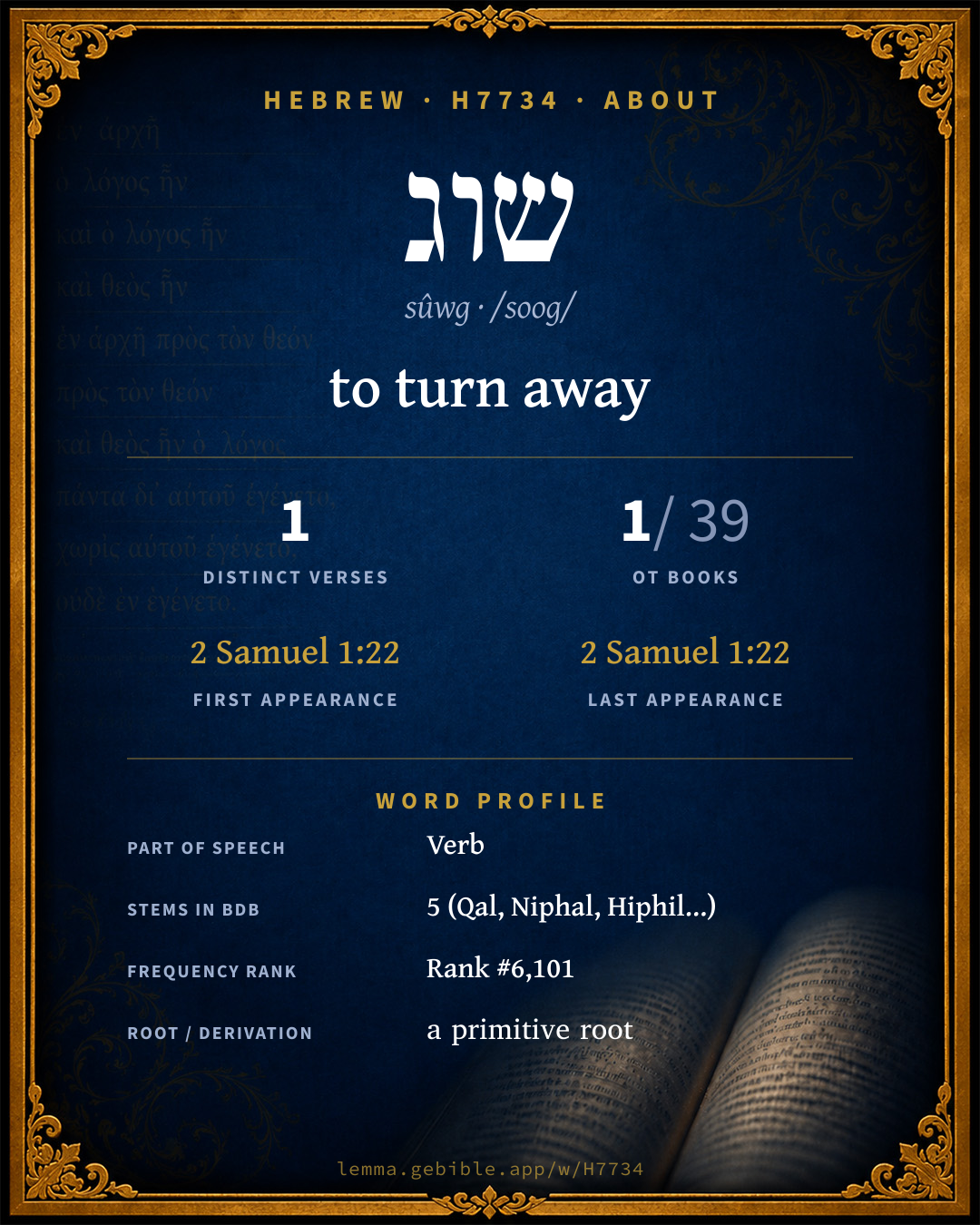
שׂוּג
to turn away
‘to turn away’ is one of 2 main senses fuller range ↓
Full lexicon entry — Brown-Driver-Briggs (BDB)
From Brown-Driver-Briggs (BDB)
Where this word appears
Grammar key — what these labels mean
Part of speech
- Verb
- An action or state-of-being word.
Stem
- Niphal
- Usually the simple passive or reflexive of the Qal (“he was written”). Here: ‘refl. turn oneself away’
Form
- Perfect
- A completed action or state — Hebrew marks aspect (completeness) more than strict tense (“he wrote”).
Person
- 3rd Person
- The one spoken about (“he / she / it / they”).
Gender
- Masculine
- Grammatically masculine.
Number
- Singular
- One.
Every verse where H7734 appears — 1 distinct verse across 1 book. Click any verse to open its interlinear word-by-word view. Verse text shown in the World English Bible for context — . Each verse’s Hebrew form is shown with its reference; the English is not keyword-highlighted, since the data carries no word-level English alignment. Use “Compare translations” on any verse to read it across multiple English versions. This concordance covers the Hebrew Bible; Septuagint (Greek Old Testament) occurrences are not indexed here.
2 Samuel 1 verse
About this entry
At a glance — auto-summarized from this page’s data, not written by a person. Every figure links to its source below. This summary describes the numbers; it doesn’t interpret them.
“to turn away” is the headline sense of the Hebrew verb שוג (sûwg). A scarce word — 1 verse in all of the Hebrew Bible. It clusters heavily in 2 Samuel, which alone accounts for 100% of its uses. Scripture uses it exactly once, at 2 Samuel 1:22. Read the stem: it spans 5 stems, including Qal and Niphal. The sections below give every sense, occurrence, and version rendering.
Gloss history
Strong's 1890 vs modern scholarship
About this word
Strong's H7734 catalogs a Hebrew word from the Hebrew Old Testament.
These counts are not copied from any lexicon or concordance. They are computed here, from the morphology-tagged Hebrew Old Testament. What Lemma adds →
- 1
- distinct verses
- The word appears in 1 distinct verse.
- 1 / 39
- OT books
- The word appears in 1 of 39 Old Testament books.
- #6,101
- by frequency
- Rank #6,101 (rank 6,101 of 8,640 Hebrew words by occurrence).
View all 1 occurrence in the concordance →
Most concentrated in
- 2 Samuel 1 verse 100%
By section of the Old Testament
By traditional corpus
Conventional, traditional groupings — biblical authorship is debated, so this is a traditional corpus grouping, not an authorship claim. Each share is this word’s portion of its verses in that division of the Hebrew canon. Each figure is a share of the word’s 1 distinct verse.
- Prophets (Nevi'im) 1 verse · 100%
How translations render this word
Counts come from each version’s own published word-to-Strong’s tagging or interlinear alignment — an approximate guide to how each version renders this word, not a word-level alignment the data otherwise carries. Because each total is that version’s own tagged count, the per-version totals vary from one another and need not match the appearance or distinct-verse counts above. These counts may also differ from a printed concordance because Lemma counts each distinctly tagged rendering and does not collapse phrase taggings into a single head-word total. This is a fixed set of word-tagged versions (KJV, ASV, BSB, ULT) and does not change with the reading translation you choose elsewhere. Each version’s license is shown beside its name below (and on Sources).
BDB lists this Strong’s number as 2 distinct words (homographs). Each count above pools all of them and is not split by sense — see the Senses section below. A low-frequency rendering may belong to a different one of those words, not the primary meaning.
- King James Version†: Turned 1×
- American Standard Version†: Turned 1×
- Berean Standard Bible†: Retreat 1×
- unfoldingWord Literal Text†: Did 1×, Turn itself 1×
King James Version Public Domain
Renders H7734 across 1† tagged occurrence — most commonly:
American Standard Version Public Domain
Renders H7734 across 1† tagged occurrence — most commonly:
Berean Standard Bible Public Domain
Renders H7734 across 1† tagged occurrence — most commonly:
unfoldingWord Literal Text CC BY-SA 4.0
Renders H7734 across 2† tagged occurrences — most commonly:
11 senses and sub-senses in the full BDB
Hebrew verbs can shift meaning by stem (binyan): Qal is the basic action, Niphal is often passive or reflexive, Piel often intensifies or makes it factitive, and Hiphil is typically causative. The senses below are grouped under the stem BDB assigns to each. This entry also uses Hophal (the passive of Hiphil) and one or more reduplicated stems (the Pōlēl/Pilpēl type), which for hollow or geminate roots behave much like Piel — often intensive or iterative.
What do BDB’s symbols mean?
BDB uses these scholarly abbreviations:
| Symbol | Meaning |
|---|---|
| 𝔊 | the Septuagint (the ancient Greek translation, LXX) |
| 𝔙 | the Vulgate (the Latin translation) |
| 𝔖 | the Syriac version (the Peshitta) |
| 𝔗 | the Targum (the Aramaic translation) |
| ψ | the Psalms |
| √ | root (the underlying root or stem) |
| ‖ | parallel passage (a synonymous or contrasted parallel) |
| † | the dagger: every passage where the word occurs is cited |
The 11 senses and sub-senses the full Brown-Driver-Briggs lexicon distinguishes for this word, in lexicon order (not ranked by frequency), with BDB’s own verbatim wording and sub-sense lettering. Shown in Hebrew script with BDB’s own scholarly abbreviations. The condensed entry is in the Lexicon Entry tab.
שוג I move away, backslide (שׂ׳ erron.
Qal
- Pf. 3 ms. סָג ψ 53:4; Impf. 1 pl. נָסוֹג ψ 80:19; Pt. act. cstr. סוּג Pr 14:14 (BaNB § 124 c Ges§ § 50 f, 72 p);—backslide, prove recreant to י׳, c. מִן ψ 80:19; so abs. 53:4; סוּג לֵב Pr 14:14 a backslider in heart. e.g. Psalms 53:4
Niphal
- Pf. 3 ms. נָסוֹג ψ 44:19, נָשׂוֹג 2 S 1:22 (שׂ for ס); 1 s. נְסוּגֹתִי Is 50:5; 3 pl. נָסֹ֫גוּ Is 42:17 Je 38:22; Impf. 3 ms. יִסַּג Mi 2:6 (Ges§ 72 dd, but v. infr.); 3 mpl. יִסֹּ֫גוּ ψ 35:4 + 3 times, וַיִּסֹּ֫גוּ ψ 78:57; Inf. abs. נָסוֹג Is 59:13; Pt. pl. נְסוֹגִים Zp 1:6 Je 46:5;— e.g. Psalms 44:19
- 1. refl. turn oneself away, turn back:
- a. lit. of Jonathan’s bow 2 S 1:22, c. מִן (v HPS). e.g. 2 Samuel 1:22
- b. fig. = prove faithless (as Qal): (1) of human friends, נס׳ אָחוֹר Je 38:22 (abs.); usually (2) נס׳ מֵאַחֲרֵי י׳ Zp 1:6 cf. Is 59:13; so abs. ψ 78:57 (+ בָּגַד), c. אָחוֹר Is 50:5 (‖ מָרִיתִי), ψ 44:19 (‖ נָטָה מִן).—לֹא יִסַּג כְּלִמּוֹת Mi 2:6 could mean reproaches do not depart, i.e. cease (Hi-St Che GASm Now RV); Now proposes also (emending foll. v.) shall not disgrace depart from Jacob’s house? BuhlLex 13 conj., plausibly, יַשִּׂיג (√ נשׂג) disgrace shall not overtake us. e.g. Jeremiah 38:22
- 2. be turned or driven back, be repulsed, of י׳’s foes: + אָחוֹר Je 46:5; Is 42:17 ψ 35:4; 40:15 = 70:3, 129:5. e.g. Jeremiah 46:5
Hiphil
- 1. usually of displacing, moving back a boundary mark (גְּבוּל), Impf. 2 ms. תַּסִּיג Dt 19:14, juss. תַּסֵּג Pr 22:28; 23:10; 3 mpl. יַשִּׂיגוּ Jb 24:2 (שׂ for ס); Pt. מַסִּיג ג׳ Dt 27:17, מַסִּיגֵי ג׳ Ho 5:10. e.g. Deuteronomy 19:14
- 2. remove, carry away, valuables, to rescue them, juss., 2 ms. תַּסֵּג Mi 6:14 si vera l. (on synt. v. Dr§ § 152, 1. 2; 155 Obs.). e.g. Micah 6:14
Hophal
- Pf. 3 ms. וְהֻסַּג אָחוֹר מִשְׁפָּט Is 59:14 and justice is driven back (‖ צְדָקָה מֵרָחוֹק תַּעֲמֹד). e.g. Isaiah 59:14
שוג II fence about (Aramaic word
Qal
- Pt. pass. f. בִּטְנֵךְ עֲרֵמַת חִטִּים סוּגָה בַּשּׁוֹשַׁנִּים Ct 7:3 thy body a heap of wheat fenced about with lilies (cf. especially De Bu). e.g. Song of Solomon 7:3
Pilp
- intens. Impf. 2 fs. תְּשַׂגְֿשֵׂ֑גִי Is 17:11 thou dost fence it carefully about (> make it grow, as if שׂוג = שׂגה, AE Ki Brd Du). e.g. Isaiah 17:11
Senses from the full Brown-Driver-Briggs lexicon (Brown, Driver, Briggs; Oxford 1906 — public domain), digitized via Sefaria, supplemented by the OpenScriptures HebrewLexicon (CC BY 4.0). Full attribution on Sources.
Word origin
I. vb. move away, backslide (שׂ׳ erron.; Arabic ((سوج), سَاجَ), go and come Lane 1459, سَوْجَانٌ abitus et adventus Frey (Kam.));—
II. vb. fence about (Aramaic word; ܣܘܓ, ܣܳܓ sepsit, circumsepsit, clausit, ܣܝܳܓܳܐ sepes, cf. 𝔗 סיג Pa. fence about, סְיָיגָא fence; NH סוג fence about; Arabic سَيَاجٌ enclosure made with thorns, etc., around grape-vines, etc. Lane1460, سوّج ii. make a سِيَاجٌ );—only
— Brown-Driver-Briggs (Oxford 1906, public domain), digitized via Sefaria, supplemented by the OpenScriptures HebrewLexicon (CC BY 4.0). See Sources.
Origin: a primitive root
Same root — word family
Other BDB entries built from the same root as H7734, grouped by Strong’s listed origin. These share a root / origin per the lexicon — not necessarily a shared meaning. Each links to that word’s own entry.
Derived from this word
Compare all same-root words → They share a root, not necessarily a meaning.
Septuagint verse parallels
This word appears in 1 verse that also exists in the Greek Old Testament (Septuagint), out of the 1 Hebrew verse it occurs in. You can read those verses in Greek by switching the Old Testament edition to the Septuagint.
Read these verses in the Septuagint
This is a verse-level parallel only — the same verses exist in both the Hebrew and Greek Old Testaments. No word-level Hebrew↔Greek correspondence is claimed: the data carries no such alignment, so no Greek word is shown as this Hebrew word’s translation. Coverage is not total — the Septuagint omits the deuterocanon and renumbers the Psalms, so some Hebrew verses have no direct Greek parallel.