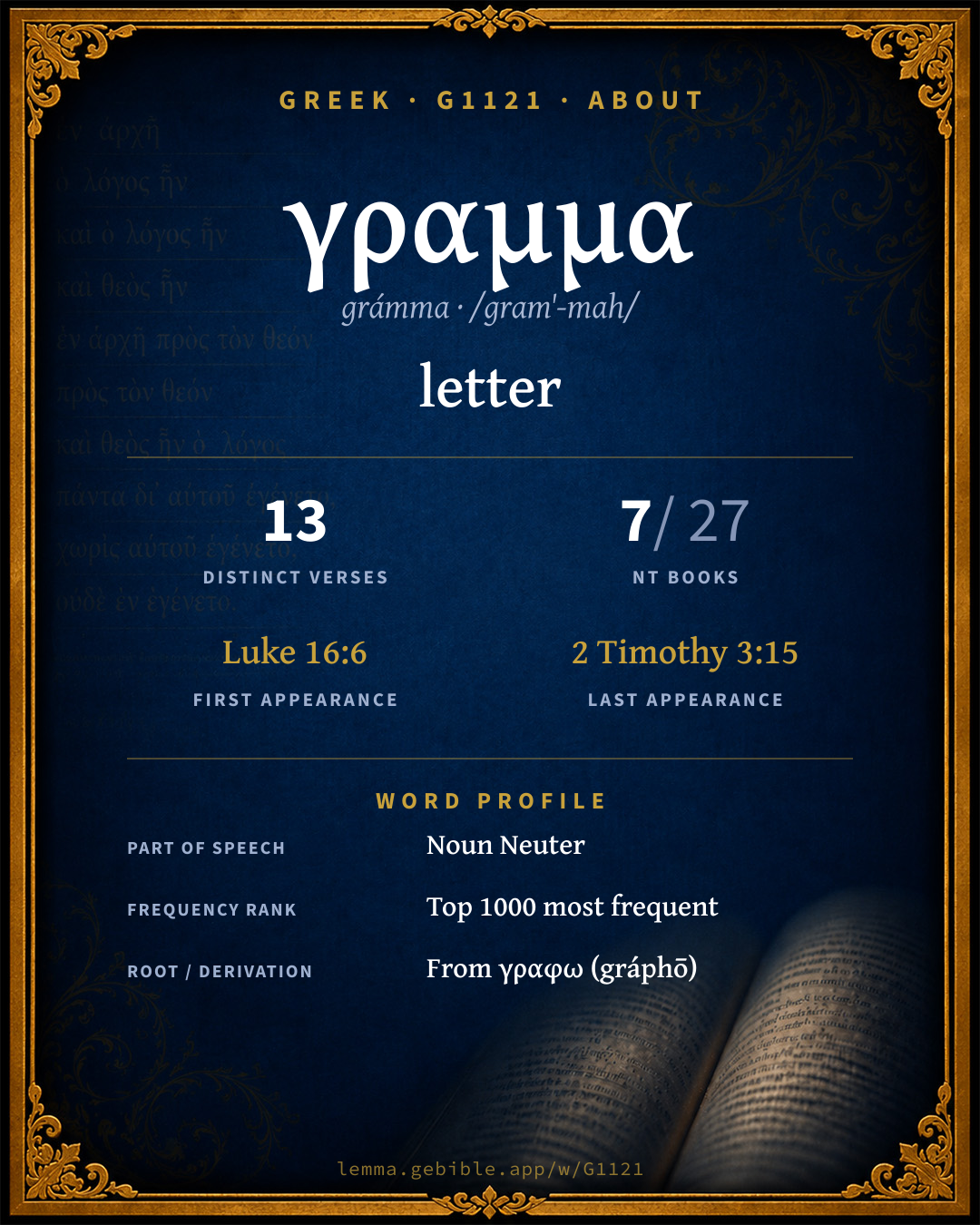
γράμμα
letter
‘letter’ is one of 3 main senses fuller range ↓
Full lexicon entry — Thayer's Greek Lexicon
From Thayer's Greek Lexicon
Where this word appears
See every Accusative-case word in the Greek New Testament →
Grammar key — what these labels mean
Part of speech
- Noun
- A naming word — a person, place, thing, or idea.
Case
- Accusative
- The case of the direct object and of extent.
- Dative
- The case of the indirect object, means, or location — “to / for / with / in.”
- Genitive
- The case of source, possession, or “of” — answers “whose / from what.”
- Nominative
- The case of the subject (and the predicate nominative).
Gender
- Neuter
- Grammatically neuter.
Number
- Plural
- More than one.
- Singular
- One.
Grammatical forms
- Noun, Accusative, Plural, Neuter 5 times (36%)
- Noun, Dative, Plural, Neuter 3 times (21%)
- Noun, Genitive, Singular, Neuter 3 times (21%)
- Noun, Dative, Singular, Neuter 1 time (7%)
- Noun, Nominative, Plural, Neuter 1 time (7%)
- Noun, Nominative, Singular, Neuter 1 time (7%)
Parsed forms decoded from the imported morphology (Robinson–Tischendorf, public domain), counted across 14 parsed occurrences — not distinct verses.
Every verse where G1121 appears — 13 distinct verses across 7 books. Click any verse to open its interlinear word-by-word view. Verse text shown in the World English Bible for context — . Each verse’s Greek form is shown with its reference; the English is not keyword-highlighted, since the data carries no word-level English alignment. Use “Compare translations” on any verse to read it across multiple English versions. This concordance covers the Greek New Testament; Septuagint (Greek Old Testament) occurrences of this word are not indexed here.
Luke 2 verses
- Luke 16:6 γράμματα n acc pl neut He said, 'A hundred batos of oil.' He said to him, 'Take your bill, and sit down quickly and write fifty.'
- Luke 16:7 γράμματα n acc pl neut Then said he to another, 'How much do you owe?' He said, 'A hundred cors of wheat.' He said to him, 'Take your bill, and write eighty.'
John 2 verses
Acts 2 verses
- Acts 26:24 γράμματα n nom pl neut As he thus made his defense, Festus said with a loud voice, "Paul, you are crazy! Your great learning is driving you insane!"
- Acts 28:21 γράμματα n acc pl neut They said to him, "We neither received letters from Judea concerning you, nor did any of the brothers come here and report or speak any evil of you.
Romans 3 verses
- Romans 2:27 γράμματος n gen sg neut Won't the uncircumcision which is by nature, if it fulfills the law, judge you, who with the letter and circumcision are a transgressor of the law?
- Romans 2:29 γράμματι n dat sg neut but he is a Jew who is one inwardly, and circumcision is that of the heart, in the spirit not in the letter; whose praise is not from men, but from God.
- Romans 7:6 γράμματος n gen sg neut But now we have been discharged from the law, having died to that in which we were held; so that we serve in newness of the spirit, and not in oldness of the letter.
2 Corinthians 2 verses
- 2 Corinthians 3:6 γράμματος γράμμα n gen sg neut n nom sg neut who also made us sufficient as servants of a new covenant; not of the letter, but of the Spirit. For the letter kills, but the Spirit gives life.
- 2 Corinthians 3:7 γράμμασιν n dat pl neut But if the service of death, written engraved on stones, came with glory, so that the children of Israel could not look steadfastly on the face of Moses for the glory of his face; which was passing away:
Galatians 1 verse
2 Timothy 1 verse
About this entry
At a glance — auto-summarized from this page’s data, not written by a person. Every figure links to its source below. This summary describes the numbers; it doesn’t interpret them.
“letter” is the headline sense of the Greek noun γραμμα (grámma). First canonically at Luke 16:6, it enters the text early. With 13 verses in 7 books, it is an uncommon word in the Greek New Testament. Lexicons map it across 3 senses. It clusters with γραφω, γραπτος and χαραξ under a shared root. See the sense tree, 13-verse concordance, and the renderings breakdown below.
Gloss history
Strong's 1890 vs modern scholarship

About this word
Strong's G1121 catalogs a Greek word from the Greek New Testament.
These counts are not copied from any lexicon or concordance. They are computed here, from the morphology-tagged Greek New Testament. What Lemma adds →
- 13
- distinct verses
- The word appears in 13 distinct verses.
- 7 / 27
- NT books
- The word appears in 7 of 27 New Testament books.
- #814
- by frequency
- Top 1000 most frequent Greek words (rank 814 of 5,347 Greek words by occurrence).
View all 13 occurrences in the concordance →
By section of the New Testament
By traditional corpus
Conventional, traditional groupings — biblical authorship is debated, so this is a traditional corpus grouping, not an authorship claim. Some books belong to more than one corpus (Luke is in both the Gospels and the Lukan corpus, and so on), so these shares overlap and need not total 100%. Each figure is a share of the word’s 13 distinct verses.
- Pauline corpus 7 verses · 54%
- Gospels 4 verses · 31%
- Lukan (Luke–Acts) 4 verses · 31%
- Johannine 2 verses · 15%
How translations render this word
Counts come from each version’s own published word-to-Strong’s tagging or interlinear alignment — an approximate guide to how each version renders this word, not a word-level alignment the data otherwise carries. Because each total is that version’s own tagged count, the per-version totals vary from one another and need not match the appearance or distinct-verse counts above. These counts may also differ from a printed concordance because Lemma counts each distinctly tagged rendering and does not collapse phrase taggings into a single head-word total. This is a fixed set of word-tagged versions (KJV, ASV, BSB, ULT) and does not change with the reading translation you choose elsewhere. Each version’s license is shown beside its name below (and on Sources).
- King James Version: Letter 6×, Letters 3×, Bill 2×
- American Standard Version: Letter 5×, Letters 3×, Bond 2×
- Berean Standard Bible: Letters 3×, Written code 3×, Bill 2×
- unfoldingWord Literal Text: Letter 5×, Letters 4×, Bill 2×
King James Version Public Domain
Renders G1121 across 14 tagged occurrences — most commonly:
Plus 3 renderings that appear only once — usually multi-word phrases or single function words the recovered tagging swept in, not distinct renderings. Not rendered by a distinct English word in 1 further occurrence.
American Standard Version Public Domain
Renders G1121 across 14 tagged occurrences — most commonly:
Plus 2 renderings that appear only once — usually multi-word phrases or single function words the recovered tagging swept in, not distinct renderings.
Berean Standard Bible Public Domain
Renders G1121 across 14 tagged occurrences — most commonly:
Plus 2 renderings that appear only once — usually multi-word phrases or single function words the recovered tagging swept in, not distinct renderings.
unfoldingWord Literal Text CC BY-SA 4.0
Renders G1121 across 15 tagged occurrences — most commonly:
Plus 2 renderings that appear only once — usually multi-word phrases or single function words the recovered tagging swept in, not distinct renderings.
Senses in Thayer's
The 3 senses Thayer's distinguishes for this word, in lexicon order (not ranked by frequency or importance). The full entry — with sub-senses — is in the Lexicon Entry tab.
- a letter
- any writing, a document or record
- letters, i.e. learning
Word origin
Derived from γραφω (gráphō) (G1125) — to write.
From G1125 ; a writing that is a letter note epistle book etc.; plural learning : - bill learning letter scripture writing written.
— Strong’s Exhaustive Concordance (1890), public domain.
Forms in the corpus
The 5 distinct written forms G1121 takes in the Greek New Testament, most frequent first — each parse links to that case’s occurrences in the concordance.
| Form | Parsing | Example | Uses |
|---|---|---|---|
| γράμματα grámmata | Noun, Accusative, Plural, Neuter | Luke 16:6 | 6 |
| γράμμασιν grámmasin | Noun, Dative, Plural, Neuter | John 5:47 | 3 |
| γράμματος grámmatos | Noun, Genitive, Singular, Neuter | Romans 2:27 | 3 |
| γράμμα grámma | Noun, Nominative, Singular, Neuter | 2 Corinthians 3:6 | 1 |
| γράμματι grámmati | Noun, Dative, Singular, Neuter | Romans 2:29 | 1 |
Same root — word family
Other Thayer's entries built from the same root as G1121, grouped by Strong’s listed origin. These share a root / origin per the lexicon — not necessarily a shared meaning. Each links to that word’s own entry.
Derives from
Shares the same root
Derived from this word
Compare all same-root words → Showing 4 of 5 — not the complete family. They share a root, not necessarily a meaning.
Septuagint usage
The same Greek word γραμμα appears 18 times in the Greek Old Testament (Septuagint), across 17 verses in 7 books.
- 18
- LXX occurrences
- Tagged occurrences of this Greek word in the Septuagint.
- 17
- verses
- Distinct Septuagint verses containing this word.
- 7 / 39
- OT books
- The word appears in 7 of the 39 Old Testament books.
Sample Septuagint occurrences
- Exodus 36:37 γράμμα
- Leviticus 19:28 γράμμα
- Joshua 15:15 γράμμα
- Judges 1:11 γράμμα
- Esther 4:3 γράμμα
- Isaiah 29:11 γράμμα
- Daniel 1:4 γράμμα
Septuagint occurrences (same lexeme)
Every verse where the same Strong’s number (G1121) appears in the Greek Septuagint. Verse text shown in the World English Bible for context; the Greek form is the matched word — the English is not keyword-highlighted.
- Exodus 36:37 γράμμα He made a screen for the door of the tent, of blue, purple, scarlet, and fine twined linen, the work of an embroiderer;
- Leviticus 19:28 γράμμα "'You shall not make any cuttings in your flesh for the dead, nor tattoo any marks on you. I am Yahweh.
- Joshua 15:15 γράμμα He went up there against the inhabitants of Debir: now the name of Debir before was Kiriath Sepher.
- Joshua 15:16 γράμμα Caleb said, He who strikes Kiriath Sepher, and takes it, to him will I give Achsah my daughter as wife.
- Joshua 15:49 γράμμα and Dannah, and Kiriath Sannah (the same is Debir),
- Joshua 21:29 γράμμα Jarmuth with its suburbs, En Gannim with its suburbs; four cities.
- Judges 1:11 γράμμα From there he went against the inhabitants of Debir. (Now the name of Debir before was Kiriath Sepher.)
- Judges 1:12 γράμμα Caleb said, He who strikes Kiriath Sepher, and takes it, to him will I give Achsah my daughter as wife.
- Esther 4:3 γράμμα In every province, wherever the king's commandment and his decree came, there was great mourning among the Jews, and fasting, and weeping, and wailing; and many lay in sackcloth and ashes.
- Esther 6:1 γράμμα On that night the king couldn't sleep; and he commanded to bring the book of records of the chronicles, and they were read before the king.
- Esther 6:2 γράμμα It was found written that Mordecai had told of Bigthana and Teresh, two of the king's chamberlains, of those who kept the threshold, who had sought to lay hands on the king Ahasuerus.
- Esther 8:5 γράμμα She said, If it please the king, and if I have found favor in his sight, and the thing seem right before the king, and I be pleasing in his eyes, let it be written to reverse the letters devised by Haman, the son of Hammedatha the Agagite, which he wrote to destroy the Jews who are in all the king's provinces:
- Esther 8:10 γράμμα He wrote the name of king Ahasuerus, and sealed it with the king's ring, and sent letters by post on horseback, riding on swift steeds that were used in the king's service, bred of the stud:
- Esther 9:1 γράμμα Now in the twelfth month, which is the month Adar, on the thirteenth day of the same, when the king's commandment and his decree drew near to be put in execution, on the day that the enemies of the Jews hoped to have rule over them, (whereas it was turned to the contrary, that the Jews had rule over those who hated them),
- Isaiah 29:11 γράμμα All vision is become to you as the words of a book that is sealed, which men deliver to one who is learned, saying, Read this, I pray you; and he says, I can't, for it is sealed:
- Isaiah 29:12 γράμμα and the book is delivered to him who is not learned, saying, Read this, I pray you; and he says, I am not learned.
- Daniel 1:4 γράμμα youths in whom was no blemish, but well-favored, and skillful in all wisdom, and endowed with knowledge, and understanding science, and such as had ability to stand in the king's palace; and that he should teach them the learning and the language of the Chaldeans.
These are occurrences of the same Greek lexeme (G1121) in the Septuagint — not a translation of any one Hebrew word. The store carries no word-level Hebrew↔Greek alignment, so no Hebrew original is asserted here. Counts come from the recovered LXX Strong's tagging — high-frequency vocabulary is well covered, while rare or late forms may be untagged — so they reflect tagged occurrences and may slightly undercount.