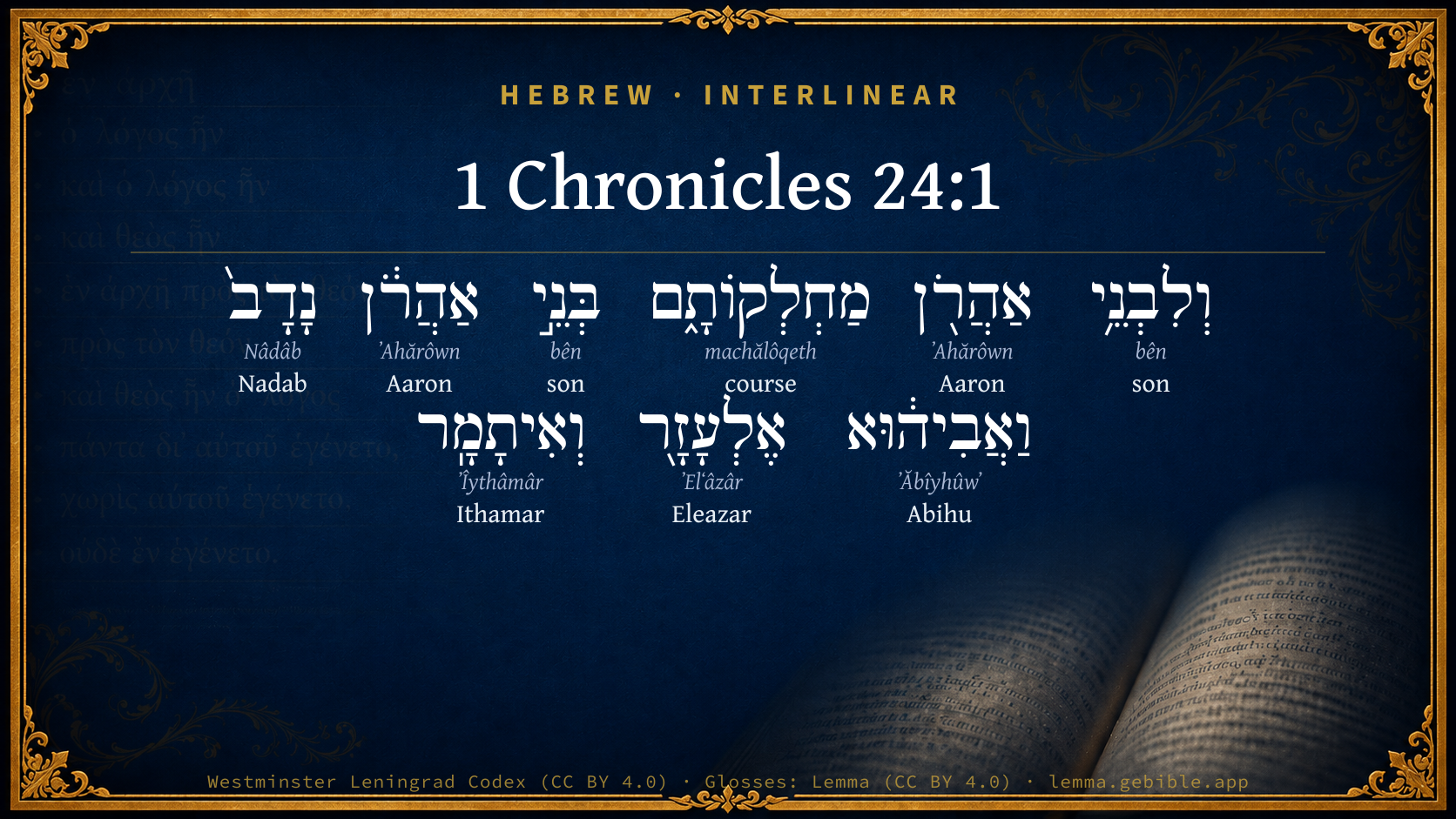
1 Chronicles 24:1

Hebrew (Westminster Leningrad Codex) 1 Chronicles 24:1 appears in the Hebrew Old Testament. The text above is from the Westminster Leningrad Codex. Each word links to its Strong’s number, a concise gloss, and parsing drawn from the Open Scriptures Hebrew Bible morphology. Click any word for its full Brown-Driver-Briggs (BDB) entry.
Download image
Cite this verse

1 Chronicles 24:1 (World English Bible). Public Domain. Lemma interlinear Bible study tool, https://lemma.gebible.app/v/1-chronicles/24/1.

Show BibTeX & RIS
BibTeX
RIS
English Translation
Thes were the divisions of the sons of Aaron. The sons of Aaron: Nadab and Abihu, Eleazar and Ithamar.
World English Bible · Public Domain
Download a study sheet

One document with this verse’s original text, its word-by-word gloss line, the meaning frame, cross-references with their text, attributed commentary, and full source and license credits — printable, and it pastes into notes with its structure intact.

This verse Autodidact and up

Study sheet (.html) Plain text (.txt)

A passage Seminary Student

Up to 50 verses in one chapter. A passage sheet keeps up to 6 commentary sources and 12 cross-references per verse, in the order this page ranks them, and says so on the sheet whenever that leaves anything out. Ask for a single verse and you get the Autodidact verse sheet above.

Everything on this page stays free to read, with no account — the sheet is a download of what is already on screen, not access to it.

Want to remove ads? Support Godless Engineer
Compare translations 3

The same verse in 3 English versions, stacked beneath the original-language interlinear above. Click any original word for its lexicon entry.

Each is an independent rendering of the whole verse — the interlinear is not word-aligned to these translations.

Highlighted words mark where these versions differ — a whole-verse word diff, not a word-by-word alignment.

  • World English Bible Public Domain
    Thes were the divisions of the sons of Aaron. The sons of Aaron: Nadab and Abihu, Eleazar and Ithamar.
  • King James Version Public Domain
    Now these are the divisions of the sons of Aaron. The sons of Aaron; Nadab, and Abihu, Eleazar, and Ithamar.
  • unfoldingWord Literal Text CC BY-SA 4.0
    And to the sons of Aaron, their divisions. The sons of Aaron: Nadab and Abihu, Eleazar and Ithamar.

unfoldingWord Literal Text — © unfoldingWord, licensed CC BY-SA 4.0. Word-aligned USFM3 via Door43 (git.door43.org/unfoldingWord/en_ult).

Versions to compare (up to 4)

3 of 4 selected

Show all 18 translations

Every available English version of this verse, each an independent rendering of the whole verse.

  • World English Bible Public Domain
    Thes were the divisions of the sons of Aaron. The sons of Aaron: Nadab and Abihu, Eleazar and Ithamar.
  • Berean Standard Bible Public Domain
    These were the divisions of the descendants of Aaron. The sons of Aaron were Nadab, Abihu, Eleazar, and Ithamar.
  • Majority Standard Bible Public Domain
    These were the divisions of the descendants of Aaron. The sons of Aaron were Nadab, Abihu, Eleazar, and Ithamar.
  • King James Version Public Domain
    Now these are the divisions of the sons of Aaron. The sons of Aaron; Nadab, and Abihu, Eleazar, and Ithamar.
  • American Standard Version (1901) Public Domain
    And the courses of the sons of Aaron `were these'. The sons of Aaron: Nadab and Abihu, Eleazar and Ithamar.
  • Revised Version (1885) Public Domain
    And the courses of the sons of Aaron were these. The sons of Aaron; Nadab and Abihu, Eleazar and Ithamar.
  • Geneva Bible (1599) Public Domain
    These are also the diuisions of the sonnes of Aaron: The sonnes of Aaron were Nadab, and Abihu, Eleazar, and Ithamar.
  • Douay-Rheims (1899) Public Domain
    Now these were the divisions of the sons of Aaron: The sons of Aaron: Nadab, and Abiu, and Eleazar, and Ithamar.
  • Young's Literal Translation Public Domain
    And to the sons of Aaron `are' their courses: sons of Aaron `are' Nadab, and Abihu, Eleazar, and Ithamar,
  • Literal Standard Version CC BY-SA 4.0
    And [these are] their divisions, of the sons of Aaron. [The] sons of Aaron [are] Nadab, and Abihu, Eleazar, and Ithamar.
  • Unlocked Literal Bible CC BY-SA 4.0
    The work groups based on Aaron's descendants were these: Nadab, Abihu, Eleazar and Ithamar.
  • unfoldingWord Literal Text CC BY-SA 4.0
    And to the sons of Aaron, their divisions. The sons of Aaron: Nadab and Abihu, Eleazar and Ithamar.
  • Darby Bible Public Domain
    And the divisions of the sons of Aaron: the sons of Aaron, Nadab and Abihu, Eleazar and Ithamar.
  • World Messianic Bible Public Domain
    These were the divisions of the sons of Aaron. The sons of Aaron: Nadab, Abihu, Eleazar, and Ithamar.
  • Webster's Bible Public Domain
    Now these are the divisions of the sons of Aaron. The sons of Aaron; Nadab, and Abihu, Eleazar, and Ithamar.
  • Free Bible Version CC BY-SA 4.0
    The sons of Aaron were placed in divisions as follows. The sons of Aaron were Nadab, Abihu, Eleazar, and Ithamar.
  • Bible in Basic English Public Domain
    Now the divisions into which the sons of Aaron were grouped were these: the sons of Aaron, Nadab and Abihu, Eleazar and Ithamar.
  • JPS Tanakh (1917) Public Domain
    And the courses of the sons of Aaron were these. The sons of Aaron: Nadab and Abihu, Eleazar and Ithamar.

Literal Standard Version (2020), Covenant Press — licensed CC BY-SA 4.0. Text via the HelloAO Bible API (eBible.org). Unlocked Literal Bible (unfoldingWord) — licensed CC BY-SA 4.0. Text via the HelloAO Bible API (eBible.org). unfoldingWord Literal Text — © unfoldingWord, licensed CC BY-SA 4.0. Word-aligned USFM3 via Door43 (git.door43.org/unfoldingWord/en_ult). Free Bible Version, Dr. Jonathan Gallagher — licensed CC BY-SA 4.0. Text via the HelloAO Bible API (eBible.org).

Word by word

More ways to search: Search by grammar → Find every occurrence → Compare this word →

Practice this passage: Drill this verse → Learn its vocabulary →

About this verse

These counts appear in no published source. They are computed here, from the morphology-tagged text and Lemma’s own curated glosses. What Lemma adds →

9
words
7
distinct lemmas
Historical
section

Notable vocabulary

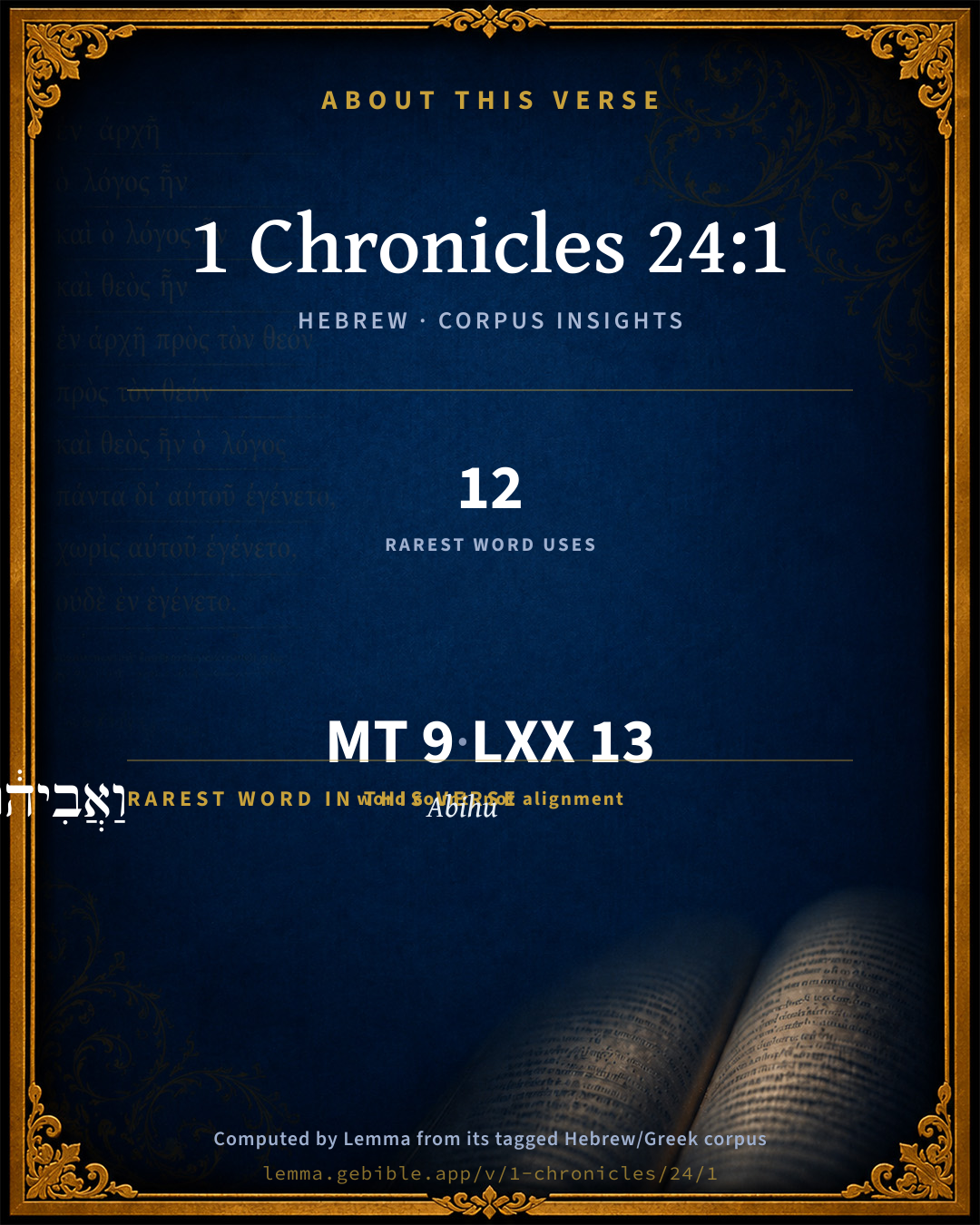
The rarest word here is וַאֲבִיה֔וּא Abihu H30 — appearing just 12 times in the whole Hebrew Bible.

Shared distinctive vocabulary

וַאֲבִיה֔וּא Abihu H30 occurs in 12 verses of the Hebrew Bible. Also found in:

Grammatical profile

  • 9 nouns

Repetition

Words recur within this verse — often emphatic in Hebrew:

  • וְלִבְנֵ֥י son H1121 ×2
  • אַהֲרֹ֖ן Aaron H175 ×2

Hebrew & Septuagint length

In English translation the verse runs 19 words from the Hebrew and 17 from the Septuagint (LXX English) — closely comparable.

A rough comparison of the two English renderings, which tokenize alike — not a word-level alignment.

Word counts can differ between the Hebrew and the Greek without any difference in meaning — e.g. the Hebrew direct-object marker אֵת has no separate Greek word, and Greek often adds the article ὁ.

In the original languages it is 9 Hebrew tokens and 13 Greek tokens — but the two are counted differently (Hebrew bundles its prefixes and suffixes into one token; the Greek is in lemma form), so that isn’t a like-for-like length.

Cross-references

7

Topical passages linked to 1 Chronicles 24:1 in the Treasury of Scripture Knowledge — connected by theme and wording, ordered by reader-vote popularity; previews shown in the World English Bible.

  • Exodus 6:23 Aaron took Elisheba, the daughter of Amminadab, the sister of Nahshon, as his wife; and she bore him Nadab and Abihu, Eleazar and Ithamar.
  • 1 Chronicles 23:6 David divided them into divisions according to the sons of Levi: Gershon, Kohath, and Merari.
  • Numbers 26:60 To Aaron were born Nadab and Abihu, Eleazar and Ithamar.
  • Exodus 28:1 "Bring Aaron your brother, and his sons with him, near to you from among the children of Israel, that he may minister to me in the priest's office, even Aaron, Nadab and Abihu, Eleazar and Ithamar, Aaron's sons.
  • Numbers 3:2 These are the names of the sons of Aaron: Nadab the firstborn, and Abihu, Eleazar, and Ithamar.
  • 1 Chronicles 6:3 The children of Amram: Aaron, and Moses, and Miriam. The sons of Aaron: Nadab, and Abihu, Eleazar, and Ithamar.
  • Leviticus 10:1–6 Nadab and Abihu, the sons of Aaron, each took his censer, and put fire in it, and laid incense on it, and offered strange fire before Yahweh, which he had not commanded them.

Cross-references courtesy of OpenBible.info (CC BY 4.0).

Hebrew and Greek witnesses Masoretic Hebrew ↔ Greek Septuagint

The same verse in the two great witnesses to the Old Testament, shown verse-for-verse.

These are two independent witnesses, not word-aligned to each other, and the Septuagint is shown in lemma (dictionary) form.

Hebrew 1 Chronicles 24:1 Masoretic · Westminster Leningrad Codex

וְלִבְנֵ֥י אַהֲרֹ֖ן מַחְלְקוֹתָ֑ם בְּנֵ֣י אַהֲרֹ֔ן נָדָב֙ וַאֲבִיה֔וּא אֶלְעָזָ֖ר וְאִיתָמָֽר

Thes were the divisions of the sons of Aaron. The sons of Aaron: Nadab and Abihu, Eleazar and Ithamar.

World English Bible · Public Domain

Greek LXX 1 Chronicles 24:1 Septuagint · lemma form

καί ὁ υἱός ἀαρών διαίρεσις υἱός ἀαρών ναδαβ καί αβιουδ ελεαζαρ καί ιθαμαρ

And they number the sons of Aaron in their division, Nadab, and Abiud, and Eleazar, and Ithamar.

LXX2012 (modern English Septuagint) · Public Domain

Hebrew: Westminster Leningrad Codex (CC BY 4.0). Greek: Septuagint (public domain); English from LXX2012 (modern English Septuagint) (Public Domain). How the Septuagint differs from the Hebrew →

Commentary

Notes on 1 Chronicles 24:1 from classic Christian and Jewish commentators (each source and its license shown beneath its notes). The classic Christian expositions comment on the surrounding passage and are grouped to its opening verse, so a note may address several verses; the Jewish commentaries on the Tanakh (Rashi and others) are per-verse, so they appear only where the commentator wrote on this verse.

Lemma curates 59 commentaries, every one of them public domain or Creative Commons licensed, each selected and text-cleaned for this edition rather than reprinted as found. About our sources →

Ellicott's Commentary for English Readers

(1) Now these are the divisions.—Literally, And for the sons of Aaron, their divisions (were as follows). The sentence forms a superscription to the section (1Ch_24:1-19).

The sons of Aaron are named above (1Ch_6:3). (Comp. Exo_6:23.) As usual, the writer starts ab ovo.

A Bible Commentary for English Readers, edited by Charles John Ellicott (1878–1897) — public domain. Text from a community e-Sword module.

The Cambridge Bible for Schools and Colleges

gen. ed. J. J. S. Perowne

Ch. 1Ch_24:1-19. David’s Organization of the Priests by courses

1. Now these are the divisions of the sons of Aaron] R.V. And the courses of the sons of Aaron were these.

the sons of Aaron] Son_6:3; Exo_6:23.

The Cambridge Bible for Schools and Colleges (gen. ed. J. J. S. Perowne; Cambridge University Press, 1878–1918) — public domain. Text from a community e-Sword module.

Trapp's Complete Commentary

John Trapp

1Ch 24:1 Now [these are] the divisions of the sons of Aaron. The sons of Aaron; Nadab, and Abihu, Eleazar, and Ithamar.

Ver. 1. Now these are the divisions,] i.e., The distinct orders and courses.

John Trapp, A Commentary or Exposition upon All the Books of the Old and New Testament (1647–1656) — public domain. Text from a community e-Sword module.

Joseph Benson's Commentary

1Ch 24:1-2. These are the divisions of the sons of Aaron — The several branches into which that family was divided. Therefore Eleazar and Ithamar executed the priest’s office — Their brethren being dead, and leaving no issue, they and their sons were the only persons to whom the execution of that office could be committed according to the law.

Joseph Benson's Commentary on the Old and New Testaments (1811–1818) — public domain. Text from a community e-Sword module.

The Preacher's Complete Homiletical Commentary

Joseph S. Exell (gen. ed.)

CRITICAL NOTES.] In this chapter we have divisions of the 24 orders of priests (1Ch_24:1-19), and the classes of Levites who attended them in discharge of their sacred functions.

1Ch_24:1-6.—The sons of Aaron. The divisions supply from 1Ch_24:6 of chap. 23. The author had there stated that “to the sons of Levi David assigned their courses.” He now adds, “To the sons of A. also (David assigned) their courses. The sons of A. (were) Nadab, &c.” [Speak. Com.]. Both, i.e., Zad. and Ahim., assisted David. 1Ch_24:4. Chief, more heads of houses. 1Ch_24:5. Lot, that is, the assignment of their order in the courses made by lot to the families belonging to both E. and Ith. Governors or princes of the sanctuary. 1Ch_24:6. Wrote, as lots were drawn forth. Taken alternately.

1Ch_24:7-19.—The allotted order. Some names in this list found elsewhere and others not. 1Ch_24:10. Abijah, Abia (Luk_1:5; Neh_10:7). 1Ch_24:11. Jeshuah, whose descendants returned from captivity (Eze_2:6; Neh_7:39). 1Ch_24:12. Eliashib, not progenitor of the one in Neh_3:1; Neh_3:20-21. 1Ch_24:15. Hezir, as a layman (cf. Neh_10:20). 1Ch_24:16. Peth., one of those who separated themselves from alliances contracted in captivity (Ez. 10:23; Neh_9:5). 1Ch_24:17. Jachin (cf. chap. 1Ch_9:10; Neh_11:10), probably the Achim of Mat_1:14. 1Ch_24:19. Orderings, the charge as 1Ch_24:3. Under, by the hand of Aaron. Commanded, a constant expression in the law of Moses (Exo_39:42; Lev_27:34; Num_36:13; Deu_34:9).

1Ch_24:20-31.—Distribution of other Levites. The rest. Object of this second enumeration of the Levitical families (cf. 1Ch_23:7-23) seems to be the designation of the heads of the families in David’s time. The omission of the Gershonites is curious, and can only be accounted for by supposing that the author did not find any account of their heads in his authorities. The addition to the Merarites (1Ch_24:26-27) is also curious. It brings the number of families up to 25, which is one more than we should have expected [Speak. Com.]. 1Ch_24:21. Rehabi. (cf. chap. 1Ch_23:17). 1Ch_24:22. Shel., Shelomith in chap. 1Ch_23:18, a different person from Amramite Shel. (cf. chap. 1Ch_26:25-26). He was probably not a contemporary of David, as the head of the family in David’s time was Jahath [Speak. Com.]. 1Ch_24:26. Beno, not really a name; Heb. for his son, and to be attached to Jaaziah. The meaning of the whole passage (1Ch_24:26-30) seems to be that there were three branches of the Merarites—the Beni-Mahli, the Beni-Mushi, and the Beni-Jaaziah—of whom the first formed a mighty house in David’s time, viz., the Beni-Kish, their head being Jerahmeel, while each of the other branches comprised three families, the heads of which were respectively in David’s time Shoham, Zaccur, Ibri, and Mahli, Eder, Jerimoth [Speak. Com.]. 1Ch_24:31. Principal, “all the Levitical houses enumerated drew lots in their courses on equal terms, the elder families having no advantage over the younger ones,” as there were 24 courses of the priests, so we must suppose that there were 24 of the Levites, though the number of the families as given in the text (chap. 1Ch_23:7-23; 1Ch_24:20-30) is 25 [Speak. Com.].

HOMILETICS

THE DIVISIONS OF PRIESTS (SONS OF AARON).—1Ch_24:1-19

The word “divisions” means courses, as 1Ch_24:6 in chap. 23; and evidently continues the subject and construction of that verse. Two sons of A. died, and the other two supply “the chief men of the house,” viz., 16 from Eleazar and 8 from Ithamar, 24 in all.

I. Divisions to facilitate work. Divided more easily performed. “Many hands make light work.” Burdens equalised carried better. Jealousies are prevented and a true spirit created. “Be not solitary, be not idle,” a saying of Burton.

II. Divisions by lot (1Ch_24:5). No ground of choice between the two families, who differed only in number, and as the highest places had already been filled by both of them, the impartiality of lot to settle the order of service.

1. Lot appointing to dignified work. “For the governors (or princes) of the sanctuary” (1Ch_24:5). High priests who exclusively could enter into the most holy place before God [Keil].

2. Lot publicly taken. “Shem., the scribe, wrote them before the king” (1Ch_24:6). Openly before witnesses and a clerk acting as secretary to scrutinise. Before king, princes, and priests the act most solemn. Fraud and suspicion impossible. “The lot causeth contentions to cease, and parteth between the mighty.”

III. Divisions in specific order (1Ch_24:7-19). Order essential to existence and efficiency. Men who seek pre-eminence and power create disorder, anarchy, and ruin. Well-ordered words make good logic; well-ordered regulations preserve the social constitution; and well-set stones make architecture. Order in God’s house and service secures regularity, beauty, and efficiency; excludes what is called “good fortune,” happy “hits,” and points to the divine side of life on its appointment. No “chance” work; all appears to be settled by law. “The lot is cast into the lap; but the whole disposing thereof is of the Lord.”

THE DEATH OF NADAB AND ABIHU.—1Ch_24:2

The story strange, and understood only by intimate acquaintance with the Jewish system and the prevailing sentiments of the time. Nadab and Abihu had been honoured with special privileges, but unduly exalted themselves, became proud, negligent, and presumptuous. Learn from their death—

I. That sin inverts the natural order of things. “They died before their father.” “Sin,” as “transgression of law,” creates confusion and disorder. It overturns and inverts. What more natural than a son to outlive his father; but wickedness shortens life, and brings untimely death.

II. That sin deprives of blessings which God can bestow. They “had no children.” Children great blessings, “a heritage from the Lord.” To be childless, under Jewish dispensation, considered calamity. Profane the name of God, and you may be cut off from high honour, just lineage, and blessed memory. The righteous alone can secure posthumous fame. “The memory of the just is blessed.”

III. That sin often overwhelms with fearful ruin. They died not a natural death. “There went out fire from the Lord and devoured them.” A punishment sudden and severe, awful and retributive (Lev_10:1-4). Indicative of their heinous guilt, and God’s jealousy in punishing it.

IV. That sin is often mentioned in history to warn of its consequences. This special sin frequently mentioned in Scripture. “By this awful judgment the wisdom of God observed the same course, in repressing the first instance of contempt for sacred things, as he did at the commencement of the Christian dispensation (Act_5:1-11).” “The temple mouse fears not the temple idol,” is a proverb. Those who minister in holy things need be careful not to arrogate to themselves the glory which belongs to God, but ever keep before them the solemnity and responsibility of that service in which they are engaged.

THE DIVISIONS OF THE LEVITES.—1Ch_24:20-31

The rest refers to those not of the sons of Aaron, and does not exhaust nonpriestly class, for we find in following two chapters others who were singers, doorkeepers, and treasurers. Two families given chiefly. Gershonites found among officers and Judges 1. The family of Kohath (1Ch_24:20-25).

2. The family of Merari (1Ch_24:26-29).

3. The three sons of Mushi (1Ch_24:30-31). These all content with an inferior “lot,” anxious to do their best, and joyfully contributing to the whole. “They were arranged by lot to match the courses of their brethren, the sons of Aaron, in the presence of the same superiors.” “The principal fathers,” or the chief over against his lesser brother. Each, great and small, his place and his work, and acting under “the great Taskmaster’s eye.” “Let every man be occupied, and occupied in the highest employment of which he is capable, and die with the consciousness that he has done his best” [Sidney].

“A wise man scorneth nothing, be it never so small or homely,

For he knoweth not the secret laws that may bind it to great effects”

[Martin Tupper].

HOMILETIC HINTS AND SUGGESTIONS

1Ch_24:2. Sad deaths. I. The sins which caused them.

1. Disobedience to divine injunction. “They offered strange fire before the Lord, which he commanded them not.”

2. Gross inconsistency. Perhaps they were drunk, hence the law (Lev_10:8). “They drink and forget the law” (Pro_31:5).

3. Rashness in approaching God. They “took,” snatched (some read 1Ch_24:1), their censers without reverence and consideration; rushed into God’s presence in haste.

4. Presumptuous in act. Not only did they take “strange incense,” but went both together when one only should have officiated; intruded into the holy of holies, to which access denied to all but high priest, and thus set a precedent most dangerous, and which called for divine displeasure. II. The punishment which followed the sins. “They died.”

1. A dishonourable death. “Without children.”

2. A sudden death. “Fire came out” suddenly.

3. An overwhelming death. Instantly died as if struck by a lightning-flash.

4. A retributive death. “Before the Lord.” Before the veil that covered the mercy-seat. “Without mercy,” and without divine interference. A foretaste of torment “in the presence of the Lamb” (Rev_14:10). “God will be sanctified either actively or passively, either in us or upon us; sure it is that he will be no loser by us. Sanctified he will be, either in the sincerity of men’s conversation or else in the severity of their condemnation. Singular things are expected of all that draw nigh to God in any duty, but especially in the office of the ministry. Those that stand in the presence of princes must be exact in their carriages. God appointed both the weights and measures of the sanctuary to be twice as large as those of the commonwealth, to show that he expects much more of those that serve him there than he doth of others. The souls of priests must be purer than sunbeams, saith Chrysostom” [Trapp].

1Ch_24:5-30. Remarkable persons. 1Ch_24:5. Governors (Heb.), Princes of the house of God. Chief priests rulers over others of their own order, and subject to the high priest. Submission and diligence give distinction in calling. “C’est par le travail qu’on regne” [Louis XIV.]. If translation be Princes of Holiness, then holiness gives influence and power; distinction of character and approbation of God. Good men are kings of society. 1Ch_24:7. Jehoiarib, the father of the Maccabees (1Ma_2:1). 1Ch_24:10. From Abijah came Zacharias, father of John the Baptist (Luk_1:5). “Old he was, yet not free from taking his turn. Dumb also for a time; yet he went on to do his office in the ministration. The evangelist’s word of the course (Grk. epi and çmerias, a daily service) importeth a daily attendance upon the work while the course continueth” [Trapp].

1Ch_24:23. Sons of Hebron. The four persons named appear to have been contemporaries of David, the heads of the Hebronite houses in his time (cf. ch. 1Ch_26:31) [Speak. Com.]. “What shall I do to be for ever known?” asked Schiller. Scripture will give the answer.

ILLUSTRATIONS TO CHAPTER 24

1Ch_24:2. Died. It is a dangerous thing in the service of God to decline from his own institutions; we have to do with a God who is wise to prescribe his own worship, just to require what he has prescribed, and powerful to revenge what he has not prescribed [Bp. Hall].

1Ch_24:5; 1Ch_24:31. Lot. Methods are the masters of masters [Tallerand]. Method is essential, and enables a larger amount of work to be got through with satisfaction. “Method,” said the Rev. R. Cecil, “is like packing things in a box: a good packer will get in half as much again as a bad one.” Cecil’s despatch of business was extraordinary, his motto being, “The shortest way to do many things is to do one thing at once” [Smiles].

The Preacher's Complete Homiletical Commentary (gen. ed. Joseph S. Exell; Funk & Wagnalls, c. 1892) — public domain (pre-1929). A full-Bible homiletical/sermon-outline anthology covering 65 of 66 books (2 John is absent from the source module). Text from a community e-Sword module.

Lange's Commentary on the Holy Scriptures

For the Chapter 24 passage and footnotes, see 1Ch_23:1 ff.

4. The Twenty-four Classes of Priests: 1Ch_24:1-19.—The enumeration of these follows quite suitably after the foregoing passage, particularly after 1Ch_23:32; comp. the “sons of Aaron” with that in 1Ch_24:1 of our chapter.—The sons of Aaron: Nadab and Abihu, etc. Comp. on this introduction to the Davidic regulations referring to the Mosaic time in 1Ch_24:1-2, 1 Chronicles 5:29, and Exo_6:23; Lev_10:1; Num_3:4.

1Ch_24:3. And David distributed them, so that Zadok of the sons of Eleazar. For ויחלקם, comp. on 1Ch_23:6; for Zadok and Abiathar, on 1Chr 5:30, 1Ch_16:39, 1Ch_18:16; for פְּקֻדָּה, official class, on 1Ch_23:11.

1Ch_24:4. And the sons of Eleazar were found more numerous in chief men. These “men” (גְּבָרִים), of whom Eleazar had twice as many in heads or chiefs (רָאשִׁים) as Ithamar, are the chiefs, not of the great complex of families or houses (Berth.), but of the several families, the fathers, chiefs of the several priestly homes.

1Ch_24:5. And they divided them. The subject is David, Zadok, and Ahimelech, to whom naturally this matter belonged.—One with the other, literally, “ these with those,” those of Eleazar with those of Ithamar; comp. 1Ch_25:8.—For the holy princes and the princes of God. On the former phrase, comp. Isa_43:28, and the parallel phrase: “princes of the priests,” שָׂרֵי הַכֹּהֲנִים, 2Ch_36:14; on the second (Sept. ἄρχοντες κυρίου) the equivalent: “high priests, upper priests.” For the princes of priests and high priests from Ithamar, who were far behind those of the line of Eleazar in number and importance, comp. on 2Chr 5:30.

1Ch_24:6. Wrote them, namely, the classes, as the lot determined.—One father-house being taken for Eleazar and one for Ithamar, that is, alternately, from the urn containing the lots for Eleazar, and then from that containing the lots for Ithamar (so אָחֻז signifies; comp. Num_31:30; Num_31:47), that none might seem preferred before the other. And, indeed, this alternation in drawing the lots might have been so managed, that, on account of the double number of the families of Eleazar, two lots for Eleazar might be drawn for every one for Ithamar (comp. Berth.). Whether this mode of drawing lots be indicated by the doubling of the אָחֻז in the second place(וְאָחֻז אָחֻז לְאִיתָמָר), as Berth, thinks, is more than doubtful. Notwithstanding the almost universal agreement of the mss. respecting this double אָחֻז, and the fact that the old translators and the Rabbis did not understand the passage, the alteration of the first אָחֻז into אֶחָד (see Crit. Note) appears to be the only means of obtaining a correct conception of these otherwise dark words.

1Ch_24:7 ff. The names of the twenty-four classes are now given in order, as they were settled by lot.—And the first lot came out of the urn; comp. for יצא in this sense, Jos_16:1; Jos_19:1. Jehoiarib and Jedaiah, the names of the first two classes, are so named together in 1Ch_9:10. For Jedaiah, comp., besides Ezr_2:36, Neh_7:39; for Jehoiarib, as the class from which Mattathias and the Maccabees sprang, 1Ma_2:1; for Abijah, as the class of Zacharias the father of John the Baptist, Luk_1:5; for the classes of Immer (1Ch_24:14) and Jachin (1Ch_24:17), 1Ch_9:10; 1Ch_9:12. Some of the twenty-four classes never occur again, namely, Seorim (1Ch_24:8), Jeshehah (1Ch_24:13), and Hapizez (1Ch_24:15), some at least not among the priests, as Mijamin (1Ch_24:9), Huppah (1Ch_24:13), and Gamul (1Ch_24:17). With respect to the name Pethahiah (1Ch_24:16), Holzhausen (Die Weissagungen des Joel übers. und erklärt, Gött. 1829) has propounded the quite arbitrary conjecture that it is identical with Pethuel (פְּתוּאֵל = פְּתַחְיָה) the father of the prophet Joel,—a conjecture which is of almost as much value as that of Raschi, who would identify Pethuel the father of Joel with Samuel (comp. R. Wünsche, Die Weissagungen des Joel, 1872, p. 1).

1Ch_24:19. According to their order by Aaron their father, as the Lord … had commanded him. Comp. the words occurring so often in the law: “And the Lord said unto Moses and Aaron” (for example, Num_4:1; Num_4:17), and similar Pentateuchic testimonies for the regulation of the priestly service according to the divine command.—The credibility of the present statements of the Chronist regarding the origin of the twenty-four classes of priests, and their order in the service by David, is attested by Eze_8:16-18 (see the exposition of the passage), Neh_12:1-7; Neh_12:12-21, and by Josephus, Antiq. vii. 14. 1 Chronicles 7 : διέμεινεν οὗτος ὁ μερισμὸς ἄχρι τῆς σήμερον ἡμέρας, Against the assertion made by de Wette and Gramberg, and defended by Herzberg (Gesch. des v. Israel, i. 381 ff.), that the twenty-four classes originated after the exile, see Movers, Chronik, p. 279 ff., and Oehler in Herzog’s Real Encycl. xii. 185 ff.

5. The Classes of the Levites: 1Ch_24:20-31.—And for the remaining sons of Levi, after the enumeration of the priests. By this might be understood all the Levites except the family of Aaron or the priests; but as in the two following chapters the twenty-four orders of singers and the divisions of the porters and of those charged with external duties are enumerated apart, it seems necessary to suppose that the present section speaks only of the Levites employed in worship, and not of the whole body. They are “the brethren of Aaron,” the Levites specially assigned to the priests as assistants in divine service, whose division into classes is here described. Only on this assumption is explained the otherwise very surprising, indeed inconceivable, incompleteness of the present list of Levitical classes, compared with that of the Levitical houses named in 1Ch_23:6-23, which embraces all the three families, the Kohathites, the Merarites, and the Gershonites, whereas the Gershonites are wholly excluded from the present list. This exclusion seems to have its ground in this, that, 1Ch_26:20 ff., several Gershonite houses had the charge over the treasures of the sanctuary, and also the duties of officers and judges (although this is not expressly stated) were partly discharged by the Gershonites. So at least Keil, whereas others certainly, as Berth., regard our list as laid out for a full enumeration of all the Levitical classes or houses, but from some cause (perhaps “because the author was not able to make out all the names of the classes”) no longer fully preserved. The list, for the at least often defective character of which the elucidation of the details will afford more than one proof, begins after omitting the Gershonites, 1Ch_24:20, at once with the classes of the Kohathites.—For the sons of Amram, Shubael was the chief or head of a class; obviously the son of Gershom son of Moses, therefore grandson of Amram, who is called Shebuel 1Ch_23:16. The same double spelling of this name is found also 1Ch_25:4; 1Ch_25:20, in a family of singers of the house of Heman. As chief of the class springing from Shubael was, in David’s time, Jehdeiah, a person otherwise unknown, whose name, 1Ch_27:30, is also borne by an officer of David.

1Ch_24:21 ff. Other chiefs of classes are now named—1. For the Amramite class, Isshiah (different from the one named 1Ch_24:25). 2. For the Izharite class, Jahath (1Ch_24:22). 3. For the Uzzielite class of Micah, Shamir (1Ch_24:24). 4. For the Uzzielite class of Isshiah, Zechariah (1Ch_24:25). In this kind of enumeration, it is strange that in 1Ch_24:23, where we should expect to find the chiefs of some classes of the great Hebronite family (1Ch_23:19), only the names of the four chiefs or founders of the Hebronite houses, Jeriah, Amariah, Jahaziel, and Jekamam, are mentioned, quite as in 1Ch_23:19, and indeed introduced by a mere וּבְנֵי before the name of the first יְרִיָּהוּ. There can be no doubt that the text is here defective. It is probable that not merely the name חֶבְרוֹן is to be inserted after וּבְנֵי (see Crit. Note), but that also the names of the four chiefs in David’s time have fallen out after those of the four classes.

1Ch_24:26-27 bear still clearer marks of the corruption of the present text, perhaps even of its complete spuriousness, than 1Ch_24:23 (comp. partly the Crit. Notes and partly the Exeg. Expl. of 1Ch_23:21-23). Especially strange is—1. The בְּנֵי יַ‍ֽעֲזִיָּהוּ in 1Ch_24:26 b, detached from that which goes before (instead of ‬וּבְנֵי י״). 2. The בְּנוֹ in the same place, that cannot possibly be taken for a proper name (with some older exegetes), but rather indicates that a proper name had fallen out before it. 3. The repetition of בְּנֵי מְרָרִי at the beginning of 1Ch_24:27, which appears to presume a wholly different mode of enumeration from that which is usual from 1Ch_24:20 on. 4. The copula וְ before שֹׁהַם, as first of the sons of Jaaziah, in 1Ch_24:27 b. To all this are to be added the reasons which make improbable the existence of a Jaaziah as third son of Merari along with Mahli and Mushi; see on 1Ch_23:21 f. The spurious character of the two verses appears therefore almost certain, though they are attested by the Sept., Syr., and the Vulg.—For 1Ch_24:28-29, comp. likewise the remark on 1Ch_23:21 ff.

1Ch_24:30. And the sons of Mushi: Mahli, and Eder, and Jerimoth. As in 1Ch_24:23, so here it is strange to name the houses without stating the chiefs of the classes taken from them. The text appears here also to be defective.

1Ch_24:31. And these also cast lots like their brethren the sons of Aaron. From this manifestation of the quite analogous character of the allotment of the Levites and the priests (1Ch_24:1-19), it is highly probable that the number of the Levitical classes (as also that of the singers in the following chapter) was likewise twenty-four, although in the present text, the partial defectiveness of which is obvious, and needs no further proof, only fifteen chiefs of classes are expressly named.—The fathers, the chief like his younger brother; that is, the eldest brother representing the house, as well as his younger brother (for הָרֹאשׁ, in apposition with the father-house, comp. on 1Ch_23:17-18). Quite correct in sense the Vulg.: “tam minores, quam majores; omnes sors æqualiter dividebat.” That nothing is communicated to us of the order of the several classes, as they were settled by lot, completes the impression of the great defectiveness which characterizes this section.

Lange's Commentary on the Holy Scriptures (Critical, Doctrinal, and Homiletical), ed. John Peter Lange, English translation edited by Philip Schaff (1864–1880) — public domain. Text from a community e-Sword module.

The Annotated Bible

Arno C. Gaebelein

3. The Twenty-four Courses of the Priests

CHAPTER 24

1. The twenty-four courses (1Ch 24:1-19)

2. The organization of other Levites (1Ch 24:20-31)

In the previous chapter we read of 24,000 Levites set apart for the service. In the next chapter we find twenty-four leaders of song and music appointed, and here David instituted twenty-four courses of priests. Each of these ministered a full week, from one sabbath to the next. These courses were not only continued by Solomon, but also by Hezekiah and Josiah. From Luk 1:5, we learn the same order was still followed in the days our Lord was born. Zecharias belonged to the eighth course, that of Abijah.

In the book of Revelation (chapter 4, etc.) we read of twenty-four elders clothed in white raiment, crowned and seated upon twenty-four thrones. They represent symbolically all the redeemed brought into glory. This number is obviously an allusion to the arrangement of the priesthood made by David for the service of the temple under the glorious reign of Solomon, the blessed type of the reign of Christ in glory. As these twenty-four courses of Priests were to minister during Solomon’s glorious reign, they are typical of the redeemed, the holy and royal priesthood, associated with the Lord Jesus Christ when He occupies His throne of glory.

Arno C. Gaebelein, The Annotated Bible (1913–1922) — public domain. Text from a community e-Sword module.

Tyndale Open Study Notes

Tyndale Open Resources

24:1-19 The information about the priests’ duties includes only their organization into orders and the assignment of their responsibilities by casting lots. The Chronicler does not explain their duties because they had long been solidly established (see Exod 28:1-5; Lev 1–7; Num 6:22-27).

24:1-2 The organization of the priests into their divisions for service began with Aaron’s sons Eleazar and Ithamar; all of Israel’s priests were descended from these two men.

Tyndale Open Study Notes — © Tyndale Open Resources, licensed CC BY-SA 4.0. Text via the HelloAO Bible API.

Matthew Henry's Commentary

The particular account of these establishments is of little use to us now; but, when Ezra published it, it was of great use to direct their church affairs after their return from captivity into the old channel again. The title of this record we have v. 1 - These are the divisions of the sons of Aaron, not by which they divided one from another, or were at variance one with another (it is a pity there should ever be any such divisions among the sons of Israel, but especially among the sons of Aaron), but the distribution of them in order to the dividing of their work among themselves; it was a division which God made, and was made for him. 1. This distribution was made for the more regular discharge of the duties of their office. God was, and still is, the God of order, and not of confusion, particularly in the things of his worship. Number without order is but a clog and an occasion of tumult; but when every one has, and knows, and keeps, his place and work, the more the better. In the mystical body, every member has its use, for the good of the whole, Rom 12:4, Rom 12:5; Co1 12:12. 2. It was made by lot, that the disposal thereof might be of the Lord, and so all quarrels and contentions might be prevented, and no man could be charged with partiality, nor could any say that they had wrong done them. As God is the God or order, so he is the God of peace. Solomon says of the lot that it causeth contention to cease. 3. The lot was cast publicly, and with great solemnity, in the presence of the king, princes, and priests, that there might be no room for any fraudulent practices or the suspicion of them. The lot is an appeal to God, and ought to be managed with corresponding reverence and sincerity. Matthias was chosen to the apostleship by lot, with prayer (Act 1:24, Act 1:26), and I know not but it might be still used in faith in parallel cases, as an instituted ordinance. We have here the name of the public notary that was employed in writing the names, and drawing the lots, (Ch1 24:6): Shemaiah, one of the Levites. 4. What those priests were chosen to was to preside in the affairs of the sanctuary (Ch1 24:5), in their several courses and turns. That which was to be determined by the lot was only the precedency, not who should serve (for they chose all the chief men), but who should serve first, and who next, that every one might know his course, and attend in it. Of the twenty-four chief men of the priests sixteen were of the house of Eleazar and eight of Ithamar; for the house of Ithamar may well be supposed to have dwindled since the sentence passed on the family of Eli, who was of that house. The method of drawing the lots is intimated (Ch1 24:6), one chief household being taken for Eleazar, and one for Ithamar. The sixteen chief names of Eleazar were put in one urn, the eight for Ithamar in another, and they drew out of them alternately, as long as those for Ithamar lasted, and then out of those only for Eleazar, or two for Eleazar, and then one for Ithamar, throughout. 5. Among these twenty-four courses the eighth is that of Abijah or Abia (Ch1 24:10), which is mentioned (Luk 1:5) as the course which Zechariah was of, the father of John the Baptist, by which it appears that these courses which David now settled, though interrupted perhaps in the bad reigns and long broken off by the captivity, yet continued in succession till the destruction of the second temple by the Romans. And each course was called by the name of him in whom it was first founded, as the high priest is here called Aaron (Ch1 24:19), because succeeding in his dignity and power, though we read not of any of them that bore that name. Whoever was high priest must be reverenced and observed by the inferior priests as their father, as Aaron their father. Christ is high priest over the house of God, to whom all believers, being made priests, are to be in subjection.

Matthew Henry's Commentary on the Whole Bible (1708–1710) — public domain (CC PDM 1.0). Text via the HelloAO Bible API.

Adam Clarke's Commentary

CHAPTER XXIV

David divides the families of Eleazar and Ithamar, by lot,

into twenty-four courses, 1-19.

How the rest of the sons of Levi were disposed of, 20-31.

NOTES ON CHAP. XXIV

Adam Clarke's Commentary on the Bible (1810–1826) — public domain. Text from a community e-Sword/MySword module.

John Gill's Exposition

Now these are the divisions of the sons of Aaron,.... Into the classes or courses following:

the sons of Aaron; Nadab and Abihu, Eleazar and Ithamar; Ch1 6:3, these were the immediate sons of Aaron; but the division or distribution of them into classes are of their posterity in the times of David, who descended from the two latter.

John Gill's Exposition of the Whole Bible (1746–1763) — public domain (CC PDM 1.0). Text via the HelloAO Bible API.

Matthew Poole's English Annotations

The divisions, i.e. the several branches into which that family was divided or distributed.

Matthew Poole's English Annotations on the Holy Bible (1683–1685) — public domain. Text from a community e-Sword/MySword module.

Dummelow's Commentary on the Holy Bible

J. R. Dummelow

The Courses of the Sons of Aaron

1. Divisions.. Aaron] i.e. courses of the priests, corresponding to the course of the Levites described in 1Ch_23:6.

3. Abimelech] an error (through an accidental omission) for 'Abiathar son of Abimelech,' and so in 1Ch_23:31.

4. Chief men] i.e. heads of families or clans (the 'principal households' of 1Ch_24:6).

6. Ahimelech the son of Abiathar] to be corrected into 'Abiathar son of Ahimelech.'

19. These were the orderings, etc.] i.e. the order in which they succeeded one another in attendance at the Temple had been determined by Aaron.

20. And the rest of the sons of Levi, etc.] The section 1Ch_24:20-30 gives the names of the representatives of the 'courses' of Levites enumerated in 1Ch_23:6., but with the omission of the 'courses' of the Gershonites: 1Ch_23:7-11.

26. Beno] This is not a proper name, but means 'his son,' Jaaziah being a third son of Merari.

29. Kish] another son of Mahli: see 1Ch_23:21.

31. Over against] better, 'equally with.'

J. R. Dummelow, A Commentary on the Holy Bible (Macmillan, 1909) — public domain. Text from a community e-Sword module.

The Pulpit Commentary

Vers. 1-19. The twenty-four classes of priests. Ver. 1. The Hebrew of this verse reads, And to the sons of Aaron, their divisions the sons of Aaron: Nadeb and Abihu, Eleazar and Ithamar. The word "divisions" is the same word that is translated "courses" in ver. 6, and which verse also would read literally, "And David divided them divisions to the sons of Levi, to Gershon, Kohath, and Merari." Our present verse evidently continues both the subject and construction of that verse. Of the four sons, (Exo_6:23) two died without issue, viz. Nadab and Abihu (ver. 2); and the other two have to supply the "chief men of the house," viz. Eleazar sixteen , and Ithamar eight (ver. 4).

The Pulpit Commentary (1880–1919), ed. H.D.M. Spence-Jones & Joseph S. Exell — public domain. Text from a community e-Sword module.

John Wesley's Explanatory Notes

The distribution of the priests, ver. 1-19. Of the Levites, ver. 20-31.

Divisions - The several branches into which that family was divided.

John Wesley, Explanatory Notes Upon the Whole Bible (1754–1765) — public domain. Text via the GEBible commentary corpus.

Keil & Delitzsch

C. F. Keil & F. Delitzsch

Now these are the divisions of the sons of Aaron,.... Into the classes or courses following:

the sons of Aaron; Nadab and Abihu, Eleazar and Ithamar; Ch1 6:3, these were the immediate sons of Aaron; but the division or distribution of them into classes are of their posterity in the times of David, who descended from the two latter.

Keil & Delitzsch — Biblical Commentary on the Old Testament (1861–1891) — public domain (CC PDM 1.0). Text via the HelloAO Bible API. (Old Testament only.)

Kretzmann's Popular Commentary

Paul E. Kretzmann

The Divisions of the Priests

v. 1. Now, these are the divisions of the sons of Aaron. The sons of Aaron: Nadab and Abihu, Eleazar and Ithamar, Lev 10:1-6.

v. 2. But Nadab and Abihu died before their father, when they attempted to bring sacrifices which were not commanded by the Lord, Num 3:4, and had no children; therefore Eleazar and Ithamar executed the priest’s office.

v. 3. And David distributed them, both Zadok of the sons, that is, of the line, of Eleazar, and Ahimelech of the sons, that is, of the line, of Ithamar, according to their offices in their service.

v. 4. And there were more chief men found of the sons of Eleazar, in whose line the high priest’s office should have remained alone, than of the sons of Ithamar; and thus were they divided. Among the sons of Eleazar there were sixteen chief men of the house of their fathers and eight among the sons of Ithamar according to the house of their fathers, a total of twenty-four father-houses.

v. 5. Thus were they divided by lot, one sort with another, the lots being drawn alternately for one line and then for the other, in order to eliminate all appearance of favoritism for the governors of the Sanctuary and governors of the house of God were of the sons of Eleazar and of the sons of Ithamar.

v. 6. And Shemaiah, the son of Nethaneel, the scribe, one of the Levites, wrote them before the king, and the princes, and Zadok, the priest, and Ahimelech, the son of Abiathar, and before the chief of the fathers of the priests and Levites, one principal household, or father-house, being taken for Eleazar and one taken for Ithamar. The lots were drawn in such a manner as to have two lots of Eleazar to one of Ithamar, the classes being noted down as they were drawn from the urn.

v. 7. Now, the first lot came forth to Jehoiarib, the second to Jedaiah,

v. 8. the third to Harim, the fourth to Seorim,

v. 9. the fifth to Malchijah, the sixth to Mijamin,

v. 10. the seventh to Hakkoz, the eighth to Abijah,

v. 11. the ninth to Jeshuah, the tenth to Shecaniah,

v. 12. the eleventh to Eliashib, the twelfth to Jakim.

v. 13. the thirteenth to Huppah, the fourteenth to Jeshebeab,

v. 14. the fifteenth to Bilgah, the sixteenth to Immer,

v. 15. the seventeenth to Hezer, the eighteenth to Aphses,

v. 16. the nineteenth to Pethahiah, the twentieth to Jehezekel,

v. 17. the one and twentieth to Jachin, the two and twentieth to Gamul,

v. 18. the three and twentieth to Delaiah, the four and twentieth to Maaziah.

v. 19. These were the orderings of them in their service to come into the house of the Lord, according to their manner, under Aaron, their father, as the Lord God of Israel had commanded him, these orders being continued even after the exile, as in the case of Zechariah. For their antiquity, Cf Eze 8:16-18; Neh 12:1-7; Neh 12:21.

Paul E. Kretzmann, Popular Commentary of the Bible (1921–1924) — public domain. Text from a community e-Sword module.

unfoldingWord translationNotes

Door43 World Missions Community

General Information:

This chapter describes how the Levites in the previous chapter were divided into work groups with different assignments.

Nadab, Abihu, Eleazar and Ithamar

Translate the names of these men as in 1 Chronicles 6:3.

Ahimelech

This is the name of a man. (See: How to Translate Names)

divided them into groups

"divided the descendants of Eleazar and Ithamar into groups"

translationWords

Aaron

descend

Eleazar

die

children

servant

priest

David

Zadok

works

unfoldingWord translationNotes — © Distant Shores Media and the Door43 World Missions Community, licensed CC BY-SA 4.0. Source: git.door43.org/Door43/en_tn.

Rashi

Rabbi Shlomo Yitzchaki (Rashi)

And of the sons of Aaron The meaning is: These are the sons of Aaron, etc. according to their divisions.

Rashi on the Tanakh — English translations: “The Judaica Press complete Tanach with Rashi, translated by A. J. Rosenberg” (CC BY 4.0); “Pentateuch with Rashi's commentary by M. Rosenbaum and A.M. Silbermann, 1929-1934” (public domain); “The Metsudah Tanach series, Lakewood, N.J” (CC BY 4.0); and “The Book of Joshua, Metsudah Publications, 1997” (CC BY 4.0). Text via Sefaria.

Lesson kit

Teaching starters — assembled from the data on this page, not authored interpretation. Every prompt links to the verse data it draws on. Edit before teaching.

1 Chronicles, in the Historical, opens this verse with 9 words (7 distinct Hebrew lemmas). Its most distinctive word is ʼĂbîyhûwʼ (“Abihu”). A historical commentator’s framing appears above. Read the whole chapter for the surrounding context.

Discussion questions

  1. What does “Abihu” (ʼĂbîyhûwʼ) contribute to the verse as a whole?
  2. Exodus 6:23 shares the word «Abihu» with this verse. How do the two illuminate each other?
  3. “son” occurs 2× in this one verse. What is the effect of the repetition?
  4. These translations render this verse differently; the difference is in the English rendering, not the original. What questions does that raise?
  5. Reading how Ellicott's Commentary for English Readers and The Cambridge Bible for Schools and Colleges read this verse, where do the two commentators agree and where do they part?

Things to notice

Reading settings

Reading text

Shown beneath each verse's original-language words.

Old Testament
Old Testament edition

Read the OT as the Masoretic Hebrew (MT) or the Greek Septuagint (LXX).

English shown for the Greek Septuagint (in the Hebrew ↔ Greek comparison).

Comparing translations? Open the Compare panel on any verse page to stack up to four side by side.