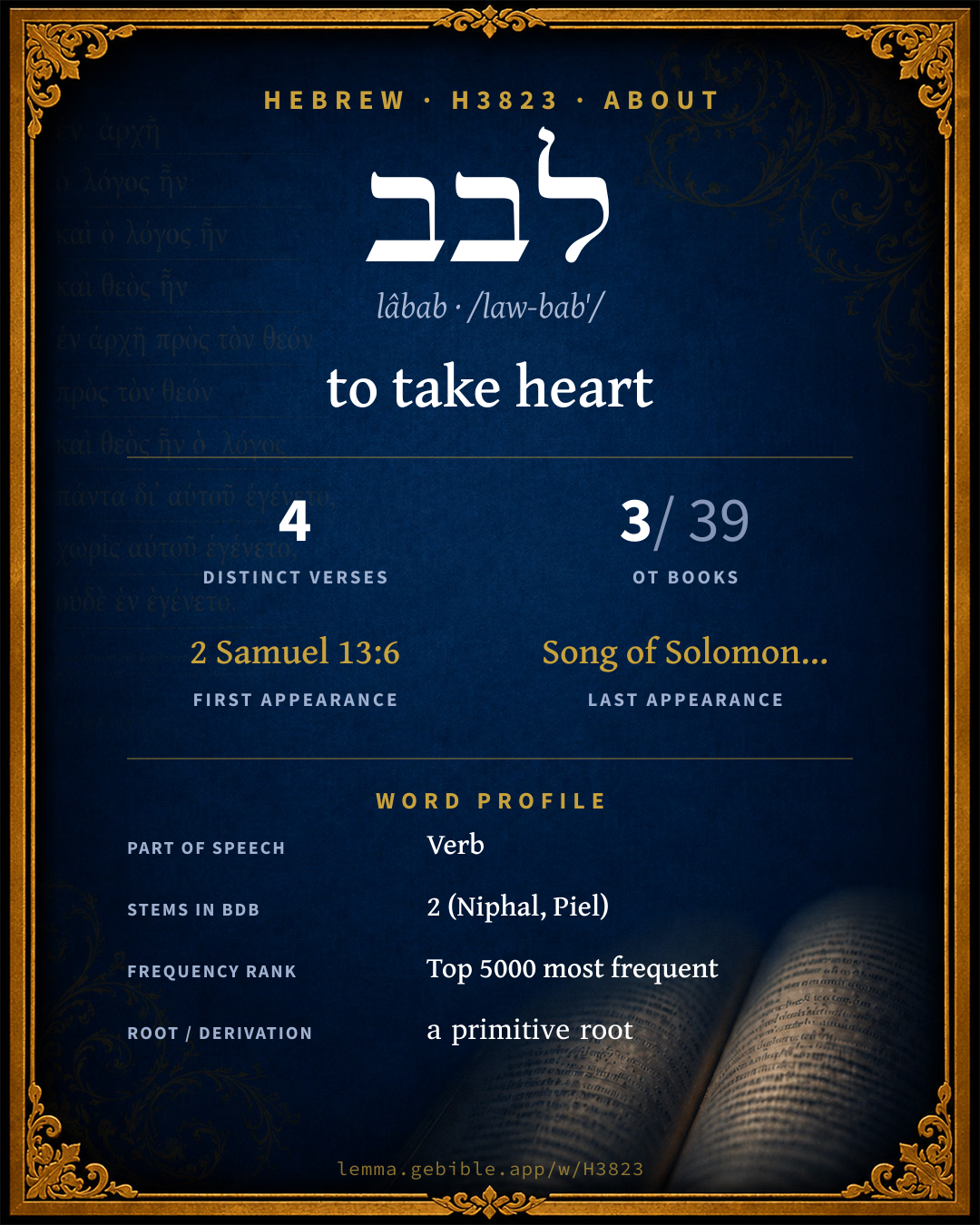
לבב
to take heart
‘to take heart’ is one of 2 main senses fuller range ↓
Full lexicon entry — Brown-Driver-Briggs (BDB)
From Brown-Driver-Briggs (BDB)
Where this word appears
See every Piel verb in the Hebrew Bible →
Grammar key — what these labels mean
Part of speech
- Verb
- An action or state-of-being word.
Stem
- Piel
- An intensive or resultative active stem.
- Niphal
- Usually the simple passive or reflexive of the Qal (“he was written”).
Form
- Perfect
- A completed action or state — Hebrew marks aspect (completeness) more than strict tense (“he wrote”).
- Imperfect
- An incomplete, ongoing, or future action (“he will / would write”).
- Sequential Imperfect
- An imperfect with prefixed waw — the standard past-narrative form (waw-consecutive imperfect).
Person
- 2nd Person
- The one addressed (“you”).
- 3rd Person
- The one spoken about (“he / she / it / they”).
Gender
- Feminine
- Grammatically feminine.
- Masculine
- Grammatically masculine.
Number
- Singular
- One.
Grammatical forms
- Verb, Piel, Perfect, 2nd Person, Feminine, Singular 2 times (40%)
- Verb, Piel, Imperfect, 3rd Person, Feminine, Singular 1 time (20%)
- Verb, Piel, Sequential Imperfect, 3rd Person, Feminine, Singular 1 time (20%)
- Verb, Niphal, Imperfect, 3rd Person, Masculine, Singular 1 time (20%)
Parsed forms decoded from the imported morphology (morphhb / Westminster Leningrad Codex — WLC text public domain, morphhb tagging CC BY 4.0), counted across 5 parsed occurrences — not distinct verses.
Every verse where H3823 appears — 4 distinct verses across 3 books. Click any verse to open its interlinear word-by-word view. Verse text shown in the World English Bible for context — . Each verse’s Hebrew form is shown with its reference; the English is not keyword-highlighted, since the data carries no word-level English alignment. Use “Compare translations” on any verse to read it across multiple English versions. This concordance covers the Hebrew Bible; Septuagint (Greek Old Testament) occurrences are not indexed here.
2 Samuel 2 verses
- 2 Samuel 13:6 וּ/תְלַבֵּ֤ב conj + Piel impf 3fs So Amnon lay down, and feigned himself sick: and when the king was come to see him, Amnon said to the king, Please let her sister Tamar come, and make me a couple of cakes in my sight, that I may eat from her hand.
- 2 Samuel 13:8 וַ/תְּלַבֵּ֣ב conj + Piel wimpf 3fs So Tamar went to her brother Amnon's house; and he was laid down. She took dough, and kneaded it, and made cakes in his sight, and did bake the cakes.
Job 1 verse
Song of Solomon 1 verse
About this entry
At a glance — auto-summarized from this page’s data, not written by a person. Every figure links to its source below. This summary describes the numbers; it doesn’t interpret them.
“to take heart” is the headline sense of the Hebrew verb לבב (lâbab). It occurs a mere 4 verses across Scripture. More than half of its appearances fall in 2 Samuel. First canonically at 2 Samuel 13:6, it enters the text early. As a verb its force shifts by stem, across 2 stems (Niphal, Piel, and more). See the sense tree, 4-verse concordance, and the renderings breakdown below.
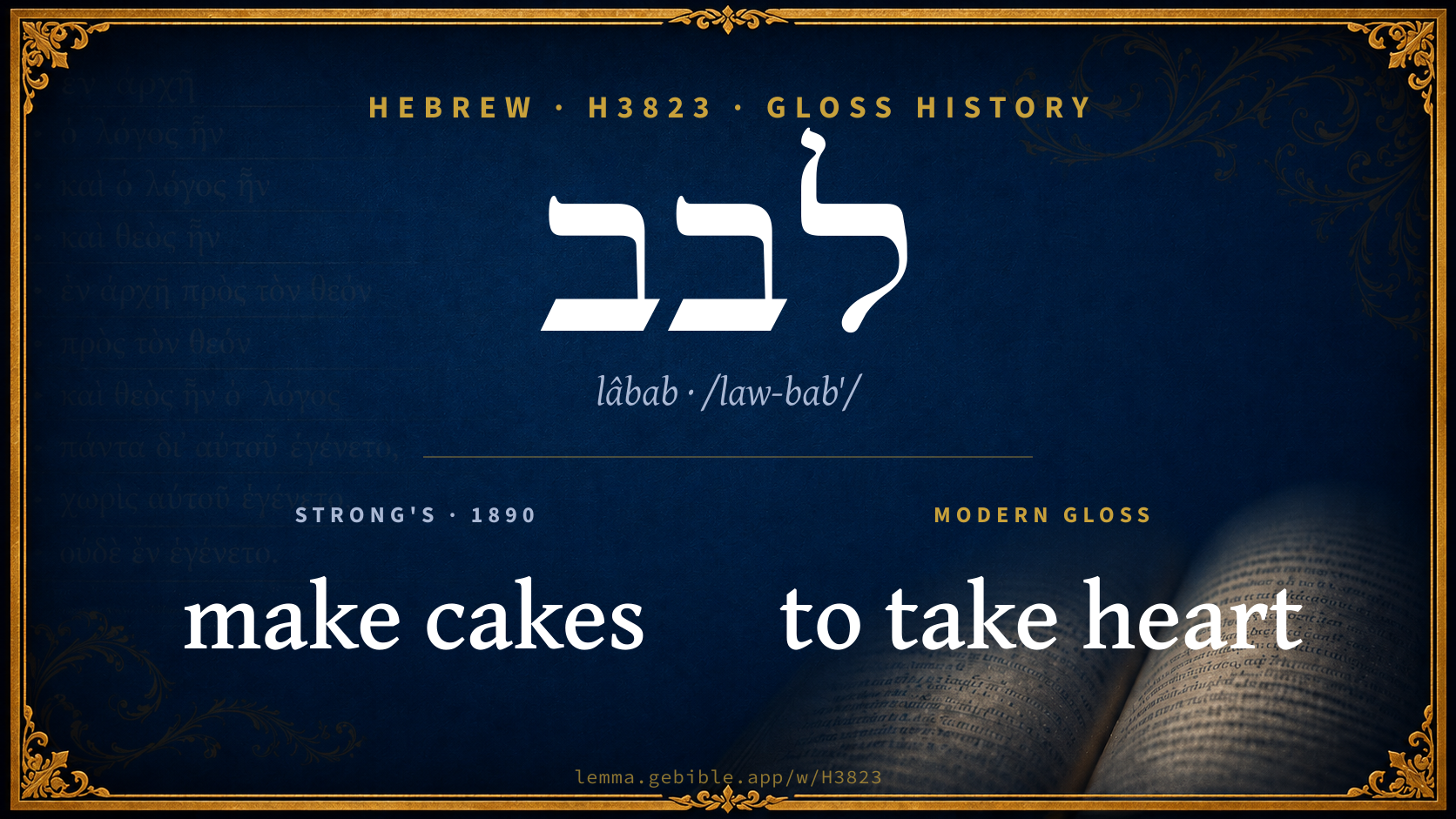
Gloss history
Strong's 1890 vs modern scholarship
About this word
Strong's H3823 catalogs a Hebrew word from the Hebrew Old Testament.
These counts are not copied from any lexicon or concordance. They are computed here, from the morphology-tagged Hebrew Old Testament. What Lemma adds →
- 4
- distinct verses
- The word appears in 4 distinct verses.
- 3 / 39
- OT books
- The word appears in 3 of 39 Old Testament books.
- #3,337
- by frequency
- Top 5000 most frequent Hebrew words (rank 3,337 of 8,640 Hebrew words by occurrence).
View all 4 occurrences in the concordance →
Most concentrated in
- 2 Samuel 2 verses 50%
- Job 1 verse 25%
- Song of Solomon 1 verse 25%
By section of the Old Testament
By traditional corpus
Conventional, traditional groupings — biblical authorship is debated, so this is a traditional corpus grouping, not an authorship claim. Each share is this word’s portion of its verses in that division of the Hebrew canon. Each figure is a share of the word’s 4 distinct verses.
- Prophets (Nevi'im) 2 verses · 50%
- Writings (Ketuvim) 2 verses · 50%
How translations render this word
Counts come from each version’s own published word-to-Strong’s tagging or interlinear alignment — an approximate guide to how each version renders this word, not a word-level alignment the data otherwise carries. Because each total is that version’s own tagged count, the per-version totals vary from one another and need not match the appearance or distinct-verse counts above. These counts may also differ from a printed concordance because Lemma counts each distinctly tagged rendering and does not collapse phrase taggings into a single head-word total. This is a fixed set of word-tagged versions (KJV, ASV, BSB, ULT) and does not change with the reading translation you choose elsewhere. Each version’s license is shown beside its name below (and on Sources).
BDB lists this Strong’s number as 2 distinct words (homographs). Each count above pools all of them and is not split by sense — see the Senses section below. A low-frequency rendering may belong to a different one of those words, not the primary meaning.
- King James Version†: Thou hast ravished my heart 2×
- American Standard Version†: Thou hast ravished my heart 2×
- Berean Standard Bible†: Can no more become wise 1×, Made cakes 1×, You have captured my heart 1×
- unfoldingWord Literal Text†: You have enchanted my heart 2×
King James Version Public Domain
Renders H3823 across 5† tagged occurrences — most commonly:
Plus 3 renderings that appear only once — usually multi-word phrases or single function words the recovered tagging swept in, not distinct renderings.
American Standard Version Public Domain
Renders H3823 across 5† tagged occurrences — most commonly:
Plus 3 renderings that appear only once — usually multi-word phrases or single function words the recovered tagging swept in, not distinct renderings.
Berean Standard Bible Public Domain
Renders H3823 across 4† tagged occurrences — most commonly:
Not rendered by a distinct English word in 1 further occurrence.
unfoldingWord Literal Text CC BY-SA 4.0
Renders H3823 across 5† tagged occurrences — most commonly:
Plus 3 renderings that appear only once — usually multi-word phrases or single function words the recovered tagging swept in, not distinct renderings.
Senses in the full BDB
Hebrew verbs can shift meaning by stem (binyan): Qal is the basic action, Niphal is often passive or reflexive, Piel often intensifies or makes it factitive, and Hiphil is typically causative. The senses below are grouped under the stem BDB assigns to each.
What do BDB’s symbols mean?
BDB uses these scholarly abbreviations:
| Symbol | Meaning |
|---|---|
| 𝔊 | the Septuagint (the ancient Greek translation, LXX) |
| 𝔙 | the Vulgate (the Latin translation) |
| 𝔖 | the Syriac version (the Peshitta) |
| 𝔗 | the Targum (the Aramaic translation) |
| ψ | the Psalms |
| √ | root (the underlying root or stem) |
| ‖ | parallel passage (a synonymous or contrasted parallel) |
| † | the dagger: every passage where the word occurs is cited |
The 2 senses and sub-senses the full Brown-Driver-Briggs lexicon distinguishes for this word, in lexicon order (not ranked by frequency), with BDB’s own verbatim wording and sub-sense lettering. Shown in Hebrew script with BDB’s own scholarly abbreviations. The condensed entry is in the Lexicon Entry tab. See also the Forms in the corpus table below.
לבב I
Niphal
- . get a mind
Piel
- . encourage
לבב II make cakes
Senses from the full Brown-Driver-Briggs lexicon (Brown, Driver, Briggs; Oxford 1906 — public domain), digitized via Sefaria, supplemented by the OpenScriptures HebrewLexicon (CC BY 4.0). Full attribution on Sources.
Word origin
[ לבב ] vb. denom. Pi. make cakes.
— Brown-Driver-Briggs (Oxford 1906, public domain), digitized via Sefaria, supplemented by the OpenScriptures HebrewLexicon (CC BY 4.0). See Sources.
Origin: a primitive root
Jastrow Dictionary
A second Hebrew/Aramaic lexicon for comparison, covering Aramaic and post-biblical (Talmudic, Targumic, Midrashic) usage that the biblical-Hebrew BDB does not. Matched by lemma rather than by Strong’s number, so a lemma may carry more than one Jastrow headword (shown separately below), and the entries cover usage well beyond the Bible.
לֵבָב
- (b. h.) = לֵב, heart; (in rabbinical homiletics) double heart, seat of two opposite inclinations (v. יֵצֶר). Ber. IX, 5 (ref. to Deut. VI, 5) בכל לְבָבְךָ בשני יצריך וכ׳ ‘with all thy heart’ means with both thy inclinations &c. (i.e. break thy evil inclination for the love of God). Gen. R. s. 48 (ref. to Gen. XVIII, 5) וסעדו לְבַבְכֶם אין וכ׳ it does not say here, ‘comfort ye your l’bab, but your leb’, which intimates that the evil inclination has no power over angels; a. e.—[Pesik. S’liḥ., p. 166ᵃ, v. next w.]—Pl. f. לְבָבוֹת. Tanḥ. Ki Thabo 1 (ref. to Deut. XXVI, 16) בשעה שאתם מתפללים … שתי ל׳ וכ׳ when you pray before the Lord, you shall not have two hearts, one for the Lord, and one for another thing (idol); ib. 2. Sot. I, 8 גנב ג׳ ל׳ (Bab. ed. p. 9ᵇ גנבות) he deceived three hearts (v. גָּנַב). B. Bath. 12ᵇ before eating and drinking man has שתי ל׳ וכ׳ two hearts (his thoughts are not clearly defined) &c. (ref. to Job XI, 12 ‘a hollow man is divided at heart’). e.g. Deuteronomy 6:5
לָבַב
- (b. h.)
- 1. to join closely; to tie.—Part. Pass. לָבוּב, pl. לְבוּבִין. Sabb. V, 2 (52ᵇ) זכרים יוצאין ל׳ wethers may be taken out (on the Sabbath) coupled; expl. ib. 53ᵇ תותרי. Ib. מאי משמע דהאי ל׳ לישנא דקרובי הוא where is the proof that this root לבב has the meaning of bringing close together? Answ. ref. to לבבתני (Cant. IV, 9) ‘thou hast chained me’; עולא אמר עור שקושרין להם כנגד לבם וכ׳ Ulla says (l’bubin refers to) the skin which is tied against their chests to protect them from the attacks of wolves; Y. ib. V, 7ᵇ bot. שהוא נותן עור וכ׳ (v. בּוּרְסִיון). e.g. Song of Solomon 4:9
- 2. (denom. of לֵב) part. pass. (עור) לָבוּב a hide showing a hole in the place corresponding to the heart.—Pl. לְבוּבִים, לְבוּבִין. Ab. Zar. II, 3 (29ᵇ) עורות ל׳ hides with holes &c. (are forbidden, because the heart has been cut out for idolatrous purposes); expl. Tosef. ib. IV (V), 7; Y. ib. II, 41ᵇ; Bab. ib. 32ᵃ
- to be tied around. Y. Sabb. X, end, 12ᵈ העושה … לִילָּבֵב he who makes a strap to be tied around (an animal’s chest &c., v. supra); Tosef. Kel. B. Bath. IV, 13 ללַבֵּב Pi.
- 1. to join, tie, v. supra.
- 2. (denom. of לֵב) to encourage; to strengthen. Tanḥ. Sh’moth 14; Ex. R. s. 2 (play on לַבַּת, Ex. III, 2) (כדי) לְלַבְּבוֹ וכ׳ in order to make him courageous when he comes to Mount Sinai &c. Gen. R. s. 77 היה … ומְלַבְּבוֹ בארי the king took his son and made him courageous by making him attack the (tamed) lion; Cant. R. to III, 6 זיווג את הארי והיה מלבבו כנגד בנו he attacked the lion and incited him against his son. Pesik. S’liḥ., p. 166ᵃ [read:] יפה כחך לַבֵּב כחך גבור improve thy strength, strengthen thy powers, valiant man! (Ar. ed. Koh. ליבב כח בגבורה, oth. ed. לבב כח בגבורה join physical strength to valor). e.g. Exodus 3:2
A Dictionary of the Targumim, the Talmud Babli and Yerushalmi, and the Midrashic Literature (Marcus Jastrow; London, Luzac, 1903) — Public Domain. Digitized via Sefaria. Digitized via Sefaria. Full attribution on Sources.
Forms in the corpus
The 5 distinct written forms H3823 takes in the Hebrew Bible, most frequent first — each parse links to that stem’s occurrences in the concordance. Hebrew forms include their vowel points and cantillation, so a single lemma takes many written forms.
| Form | Parsing | Example | Uses |
|---|---|---|---|
| וַ/תְּלַבֵּ֣ב | Verb, Piel, Sequential Imperfect, 3rd Person, Feminine, Singular | 2 Samuel 13:8 | 1 |
| וּ/תְלַבֵּ֤ב | Verb, Piel, Imperfect, 3rd Person, Feminine, Singular | 2 Samuel 13:6 | 1 |
| יִלָּבֵ֑ב | Verb, Niphal, Imperfect, 3rd Person, Masculine, Singular | Job 11:12 | 1 |
| לִבַּבְתִּ֖/נִי | Verb, Piel, Perfect, 2nd Person, Feminine, Singular | Song of Solomon 4:9 | 1 |
| לִבַּבְתִּ֨י/נִי֙ | Verb, Piel, Perfect, 2nd Person, Feminine, Singular | Song of Solomon 4:9 | 1 |
Same root — word family
Other BDB entries built from the same root as H3823, grouped by Strong’s listed origin. These share a root / origin per the lexicon — not necessarily a shared meaning. Each links to that word’s own entry.
Derived from this word
Compare all same-root words → They share a root, not necessarily a meaning.
Septuagint verse parallels
This word appears in 4 verses that also exist in the Greek Old Testament (Septuagint), out of the 4 Hebrew verses it occurs in. You can read those verses in Greek by switching the Old Testament edition to the Septuagint.
Read these verses in the Septuagint
This is a verse-level parallel only — the same verses exist in both the Hebrew and Greek Old Testaments. No word-level Hebrew↔Greek correspondence is claimed: the data carries no such alignment, so no Greek word is shown as this Hebrew word’s translation. Coverage is not total — the Septuagint omits the deuterocanon and renumbers the Psalms, so some Hebrew verses have no direct Greek parallel.