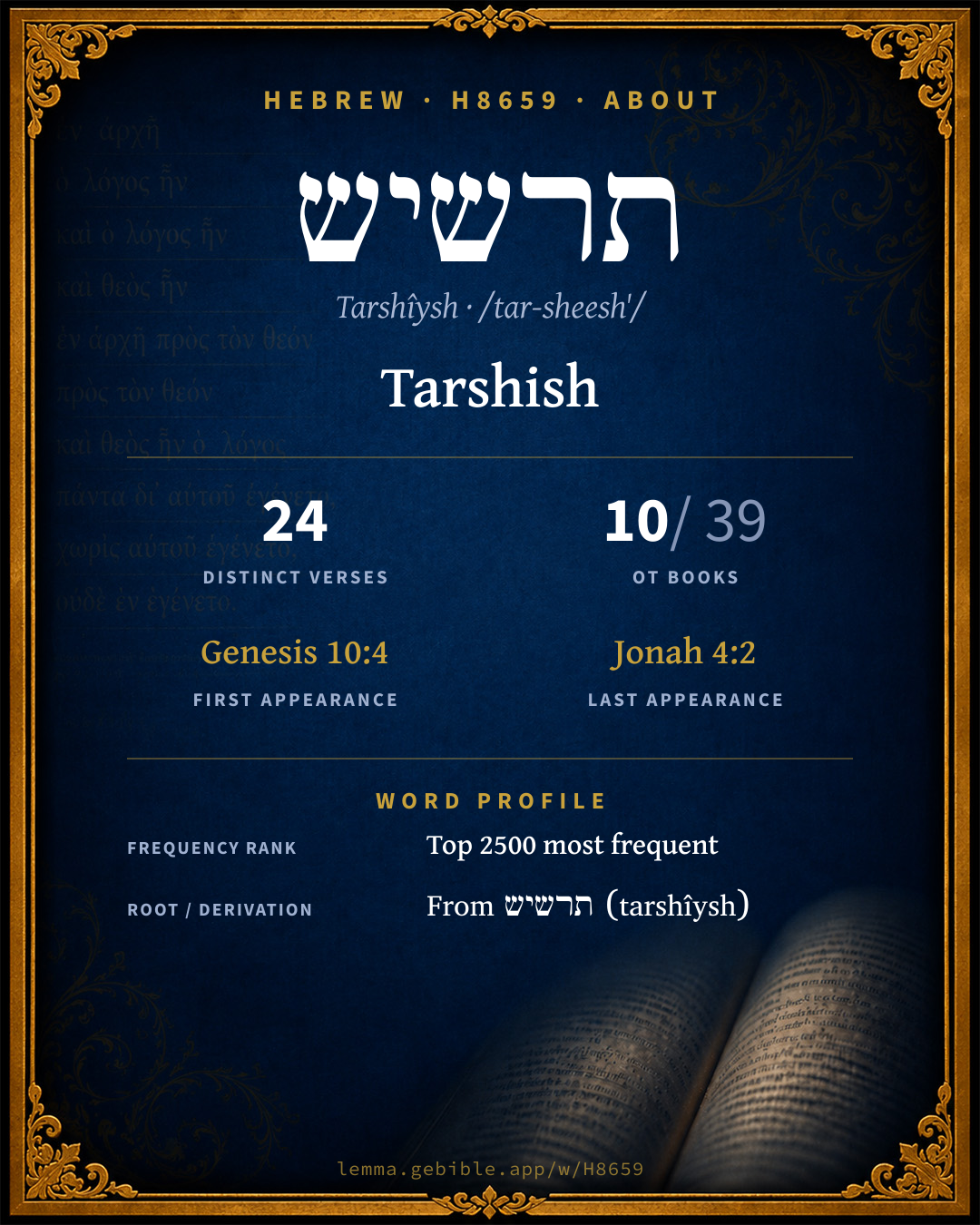
תַּרְשִׁישׁ
Tarshish
BDB lists 6 entries for ‘Tarshish’ fuller range ↓
Full lexicon entry — Brown-Driver-Briggs (BDB)
From Brown-Driver-Briggs (BDB)
Where this word appears
Grammar key — what these labels mean
Part of speech
- Noun
- A naming word — a person, place, thing, or idea.
Noun type
- Proper
- A name of a specific person, place, or people (e.g. Abraham, Zion, Israel).
Every verse where H8659 appears in the Book of Ezekiel — 3 distinct verses. Click any verse to open its interlinear word-by-word view. Verse text shown in the World English Bible for context — . Each verse’s Hebrew form is shown with its reference; the English is not keyword-highlighted, since the data carries no word-level English alignment. Use “Compare translations” on any verse to read it across multiple English versions. This concordance covers the Hebrew Bible; Septuagint (Greek Old Testament) occurrences are not indexed here.
Ezekiel
- Ezekiel 27:12 תַּרְשִׁ֥ישׁ n Proper Tarshish was your merchant by reason of the multitude of all kinds of riches; with silver, iron, tin, and lead, they traded for your wares.
- Ezekiel 27:25 תַּרְשִׁ֔ישׁ n Proper The ships of Tarshish were your caravans for your merchandise: and you were replenished, and made very glorious in the heart of the seas.
- Ezekiel 38:13 תַרְשִׁ֤ישׁ n Proper Sheba, and Dedan, and the merchants of Tarshish, with all the young lions of it, shall tell you, Are you come to take the spoil? have you assembled your company to take the prey? to carry away silver and gold, to take away cattle and goods, to take great spoil?
About this entry
At a glance — auto-summarized from this page’s data, not written by a person. Every figure links to its source below. This summary describes the numbers; it doesn’t interpret them.
The Hebrew name תרשיש centers on the idea of “Tarshish.” First canonically at Genesis 10:4, it enters the text early. The Hebrew Bible uses it across 24 verses — uncommon. Isaiah dominates its distribution — 7 of 24 verses. Dig into 24-verse concordance and the renderings breakdown below.
Gloss history
Strong's 1890 vs modern scholarship
About this word
Strong's H8659 catalogs a Hebrew word from the Hebrew Old Testament.
These counts are not copied from any lexicon or concordance. They are computed here, from the morphology-tagged Hebrew Old Testament. What Lemma adds →
- 24
- distinct verses
- The word appears in 24 distinct verses.
- 10 / 39
- OT books
- The word appears in 10 of 39 Old Testament books.
- #1,190
- by frequency
- Top 2500 most frequent Hebrew words (rank 1,190 of 8,640 Hebrew words by occurrence).
View all 24 occurrences in the concordance →
Most concentrated in
- Isaiah 7 verses 29%
- 2 Chronicles 3 verses 13%
- Ezekiel 3 verses 13%
By section of the Old Testament
By traditional corpus
Conventional, traditional groupings — biblical authorship is debated, so this is a traditional corpus grouping, not an authorship claim. Each share is this word’s portion of its verses in that division of the Hebrew canon. Each figure is a share of the word’s 24 distinct verses.
- Prophets (Nevi'im) 15 verses · 63%
- Writings (Ketuvim) 8 verses · 33%
- Torah (Pentateuch) 1 verse · 4%
How translations render this word
Counts come from each version’s own published word-to-Strong’s tagging or interlinear alignment — an approximate guide to how each version renders this word, not a word-level alignment the data otherwise carries. Because each total is that version’s own tagged count, the per-version totals vary from one another and need not match the appearance or distinct-verse counts above. These counts may also differ from a printed concordance because Lemma counts each distinctly tagged rendering and does not collapse phrase taggings into a single head-word total. This is a fixed set of word-tagged versions (KJV, ASV, BSB, ULT) and does not change with the reading translation you choose elsewhere. Each version’s license is shown beside its name below (and on Sources).
BDB lists this Strong’s number as 2 distinct words (homographs). Each count above pools all of them and is not split by sense — see the Senses section below. A low-frequency rendering may belong to a different one of those words, not the primary meaning.
- King James Version†: Tarshish 24×, Tharshish 4×
- American Standard Version†: Tarshish 25×
- Berean Standard Bible†: Tarshish 27×
- unfoldingWord Literal Text†: Tarshish 27×
King James Version Public Domain
Renders H8659 across 28† tagged occurrences — most commonly:
American Standard Version Public Domain
Renders H8659 across 28† tagged occurrences — most commonly:
Plus 3 renderings that appear only once — usually multi-word phrases or single function words the recovered tagging swept in, not distinct renderings.
Berean Standard Bible Public Domain
Renders H8659 across 28† tagged occurrences — most commonly:
Plus 1 rendering that appears only once — usually multi-word phrases or single function words the recovered tagging swept in, not distinct renderings.
unfoldingWord Literal Text CC BY-SA 4.0
Renders H8659 across 28† tagged occurrences — most commonly:
Plus 1 rendering that appears only once — usually multi-word phrases or single function words the recovered tagging swept in, not distinct renderings.
Senses in the full BDB
What do BDB’s symbols mean?
BDB uses these scholarly abbreviations:
| Symbol | Meaning |
|---|---|
| 𝔊 | the Septuagint (the ancient Greek translation, LXX) |
| 𝔙 | the Vulgate (the Latin translation) |
| 𝔖 | the Syriac version (the Peshitta) |
| 𝔗 | the Targum (the Aramaic translation) |
| ψ | the Psalms |
| √ | root (the underlying root or stem) |
| ‖ | parallel passage (a synonymous or contrasted parallel) |
| † | the dagger: every passage where the word occurs is cited |
The 4 senses and sub-senses the full Brown-Driver-Briggs lexicon distinguishes for this word, in lexicon order (not ranked by frequency), with BDB’s own verbatim wording and sub-sense lettering. Shown in Hebrew script with BDB’s own scholarly abbreviations. The condensed entry is in the Lexicon Entry tab. See also the Forms in the corpus table below.
תרשיש I a precious stone, perhaps yellow jasper, or other gold-coloured stone (𝔊 Ex 28
תרשיש II
- 1. loc. a distant port, site not certainly known (WklAltor. Forsch. v. 445); most Tartessus in Spain Thes (after older authorities) Ges Is i, 719 MeyGesch. d. Alt. i, § 281; other views are: Tyrseni (Etruscans) in Italy, WMMHast. DB Tarshish, Phoenicia RenoufPSBA xvi. 134 ff., Sardinia HalRÉJ xiii. 14; v. also Ency. Bib.Tarshish;— Tarshish, 𝔊 usually Θαρσ(ε)ις (Is 23:1, 14 Καρχήδων = Carthage);—especially in phr. אֳנִיּוֹת ת׳ Tarshish-ships (large, sea-going vessels, fit to ply to Tarshish) Is 2:16 (𝔊 πλοῖον θαλάσσης), 23:1, 14; 60:9; Ez 27:25; 1 K 22:49, ‖ 2 Ch 20:36, 37 (where the ships go to ת׳); אֳנִי ת׳ 1 K 10:22(×2) ‖ 2 Ch 9:21 (אֳנִיּוֹת), + v 21 (ships go to ת׳); ת׳ alone Is 23:6 Jon 1:3(×2); 4:2 (all c. ה loc.), Gn 10:4 ‖ 1 Ch 1:7 (erron. ה loc.), Is 66:19 ψ 72:10 Jon 1:3; בַּת־ת׳ Is 23:10; trading-port Ez 27:12; 38:13, whence comes silver Je 10:9. e.g. Isaiah 23:1
- 2. m.
- a. in Benjamin 1 Ch 7:10. e.g. 1 Chronicles 7:10
- b. Persian noble Est 1:14; expl. by Scheft53 as OIran. tṛšus, ‘der Gierige.’ e.g. Esther 1:14
Senses from the full Brown-Driver-Briggs lexicon (Brown, Driver, Briggs; Oxford 1906 — public domain), digitized via Sefaria, supplemented by the OpenScriptures HebrewLexicon (CC BY 4.0). Full attribution on Sources.
Word origin
n.m. a precious stone, perhaps yellow jasper, or other gold-coloured stone (𝔊 Ex 28:20; 39:13 χρυσόλιθος, so JosAnt. iii, 7, 5 [168], v. PetrieHast. DB Stones, Precious MyresEncy. Bib. Id. § 17 Dr Dn 10:6);—כְּעֵין ת׳ Ez 1:16; כְּעֵין אֶבֶן ת׳ 10:9; in list of gems 28:13; Ex 28:20; 39:13; in sim. of resplendent body Dn 10:6, cf.Ct 5:14.
— Brown-Driver-Briggs (Oxford 1906, public domain), digitized via Sefaria, supplemented by the OpenScriptures HebrewLexicon (CC BY 4.0). See Sources.
Derived from תרשיש (tarshîysh) (H8658) — precious stone.
Forms in the corpus
The 19 distinct written forms H8659 takes in the Hebrew Bible, most frequent first — each parse links to that state’s occurrences in the concordance. Hebrew forms include their vowel points and cantillation, so a single lemma takes many written forms.
| Form | Parsing | Example | Uses |
|---|---|---|---|
| תַּרְשִׁ֑ישׁ | Noun, Proper | 2 Chronicles 20:36 | 3 |
| תַרְשִׁ֗ישׁ | Noun, Proper | 1 Kings 10:22 | 2 |
| תַרְשִׁ֤ישׁ | Noun, Proper | Ezekiel 38:13 | 2 |
| תַּרְשִׁ֑ישָׁ/ה | Noun, Proper | Isaiah 23:6 | 2 |
| תַּרְשִׁ֔ישׁ | Noun, Proper | Ezekiel 27:25 | 2 |
| תַּרְשִׁ֔ישָׁ/ה | Noun, Proper | Jonah 1:3 | 2 |
| תַּרְשִׁ֗ישׁ | Noun, Proper | 2 Chronicles 9:21 | 2 |
| תַּרְשִֽׁישׁ | Noun, Proper | 2 Chronicles 20:37 | 2 |
| וְ/תַרְשִׁ֑ישׁ | Noun, Proper | Genesis 10:4 | 1 |
| וְ/תַרְשִׁ֑ישָׁ/ה | Noun, Proper | 1 Chronicles 1:7 | 1 |
| וְ/תַרְשִׁ֖ישׁ | Noun, Proper | 1 Chronicles 7:10 | 1 |
| מִ/תַּרְשִׁ֣ישׁ | Noun, Proper | Jeremiah 10:9 | 1 |
| תַרְשִׁ֔ישׁ | Noun, Proper | Esther 1:14 | 1 |
| תַרְשִׁ֣ישׁ | Noun, Proper | Psalms 72:10 | 1 |
| תַּרְשִׁ֕ישׁ | Noun, Proper | Isaiah 23:10 | 1 |
| תַּרְשִׁ֜ישׁ | Noun, Proper | 1 Kings 22:48 | 1 |
| תַּרְשִׁ֥ישׁ | Noun, Proper | Ezekiel 27:12 | 1 |
| תַּרְשִׁ֨ישׁ | Noun, Proper | Isaiah 66:19 | 1 |
| תַּרְשִׁישׁ֙ | Noun, Proper | Isaiah 60:9 | 1 |
Same root — word family
Other BDB entries built from the same root as H8659, grouped by Strong’s listed origin. These share a root / origin per the lexicon — not necessarily a shared meaning. Each links to that word’s own entry.
Derives from
Derived from this word
Compare all same-root words → They share a root, not necessarily a meaning.
Bible dictionary
Public-domain dictionary articles matched to this entry by name (Tarshish). A biblical name can be shared by more than one person or place, so an article may treat several.
Easton's Bible Dictionary · M. G. Easton, 1897
A Sanscrit or Aryan word, meaning "the sea coast." (1.) One of the "sons" of Javan (Gen. 10:4; 1 Chr. 1:7).
(2.) The name of a place which first comes into notice in the days of Solomon. The question as to the locality of Tarshish has given rise to not a little discussion. Some think there was a Tarshish in the East, on the Indian coast, seeing that "ships of Tarshish" sailed from Eziongeber, on the Red Sea (1 Kings 9:26; 22:48; 2 Chr. 9:21). Some, again, argue that Carthage was the place so named. There can be little doubt, however, that this is the name of a Phoenician port in Spain, between the two mouths of the Guadalquivir (the name given to the river by the Arabs, and meaning "the great wady" or water-course). It was founded by a Carthaginian colony, and was the farthest western harbour of Tyrian sailors. It was to this port Jonah's ship was about to sail from Joppa. It has well been styled "the Peru of Tyrian adventure;" it abounded in gold and silver mines.
It appears that this name also is used without reference to any locality. "Ships of Tarshish" is an expression sometimes denoting simply ships intended for a long voyage (Isa. 23:1, 14), ships of a large size (sea-going ships), whatever might be the port to which they sailed. Solomon's ships were so styled (1 Kings 10:22; 22:49).
Smith's Bible Dictionary · William Smith, 1863
(established).
+ Probably Tartessus, a city and emporium of the Phoenicians in the south of Spain, represented as one of the sons of Javan. (Genesis 10:4; 1 Kings 10:22; 1 Chronicles 1:7; Psalms 48:7; Isaiah 2:16; Jeremiah 10:9; Ezekiel 27:12,25; Jonah 1:3; 4:2) The identity of the two places is rendered highly probable by the following circumstances: 1st. There is a very close similarity of name between them, Tartessus being merely Tarshish in the Aramaic form. 2nd. There seems to have been a special relation between Tarshish and Tyre, as there was at one time between Tartessus and Phoenicians. 3rd. The articles which Tarshish is stated by the prophet Ezekiel, (Ezekiel 27:12) to have supplied to Tyre are precisely such as we know, through classical writers, to have been productions of the Spanish peninsula. In regard to tin, the trade of Tarshish in this metal is peculiarly significant, and, taken in conjunction with similarity of name and other circumstances already mentioned, is reasonably conclusive as to its identity with Tartessus. For even not when countries in Europe or on the shores of the Mediterranean Sea where tin is found are very few; and in reference to ancient times, it would be difficult to name any such countries except Iberia or Spain, Lusitania, which was somewhat less in extent than Portugal, and Cornwall in Great Britain. In the absence of positive proof, we may acquiesce in the statement of Strabo, that the river Baetis (now the Guadalquivir) was formerly called Tartessus, that the city Tartessus was situated between the two arms by which the river flowed into the sea, and that the adjoining country was called Tartessis. + From the book of Chronicles there would seem to have been a Tarshish accessible from the Red Sea, in addition to the Tarshish of the south of Spain. Thus, with regard to the ships of Tarshish, which Jehoshaphat caused to be constructed at Ezion-geber on the Elanitic Gulf of the Red Sea, (1 Kings 22:48) it is said in the Chronicles, (2 Chronicles 20:36) that they were made to go to Tarshish; and in like manner the navy of ships, which Solomon had previously made in Ezion-geber, (1 Kings 9:26) is said in the Chronicles, (2 Chronicles 9:21) to have gone to Tarshish with the servants of Hiram. It is not to be supposed that the author of these passages in the Chronicles contemplated a voyage to Tarshish in the south of Spain by going round what has since been called the Cape of Good Hope. The expression "ships of Tarshish" originally meant ships destined to go to Tarshish; and then probably came to signify large Phoenician ships, of a particular size the description, destined for long voyages, just as in English "East Indiaman" was a general name given to vessels, some of which were not intended to go to India at all. Hence we may infer that the word Tarshish was also used to signify any distant place, and in this case would be applied to one in the Indian Ocean. This is shown by the nature of the imports with which the fleet returned, which are specified as "gold, silver, ivory, apes, and peacocks ." (1 Kings 10:22) The gold might possibly have been obtained form Africa, or from Ophir in Arabia, and the ivory and the apes might likewise have been imported from Africa; but the peacocks point conclusively, not to Africa, but to India. There are only two species known: both inhabit the mainland and islands of India; so that the mention of the peacock seems to exclude the possibility of the voyage having been to Africa.
Hitchcock's Bible Names Dictionary · Roswell D. Hitchcock, 1869
contemplation; examination
Classic public-domain reference works; full attribution on Sources.
Septuagint verse parallels
This word appears in 22 verses that also exist in the Greek Old Testament (Septuagint), out of the 24 Hebrew verses it occurs in. You can read those verses in Greek by switching the Old Testament edition to the Septuagint.
Read these verses in the Septuagint
- Genesis 10:4
- 1 Kings 10:22
- 1 Chronicles 1:7
- 2 Chronicles 9:21
- Esther 1:14
- Psalms 48:7
- Isaiah 2:16
- Jeremiah 10:9
- Ezekiel 27:12
- Jonah 1:3
This is a verse-level parallel only — the same verses exist in both the Hebrew and Greek Old Testaments. No word-level Hebrew↔Greek correspondence is claimed: the data carries no such alignment, so no Greek word is shown as this Hebrew word’s translation. Coverage is not total — the Septuagint omits the deuterocanon and renumbers the Psalms, so some Hebrew verses have no direct Greek parallel.