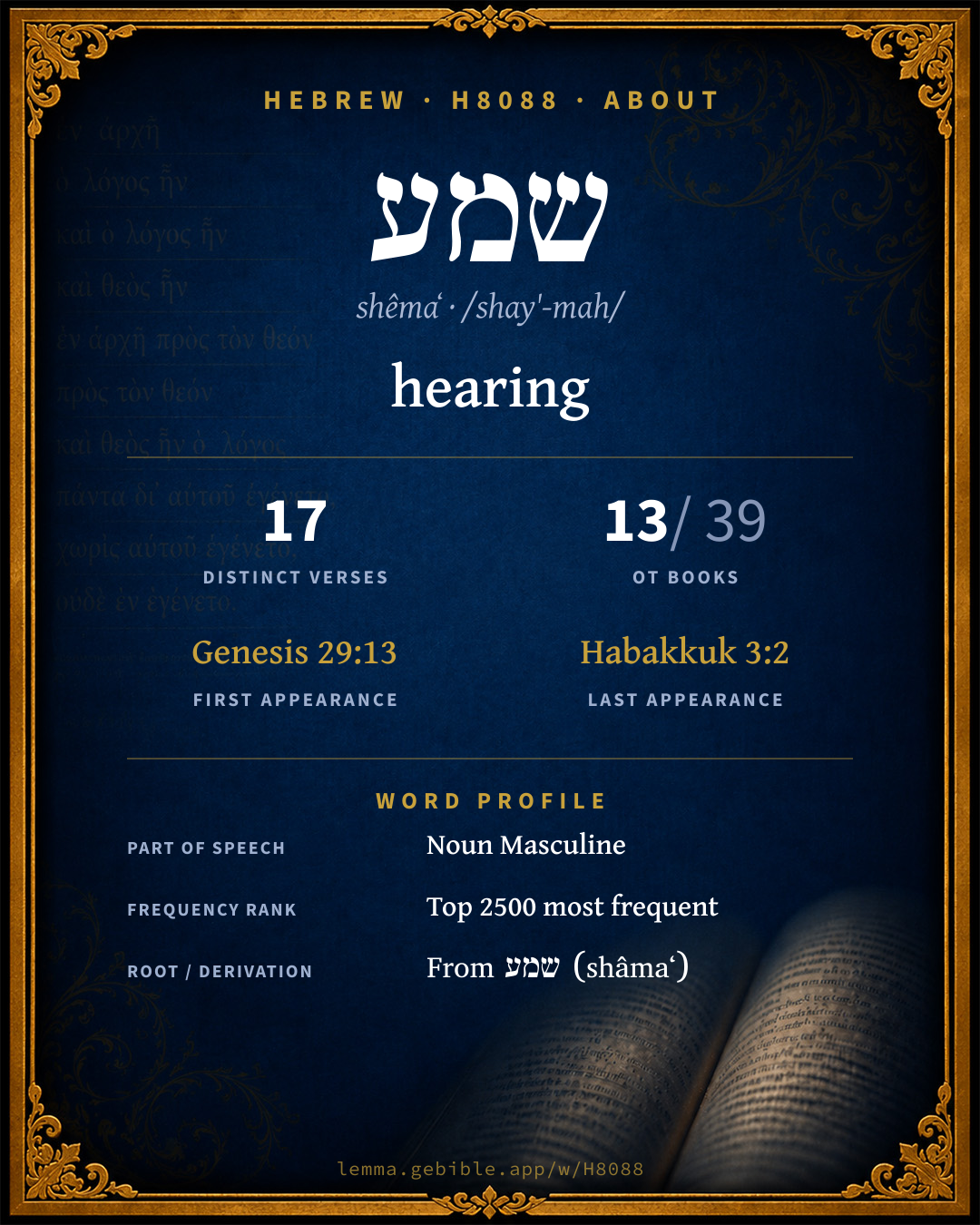
שמע
hearing
Full lexicon entry — Brown-Driver-Briggs (BDB)
From Brown-Driver-Briggs (BDB)
Where this word appears
Grammar key — what these labels mean
Part of speech
- Noun
- A naming word — a person, place, thing, or idea.
Noun type
- Common
- A common noun — a general class of person, place, or thing (“king,” “city,” “water”), not a specific name.
State
- Construct
- A noun bound to a following noun in a possessive / “of” relationship (the construct chain).
- Absolute
- The independent form of a noun, not bound to a following word.
Gender
- Masculine
- Grammatically masculine.
Number
- Singular
- One.
Every verse where H8088 appears in the Book of Jeremiah — 2 distinct verses. Click any verse to open its interlinear word-by-word view. Verse text shown in the World English Bible for context — . Each verse’s Hebrew form is shown with its reference; the English is not keyword-highlighted, since the data carries no word-level English alignment. Use “Compare translations” on any verse to read it across multiple English versions. This concordance covers the Hebrew Bible; Septuagint (Greek Old Testament) occurrences are not indexed here.
Jeremiah
- Jeremiah 37:5 שִׁמְעָ֔/ם n c ms cs + sfx pers 3mp Pharaoh's army was come forth out of Egypt; and when the Chaldeans who were besieging Jerusalem heard news of them, they broke up from Jerusalem.
- Jeremiah 50:43 שִׁמְעָ֖/ם n c ms cs + sfx pers 3mp The king of Babylon has heard the news of them, and his hands wax feeble: anguish has taken hold of him, [and] pangs as of a woman in travail.
About this entry
At a glance — auto-summarized from this page’s data, not written by a person. Every figure links to its source below. This summary describes the numbers; it doesn’t interpret them.
“hearing” is the headline sense of the Hebrew noun שמע (shêmaʻ). Scripture first uses it in Genesis 29:13. It appears 17 verses across 13 books of the Hebrew Bible, among its uncommon vocabulary. It shares a root with שמע, השמעות and משמע. The sections below give every sense, occurrence, and version rendering.
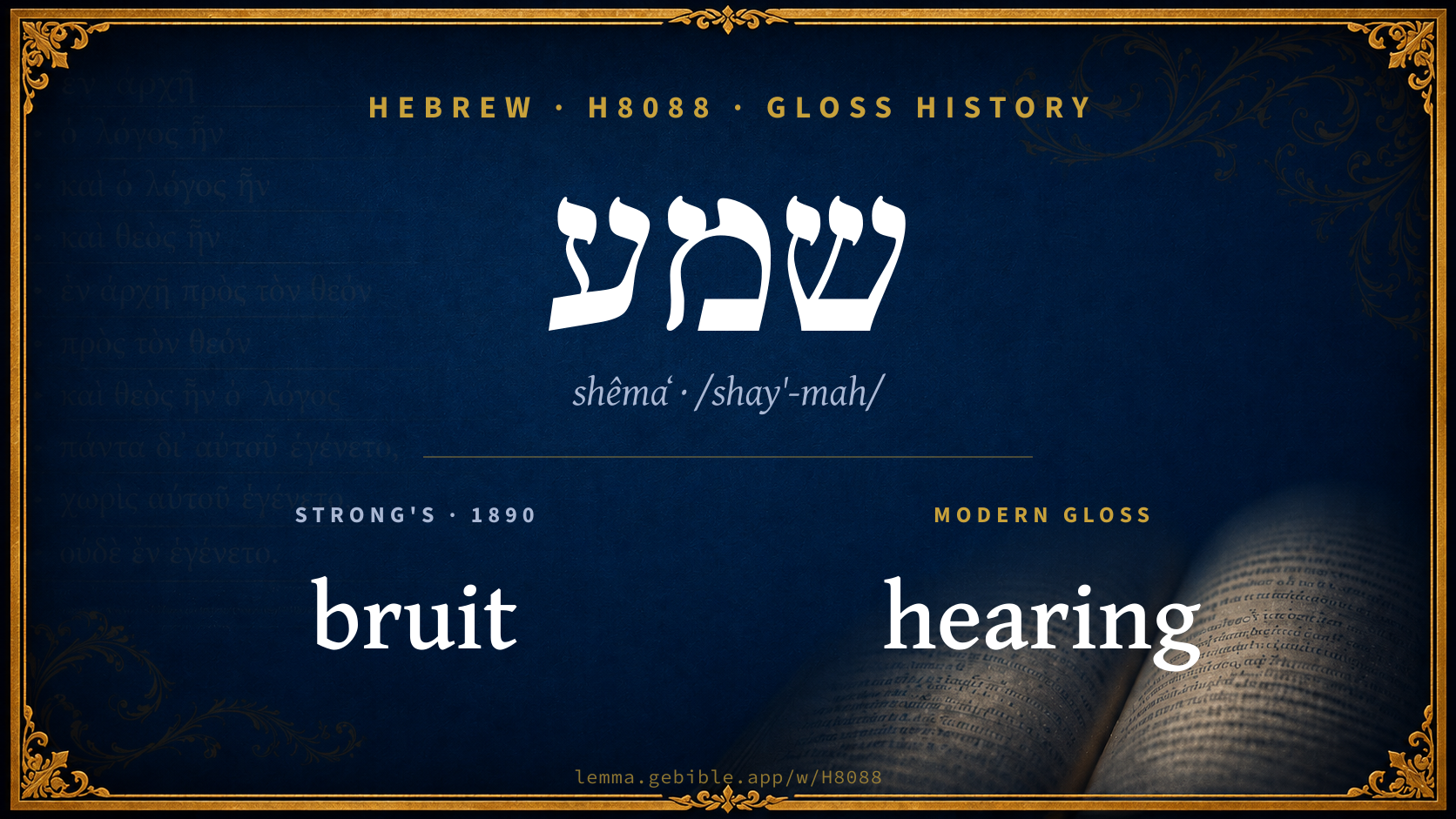
Gloss history
Strong's 1890 vs modern scholarship
About this word
Strong's H8088 catalogs a Hebrew word from the Hebrew Old Testament.
These counts are not copied from any lexicon or concordance. They are computed here, from the morphology-tagged Hebrew Old Testament. What Lemma adds →
- 17
- distinct verses
- The word appears in 17 distinct verses.
- 13 / 39
- OT books
- The word appears in 13 of 39 Old Testament books.
- #1,612
- by frequency
- Top 2500 most frequent Hebrew words (rank 1,612 of 8,640 Hebrew words by occurrence).
View all 17 occurrences in the concordance →
By section of the Old Testament
By traditional corpus
Conventional, traditional groupings — biblical authorship is debated, so this is a traditional corpus grouping, not an authorship claim. Each share is this word’s portion of its verses in that division of the Hebrew canon. Each figure is a share of the word’s 17 distinct verses.
- Prophets (Nevi'im) 8 verses · 47%
- Writings (Ketuvim) 5 verses · 29%
- Torah (Pentateuch) 4 verses · 24%
How translations render this word
Counts come from each version’s own published word-to-Strong’s tagging or interlinear alignment — an approximate guide to how each version renders this word, not a word-level alignment the data otherwise carries. Because each total is that version’s own tagged count, the per-version totals vary from one another and need not match the appearance or distinct-verse counts above. These counts may also differ from a printed concordance because Lemma counts each distinctly tagged rendering and does not collapse phrase taggings into a single head-word total. This is a fixed set of word-tagged versions (KJV, ASV, BSB, ULT) and does not change with the reading translation you choose elsewhere. Each version’s license is shown beside its name below (and on Sources).
- King James Version: Fame 5×, Report 5×, Tidings 2×
- American Standard Version: Report 6×, Fame 4×, Tidings 3×
- Berean Standard Bible: Report 4×, Fame 3×
- unfoldingWord Literal Text: Report of 4×, Report 3×, Hearing 2×
King James Version Public Domain
Renders H8088 across 18 tagged occurrences — most commonly:
Plus 6 renderings that appear only once — usually multi-word phrases or single function words the recovered tagging swept in, not distinct renderings.
American Standard Version Public Domain
Renders H8088 across 18 tagged occurrences — most commonly:
Plus 5 renderings that appear only once — usually multi-word phrases or single function words the recovered tagging swept in, not distinct renderings.
Berean Standard Bible Public Domain
Renders H8088 across 18 tagged occurrences — most commonly:
Plus 11 renderings that appear only once — usually multi-word phrases or single function words the recovered tagging swept in, not distinct renderings.
unfoldingWord Literal Text CC BY-SA 4.0
Renders H8088 across 16 tagged occurrences — most commonly:
Plus 5 renderings that appear only once — usually multi-word phrases or single function words the recovered tagging swept in, not distinct renderings.
Senses in BDB
The 1 sense BDB distinguishes for this word, in lexicon order (not ranked by frequency or importance). The full entry — with sub-senses — is in the Lexicon Entry tab.
- report, a hearing
Word origin
n.[m.] hearing, report (on form cf. LagBN 143);—שׁ׳ abs. Is 23:5; cstr. v 5 +; sf. שִׁמְעִי 66:19, etc.;—report, usually c. genit. obj.: acc. with שָׁמַע Gn 29:13 (J) the tidings about Jacob, Is 23:5 + (c. sf.) Nu 14:15 (JE), Dt 2:25; 1 K 10:1 = 2 Ch 9:1; Na 3:19; Hb 3:2; Je 37:5; 50:43; Is 66:19, c. ל genit. Is 23:5; לַעֲדָתָם Ho 7:12 usually according to the report (heard by) their congregation (!), but inexpl. and prob. corrupt, We Now; Marti (cf. Oettli) עַל־רָעָתָם (כְּשֵׁמַע as gloss) according to their wickedness; נָשָׂא שׁ׳ שָׁוְא Ex 23:1 (E) take up (utter) a false report; לְשׁ׳ אֹזֶן ψ 18:45 i.e. as soon as heard of, = mere report Jb 42:5 (opp. personal knowledge), cf. שִׁמְעָהּ 28:22.
— Brown-Driver-Briggs (Oxford 1906, public domain), digitized via Sefaria, supplemented by the OpenScriptures HebrewLexicon (CC BY 4.0). See Sources.
Derived from שמע (shâmaʻ) (H8085) — to hear.
Jastrow Dictionary
A second Hebrew/Aramaic lexicon for comparison, covering Aramaic and post-biblical (Talmudic, Targumic, Midrashic) usage that the biblical-Hebrew BDB does not. Matched by lemma rather than by Strong’s number, so a lemma may carry more than one Jastrow headword (shown separately below), and the entries cover usage well beyond the Bible.
שָׁמַע
- (b. h.) [to be still,] to hear, listen, obey; to understand. R. Hash. IV, 2 כל עיר … ושׁוֹמַעַת וכ׳ every township near Jerusalem from where you can see (the city) and hear (the Shofar) &c. Ib. 21ᵇ עד שיִשְׁמְעוּ … מקודש until they heard from the mouth of the court m’ḳuddash (v. קָרַשׁ). Snh. 90ᵃ שְׁמַע לו listen to him (obey the prophet’s command); אל תִּשְׁמַע לו listen not to him. Keth. 5ᵇ אם יִשְׁמַע וכ׳ if a man hears an improper word &c., v. שָׁפָה II. Ber. 13ᵃ the text (Deut. VI, 4) says ‘hear’ (or ‘understand’), בכל לשון שאתה שׁוֹמֵעַ recite the Sh’mʿa in whatever language you understand. R. Hash. III, 7 אם קול שופר ש׳ if he heard the sound of a Shofar; ואם קול הברה ש׳, v. הֲבָרָה. Y. Hor. I, 46ᵃ top נותנין לו שהות עד שׁיִשְׁמַע we allow him time enough that he may have heard (the decision of the other court), opp. to עד שישמע (not שישפע) (he is not guilty) until he has really heard it; a. v. fr. e.g. Deuteronomy 6:4
- 1. to cause to hear; to announce. Ber. l. c. הַשְׁמַע לאזניך וכ׳ let thy ears hear what thou utterest &c. Ib. לא ה׳ לאזנו if he read the Sh’inʿa inaudibly to himself. R. Hash. 28ᵇ עד שיתכוין שומע ומַשְׁמִיעַ until he that hears (the Shofar) and he that causes to hear (that blows) have the intention to perform a religious act. Shek. I, 1 מַשְׁמִיעִין על השקלים וכ׳ (Y. ed. מְשַׁמְּעִין, Pi.) public announcement is made concerning the contribution of the half-Shekels &c.; a. fr.
- 2. (sub. עצמו) to show one’s self obedient, be persuaded, surrender, v. Nif.
- 1. to announce, v. supra. Y. Shek. I, beg. 45ᶜ; Y. Meg. I, 71ᵃ.
- 2. to assemble for mourning services, invite. Snh. 47ᵃ הלינו לכבודו לשַׁמֵּעַ עליו וכ׳ if burial is postponed for the honor of the dead, to assemble the surrounding townships for his funeral, to bring on lamenting women &c.
- 1. to be heard; to be listened to, be obeyed. Ber. 6ᵃ אין תפלה … נִשְׁמַעַת וכ׳ man’s prayer is heard only in the house of prayer. Y. ib. V, end, 9ᵇ שׁנִשְׁמְעָה תפלתו that his prayer will be heard (his petition be granted). Erub. 18ᵇ כל בית שׁנִשְׁמָעִין וכ׳ a house in which the words of the Law are heard by night will never be destroyed. Yeb. 65ᵇ כשם … דבר הנִשְׁמָע וכ׳ as well as it is proper to say a thing that has been heard (to mention one’s authority), so it is proper not to say a thing that has not been heard (for which you cannot cite your authority); a. fr.
- 2. to show one’s self willing; to submit to authority; (of woman) to surrender. R. Hash. 25ᵇ אשרי הדור שהגדולים נִשְׁמָעִים וכ׳ blessed the generation in which the superiors (in wisdom) submit to the authority of their inferiors, and how much more when inferiors acknowledge the authority of their superiors!—Snh. 82ᵃ הִשָּׁמְעִי לי (ed. הַשְׁמִיעִי לי) surrender thyself to me; לא תִשָּׁמְעִי אלא וכ׳ surrender thyself only to a prominent man among them; Sifré Num. 131; ib. רצונך שׁאֶשָּׁמַע לך הנזר וכ׳ if thou desirest me to surrender myself to thee, renounce the law of Moses; Yalk. ib. 771. Y. Succ. V, 55ᵇ top נִשְׁמָעוֹת … לליגיונותי וכ׳ if you will surrender to my legions, I will not put you to death. Snh. 93ᵃ הַשְׁמִיעִי אל וכ׳ surrender thyself to Zedekiah; a. fr.
שְׁמַע I
- Targ. Gen. XXVII, 5. Targ. Ex. XVIII, 1. Targ. Job IV, 16; a. v. fr.—Part. pass. שְׁמִיעַ; f. שְׁמִיעָא. Targ. Ps. XXIX, 3, sq. Targ. II Chr. VII, 12; a. fr.—Y. Ter. X, 47ᵇ bot. אנא מה דשַׁמְעִית ואינון מה דשַׁמְעוּן I report what I have heard, and they, what they have heard. Sabb. 46ᵇ הא שַׁמְעִינָן ליה לר"ש וכ׳ have we not heard what R. S. says &c.? Y. Sot. VII, beg. 21ᵇ, v. אֲלִנִיסְטִי; a. v. fr.—שמיע ל־ he has heard, he knows of. Erub. 9ᵇ ור"י מי לא ש׳ ליה הא but has R. J. not heard that (does he not know that Boraitha of R. Ḥiya)? ש׳ ליה ולא סבר (v. Rabb. D. S. a. l.) he knows of it, but does not accept it. Ib. 10ᵃ, a. fr. לא ש׳ לי הא שמעתתא this tradition is not known to me. Pes. 34ᵃ מידי ש׳ לך בהא do you know anything about this (hălakhah)?; a. v. fr.—Esp. שמע מ־ to understand from, to infer, prove. Ab. Zar. 72ᵇ, a. fr. ש׳ מינה וכ׳ (abbrev. ש"מ) deduce from this that &c. Ib. שַׁמְעַת מינה וכ׳ wilt thou conclude from this that &c.? Ib., a. fr. אלא מהא ליכא למִשְׁמַע מינה but (the conclusion is,) you can derive nothing from this.—Ib., a. fr. תא שמע (abbrev. ת"ש; v. אֲתָא) come and learn, i.e. derive it from the following. Sabb. 13ᵇ ת"ש … ש"מ ואלו תנן ש"מ I will prove it (from this Tosefta): ‘you must not …, and those are some of the halakhoth &c.’, which proves that the right version is ‘and those’: it stands proved. Y. M. Kat. III, 83ᵃ top נִישְׁמְעִינָהּ מן הדא let us prove it from this; a. v. fr.
- 1. to make music; to sing, v. Af.
- שַׁמְּעָא) to minister to, be an attendant of. Ber. 41ᵇ מאן … ונְשַׁמְּעִינָךְ would that we had iron feet, that we could always wait on thee! Meg. 28ᵇ ניחא לי דאֲשַׁמְּעֵיה למר (Ms. M. דאשתמש ליה למר, v. Rabb. D. S. a. l.) it gives me pleasure to be your servant; a. e.
- 1. to cause to hear, cause to be heard, announce, proclaim. Targ. Deut. IV, 36. Targ. Is. LII, 7. Targ. Ps. XXVI, 7; a. fr.—Esp. (interch. with Pa.) to make music, play; to be a musician. Targ. I Sam. XXIX, 5 (Ms. Pa.). Targ. I Chr. XV, 16. Ib. XVI, 42 מַשְׁמְעַיָּא ed. Lag. (ed. Rahmer משמעייאה, Var. מַשְׁמְעַיָּה; h. text מַשְׁמִיעִים) musicians. Targ. Ps. CL, 5 דמְשַׁמְּעִין לבדוחא Ms. (ed. Lag. דמשמעין בלחודיהון; ed. Wil. a. oth. דשמעין בלחודיהון, corr. acc.). Ib. דמַשְׁ׳ ביבבא (Ms. Pa.).
- 2. to give to understand; to teach, prove. Ber. 2ᵃ מילתא … קא מַשְׁמַע לן וכ׳ (the Tannai in using such an expression) wants to teach us something by the way: when do the priests eat &c.; והא קמשמע לן וכ׳ (abbrev. קמ"ל) and it is this he teaches us, that the sacrifice of atonement is not indispensable &c. Ib. 4ᵇ לאפוקי … קמ"ל דחובה in opposition to the opinion that the evening prayer is optional, he gives us to understand that it is obligatory. Sabb. 19ᵃ מהו דתימא … קמ"ל you may have thought (that the cases are different, because) this devolves upon him, and the other does not, therefore he teaches us (that they are the same). Ib. 108ᵃ מאי קמ"ל what does he teach us (is it not a matter of course)? Ber. 21ᵃ sq. דאי אַשְׁמְעִינָן וכ׳, v. צְרִיךְ; a. v. fr.—Part. pass. מַשְׁמֵע a) understood. Yeb. 102ᵇ מ׳ הכי ומ׳ הכי it may be understood thus (it may mean, ‘to take off’), and may be understood thus (it may mean, ‘to strengthen’); a. fr.—2) inferred, proved; evidence. Sabb. 84ᵇ מאי מ׳ how is this proved (from the verse quoted)? Erub. 65ᵃ מאי מ׳ וכ׳ what evidence is there &c.?, v. פּוּק. Ib. מַשְׁמְעֵי, v. infra; a. fr.—V. מַשְׁמָע.
- 1. to be heard, let one’s self be heard. Targ. Gen. XLV, 16. Targ. Job XXXVII, 4 Ms. (ed. ישמע). Targ. Ps. LXXVII, 19; a. fr.—Snh. 95ᵇ (prov.) אגב אורחך … א׳ on thy road let thy enemy hear from thee, i.e. take revenge when occasion offers. R. Hash. 27ᵃ תרתי … לא מִשְׁתַּמְּעֵי … משתמעי two different sounds produced simultaneously by the same person are not distinctly perceived, but if produced by two persons, they are. Erub. l. c. מכדי קראי מִשְׁתַּמְּעֵי בין למר וכ׳ Ms. M. (ed. משמעי, v. Rabb. D. S. a. l. note) since verses may be quoted in favor of the one as well as of the other, what is the practical difference between them?; a. fr.
- 2. to make one’s self subservient, obey; to surrender to the enemy, desert. Targ. II Kings XXV, 11 (h. text נפלו). Ib. VII, 4. Targ. Ps. XVIII, 45; II Sam. XXII, 45; a. fr. e.g. 2 Samuel 22:45
שְׁמַע II
- (v. Deut. VI, 4) Sh’mʿa, the confession of faith in the morning and evening prayers (recitation of Deut. VI, 4-9; XI, 13-21; Num. XVI, 37-41). Targ. Y. I Num. XXV, 6. Targ. II Esth. III, 8.—Ber. I, 1 מאימתי קורין את ש׳ וכ׳ from what time of the day may we read the Sh’mʿa of the evening prayer? Ib. II, 2 (13ᵃ) למה קדמה (פרשת) ש׳ וכ׳ why does the reading of the section of Sh’mʿa (Deut. VI, 4–9) precede that of v’hayah (ib. XI, 13-21) Ib. בין שניה לש׳ ובין ש׳ וכ׳ between the second benediction and Sh’mʿa (the first section), and between Sh’mʿa and v’hayah &c.; a. fr.—קריאת ש׳ (abbr. ק"ש), v. קְרִיאָה. Ib. 2ᵃ ק"ש דשכיבה the recitation of Sh’mʿa at bed-time. Num. R. s. 2020 עומדין … וחוטפין ק"ש וכ׳ they rise from their sleep like lions, and hasten to read the Sh’mʿa, and proclaim the kingship of the Lord &c. Ib. והוא … בק"ש משומרי וכ׳ and with the recital of the Sh’mʿa he is handed over from the guards of the day to those of the night. Ber. 4ᵇ אע"פ שקרא אדם ק"ש וכ׳ although one has read the Sh. in synagogue, it is proper to recite it again on going to bed. Ib. 5ᵃ אם … ואם לאו יקרא ק"ש if he conquers it (the evil thought), it is well, and if not, let him read the Sh.; a. v. fr. e.g. Deuteronomy 6:4
שֵׁמַע
- 1. report, fame. Deut. R. s. 1, end היו … שומעים שִׁמְעֲכֶם וכ׳ the nations heard of your fame and were afraid; a. e.
- 2. = מִשְׁמָע understanding, meaning. Sifré Num. 142 (ref. to Num. XXVIII, 3) כשִׁמְעוֹ וכ׳ (trad. pronunc. כִּשְׁמָעוֹ) according to its literal meaning, two each day. e.g. Numbers 28:3
שֵׁמַע ²
- , report, fame. Targ. Gen. XXIX, 13. Targ. Ps. XVIII, 45; II Sam. XXII, 45 ed. Lag. (oth. שְׁמוֹעַ, שְׁמוּעַ). Targ. Josh. VI, 27 שִׁמְעֵיה (some ed. שָׁמְ׳); a. e. e.g. 2 Samuel 22:45
A Dictionary of the Targumim, the Talmud Babli and Yerushalmi, and the Midrashic Literature (Marcus Jastrow; London, Luzac, 1903) — Public Domain. Digitized via Sefaria. Digitized via Sefaria. Full attribution on Sources.
Forms in the corpus
The 16 distinct written forms H8088 takes in the Hebrew Bible, most frequent first — each parse links to that state’s occurrences in the concordance. Hebrew forms include their vowel points and cantillation, so a single lemma takes many written forms.
Same root — word family
Other BDB entries built from the same root as H8088, grouped by Strong’s listed origin. These share a root / origin per the lexicon — not necessarily a shared meaning. Each links to that word’s own entry.
Derives from
Shares the same root
- השמעות hashmâʻûwth H2045 report
- משמע mishmâʻ H4926 rumor
- שמע shᵉmaʻ H8086 to hear
- שמע shômaʻ H8089 report
Proper names from this root
People and places named from this root — a name, not an additional meaning of the word.
- אשתמע ʼEshtᵉmôaʻ H851 Eshtemoh
- ישמעאל Yishmâʻêʼl H3458 Ishmael
- ישמעיה Yishmaʻyâh H3460 Ishmaiah
- שמואל Shᵉmûwʼêl H8050 Samuel
- שמע Shâmâʻ H8091 Shama
- שמעון Shimʻôwn H8095 Simeon
- שמעיה Shᵉmaʻyâh H8098 Shemaiah
- שמע Shemaʻ H8087 Shema
- שמעה Shimʻâh H8093 Shimeah
- שמעי Shimʻîy H8096 Shimei
- שמעת Shimʻath H8100 Shimeath
Compare all same-root words → Showing 4 of 17 — not the complete family. 11 of the same-root words are proper names (people or places). They share a root, not necessarily a meaning.
Septuagint verse parallels
This word appears in 15 verses that also exist in the Greek Old Testament (Septuagint), out of the 17 Hebrew verses it occurs in. You can read those verses in Greek by switching the Old Testament edition to the Septuagint.
Read these verses in the Septuagint
- Genesis 29:13
- Exodus 23:1
- Numbers 14:15
- Deuteronomy 2:25
- 1 Kings 10:1
- 2 Chronicles 9:1
- Job 28:22
- Psalms 150:5
- Isaiah 23:5
- Jeremiah 37:5
- Hosea 7:12
- Nahum 3:19
This is a verse-level parallel only — the same verses exist in both the Hebrew and Greek Old Testaments. No word-level Hebrew↔Greek correspondence is claimed: the data carries no such alignment, so no Greek word is shown as this Hebrew word’s translation. Coverage is not total — the Septuagint omits the deuterocanon and renumbers the Psalms, so some Hebrew verses have no direct Greek parallel.