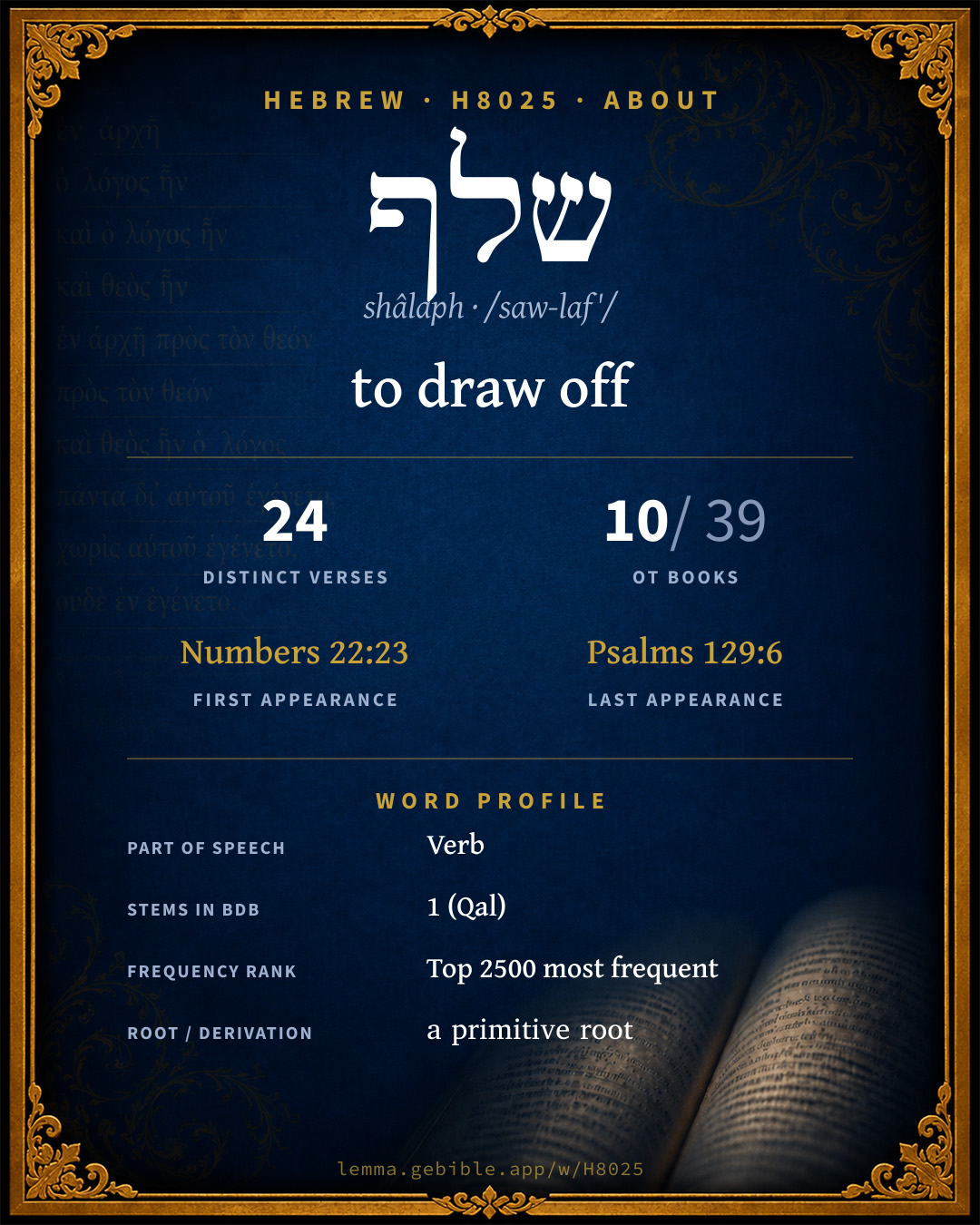
שָׁלַף
to draw off
‘to draw off’ is one of 4 main senses fuller range ↓
Full lexicon entry — Brown-Driver-Briggs (BDB)
From Brown-Driver-Briggs (BDB)
Where this word appears
Grammar key — what these labels mean
Part of speech
- Verb
- An action or state-of-being word.
Stem
- Qal
- The basic, simple active stem — the plain form of the verb (“he wrote”). Here: ‘draw out sword from’
Form
- Participle Active
- A verbal adjective expressing ongoing or characteristic action (“writing / one who writes”).
- Perfect
- A completed action or state — Hebrew marks aspect (completeness) more than strict tense (“he wrote”).
- Participle Passive
- A verbal adjective expressing action received (“written”).
- Imperative
- A direct command (“write!”).
- Sequential Imperfect
- An imperfect with prefixed waw — the standard past-narrative form (waw-consecutive imperfect).
State
- Absolute
- The independent form of a noun, not bound to a following word.
- Construct
- A noun bound to a following noun in a possessive / “of” relationship (the construct chain).
Person
- 3rd Person
- The one spoken about (“he / she / it / they”).
- 2nd Person
- The one addressed (“you”).
Gender
- Masculine
- Grammatically masculine.
- Feminine
- Grammatically feminine.
Number
- Singular
- One.
- Plural
- More than one (in Hebrew, generally three or more).
Every verse where H8025 appears in the Book of Job — 1 distinct verse. Click any verse to open its interlinear word-by-word view. Verse text shown in the World English Bible for context — . Each verse’s Hebrew form is shown with its reference; the English is not keyword-highlighted, since the data carries no word-level English alignment. Use “Compare translations” on any verse to read it across multiple English versions. This concordance covers the Hebrew Bible; Septuagint (Greek Old Testament) occurrences are not indexed here.
Job
About this entry
At a glance — auto-summarized from this page’s data, not written by a person. Every figure links to its source below. This summary describes the numbers; it doesn’t interpret them.
At its core, שלף (shâlaph) means “to draw off.” The King James Version usually renders it “drew,” while modern versions prefer “drawing” (unfoldingWord Literal Text) — see the renderings breakdown. With 24 verses in 10 books, it is an uncommon word in the Hebrew Bible. Its uses concentrate in Judges (42% of all occurrences). Not a single-sense word: explore its full sense range. Each statement above links to its evidence; the full detail follows below.
Gloss history
Strong's 1890 vs modern scholarship
About this word
Strong's H8025 catalogs a Hebrew word from the Hebrew Old Testament.
These counts are not copied from any lexicon or concordance. They are computed here, from the morphology-tagged Hebrew Old Testament. What Lemma adds →
- 24
- distinct verses
- The word appears in 24 distinct verses.
- 10 / 39
- OT books
- The word appears in 10 of 39 Old Testament books.
- #1,282
- by frequency
- Top 2500 most frequent Hebrew words (rank 1,282 of 8,640 Hebrew words by occurrence).
View all 24 occurrences in the concordance →
Most concentrated in
- Judges 10 verses 42%
- 1 Chronicles 3 verses 13%
- Numbers 2 verses 8%
By section of the Old Testament
By traditional corpus
Conventional, traditional groupings — biblical authorship is debated, so this is a traditional corpus grouping, not an authorship claim. Each share is this word’s portion of its verses in that division of the Hebrew canon. Each figure is a share of the word’s 24 distinct verses.
- Prophets (Nevi'im) 15 verses · 63%
- Writings (Ketuvim) 7 verses · 29%
- Torah (Pentateuch) 2 verses · 8%
How translations render this word
Counts come from each version’s own published word-to-Strong’s tagging or interlinear alignment — an approximate guide to how each version renders this word, not a word-level alignment the data otherwise carries. Because each total is that version’s own tagged count, the per-version totals vary from one another and need not match the appearance or distinct-verse counts above. These counts may also differ from a printed concordance because Lemma counts each distinctly tagged rendering and does not collapse phrase taggings into a single head-word total. This is a fixed set of word-tagged versions (KJV, ASV, BSB, ULT) and does not change with the reading translation you choose elsewhere. Each version’s license is shown beside its name below (and on Sources).
- King James Version: Drew 11×, Draw 3×, Drawn 3×
- American Standard Version: Drew 10×, Drawn 3×, All these drew 2×
- Berean Standard Bible: Draw 4×, Drawn 4×, Armed 3×
- unfoldingWord Literal Text: Drawing 10×, Draw 4×, Drawn 4×
King James Version Public Domain
Renders H8025 across 25 tagged occurrences — most commonly:
Plus 6 renderings that appear only once — usually multi-word phrases or single function words the recovered tagging swept in, not distinct renderings.
American Standard Version Public Domain
Renders H8025 across 25 tagged occurrences — most commonly:
Plus 8 renderings that appear only once — usually multi-word phrases or single function words the recovered tagging swept in, not distinct renderings.
Berean Standard Bible Public Domain
Renders H8025 across 20 tagged occurrences — most commonly:
Plus 7 renderings that appear only once — usually multi-word phrases or single function words the recovered tagging swept in, not distinct renderings. Not rendered by a distinct English word in 3 further occurrences.
unfoldingWord Literal Text CC BY-SA 4.0
Renders H8025 across 29 tagged occurrences — most commonly:
Plus 11 renderings that appear only once — usually multi-word phrases or single function words the recovered tagging swept in, not distinct renderings.
Senses in the full BDB
What do BDB’s symbols mean?
BDB uses these scholarly abbreviations:
| Symbol | Meaning |
|---|---|
| 𝔊 | the Septuagint (the ancient Greek translation, LXX) |
| 𝔙 | the Vulgate (the Latin translation) |
| 𝔖 | the Syriac version (the Peshitta) |
| 𝔗 | the Targum (the Aramaic translation) |
| ψ | the Psalms |
| √ | root (the underlying root or stem) |
| ‖ | parallel passage (a synonymous or contrasted parallel) |
| † | the dagger: every passage where the word occurs is cited |
The 4 senses and sub-senses the full Brown-Driver-Briggs lexicon distinguishes for this word, in lexicon order (not ranked by frequency), with BDB’s own verbatim wording and sub-sense lettering. Shown in Hebrew script with BDB’s own scholarly abbreviations. The condensed entry is in the Lexicon Entry tab. See also the Forms in the corpus table below.
Qal
- Pf. 3 ms. שׁ׳ Ju 3:22 +; Impf. 3 ms. וַיִּשְׁלֹף Ru 4:8, etc.; Imv. ms. שְׁלֹף Ju 9:54 +; Pt. act. שֹׁלֵף 8:10 +, etc.; pass. f. שְׁלוּפָה Nu 22:23 +;— e.g. Judges 3:22
- 1. draw out sword from (מִן) wound Ju 3:22, cf. Jb 20:25; usually sword from sheath Ju 8:20; 9:54; 1 S 31:4 = 1 Ch 10:4, + מִתַּעְרָהּ 1 S 17:51; וְחַרְבּוֹ שְׁלוּפָה בְּיָדוֹ Nu 22:23, 31; Jos 5:13 (all J), 1 Ch 21:16; elsewhere אִישׁ שֹׁלֵף ח׳ coll. Ju 8:10; 20:2, 15, 17, 46; 2 S 24:9 2 K 3:26 1 Ch 21:5(×2), cf. Ju 20:35 and (שֹׁלְפֵי ח׳) v 25. e.g. Judges 3:22
- 2. draw off sandal Ru 4:7, 8 (cf. I. חלץ 1; also RSK 269 Dr Dt 25:9 BewerSK lxxvi (1903), 332). e.g. Ruth 4:7
- 3. shoot up (?), i.e. draw out blade, of grass on roof ψ 129:6 (cf. Ew Bae al.); Che Dr is unsheathed (vb. c. subj. indef. = pass.), with same meaning; Hup-Now proposes שָׁלֵם (with ‖ in Syriac); v. OrtenbergTextkritik d. Ps. (1861), 30 שֶׁחָלָף, WeHpt Du חֲלֹף (as 90:5, 6, v. ח׳ 2). e.g. Psalms 129:6
Senses from the full Brown-Driver-Briggs lexicon (Brown, Driver, Briggs; Oxford 1906 — public domain), digitized via Sefaria, supplemented by the OpenScriptures HebrewLexicon (CC BY 4.0). Full attribution on Sources.
Word origin
vb. draw out, off (NH id., loosen, draw (nail, sword; Jastr); Assyrian šalâpu, pluck out, draw sword; Aramaic שְׁלַף draw sword, draw off shoe, ܫܠܰܦ draw sword, in Lexx. remove corselet; Arabic سَلَفَ is pass, pass away, سَلَبَ strip, plunder, etc.);—
— Brown-Driver-Briggs (Oxford 1906, public domain), digitized via Sefaria, supplemented by the OpenScriptures HebrewLexicon (CC BY 4.0). See Sources.
Origin: a primitive root
Jastrow Dictionary
A second Hebrew/Aramaic lexicon for comparison, covering Aramaic and post-biblical (Talmudic, Targumic, Midrashic) usage that the biblical-Hebrew BDB does not. Matched by lemma rather than by Strong’s number, so a lemma may carry more than one Jastrow headword (shown separately below), and the entries cover usage well beyond the Bible.
שָׁלַף
- 1. to be lax, hang down, be loose, slip. Denom. שָׁלִיף.
- 2. to loosen, take off, pull, draw a sword. Lev. R. s. 34 יִשְׁלוֹף Ar. (ed. ישמוט) may he loosen (release), v. חָלַץ. Y. Kidd. I, 60ᶜ top (ref. to Ruth IV, 7) מי ש׳ which took the shoe off (the buyer or the seller)? Num. R. s. 144 מסמר … נוח לִשְׁלוֹף a nail with a big head is easily pulled; Pesik. R. s. 3. Midr. Till. to Ps. CXX אם יִשְׁלוֹף האדם וכ׳ if a man draws the sword which he has in his hand to slay his neighbor &c.; a. e. e.g. Ruth 4:7
- to be loosened, drawn. Gen. R. s. 93; Yalk. ib. 150 ואינה נִשְׁלֶפֶת, v. תַּעַר.
- to pull, pluck the last growth. Gen. R. s. 20; Yalk. ib. 32 על … שאדם מַשְׁלִיף שדהו אוכלה וכ׳ this (Gen. III, 18) was said with reference to these days, when one plucks his field over and again and eats it (the aftermath) &c., v. Pes. 118ᵃ e.g. Genesis 3:18
שְׁלַף
- , to loosen, pull, draw. Targ. Hos. IV, 11. Targ. Y. Num. XXXI, 8. Targ. Jud. III, 22. Targ. Y. Ex. III, 5; a. fr.—Targ. I Chr. I, 20 (play on שלף, ib.) ש׳ … לתחומיה (not לתחומיא) he drew the rivers into his domain.—Part. pass. שְׁלִיף. Targ. Y. I Deut. XXV, 10 (Y. II שְׁלוּפֵי Hebraism, pl., h. text חלוץ).—V. שְׁלִיף II.—Yeb. 102ᵇ ממאי דהאי וחלצה … מִישְׁלַף הוא how do we know that this v’ḥal’tsah (Deut. XXV, 9) means taking off? Y. ib. XII, 13ᵃ top ושַׁלְפַת סיניה and she took off his shoe. Sabb. 59ᵇ דילמא שָׁלְפָא וכ׳ she might take off (her jewelry) and show it. Ib. מְשַׁלְּפָא (Pa.). Ib. 82ᵃ ולא שליף ירקא וכ׳ and that no vegetable will be pulled, and eaten by you, out of the bunch &c. Shebu. 31ᵃ שְׁלוֹפוּ, v. פּוּזְמְקֵי. Erub. 11ᵇ זיל שְׁלוֹף וכ׳ go and pull (the reeds) out, and throw them away; a. fr.—Trnsf. (cmp. נתר, שרי) to untie, annul. Gitt. 33ᵇ מילתא … למִישְׁלְפָהּ an act performed in the presence of ten persons, requires ten for revoking it; a. e.—Yeb. 109ᵇ ערבי שלציון דעבדי שְׁלוֹף דוץ the guarantors of Shaltsiyon, where they practice ‘pull and stick in’, release the debtor and seize the guarantor.—Sabb. 90ᵃ, a. e. שלוף דוץ, v. שְׁלוֹף.—[Sabb. 98ᵇ; Yalk. Ex. 370, v. שַׁלְחֵף.] e.g. Deuteronomy 25:9
- same. Targ. O. Lev. XIV, 40 (h. text חלץ). Ib. 43 (some ed. Pe.).—Yeb. 102ᵇ (ref. to החלצו, Num. XXXI, 3) שַׁלּוּפֵי מביתא וכ׳ it means tearing away from home to war. M. Kat. 4ᵇ, v. דָּלַל. Sabb. 59ᵇ, v. supra; a. e. e.g. Numbers 31:3
- to be drawn; to be loosened, to slip. Targ. Ez. XXI, 15 (h. text הוחדה). Targ. II Kings VI, 5. Targ. Is. XXXIII, 20 (h. text יסע); a. e.
שֶׁלֶף
- (preced.) [that which is pulled out,] stubble field. Tosef. B. Mets. IX, 29 אינו … נירה למניחה לפניו ש׳ it is not the same when he surrenders the land tilled (cleared), as when he surrenders it with the stubbles.—Pl. שְׁלָפִים. Cant. R. to VI, 12 מלקטת בש׳ picked up (ears) among the stubbles.—Trnsf. constr. שִׁלְפֵי, שִׁי׳ the end of a period. Yeb. 116ᵇ ש׳ קציר חטים היו it was towards the end of the wheat harvest. Sabb. 60ᵃ ש׳ הגזירה היו (Ar. השמד; Ms. M. שליפי, corr. acc.; Ms. O. שלהי, v. Rabb. D. S. a. l. note) it was the end of the period of persecution; Cant. R. to II, 5 בש׳ השמד.
A Dictionary of the Targumim, the Talmud Babli and Yerushalmi, and the Midrashic Literature (Marcus Jastrow; London, Luzac, 1903) — Public Domain. Digitized via Sefaria. Digitized via Sefaria. Full attribution on Sources.
Forms in the corpus
The 16 distinct written forms H8025 takes in the Hebrew Bible, most frequent first — each parse links to that stem’s occurrences in the concordance. Hebrew forms include their vowel points and cantillation, so a single lemma takes many written forms.
| Form | Parsing | Example | Uses |
|---|---|---|---|
| שֹׁ֣לֵֽף | Verb, Qal, Participle Active, Masculine, Singular, Absolute | 1 Chronicles 21:5 | 5 |
| שֹׁ֥לֵֽף | Verb, Qal, Participle Active, Masculine, Singular, Absolute | 1 Chronicles 21:5 | 4 |
| שְׁלֹ֥ף | Verb, Qal, Imperative, 2nd Person, Masculine, Singular | 1 Chronicles 10:4 | 2 |
| שְׁלוּפָה֙ | Verb, Qal, Participle Passive, Feminine, Singular, Absolute | 1 Chronicles 21:16 | 2 |
| וַ/יִּשְׁלֹ֖ף | Verb, Qal, Sequential Imperfect, 3rd Person, Masculine, Singular | Ruth 4:8 | 1 |
| וַֽ/יִּשְׁלְפָ֤/הּ | Verb, Qal, Sequential Imperfect, 3rd Person, Masculine, Singular | 1 Samuel 17:51 | 1 |
| שְׁלֹ֤ף | Verb, Qal, Imperative, 2nd Person, Masculine, Singular | Judges 9:54 | 1 |
| שְׁלֻפָ֖ה | Verb, Qal, Participle Passive, Feminine, Singular, Absolute | Numbers 22:31 | 1 |
| שְׁלוּפָ֖ה | Verb, Qal, Participle Passive, Feminine, Singular, Absolute | Joshua 5:13 | 1 |
| שָׁלַ֛ף | Verb, Qal, Perfect, 3rd Person, Masculine, Singular | Judges 3:22 | 1 |
| שָׁלַ֣ף | Verb, Qal, Perfect, 3rd Person, Masculine, Singular | Psalms 129:6 | 1 |
| שָׁלַ֥ף | Verb, Qal, Perfect, 3rd Person, Masculine, Singular | Ruth 4:7 | 1 |
| שָׁלַ֨ף | Verb, Qal, Perfect, 3rd Person, Masculine, Singular | Judges 8:20 | 1 |
| שָׁלַף֮ | Verb, Qal, Perfect, 3rd Person, Masculine, Singular | Job 20:25 | 1 |
| שֹׁ֥לְפֵי | Verb, Qal, Participle Active, Masculine, Plural, Construct | Judges 20:25 | 1 |
| שֹׁ֥לֵף | Verb, Qal, Participle Active, Masculine, Singular, Absolute | Judges 20:35 | 1 |
Same root — word family
Other BDB entries built from the same root as H8025, grouped by Strong’s listed origin. These share a root / origin per the lexicon — not necessarily a shared meaning. Each links to that word’s own entry.
Proper names from this root
People and places named from this root — a name, not an additional meaning of the word.
Compare all same-root words → 1 of the same-root words is a proper name (a person or place). They share a root, not necessarily a meaning.
Septuagint verse parallels
This word appears in 23 verses that also exist in the Greek Old Testament (Septuagint), out of the 24 Hebrew verses it occurs in. You can read those verses in Greek by switching the Old Testament edition to the Septuagint.
Read these verses in the Septuagint
- Numbers 22:23
- Joshua 5:13
- Judges 3:22
- Ruth 4:7
- 1 Samuel 31:4
- 2 Samuel 24:9
- 2 Kings 3:26
- 1 Chronicles 10:4
- Job 20:25
- Psalms 129:6
This is a verse-level parallel only — the same verses exist in both the Hebrew and Greek Old Testaments. No word-level Hebrew↔Greek correspondence is claimed: the data carries no such alignment, so no Greek word is shown as this Hebrew word’s translation. Coverage is not total — the Septuagint omits the deuterocanon and renumbers the Psalms, so some Hebrew verses have no direct Greek parallel.