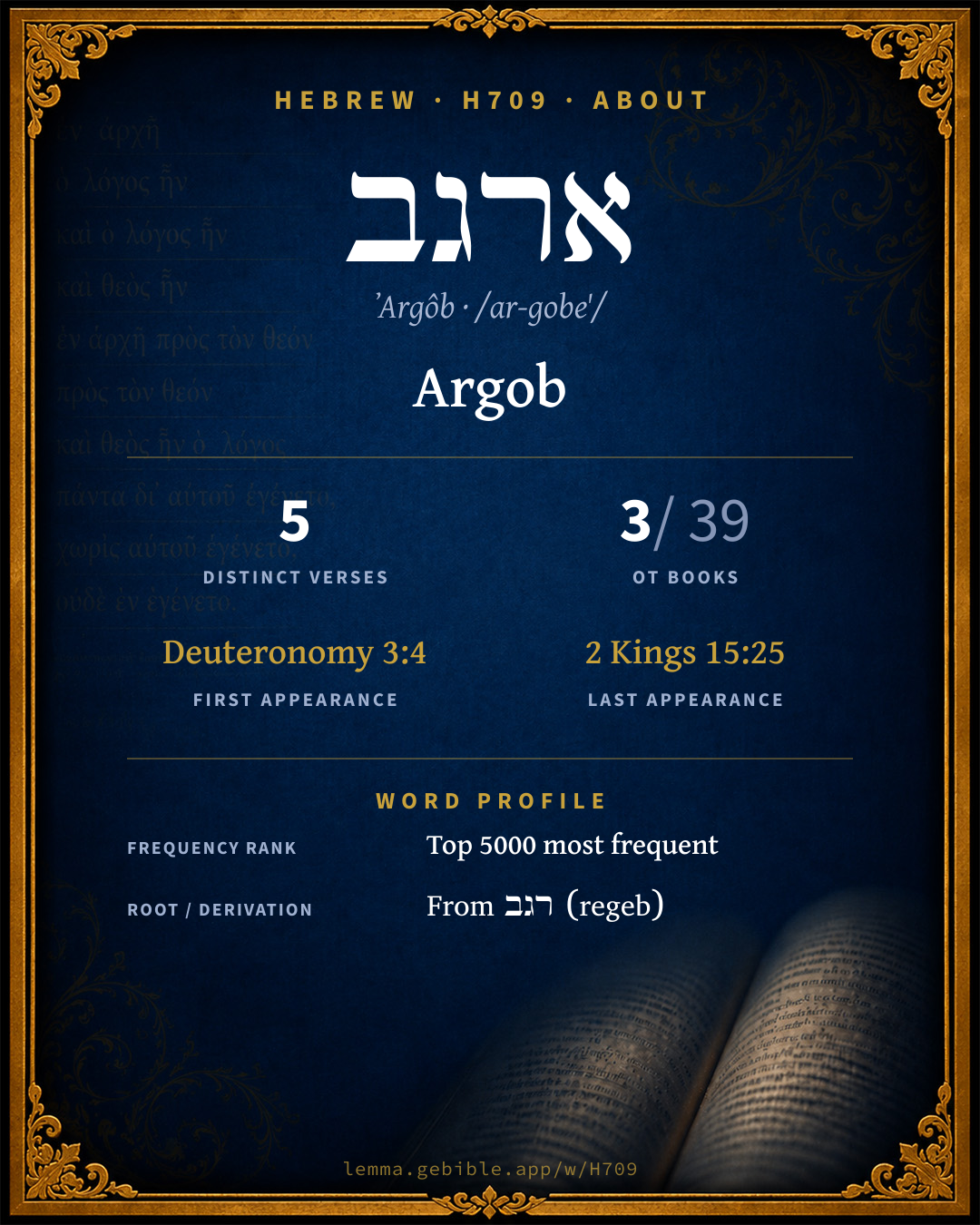
אַרְגֹּב
Argob
BDB lists 3 entries for ‘Argob’ fuller range ↓
Full lexicon entry — Brown-Driver-Briggs (BDB)
From Brown-Driver-Briggs (BDB)
Where this word appears
Grammar key — what these labels mean
Part of speech
- Noun
- A naming word — a person, place, thing, or idea.
Noun type
- Proper
- A name of a specific person, place, or people (e.g. Abraham, Zion, Israel).
Every verse where H709 appears — 5 distinct verses across 3 books. Click any verse to open its interlinear word-by-word view. Verse text shown in the World English Bible for context — . Each verse’s Hebrew form is shown with its reference; the English is not keyword-highlighted, since the data carries no word-level English alignment. Use “Compare translations” on any verse to read it across multiple English versions. This concordance covers the Hebrew Bible; Septuagint (Greek Old Testament) occurrences are not indexed here.
Deuteronomy 3 verses
- Deuteronomy 3:4 אַרְגֹּ֔ב n Proper We took all his cities at that time; there was not a city which we didn't take from them; sixty cities, all the region of Argob, the kingdom of Og in Bashan.
- Deuteronomy 3:13 הָֽ/אַרְגֹּב֙ ptcl def.art + n Proper and the rest of Gilead, and all Bashan, the kingdom of Og, gave I to the half-tribe of Manasseh; all the region of Argob, even all Bashan. (The same is called the land of Rephaim.
- Deuteronomy 3:14 אַרְגֹּ֔ב n Proper Jair the son of Manasseh took all the region of Argob, to the border of the Geshurites and the Maacathites, and called them, even Bashan, after his own name, Havvoth Jair, to this day.)
1 Kings 1 verse
2 Kings 1 verse
About this entry
At a glance — auto-summarized from this page’s data, not written by a person. Every figure links to its source below. This summary describes the numbers; it doesn’t interpret them.
At its core, ארגב (ʼArgôb) means “Argob.” It occurs a mere 5 verses across Scripture. The word gravitates to Deuteronomy (60%), then 1 Kings and 2 Kings. Scripture first uses it in Deuteronomy 3:4. Dig into 5-verse concordance and the renderings breakdown below.
Gloss history
Strong's 1890 vs modern scholarship
About this word
Strong's H709 catalogs a Hebrew word from the Hebrew Old Testament.
These counts are not copied from any lexicon or concordance. They are computed here, from the morphology-tagged Hebrew Old Testament. What Lemma adds →
- 5
- distinct verses
- The word appears in 5 distinct verses.
- 3 / 39
- OT books
- The word appears in 3 of 39 Old Testament books.
- #3,337
- by frequency
- Top 5000 most frequent Hebrew words (rank 3,337 of 8,640 Hebrew words by occurrence).
View all 5 occurrences in the concordance →
Most concentrated in
- Deuteronomy 3 verses 60%
- 1 Kings 1 verse 20%
- 2 Kings 1 verse 20%
By section of the Old Testament
By traditional corpus
Conventional, traditional groupings — biblical authorship is debated, so this is a traditional corpus grouping, not an authorship claim. Each share is this word’s portion of its verses in that division of the Hebrew canon. Each figure is a share of the word’s 5 distinct verses.
- Torah (Pentateuch) 3 verses · 60%
- Prophets (Nevi'im) 2 verses · 40%
How translations render this word
Counts come from each version’s own published word-to-Strong’s tagging or interlinear alignment — an approximate guide to how each version renders this word, not a word-level alignment the data otherwise carries. Because each total is that version’s own tagged count, the per-version totals vary from one another and need not match the appearance or distinct-verse counts above. These counts may also differ from a printed concordance because Lemma counts each distinctly tagged rendering and does not collapse phrase taggings into a single head-word total. This is a fixed set of word-tagged versions (KJV, ASV, BSB, ULT) and does not change with the reading translation you choose elsewhere. Each version’s license is shown beside its name below (and on Sources).
- King James Version: Argob 5×
- American Standard Version: Argob 5×
- Berean Standard Bible: Argob 5×
- unfoldingWord Literal Text: Argob 5×
King James Version Public Domain
Renders H709 across 5 tagged occurrences — most commonly:
American Standard Version Public Domain
Renders H709 across 5 tagged occurrences — most commonly:
Berean Standard Bible Public Domain
Renders H709 across 5 tagged occurrences — most commonly:
unfoldingWord Literal Text CC BY-SA 4.0
Renders H709 across 5 tagged occurrences — most commonly:
Senses in the full BDB
What do BDB’s symbols mean?
BDB uses these scholarly abbreviations:
| Symbol | Meaning |
|---|---|
| 𝔊 | the Septuagint (the ancient Greek translation, LXX) |
| 𝔙 | the Vulgate (the Latin translation) |
| 𝔖 | the Syriac version (the Peshitta) |
| 𝔗 | the Targum (the Aramaic translation) |
| ψ | the Psalms |
| √ | root (the underlying root or stem) |
| ‖ | parallel passage (a synonymous or contrasted parallel) |
| † | the dagger: every passage where the word occurs is cited |
The 2 senses and sub-senses the full Brown-Driver-Briggs lexicon distinguishes for this word, in lexicon order (not ranked by frequency), with BDB’s own verbatim wording and sub-sense lettering. Shown in Hebrew script with BDB’s own scholarly abbreviations. The condensed entry is in the Lexicon Entry tab. See also the Forms in the corpus table below.
- 1. loc. (heap, or region of clods; ‘glebe’ GASm G 551);—always חֶבֶל א׳ Dt 3:4, 14; 1 K 4:13, ח׳ הָא׳ Dt 3:13, = measured region of Argōb; some well-defined district of Bashan (appar. identif. with חַוֹּת יָאִיר Dt 3:14 [where ח׳ י׳ in Bashan, so Jos 13:30], but this a harmonistic correction; ח׳ י׳ in fact in Gilead [Nu 32:41 Ju 10:4], and disting. from אַרְגֹּב 1 K 4:13 cf. Dt 3:13); exact loc. dubious, GASml.c. and especially Dr Dt 3:4; BuhlGeogr. 18 thinks of Ṣuwet, S. of Upper Yarmuk, a border district between Bashan and Gilead.—Αργοβ; 1 K 4:13 Ερεβαταμ, 𝔊L Ραγαβαν, A Εργαβ. e.g. Deuteronomy 3:4
- 2. m. 2 K 15:25, Αργοβ; dub.; v. Klo Kit Benz Bur. e.g. 2 Kings 15:25
Senses from the full Brown-Driver-Briggs lexicon (Brown, Driver, Briggs; Oxford 1906 — public domain), digitized via Sefaria, supplemented by the OpenScriptures HebrewLexicon (CC BY 4.0). Full attribution on Sources.
Word origin
Derived from רגב (regeb) (H7263) — clod.
Forms in the corpus
The 4 distinct written forms H709 takes in the Hebrew Bible, most frequent first — each parse links to that state’s occurrences in the concordance. Hebrew forms include their vowel points and cantillation, so a single lemma takes many written forms.
| Form | Parsing | Example | Uses |
|---|---|---|---|
| אַרְגֹּ֔ב | Noun, Proper | Deuteronomy 3:4 | 2 |
| אַרְגֹּ֣ב | Noun, Proper | 2 Kings 15:25 | 1 |
| אַרְגֹּב֙ | Noun, Proper | 1 Kings 4:13 | 1 |
| הָֽ/אַרְגֹּב֙ | Noun, Proper | Deuteronomy 3:13 | 1 |
Same root — word family
Other BDB entries built from the same root as H709, grouped by Strong’s listed origin. These share a root / origin per the lexicon — not necessarily a shared meaning. Each links to that word’s own entry.
Derives from
Shares the same root
Compare all same-root words → They share a root, not necessarily a meaning.
Bible dictionary
Public-domain dictionary articles matched to this entry by name (Argob). A biblical name can be shared by more than one person or place, so an article may treat several.
Easton's Bible Dictionary · M. G. Easton, 1897
Stony heap, an "island," as it has been called, of rock about 30 miles by 20, rising 20 or 30 feet above the table-land of Bashan; a region of crags and chasms wild and rugged in the extreme. On this "island" stood sixty walled cities, ruled over by Og. It is called Trachonitis ("the rugged region") in the New Testament (Luke 3:1). These cities were conquered by the Israelites (Deut. 3:4; 1 Kings 4:13). It is now called the Lejah. Here "sixty walled cities are still traceable in a space of 308 square miles. The architecture is ponderous and massive. Solid walls 4 feet thick, and stones on one another without cement; the roofs enormous slabs of basaltic rock, like iron; the doors and gates are of stone 18 inches thick, secured by ponderous bars. The land bears still the appearance of having been called the land of giants' under the giant Og." "I have more than once entered a deserted city in the evening, taken possession of a comfortable house, and spent the night in peace. Many of the houses in the ancient cities of Bashan are perfect, as if only finished yesterday. The walls are sound, the roofs unbroken, and even the window-shutters in their places. These ancient cities of Bashan probably contain the very oldest specimens of domestic architecture in the world" (Porter's Giant Cities). (See BASHAN.)
Smith's Bible Dictionary · William Smith, 1863
perhaps a Gileadite officer who was governor of Argob. He was either an accomplice of Pekah in the murder of Pekahiah or was slain by Pekah. (2 Kings 15:25)
(stony), a tract of country on the east of the Jordan, in Bashan, the kingdom of Og, containing 60 great and fortified cities. In later times it was called Trachonitis, and it is now apparently identified with the Leiah, a very remarkable district south of Damascus and east of the Sea of Galilee. (3:4,13,14)
Hitchcock's Bible Names Dictionary · Roswell D. Hitchcock, 1869
a turf, or fat land
Classic public-domain reference works; full attribution on Sources.
Septuagint verse parallels
This word appears in 5 verses that also exist in the Greek Old Testament (Septuagint), out of the 5 Hebrew verses it occurs in. You can read those verses in Greek by switching the Old Testament edition to the Septuagint.
Read these verses in the Septuagint
This is a verse-level parallel only — the same verses exist in both the Hebrew and Greek Old Testaments. No word-level Hebrew↔Greek correspondence is claimed: the data carries no such alignment, so no Greek word is shown as this Hebrew word’s translation. Coverage is not total — the Septuagint omits the deuterocanon and renumbers the Psalms, so some Hebrew verses have no direct Greek parallel.