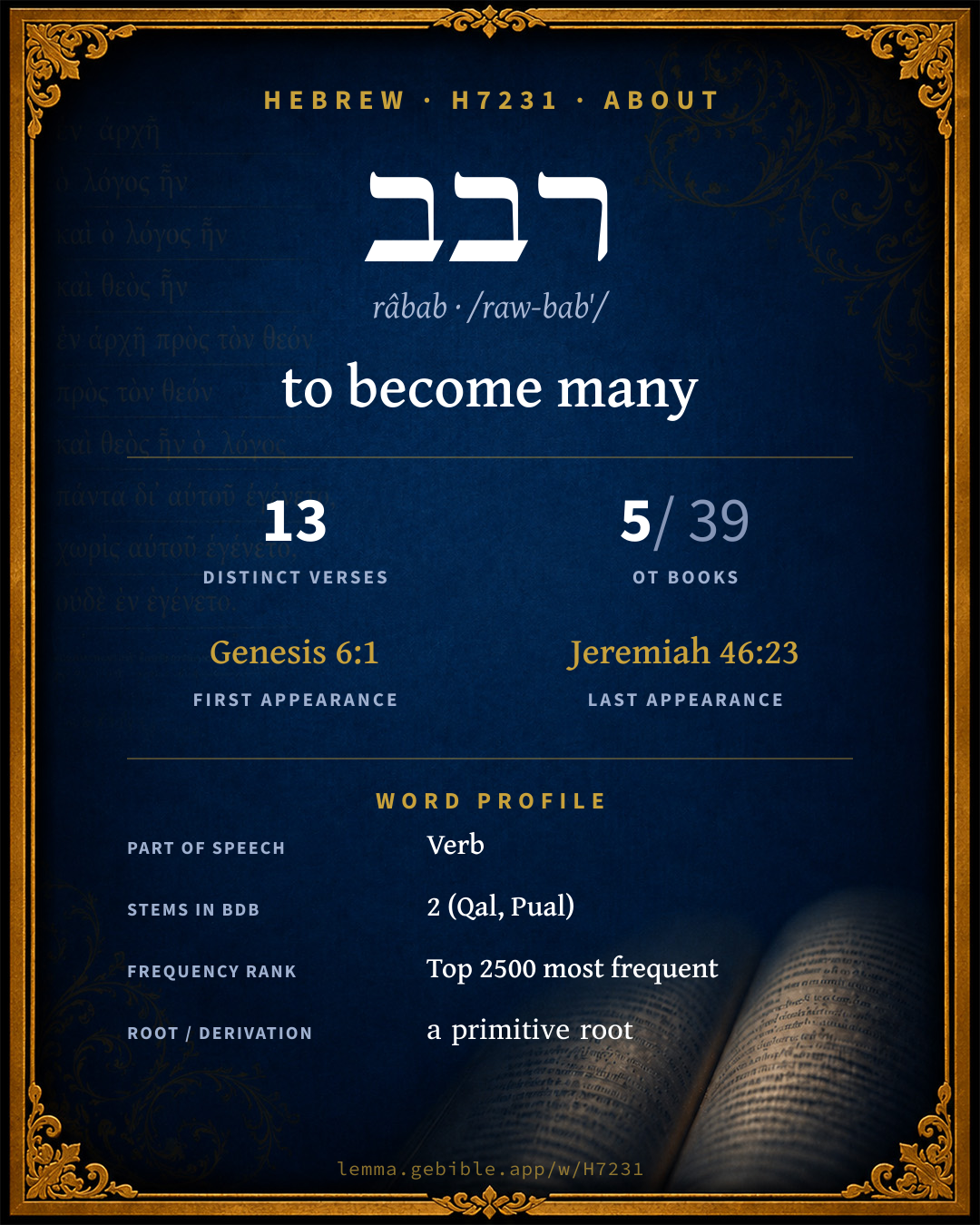
רָבַב
to become many
‘to become many’ is one of 2 main senses fuller range ↓
Full lexicon entry — Brown-Driver-Briggs (BDB)
From Brown-Driver-Briggs (BDB)
Where this word appears
See every Qal verb in the Hebrew Bible →
Grammar key — what these labels mean
Part of speech
- Verb
- An action or state-of-being word.
Stem
- Qal
- The basic, simple active stem — the plain form of the verb (“he wrote”). Here: ‘be’
- Pual
- The passive counterpart of the Piel.
Form
- Perfect
- A completed action or state — Hebrew marks aspect (completeness) more than strict tense (“he wrote”).
- Sequential Perfect
- A perfect with prefixed waw continuing a preceding imperfect or command (waw-consecutive perfect).
- Infinitive Construct
- A bound verbal noun, frequently with prepositions (“to write / in writing”).
- Participle Passive
- A verbal adjective expressing action received (“written”).
State
- Absolute
- The independent form of a noun, not bound to a following word.
Person
- 3rd Person
- The one spoken about (“he / she / it / they”).
Gender
- Common
- Either gender — not distinguished for this form.
- Feminine
- Grammatically feminine.
Number
- Plural
- More than one (in Hebrew, generally three or more).
Every verse where H7231 appears in the Book of Psalms — 7 distinct verses. Click any verse to open its interlinear word-by-word view. Verse text shown in the World English Bible for context — . Each verse’s Hebrew form is shown with its reference; the English is not keyword-highlighted, since the data carries no word-level English alignment. Use “Compare translations” on any verse to read it across multiple English versions. This concordance covers the Hebrew Bible; Septuagint (Greek Old Testament) occurrences are not indexed here.
Psalms
- Psalms 3:1 רַבּ֣וּ Qal pf 3cp Yahweh, how my adversaries have increased! Many are those who rise up against me.
- Psalms 4:7 רָֽבּוּ Qal pf 3cp You have put gladness in my heart, More than when their grain and their new wine are increased.
- Psalms 25:19 רָ֑בּוּ Qal pf 3cp Consider my enemies, for they are many. They hate me with cruel hatred.
- Psalms 38:19 וְ/רַבּ֖וּ conj + Qal pf 3cp But my enemies are vigorous and many. Those who hate me without reason are numerous.
- Psalms 69:4 רַבּ֤וּ Qal pf 3cp Those who hate me without a cause are more than the hairs of my head. Those who want to cut me off, being my enemies wrongfully, are mighty. I have to restore what I didn't take away.
- Psalms 104:24 רַבּ֬וּ Qal pf 3cp Yahweh, how many are your works! In wisdom have you made them all. The earth is full of your riches.
- Psalms 144:13 מְרֻבָּב֗וֹת Pual ptcp.pass fp Our barns are full, filled with all kinds of provision. Our sheep bring forth thousands and ten thousands in our fields.
About this entry
At a glance — auto-summarized from this page’s data, not written by a person. Every figure links to its source below. This summary describes the numbers; it doesn’t interpret them.
רבב — transliterated râbab — is a Hebrew verb carrying the sense “to become many.” More than half of its appearances fall in Psalms. The Hebrew Bible uses it across 13 verses — uncommon. It first appears in Genesis 6:1. Different stems carry different senses — BDB groups them under 2 stems, among them Qal and Pual. Each statement above links to its evidence; the full detail follows below.
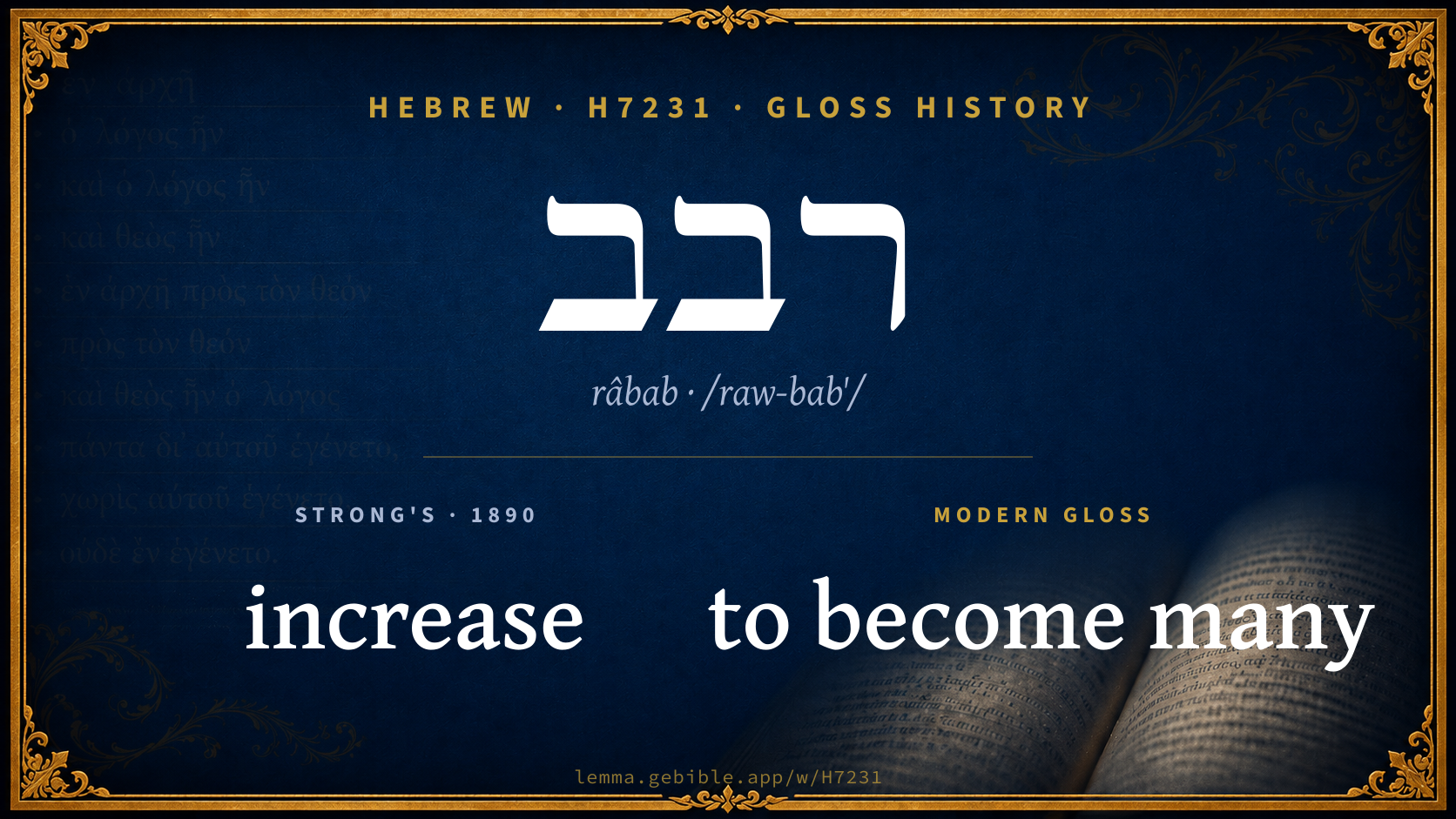
Gloss history
Strong's 1890 vs modern scholarship
About this word
Strong's H7231 catalogs a Hebrew word from the Hebrew Old Testament.
These counts are not copied from any lexicon or concordance. They are computed here, from the morphology-tagged Hebrew Old Testament. What Lemma adds →
- 13
- distinct verses
- The word appears in 13 distinct verses.
- 5 / 39
- OT books
- The word appears in 5 of 39 Old Testament books.
- #2,001
- by frequency
- Top 2500 most frequent Hebrew words (rank 2,001 of 8,640 Hebrew words by occurrence).
View all 13 occurrences in the concordance →
By section of the Old Testament
By traditional corpus
Conventional, traditional groupings — biblical authorship is debated, so this is a traditional corpus grouping, not an authorship claim. Each share is this word’s portion of its verses in that division of the Hebrew canon. Each figure is a share of the word’s 13 distinct verses.
- Writings (Ketuvim) 8 verses · 62%
- Prophets (Nevi'im) 4 verses · 31%
- Torah (Pentateuch) 1 verse · 8%
How translations render this word
Counts come from each version’s own published word-to-Strong’s tagging or interlinear alignment — an approximate guide to how each version renders this word, not a word-level alignment the data otherwise carries. Because each total is that version’s own tagged count, the per-version totals vary from one another and need not match the appearance or distinct-verse counts above. These counts may also differ from a printed concordance because Lemma counts each distinctly tagged rendering and does not collapse phrase taggings into a single head-word total. This is a fixed set of word-tagged versions (KJV, ASV, BSB, ULT) and does not change with the reading translation you choose elsewhere. Each version’s license is shown beside its name below (and on Sources).
BDB lists this Strong’s number as 3 distinct words (homographs). Each count above pools all of them and is not split by sense — see the Senses section below. A low-frequency rendering may belong to a different one of those words, not the primary meaning.
- King James Version†: Are many 2×, Are multiplied 2×, They are many 2×
- American Standard Version†: Are many 3×, Are multiplied 2×
- Berean Standard Bible†: Many 4×, Are many 2×
- unfoldingWord Literal Text†: And 2×, Are many 2×, Many 2×
King James Version Public Domain
Renders H7231 across 17† tagged occurrences — most commonly:
Plus 11 renderings that appear only once — usually multi-word phrases or single function words the recovered tagging swept in, not distinct renderings.
American Standard Version Public Domain
Renders H7231 across 16† tagged occurrences — most commonly:
Plus 11 renderings that appear only once — usually multi-word phrases or single function words the recovered tagging swept in, not distinct renderings.
Berean Standard Bible Public Domain
Renders H7231 across 21† tagged occurrences — most commonly:
Plus 15 renderings that appear only once — usually multi-word phrases or single function words the recovered tagging swept in, not distinct renderings.
unfoldingWord Literal Text CC BY-SA 4.0
Renders H7231 across 17† tagged occurrences — most commonly:
Plus 9 renderings that appear only once — usually multi-word phrases or single function words the recovered tagging swept in, not distinct renderings.
Senses in the full BDB
Hebrew verbs can shift meaning by stem (binyan): Qal is the basic action, Niphal is often passive or reflexive, Piel often intensifies or makes it factitive, and Hiphil is typically causative. The senses below are grouped under the stem BDB assigns to each. This entry also uses Pual (the passive of Piel).
What do BDB’s symbols mean?
BDB uses these scholarly abbreviations:
| Symbol | Meaning |
|---|---|
| 𝔊 | the Septuagint (the ancient Greek translation, LXX) |
| 𝔙 | the Vulgate (the Latin translation) |
| 𝔖 | the Syriac version (the Peshitta) |
| 𝔗 | the Targum (the Aramaic translation) |
| ψ | the Psalms |
| √ | root (the underlying root or stem) |
| ‖ | parallel passage (a synonymous or contrasted parallel) |
| † | the dagger: every passage where the word occurs is cited |
The 5 senses and sub-senses the full Brown-Driver-Briggs lexicon distinguishes for this word, in lexicon order (not ranked by frequency), with BDB’s own verbatim wording and sub-sense lettering. Shown in Hebrew script with BDB’s own scholarly abbreviations. The condensed entry is in the Lexicon Entry tab. See also the Forms in the corpus table below.
רבב I be or become, many, much (NH רַב especially lord, master, רַבִּי my master, teacher
Qal
- Pf. 3 fs. consec. וְרַבָּה Ex 23:29; Is 6:12, רָ֑בָּה Gn 18:20 (Ho 9:7 read וְרֹב הַמַּשְׂטֵמָה [for MT וְרַבָּה מ׳] 𝔊 We Now); elsewhere only 3 pl. רַבּוּ 1 S 25:10 +, רָ֑בּוּ Je 46:23 + 2 times [other forms supplied by רבה q.v.]; Inf. cstr. רֹב Gn 6:1; Jos 9:13; Lv 25:16 (‖ מְעֹט), sf. רֻבְּכֶם Dt 7:7, and perhaps רֻבָּם Ho 4:7 (cf. רֹב infr.);— e.g. Exodus 23:29
- 1. be (become) many, pers. Gn 6:1 (J) Ex 23:29 (E; v. supr.), 1 S 25:10; Ho 4:7 (perhaps), Is 66:16 ψ 3:2; 25:19; 38:20; Ec 5:10, + מִן comp. Je 46:23; Dt 7:7 ψ 69:5; of things Is 22:9 ψ 4:8; 104:24, years Lv 25:16 (P), sins Je 5:6; 14:7; Is 59:12; Jb 35:6. e.g. Genesis 6:1
- 2. become great, Gn 18:20 (J), Is 6:12; be long, of journey, Jos 9:13.— e.g. Genesis 18:20
Pual
- v. [רָבַב] denom.*
רבב II Pu.denom. from preceding
רבב III shoot
Qal
- Pf. 3 pl. וָרֹ֑בּוּ (Ges§ 67 m) Gn 49:23 abs. (בַּעֲלֵי חִצִּים in ‖ l.; Sam. וַיְרִיבֻהוּ, so perhaps 𝔊 ἐλοιδόρουν).—רָ֜ב ψ 18:15 (חִצָּיו in ‖ l.), v. i. רַב 1 g. e.g. Genesis 49:23
Senses from the full Brown-Driver-Briggs lexicon (Brown, Driver, Briggs; Oxford 1906 — public domain), digitized via Sefaria, supplemented by the OpenScriptures HebrewLexicon (CC BY 4.0). Full attribution on Sources.
Word origin
I. vb. be or become, many, much (NH רַב especially lord, master, רַבִּי my master, teacher; MI5 adj. pl. רבן; Ph. רב, f. רבת; Assyrian [rabâbu], rabbu; Arabic رَبَّ rear, increase (act.; رُبٌ thick juice, cf. NH רְבָב grease, is thought by Buhl al. to indicate original meaning be thick), رَبٌّ lord, owner, master; Sab. רב especially in n.pr., רבאל, רבבם, רבשמסם, etc., CISiv, nos. 285, 3; 286, 1; 287, 12, etc.; Liḥy. רבה its lord DHMEpigr. Denkm. Ar. 232; Ethiopic ረበበ: expand, spread (intrans.); Aramaic רַב, ܪܒ great, chief, so Old Aramaic Nab. Palm. רב, Lzb366 Cook107);—
II. Pu.denom. from preceding:—Pt. fpl. מְרֻבָּבוֹת ψ 144:13 multiplied ten thousand-fold.
— Brown-Driver-Briggs (Oxford 1906, public domain), digitized via Sefaria, supplemented by the OpenScriptures HebrewLexicon (CC BY 4.0). See Sources.
Origin: a primitive root
Jastrow Dictionary
A second Hebrew/Aramaic lexicon for comparison, covering Aramaic and post-biblical (Talmudic, Targumic, Midrashic) usage that the biblical-Hebrew BDB does not. Matched by lemma rather than by Strong’s number, so a lemma may carry more than one Jastrow headword (shown separately below), and the entries cover usage well beyond the Bible.
רָבַב
- (b. h.)
- 1. to be great, numerous. M. Kat. 28ᵇ רַבּוּ עונותיו many are his sins. Gen. R. s. 27 (expl. רבה, Gen. VI, 5) רַבָּה והולכת was growing more and more; a. e.—Denom. רַב. e.g. Genesis 6:5
- 2. to line, v. infra.
- [to make strong, thick,] to line. Pesik. Zuṭr. Haăz., ed. Bub. p. 110 שמְרַבֶּבֶת, v. רָבִיב.—Esp. to line a skin with pitch (v. חֵמֶת). Ab. Zar. 33ᵃ נכרי רִיבְּבָן … וישראל נותן וכ׳ if a gentile pitched them and tanned them, and an Israelite puts wine into them; Tosef. ib. IV (V), 10 גוי עובדו וזופתו ed. Zuck. (Var. ורוֹבְבוֹ, ורובבין, ורובדו, v. ed. Zuck. note); Y. ib. II, 41ᵇ bot. עובדן ודיבבן, v. דָּבַב I.—[Yalk. Cant. 988 צפונית מרבבת, some ed. מרכבת, read: מְכַבֶּדֶת, as Num. R. s. 13.]
רְבַב
- , to be great, esp. to be a teacher, be in office. Y. M. Kat. III, 83ᵇ top כגון אנן דרַבְבִינָן משגחין וכ׳ such as we, who are teachers: people look up to us to answer their questions; ib. ואנן אפי׳ רבבינן וכ׳ and we, although we are teachers, we know not &c.
רָבָב
- (v. רָבַבPi.) a thick, viscid mass, fat; grease, pitch &c. Sot. 49ᵃ אילמלא … מוכרי ר׳ but for David’s prayer, all Israelites would be sellers of grease. Zeb. 98ᵇ ר׳ על בגדו וכ׳ grease on a garment is an unlawful interposition (at its immersion), but if he is a seller of grease &c. Sabb. 20ᵇ של ר׳ (מדורה) a fire made with fatty substances. Ib. 78ᵇ ר׳ כדי לסוך וכ׳ fat, as much as is required to smear under a small cake. Ib. 114ᵃ כל ת"ח שנמצא ר׳ וכ׳ a scholar on whose garment there is a greasy stain &c.; Rabina said, רבד איתמר the word rabad was used (by R. Joḥanan), v. רָבָד.
A Dictionary of the Targumim, the Talmud Babli and Yerushalmi, and the Midrashic Literature (Marcus Jastrow; London, Luzac, 1903) — Public Domain. Digitized via Sefaria. Digitized via Sefaria. Full attribution on Sources.
Forms in the corpus
The 11 distinct written forms H7231 takes in the Hebrew Bible, most frequent first — each parse links to that stem’s occurrences in the concordance. Hebrew forms include their vowel points and cantillation, so a single lemma takes many written forms.
| Form | Parsing | Example | Uses |
|---|---|---|---|
| וְ/רַבּ֖וּ | Verb, Qal, Perfect, 3rd Person, Common, Plural | Psalms 38:19 | 2 |
| רַבּוּ֙ | Verb, Qal, Perfect, 3rd Person, Common, Plural | Jeremiah 5:6 | 2 |
| וְ/רַבּ֥וּ | Verb, Qal, Perfect, 3rd Person, Common, Plural | Job 35:6 | 1 |
| לָ/רֹ֖ב | Verb, Qal, Infinitive Construct | Genesis 6:1 | 1 |
| מְרֻבָּב֗וֹת | Verb, Pual, Participle Passive, Feminine, Plural, Absolute | Psalms 144:13 | 1 |
| רַבּ֣וּ | Verb, Qal, Perfect, 3rd Person, Common, Plural | Psalms 3:1 | 1 |
| רַבּ֤וּ | Verb, Qal, Perfect, 3rd Person, Common, Plural | Psalms 69:4 | 1 |
| רַבּ֥וּ | Verb, Qal, Perfect, 3rd Person, Common, Plural | Jeremiah 14:7 | 1 |
| רַבּ֬וּ | Verb, Qal, Perfect, 3rd Person, Common, Plural | Psalms 104:24 | 1 |
| רָ֑בּוּ | Verb, Qal, Perfect, 3rd Person, Common, Plural | Psalms 25:19 | 1 |
| רָֽבּוּ | Verb, Qal, Perfect, 3rd Person, Common, Plural | Psalms 4:7 | 1 |
Same root — word family
Other BDB entries built from the same root as H7231, grouped by Strong’s listed origin. These share a root / origin per the lexicon — not necessarily a shared meaning. Each links to that word’s own entry.
Derived from this word
- רב rab H7227 many
- רב rôb H7230 multitude
- רבב râbab H7232 to shoot
- רבבה rᵉbâbâh H7233 myriad
- רבו ribbôw H7239 ten thousand
- רביב râbîyb H7241 heavy showers
Proper names from this root
People and places named from this root — a name, not an additional meaning of the word.
Compare all same-root words → Showing 4 of 9 — not the complete family. 2 of the same-root words are proper names (people or places). They share a root, not necessarily a meaning.
Septuagint verse parallels
This word appears in 10 verses that also exist in the Greek Old Testament (Septuagint), out of the 13 Hebrew verses it occurs in. You can read those verses in Greek by switching the Old Testament edition to the Septuagint.
Read these verses in the Septuagint
This is a verse-level parallel only — the same verses exist in both the Hebrew and Greek Old Testaments. No word-level Hebrew↔Greek correspondence is claimed: the data carries no such alignment, so no Greek word is shown as this Hebrew word’s translation. Coverage is not total — the Septuagint omits the deuterocanon and renumbers the Psalms, so some Hebrew verses have no direct Greek parallel.