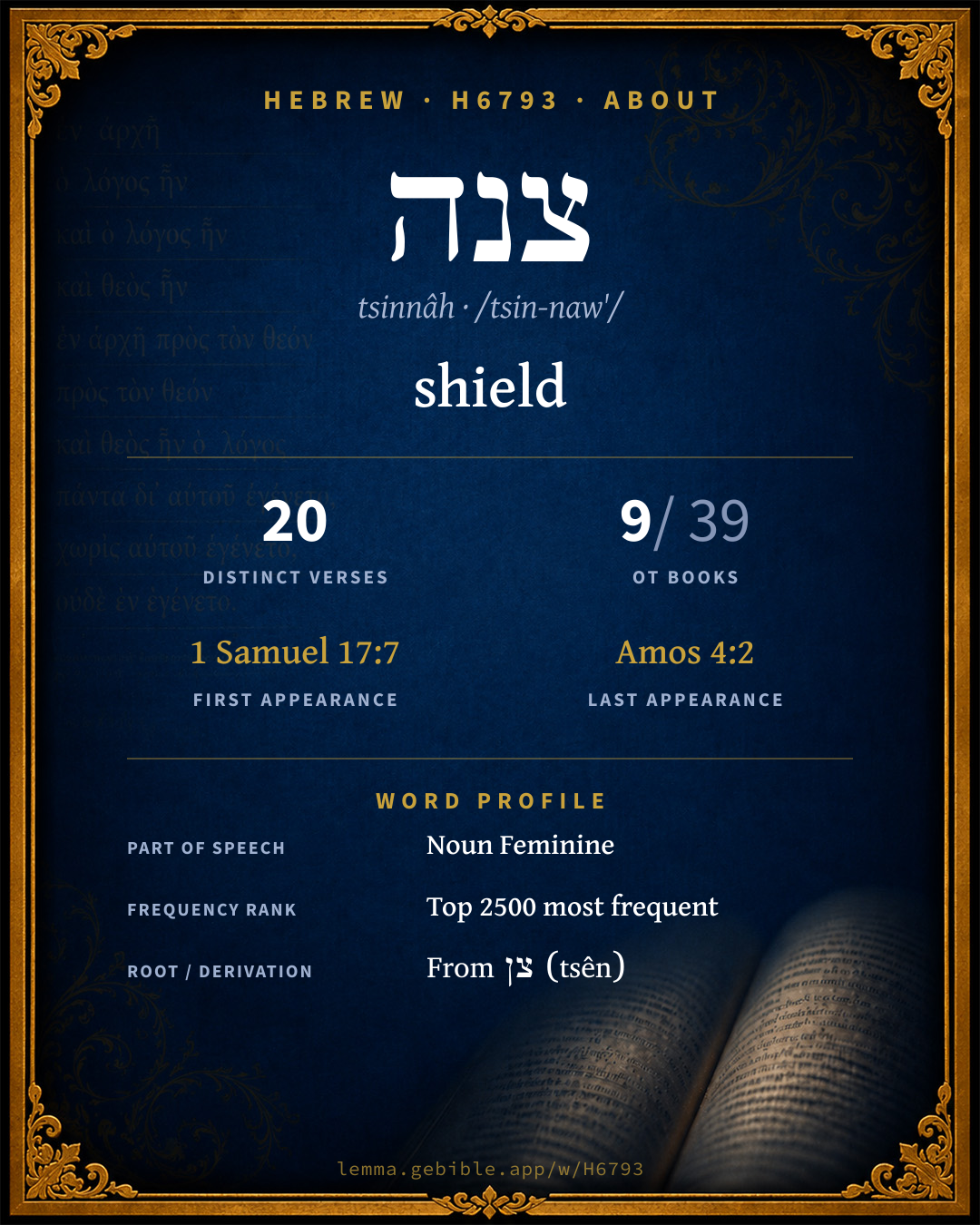
צִנָּה
shield
‘shield’ is one of 3 main senses fuller range ↓
Full lexicon entry — Brown-Driver-Briggs (BDB)
From Brown-Driver-Briggs (BDB)
Where this word appears
See every Absolute-state word in the Hebrew Bible →
Grammar key — what these labels mean
Part of speech
- Noun
- A naming word — a person, place, thing, or idea.
Noun type
- Common
- A common noun — a general class of person, place, or thing (“king,” “city,” “water”), not a specific name.
State
- Absolute
- The independent form of a noun, not bound to a following word.
- Construct
- A noun bound to a following noun in a possessive / “of” relationship (the construct chain).
Gender
- Feminine
- Grammatically feminine.
- Masculine
- Grammatically masculine.
Number
- Singular
- One.
- Plural
- More than one (in Hebrew, generally three or more).
Grammatical forms
- Noun, Common, Feminine, Singular, Absolute 19 times (86%)
- Noun, Common, Feminine, Plural, Absolute 1 time (5%)
- Noun, Common, Feminine, Singular, Construct 1 time (5%)
- Noun, Common, Masculine, Plural, Absolute 1 time (5%)
Parsed forms decoded from the imported morphology (morphhb / Westminster Leningrad Codex — WLC text public domain, morphhb tagging CC BY 4.0), counted across 22 parsed occurrences — not distinct verses.
Every verse where H6793 appears — 20 distinct verses across 9 books. Click any verse to open its interlinear word-by-word view. Verse text shown in the World English Bible for context — . Each verse’s Hebrew form is shown with its reference; the English is not keyword-highlighted, since the data carries no word-level English alignment. Use “Compare translations” on any verse to read it across multiple English versions. This concordance covers the Hebrew Bible; Septuagint (Greek Old Testament) occurrences are not indexed here.
1 Samuel 2 verses
- 1 Samuel 17:7 הַ/צִּנָּ֖ה ptcl def.art + n c fs The staff of his spear was like a weaver's beam; and his spear's head [weighed] six hundred shekels of iron: and his shield-bearer went before him.
- 1 Samuel 17:41 הַ/צִּנָּ֖ה ptcl def.art + n c fs The Philistine came on and drew near to David; and the man who bore the shield went before him.
1 Kings 1 verse
1 Chronicles 3 verses
- 1 Chronicles 12:8 צִנָּ֖ה n c fs Of the Gadites there separated themselves to David to the stronghold in the wilderness, mighty men of valor, men trained for war, that could handle shield and spear; whose faces were like the faces of lions, and they were as swift as the roes on the mountains;
- 1 Chronicles 12:24 צִנָּ֖ה n c fs The children of Judah who bore shield and spear were six thousand and eight hundred, armed for war.
- 1 Chronicles 12:34 בְּ/צִנָּ֣ה prep + n c fs Of Naphtali one thousand captains, and with them with shield and spear thirty-seven thousand.
2 Chronicles 4 verses
- 2 Chronicles 9:15 צִנָּ֖ה הַ/צִּנָּ֥ה n c fs ptcl def.art + n c fs King Solomon made two hundred bucklers of beaten gold; six hundred [shekels] of beaten gold went to one buckler.
- 2 Chronicles 11:12 צִנּ֣וֹת n c fp In every city [he put] shields and spears, and made them exceeding strong. Judah and Benjamin belonged to him.
- 2 Chronicles 14:8 צִנָּ֣ה n c fs Asa had an army that bore bucklers and spears, out of Judah three hundred thousand; and out of Benjamin, that bore shields and drew bows, two hundred eighty thousand: all these were mighty men of valor.
- 2 Chronicles 25:5 וְ/צִנָּֽה conj + n c fs Moreover Amaziah gathered Judah together, and ordered them according to their fathers' houses, under captains of thousands and captains of hundreds, even all Judah and Benjamin: and he numbered them from twenty years old and upward, and found them three hundred thousand chosen men, able to go forth to war, who could handle spear and shield.
Psalms 3 verses
- Psalms 5:12 כַּ֝/צִּנָּ֗ה prep det + n c fs For you will bless the righteous. Yahweh, you will surround him with favor as with a shield.
- Psalms 35:2 וְ/צִנָּ֑ה conj + n c fs Take hold of shield and buckler, And stand up for my help.
- Psalms 91:4 צִנָּ֖ה n c fs He will cover you with his feathers. Under his wings you will take refuge. His faithfulness is your shield and rampart.
Proverbs 1 verse
Jeremiah 1 verse
Ezekiel 4 verses
- Ezekiel 23:24 צִנָּ֤ה n c fs They shall come against you with weapons, chariots, and wagons, and with a company of peoples; they shall set themselves against you with buckler and shield and helmet round about; and I will commit the judgment to them, and they shall judge you according to their judgments.
- Ezekiel 26:8 צִנָּֽה n c fs He shall kill with the sword your daughters in the field; and he shall make forts against you, and cast up a mound against you, and raise up the buckler against you.
- Ezekiel 38:4 צִנָּ֣ה n c fs and I will turn you about, and put hooks into your jaws, and I will bring you forth, and all your army, horses and horsemen, all of them clothed in full armor, a great company with buckler and shield, all of them handling swords;
- Ezekiel 39:9 וְ/צִנָּה֙ conj + n c fs Those who dwell in the cities of Israel shall go forth, and shall make fires of the weapons and burn them, both the shields and the bucklers, the bows and the arrows, and the war clubs, and the spears, and they shall make fires of them seven years;
Amos 1 verse
About this entry
At a glance — auto-summarized from this page’s data, not written by a person. Every figure links to its source below. This summary describes the numbers; it doesn’t interpret them.
צנה — transliterated tsinnâh — is a Hebrew noun carrying the sense “shield.” It first appears in 1 Samuel 17:7. With 20 verses in 9 books, it is an uncommon word in the Hebrew Bible. Its lexical range runs to 3 senses. From the same root come צן, צנין and צנצנת. See the sense tree, 20-verse concordance, and the renderings breakdown below.
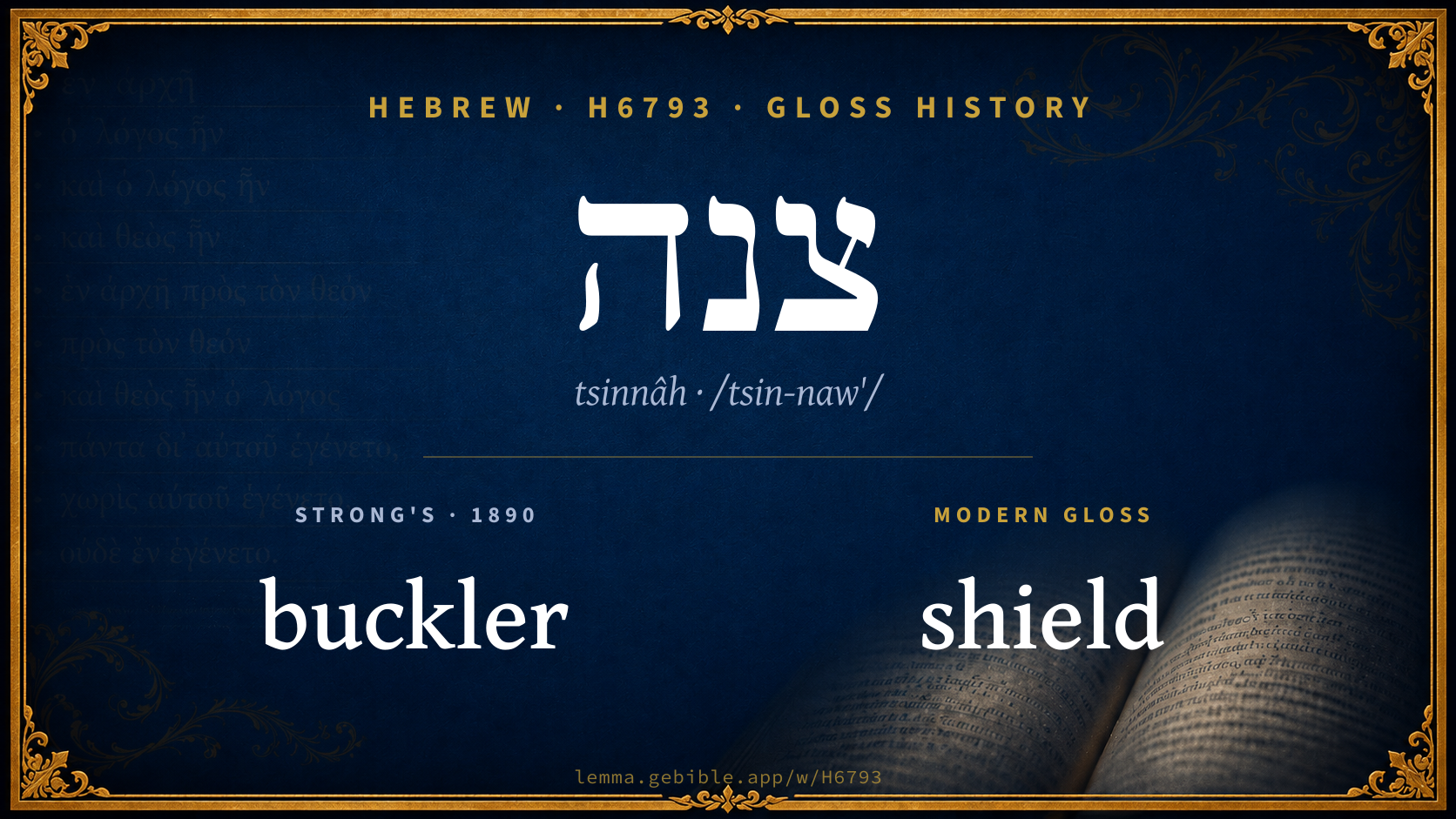
Gloss history
Strong's 1890 vs modern scholarship
About this word
Strong's H6793 catalogs a Hebrew word from the Hebrew Old Testament.
These counts are not copied from any lexicon or concordance. They are computed here, from the morphology-tagged Hebrew Old Testament. What Lemma adds →
- 20
- distinct verses
- The word appears in 20 distinct verses.
- 9 / 39
- OT books
- The word appears in 9 of 39 Old Testament books.
- #1,412
- by frequency
- Top 2500 most frequent Hebrew words (rank 1,412 of 8,640 Hebrew words by occurrence).
View all 20 occurrences in the concordance →
Most concentrated in
- 2 Chronicles 4 verses 20%
- Ezekiel 4 verses 20%
- 1 Chronicles 3 verses 15%
By section of the Old Testament
By traditional corpus
Conventional, traditional groupings — biblical authorship is debated, so this is a traditional corpus grouping, not an authorship claim. Each share is this word’s portion of its verses in that division of the Hebrew canon. Each figure is a share of the word’s 20 distinct verses.
- Writings (Ketuvim) 11 verses · 55%
- Prophets (Nevi'im) 9 verses · 45%
How translations render this word
Counts come from each version’s own published word-to-Strong’s tagging or interlinear alignment — an approximate guide to how each version renders this word, not a word-level alignment the data otherwise carries. Because each total is that version’s own tagged count, the per-version totals vary from one another and need not match the appearance or distinct-verse counts above. These counts may also differ from a printed concordance because Lemma counts each distinctly tagged rendering and does not collapse phrase taggings into a single head-word total. This is a fixed set of word-tagged versions (KJV, ASV, BSB, ULT) and does not change with the reading translation you choose elsewhere. Each version’s license is shown beside its name below (and on Sources).
BDB lists this Strong’s number as 4 distinct words (homographs). Each count above pools all of them and is not split by sense — see the Senses section below. A low-frequency rendering may belong to a different one of those words, not the primary meaning.
- King James Version†: Shield 8×, Targets 3×, Buckler 2×
- American Standard Version†: Shield 7×, Buckler 4×, Bucklers 3×
- Berean Standard Bible†: Shield 5×, Large shields 3×, Shields 3×
- unfoldingWord Literal Text†: Shield 6×, Large shield 5×, Small shields 3×
King James Version Public Domain
Renders H6793 across 22† tagged occurrences — most commonly:
Plus 5 renderings that appear only once — usually multi-word phrases or single function words the recovered tagging swept in, not distinct renderings.
American Standard Version Public Domain
Renders H6793 across 21† tagged occurrences — most commonly:
Plus 7 renderings that appear only once — usually multi-word phrases or single function words the recovered tagging swept in, not distinct renderings.
Berean Standard Bible Public Domain
Renders H6793 across 20† tagged occurrences — most commonly:
Plus 7 renderings that appear only once — usually multi-word phrases or single function words the recovered tagging swept in, not distinct renderings. Not rendered by a distinct English word in 2 further occurrences.
unfoldingWord Literal Text CC BY-SA 4.0
Renders H6793 across 21† tagged occurrences — most commonly:
Plus 5 renderings that appear only once — usually multi-word phrases or single function words the recovered tagging swept in, not distinct renderings.
Senses in the full BDB
What do BDB’s symbols mean?
BDB uses these scholarly abbreviations:
| Symbol | Meaning |
|---|---|
| 𝔊 | the Septuagint (the ancient Greek translation, LXX) |
| 𝔙 | the Vulgate (the Latin translation) |
| 𝔖 | the Syriac version (the Peshitta) |
| 𝔗 | the Targum (the Aramaic translation) |
| ψ | the Psalms |
| √ | root (the underlying root or stem) |
| ‖ | parallel passage (a synonymous or contrasted parallel) |
| † | the dagger: every passage where the word occurs is cited |
The 0 senses and sub-senses the full Brown-Driver-Briggs lexicon distinguishes for this word, in lexicon order (not ranked by frequency), with BDB’s own verbatim wording and sub-sense lettering. Shown in Hebrew script with BDB’s own scholarly abbreviations. The condensed entry is in the Lexicon Entry tab. See also the Forms in the corpus table below.
צנה I i, ii, iii. צִנָּה, v. I, II, III. צנן.
צנה II appar. hook, or barb (of fishing-spear?)
צנה III coolness
צנה IV large shield (covering whole body)
Senses from the full Brown-Driver-Briggs lexicon (Brown, Driver, Briggs; Oxford 1906 — public domain), digitized via Sefaria, supplemented by the OpenScriptures HebrewLexicon (CC BY 4.0). Full attribution on Sources.
Word origin
I. i, ii, iii. צִנָּה, v. I, II, III. צנן.
I. n.f. appar. hook, or barb (of fishing-spear?);—pl. צִנּוֹת Am 4:2 (‖ סִירוֹת דּוּגָה).
II. n.f. coolness;—cstr. צִנַּת־שֶׁלֶג Pr 25:13 coolness of snow (צינת רוח צפון Ecclus 43:20).
III. n.f. large shield (covering whole body);—abs. צ׳ 1 S 17:7 +; pl. צִנּוֹת 2 Ch 11:12;—shield, larger than מָגֵן 1 K 10:16(×2) (cf. v 17) = 2 Ch 9:15(×2); נֹשֵׂא (הַ)צִנָּה 1 S 17:7, 41 (הָאִישׁ נ׳ הַצּ׳), 2 Ch 14:7, נֹשְׂאֵי צ׳ 1 Ch 12:25 (van d. H. v 24); עִרְכוּ מָגֵן וְצִנָּה Je 46:3, cf. עֹרְכֵי צ׳ 1 Ch 12:9 (van d. H. v 8); אֹחֵז רֹמַח וְצ׳ 2 Ch 25:5; הַחֲזֵק מָגֵן וְצ׳ ψ 35:2; הֵקִים עָלַיִךְ צ׳ Ez 26:8; + מָגֵן also 23:24; 38:4; 39:9; צ׳ 1 Ch 12:35 (van d. H. v 34) 2 Ch 11:12; sim. of י׳’s favour ψ 5:13; fig. of י׳’s faithfulness 91:4.
— Brown-Driver-Briggs (Oxford 1906, public domain), digitized via Sefaria, supplemented by the OpenScriptures HebrewLexicon (CC BY 4.0). See Sources.
Derived from צן (tsên) (H6791) — thorn.
Jastrow Dictionary
A second Hebrew/Aramaic lexicon for comparison, covering Aramaic and post-biblical (Talmudic, Targumic, Midrashic) usage that the biblical-Hebrew BDB does not. Matched by lemma rather than by Strong’s number, so a lemma may carry more than one Jastrow headword (shown separately below), and the entries cover usage well beyond the Bible.
צִנָּה
- v. צָנַן) polished buckler or cuirass (cmp. סַנְוַורְתָּא). Midr. Till. to Ps. I מנין … ת"ל וכ׳ whence do we learn to include the fourth side (as protected)? We read (Ps. V, 13) ‘as with a cuirass &c.’ Midr. Till. to Ps. XXXV, 2 וכי למגן וצ׳ וכ׳ (ed. Bub.) do I need buckler and cuirass?; Yalk. ib. 722. Tanḥ. Naso, ed. Bub. 27 (ref. to Ps. XCI, 4) צ׳ אני נעשה לכל מי שהוא סוחר בתורה I am a cuirass to whosoever travels about with the Law; Yalk. Ps. 842; Tanḥ. Naso 23. Ex. R. s. 40 (ref. to צנן, Josh. XV, 37) [read:] צנן שהוא צ׳ Jerusalem is surnamed Zenan, because it is a cuirass (the Temple being a protection); a. e. e.g. Psalms 5:13
צִנָּה II
- (v. צָנַן) stinging palm, stone-palm (whose wood is very hard and thorny).—Pl. צִנִּים, צִנִּין, צִי׳. Y. B. Mets. II, end, 8ᵈ קורדום … לא צ׳ ועצי זית if one finds an axe, he may use it for chopping ordinary wood, but not for stone-palms and olive trees; Tosef. B. Mets. II, 22 צנם ed. Zuck. (Var. צנון, read: צנה or צנין). Succ. III, 1 צִינֵּי … כשרות the palms of the Iron Mount are fit (for the festive wreath), expl. ib. 32ᵇ; Erub. 19ᵃ
צִנָּה ²
- cold. Tosef. Ohol. II, 6 נכנסה עליו צ׳ ומת he caught cold on it (on the trepanned skull) and died. Y. Sabb. XIV, 14ᶜ bot. תשעים … מתים בצ׳ וכ׳ ninety-nine men die from cold to one by the hands of heaven; Lev. R. s. 16. B. Mets. 107ᵇ (ref. to כל חלי, Deut. VII, 15) זו צ׳ that means cold. Tosef. Sabb. III (IV), 5 צִינָּתָן; Y. ib. III, 6ᵇ top צִינָּתָהּ, v. פּוּג h.; a. fr.—Pl. צִנִּים, צִנִּין, צִי׳. Y. B. Kam. VIII, beg. 6ᵇ הטיל עליו שלג או צ׳ וכ׳ if he put snow or ice-cold water &c.; ib. bot. צונן. Ex. R. s. 25, beg. בקש צ׳ … בקש חמים וכ׳ (not גחלים) if he wants ice-water, he gets it (out of the milliarium); if he wants hot water &c.; (Tanḥ. Vayera 10 חמין … צונן).—צ׳ פחים (adopted from Prov. XXII, 5) blowing cold winds, cold draughts; [oth. opin.: צ׳ ופ׳ cold and heat, v. פַּח II]. B. Mets. l. c.; Ab. Zar. 3ᵇ; Keth. 30ᵃ; B. Bath. 144ᵇ הכל בידי שמים חוץ מצ׳ פ׳ everything is in the power of heavens (comes from no fault of man), except sickness from cold droughts, as we read (Prov. l. c.) &c.; Yalk. Prov. 960 מצ׳ ופ׳. e.g. Deuteronomy 7:15
A Dictionary of the Targumim, the Talmud Babli and Yerushalmi, and the Midrashic Literature (Marcus Jastrow; London, Luzac, 1903) — Public Domain. Digitized via Sefaria. Digitized via Sefaria. Full attribution on Sources.
Forms in the corpus
The 15 distinct written forms H6793 takes in the Hebrew Bible, most frequent first — each parse links to that state’s occurrences in the concordance. Hebrew forms include their vowel points and cantillation, so a single lemma takes many written forms.
Same root — word family
Other BDB entries built from the same root as H6793, grouped by Strong’s listed origin. These share a root / origin per the lexicon — not necessarily a shared meaning. Each links to that word’s own entry.
Derives from
Shares the same root
Compare all same-root words → They share a root, not necessarily a meaning.
Septuagint verse parallels
This word appears in 19 verses that also exist in the Greek Old Testament (Septuagint), out of the 20 Hebrew verses it occurs in. You can read those verses in Greek by switching the Old Testament edition to the Septuagint.
Read these verses in the Septuagint
- 1 Samuel 17:7
- 1 Kings 10:16
- 1 Chronicles 12:8
- 2 Chronicles 9:15
- Psalms 5:12
- Proverbs 25:13
- Jeremiah 46:3
- Ezekiel 23:24
- Amos 4:2
This is a verse-level parallel only — the same verses exist in both the Hebrew and Greek Old Testaments. No word-level Hebrew↔Greek correspondence is claimed: the data carries no such alignment, so no Greek word is shown as this Hebrew word’s translation. Coverage is not total — the Septuagint omits the deuterocanon and renumbers the Psalms, so some Hebrew verses have no direct Greek parallel.