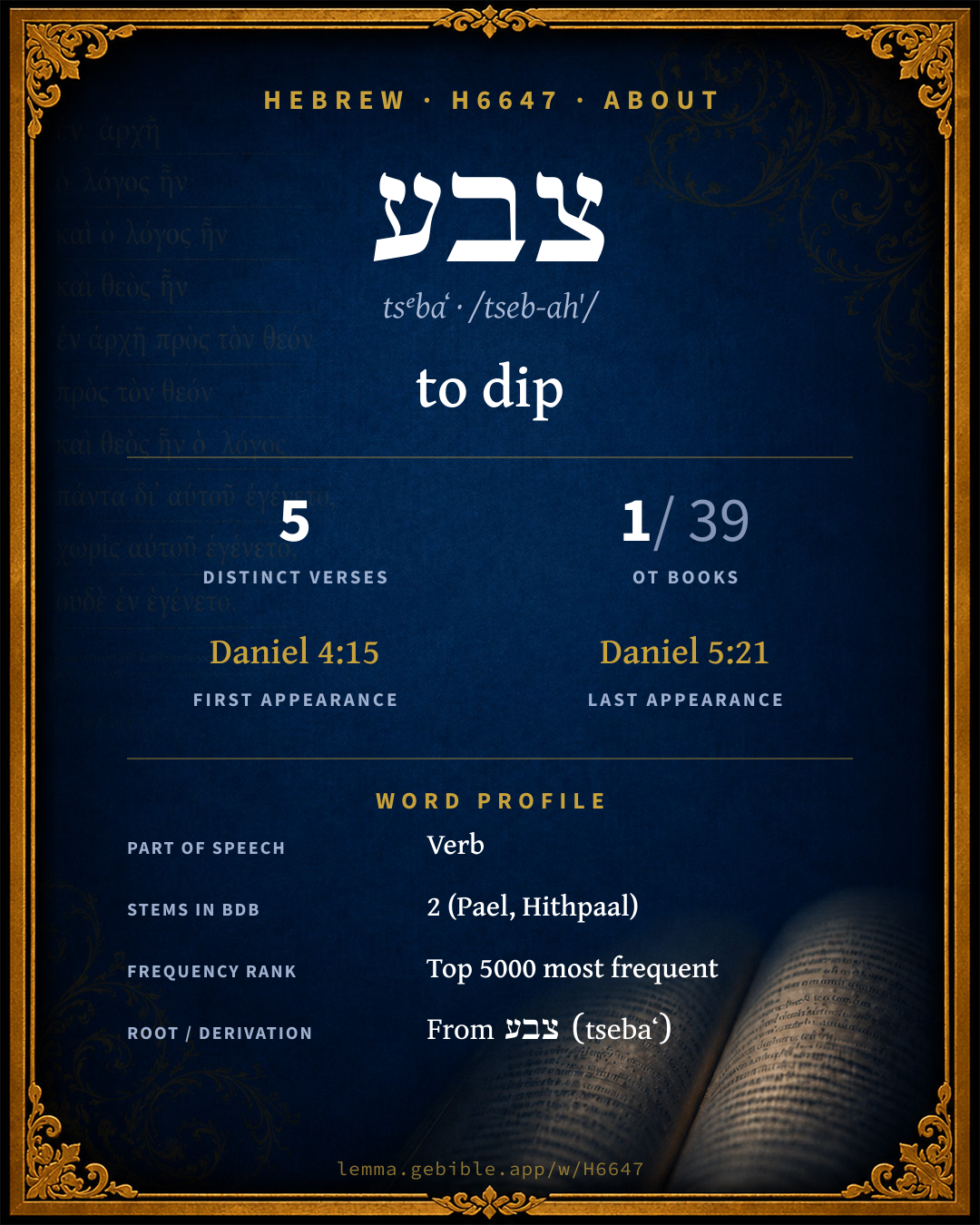
צְבַע
to dip
‘to dip’ is one of 3 main senses fuller range ↓
Full lexicon entry — Brown-Driver-Briggs (BDB)
From Brown-Driver-Briggs (BDB)
Where this word appears
See every Poal verb in the Hebrew Bible →
Grammar key — what these labels mean
Part of speech
- Verb
- An action or state-of-being word.
Stem
- Piel
- An intensive or resultative active stem.
Form
- Imperfect
- An incomplete, ongoing, or future action (“he will / would write”).
- Participle Active
- A verbal adjective expressing ongoing or characteristic action (“writing / one who writes”).
State
- Absolute
- The independent form of a noun, not bound to a following word.
Person
- 3rd Person
- The one spoken about (“he / she / it / they”).
Gender
- Masculine
- Grammatically masculine.
Number
- Singular
- One.
- Plural
- More than one (in Hebrew, generally three or more).
Grammatical forms
- Verb, Poal, Imperfect, 3rd Person, Masculine, Singular 4 times (80%)
- Verb, Piel, Participle Active, Masculine, Plural, Absolute 1 time (20%)
Parsed forms decoded from the imported morphology (morphhb / Westminster Leningrad Codex — WLC text public domain, morphhb tagging CC BY 4.0), counted across 5 parsed occurrences — not distinct verses.
Every verse where H6647 appears — 5 distinct verses across 1 book. Click any verse to open its interlinear word-by-word view. Verse text shown in the World English Bible for context — . Each verse’s Hebrew form is shown with its reference; the English is not keyword-highlighted, since the data carries no word-level English alignment. Use “Compare translations” on any verse to read it across multiple English versions. This concordance covers the Hebrew Bible; Septuagint (Greek Old Testament) occurrences are not indexed here.
Daniel 5 verses
- Daniel 4:15 יִצְטַבַּ֔ע Poal impf 3ms Nevertheless leave the stump of its roots in the earth, even with a band of iron and brass, in the tender grass of the field; and let it be wet with the dew of the sky: and let his portion be with the animals in the grass of the earth:
- Daniel 4:23 יִצְטַבַּ֗ע Poal impf 3ms Whereas the king saw a watcher and a holy one coming down from the sky, and saying, Hew down the tree, and destroy it; nevertheless leave the stump of the roots of it in the earth, even with a band of iron and brass, in the tender grass of the field, and let it be wet with the dew of the sky: and let his portion be with the animals of the field, until seven times pass over him;
- Daniel 4:25 מְצַבְּעִ֔ין Piel ptcp.act mp that you shall be driven from men, and your dwelling shall be with the animals of the field, and you shall be made to eat grass as oxen, and shall be wet with the dew of the sky, and seven times shall pass over you; until you know that the Most High rules in the kingdom of men, and gives it to whoever he will.
- Daniel 4:33 יִצְטַבַּ֑ע Poal impf 3ms The same hour was the thing fulfilled on Nebuchadnezzar: and he was driven from men, and ate grass as oxen, and his body was wet with the dew of the sky, until his hair was grown like eagles' [feathers], and his nails like birds' [claws].
- Daniel 5:21 יִצְטַבַּ֑ע Poal impf 3ms and he was driven from the sons of men, and his heart was made like the animals', and his dwelling was with the wild donkeys; he was fed with grass like oxen, and his body was wet with the dew of the sky; until he knew that the Most High God rules in the kingdom of men, and that he sets up over it whoever he will.
About this entry
At a glance — auto-summarized from this page’s data, not written by a person. Every figure links to its source below. This summary describes the numbers; it doesn’t interpret them.
At its core, צבע (tsᵉbaʻ) means “to dip.” It is rare — just 5 verses in the entire Hebrew Bible. Its uses cluster heavily in Daniel (100% of all occurrences). First canonically at Daniel 4:15, it enters the text early. Across 2 stems, its meaning turns on the binyan (Pael, Hithpaal). Each statement above links to its evidence; the full detail follows below.
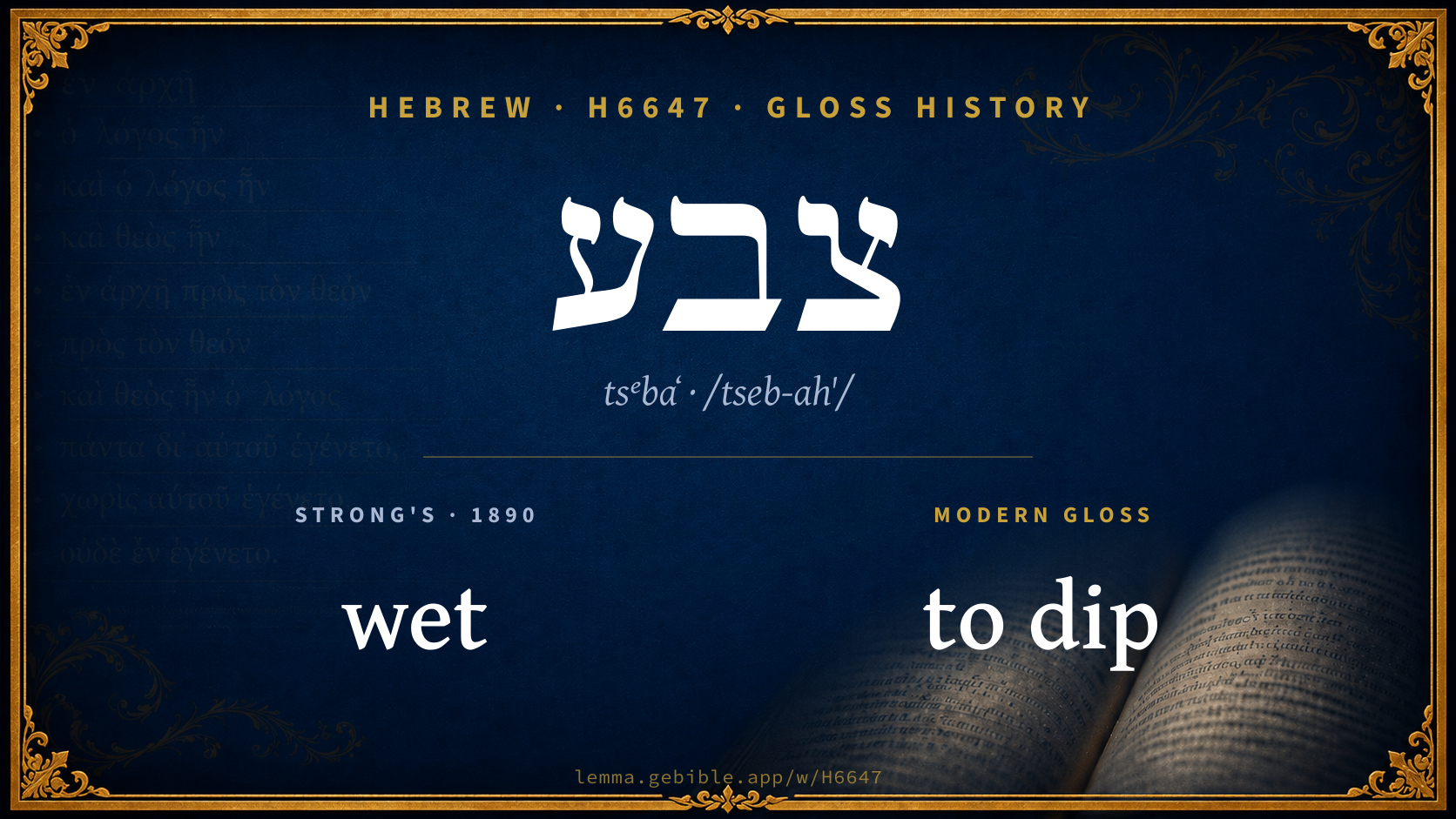
Gloss history
Strong's 1890 vs modern scholarship
About this word
Strong's H6647 catalogs a Hebrew word from the Hebrew Old Testament.
These counts are not copied from any lexicon or concordance. They are computed here, from the morphology-tagged Hebrew Old Testament. What Lemma adds →
- 5
- distinct verses
- The word appears in 5 distinct verses.
- 1 / 39
- OT books
- The word appears in 1 of 39 Old Testament books.
- #3,337
- by frequency
- Top 5000 most frequent Hebrew words (rank 3,337 of 8,640 Hebrew words by occurrence).
View all 5 occurrences in the concordance →
Most concentrated in
- Daniel 5 verses 100%
By section of the Old Testament
By traditional corpus
Conventional, traditional groupings — biblical authorship is debated, so this is a traditional corpus grouping, not an authorship claim. Each share is this word’s portion of its verses in that division of the Hebrew canon. Each figure is a share of the word’s 5 distinct verses.
- Writings (Ketuvim) 5 verses · 100%
How translations render this word
Counts come from each version’s own published word-to-Strong’s tagging or interlinear alignment — an approximate guide to how each version renders this word, not a word-level alignment the data otherwise carries. Because each total is that version’s own tagged count, the per-version totals vary from one another and need not match the appearance or distinct-verse counts above. These counts may also differ from a printed concordance because Lemma counts each distinctly tagged rendering and does not collapse phrase taggings into a single head-word total. This is a fixed set of word-tagged versions (KJV, ASV, BSB, ULT) and does not change with the reading translation you choose elsewhere. Each version’s license is shown beside its name below (and on Sources).
- King James Version: Let it be wet 2×, Was wet 2×
- American Standard Version: Let it be wet 2×, Was wet 2×
- Berean Standard Bible: Let him be drenched 2×, Was drenched 2×
- unfoldingWord Literal Text: Let him be wet 2×, Was wet 2×
King James Version Public Domain
Renders H6647 across 5 tagged occurrences — most commonly:
Plus 1 rendering that appears only once — usually multi-word phrases or single function words the recovered tagging swept in, not distinct renderings.
American Standard Version Public Domain
Renders H6647 across 5 tagged occurrences — most commonly:
Plus 1 rendering that appears only once — usually multi-word phrases or single function words the recovered tagging swept in, not distinct renderings.
Berean Standard Bible Public Domain
Renders H6647 across 5 tagged occurrences — most commonly:
Plus 1 rendering that appears only once — usually multi-word phrases or single function words the recovered tagging swept in, not distinct renderings.
unfoldingWord Literal Text CC BY-SA 4.0
Renders H6647 across 5 tagged occurrences — most commonly:
Plus 1 rendering that appears only once — usually multi-word phrases or single function words the recovered tagging swept in, not distinct renderings.
Senses in the full BDB
Hebrew verbs can shift meaning by stem (binyan): Qal is the basic action, Niphal is often passive or reflexive, Piel often intensifies or makes it factitive, and Hiphil is typically causative. The senses below are grouped under the stem BDB assigns to each. This entry also uses Pael (the intensive Aramaic stem, parallel to Piel) and Hithpaal (the reflexive or passive Aramaic stem).
What do BDB’s symbols mean?
BDB uses these scholarly abbreviations:
| Symbol | Meaning |
|---|---|
| 𝔊 | the Septuagint (the ancient Greek translation, LXX) |
| 𝔙 | the Vulgate (the Latin translation) |
| 𝔖 | the Syriac version (the Peshitta) |
| 𝔗 | the Targum (the Aramaic translation) |
| ψ | the Psalms |
| √ | root (the underlying root or stem) |
| ‖ | parallel passage (a synonymous or contrasted parallel) |
| † | the dagger: every passage where the word occurs is cited |
The 2 senses and sub-senses the full Brown-Driver-Briggs lexicon distinguishes for this word, in lexicon order (not ranked by frequency), with BDB’s own verbatim wording and sub-sense lettering. Shown in Hebrew script with BDB’s own scholarly abbreviations. The condensed entry is in the Lexicon Entry tab. See also the Forms in the corpus table below.
Pael
- . wet thee
Hithpaal
- . be wet
Senses from the full Brown-Driver-Briggs lexicon (Brown, Driver, Briggs; Oxford 1906 — public domain), digitized via Sefaria, supplemented by the OpenScriptures HebrewLexicon (CC BY 4.0). Full attribution on Sources.
Word origin
[ צְבַע ] vb. dip, wet
— Brown-Driver-Briggs (Oxford 1906, public domain), digitized via Sefaria, supplemented by the OpenScriptures HebrewLexicon (CC BY 4.0). See Sources.
Derived from צבע (tsebaʻ) (H6648) — dyed cloth.
Jastrow Dictionary
A second Hebrew/Aramaic lexicon for comparison, covering Aramaic and post-biblical (Talmudic, Targumic, Midrashic) usage that the biblical-Hebrew BDB does not. Matched by lemma rather than by Strong’s number, so a lemma may carry more than one Jastrow headword (shown separately below), and the entries cover usage well beyond the Bible.
צָבַע I
- (cmp. צָבַט) to seize, handle. Ḥag. 22ᵇ שנקיי … צוֹבְעִין ed., v. צָבַט.
- (denom. of אֶצְבַּע) to raise one or more fingers for the casting of lots. Yoma II, 1 הממונה … הַצְבִּיעוּ the superintending priest said to them, raise your fingers; Tam. 28ᵃ; Y. Yoma II, 39ᵈ top, expl. הוציאו אצבע.
צְבַע
- ; Pa. צַבַּע, with פייסא (v. preced.Hif.) to cast lots. Targ. II Esth. III, 7; IX, 24.
צָבַע II
- (cmp. טָבַע I) to dip; to dye. Orl. III, 1 בגד שצְבָעוֹ וכ׳ a garment which one dyed with shells of fruits forbidden as ‘Orlah (v. עָרְלָה). Sabb. VII, 2 והצוֹבְעוֹ and he who dyes it (the wool). Ib. 75ᵃ, sq., a. fr. (חייב) משום צוֹבֵעַ he is guilty because it is an act coming under the category of dyeing; a. fr.—[Y. Sabb. VI, 7ᵈ צובעין תותבן, read: צבעונין או זהובין, v. צִבְעוֹן.]—V. צוֹבַע.—Part. pass. צָבוּעַ; f. צְבוּעָה; pl. צְבוּעִים, צְבוּעִין; צְבוּעוֹת. Gen. R. s. 96, v. בּוּרְדִּיקָא. Num. R. s. 2 מפה שלו צ׳ אדום his flag was red-colored. Meg. IV, 7 מי שהיו ידיו צ׳ וכ׳ he whose hands are spotted from handling woad; a. fr.—Sot. 22ᵇ הצ׳ the painted (hypocrites), v. פָּרוּשׁ.—V. צָבוּעַ.
צְבַע ²
- , to dip; to dye. Targ. Y. Ex. XII, 22 Ar. (ed. טמש; h. text טבל). Targ. Y. II, Lev. IV, 6 יִצְבּוֹעַ.—Y. Sabb. II, 4ᵈ top, v. פְּתִילְתָּא.—Y. Taan. IV, end, 69ᶜ הוה צ׳ פיסתיה וכ׳ dipped his bread in ashes. Koh. R. to VII, 11 הוה צ׳ חדא וכ׳ dipped one of his fingers in blood of a swine. Y. B. Kam. IX, 6ᵈ bot. א"ל צִיבְעֵיה סומק וצַבְעֵיה אוכם if he told the dyer, dye it red, and he dyed it black; אילו צְבַעְתֵּיה סומק וכ׳ if thou hadst dyed it red, it would have been worth &c. Men. 42ᵇ הא … היכי צַבְעִיתוּ לה how do you dye the purple-blue?; a. e.
- same, to dip, immerse. Targ. O. Lev. XIII, 6 (Y. יִצְכַּע Pe.; h. text כבס). Ib. XIV, 9; a. fr.
- to be dipped, immersed; to be soaked. Ib. XIII, 58. Targ. Cant. V, 2.
צֶבַע
- preced.) dye, color; dyed material. Sifra B’har, ch. I לצבוע בה צ׳ to use it for dyeing. Arakh. VI, 5 (24ᵃ) צ׳ שצבעו לשמן (not שצבען) dyed cloth which he had dyed for them (his wife and children). Mikv. VII, 3 מי הצ׳ dye-water. Num. R. s. 2; a. fr.—Pl. צְבָעִים, צְבָעִין. Ib. וצבע מפה שלו דומה לי"ב צ׳ and the color of his (Benjamin’s) flag was like the twelve colors (combined); a. e.—V. צוֹבַע.
צֶבַע ²
- constr. צְבַע. Targ. Ex. XXV, 4 צְ׳ זהורי (h. text תולעת שני). Targ. Lev. XIV, 4; a. fr.—Sabb. 75ᵃ דליציל צִיבְעֵיה that its color may be so much brighter. Y. Pes. III, beg. 29ᵈ בגין דיקלוט צ׳ in order that it may take the dye; a. e.
צַבָּע
- (preced.) dyer. Sabb. 11ᵇ, v. דּוּגְמָא. B. Kam. IX, 4; a. fr.—Pl. צַבָּעִים, צַבָּעִין. Pes. III, 1, v. זוֹמָא I. Tosef. Shebi. V, 8. Y. Sabb. VII, 10ᶜ top הצ׳ שבירושלים וכ׳ the dyers in Jerusalem considered wringing (the dyed clothes) a special art; Tosef. Sabb. IX (X), 18; a. fr.
A Dictionary of the Targumim, the Talmud Babli and Yerushalmi, and the Midrashic Literature (Marcus Jastrow; London, Luzac, 1903) — Public Domain. Digitized via Sefaria. Digitized via Sefaria. Full attribution on Sources.
Forms in the corpus
The 4 distinct written forms H6647 takes in the Hebrew Bible, most frequent first — each parse links to that stem’s occurrences in the concordance. Hebrew forms include their vowel points and cantillation, so a single lemma takes many written forms.
| Form | Parsing | Example | Uses |
|---|---|---|---|
| יִצְטַבַּ֑ע | Verb, Poal, Imperfect, 3rd Person, Masculine, Singular | Daniel 4:33 | 2 |
| יִצְטַבַּ֔ע | Verb, Poal, Imperfect, 3rd Person, Masculine, Singular | Daniel 4:15 | 1 |
| יִצְטַבַּ֗ע | Verb, Poal, Imperfect, 3rd Person, Masculine, Singular | Daniel 4:23 | 1 |
| מְצַבְּעִ֔ין | Verb, Piel, Participle Active, Masculine, Plural, Absolute | Daniel 4:25 | 1 |
Same root — word family
Other BDB entries built from the same root as H6647, grouped by Strong’s listed origin. These share a root / origin per the lexicon — not necessarily a shared meaning. Each links to that word’s own entry.
Derives from
Shares the same root
Proper names from this root
People and places named from this root — a name, not an additional meaning of the word.
Compare all same-root words → Showing 4 of 5 — not the complete family. 1 of the same-root words is a proper name (a person or place). They share a root, not necessarily a meaning.
Septuagint verse parallels
This word appears in 3 verses that also exist in the Greek Old Testament (Septuagint), out of the 5 Hebrew verses it occurs in. You can read those verses in Greek by switching the Old Testament edition to the Septuagint.
Read these verses in the Septuagint
This is a verse-level parallel only — the same verses exist in both the Hebrew and Greek Old Testaments. No word-level Hebrew↔Greek correspondence is claimed: the data carries no such alignment, so no Greek word is shown as this Hebrew word’s translation. Coverage is not total — the Septuagint omits the deuterocanon and renumbers the Psalms, so some Hebrew verses have no direct Greek parallel.