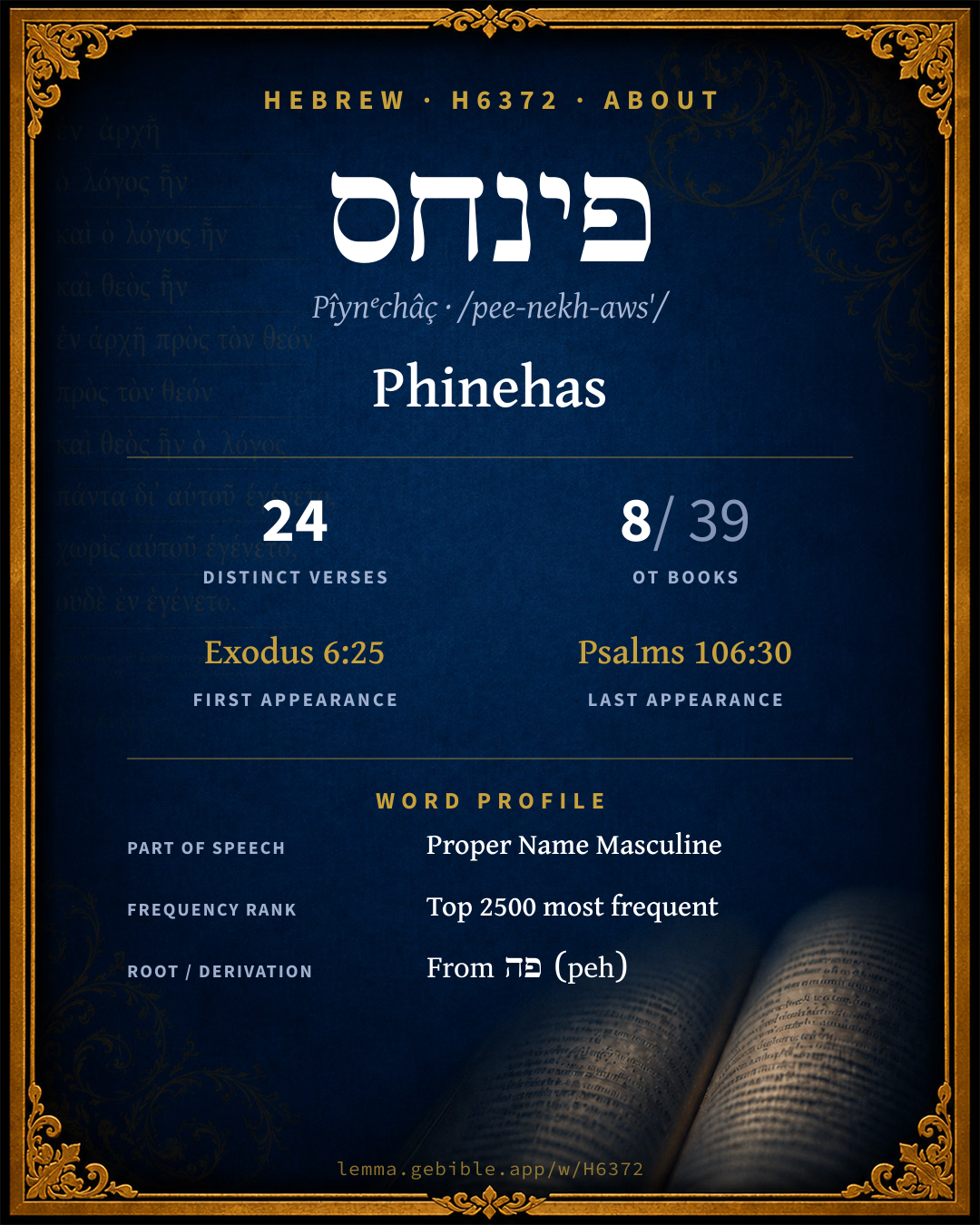
פִּינְחָס
Phinehas
BDB lists 4 entries for ‘Phinehas’ fuller range ↓
Full lexicon entry — Brown-Driver-Briggs (BDB)
From Brown-Driver-Briggs (BDB)
Where this word appears
Grammar key — what these labels mean
Part of speech
- Noun
- A naming word — a person, place, thing, or idea.
Noun type
- Proper
- A name of a specific person, place, or people (e.g. Abraham, Zion, Israel).
Every verse where H6372 appears in the Book of Numbers — 3 distinct verses. Click any verse to open its interlinear word-by-word view. Verse text shown in the World English Bible for context — . Each verse’s Hebrew form is shown with its reference; the English is not keyword-highlighted, since the data carries no word-level English alignment. Use “Compare translations” on any verse to read it across multiple English versions. This concordance covers the Hebrew Bible; Septuagint (Greek Old Testament) occurrences are not indexed here.
Numbers
- Numbers 25:7 פִּֽינְחָס֙ n Proper When Phinehas, the son of Eleazar, the son of Aaron the priest, saw it, he rose up from the midst of the congregation, and took a spear in his hand;
- Numbers 25:11 פִּֽינְחָ֨ס n Proper Phinehas, the son of Eleazar, the son of Aaron the priest, has turned my wrath away from the children of Israel, in that he was jealous with my jealousy among them, so that I didn't consume the children of Israel in my jealousy.
- Numbers 31:6 פִּ֨ינְחָ֜ס n Proper Moses sent them, one thousand of every tribe, to the war, them and Phinehas the son of Eleazar the priest, to the war, with the vessels of the sanctuary and the trumpets for the alarm in his hand.
About this entry
At a glance — auto-summarized from this page’s data, not written by a person. Every figure links to its source below. This summary describes the numbers; it doesn’t interpret them.
פינחס (Pîynᵉchâç) is a Hebrew name most often rendered “Phinehas.” Debuting at Exodus 6:25, it then recurs through the corpus. The Hebrew Bible uses it across 24 verses — uncommon. 1 Samuel dominates its distribution — 7 of 24 verses. For the data behind this summary, explore 24-verse concordance and the renderings breakdown below.
Gloss history
Strong's 1890 vs modern scholarship
About this word
Strong's H6372 catalogs a Hebrew word from the Hebrew Old Testament.
These counts are not copied from any lexicon or concordance. They are computed here, from the morphology-tagged Hebrew Old Testament. What Lemma adds →
- 24
- distinct verses
- The word appears in 24 distinct verses.
- 8 / 39
- OT books
- The word appears in 8 of 39 Old Testament books.
- #1,282
- by frequency
- Top 2500 most frequent Hebrew words (rank 1,282 of 8,640 Hebrew words by occurrence).
View all 24 occurrences in the concordance →
By section of the Old Testament
By traditional corpus
Conventional, traditional groupings — biblical authorship is debated, so this is a traditional corpus grouping, not an authorship claim. Each share is this word’s portion of its verses in that division of the Hebrew canon. Each figure is a share of the word’s 24 distinct verses.
- Prophets (Nevi'im) 13 verses · 54%
- Writings (Ketuvim) 7 verses · 29%
- Torah (Pentateuch) 4 verses · 17%
How translations render this word
Counts come from each version’s own published word-to-Strong’s tagging or interlinear alignment — an approximate guide to how each version renders this word, not a word-level alignment the data otherwise carries. Because each total is that version’s own tagged count, the per-version totals vary from one another and need not match the appearance or distinct-verse counts above. These counts may also differ from a printed concordance because Lemma counts each distinctly tagged rendering and does not collapse phrase taggings into a single head-word total. This is a fixed set of word-tagged versions (KJV, ASV, BSB, ULT) and does not change with the reading translation you choose elsewhere. Each version’s license is shown beside its name below (and on Sources).
- King James Version: Phinehas 23×
- American Standard Version: Phinehas 23×
- Berean Standard Bible: Phinehas 25×
- unfoldingWord Literal Text: Phinehas 25×
King James Version Public Domain
Renders H6372 across 25 tagged occurrences — most commonly:
Plus 2 renderings that appear only once — usually multi-word phrases or single function words the recovered tagging swept in, not distinct renderings.
American Standard Version Public Domain
Renders H6372 across 25 tagged occurrences — most commonly:
Plus 2 renderings that appear only once — usually multi-word phrases or single function words the recovered tagging swept in, not distinct renderings.
Berean Standard Bible Public Domain
Renders H6372 across 25 tagged occurrences — most commonly:
unfoldingWord Literal Text CC BY-SA 4.0
Renders H6372 across 25 tagged occurrences — most commonly:
Senses in the full BDB
What do BDB’s symbols mean?
BDB uses these scholarly abbreviations:
| Symbol | Meaning |
|---|---|
| 𝔊 | the Septuagint (the ancient Greek translation, LXX) |
| 𝔙 | the Vulgate (the Latin translation) |
| 𝔖 | the Syriac version (the Peshitta) |
| 𝔗 | the Targum (the Aramaic translation) |
| ψ | the Psalms |
| √ | root (the underlying root or stem) |
| ‖ | parallel passage (a synonymous or contrasted parallel) |
| † | the dagger: every passage where the word occurs is cited |
The 2 senses and sub-senses the full Brown-Driver-Briggs lexicon distinguishes for this word, in lexicon order (not ranked by frequency), with BDB’s own verbatim wording and sub-sense lettering. Shown in Hebrew script with BDB’s own scholarly abbreviations. The condensed entry is in the Lexicon Entry tab. See also the Forms in the corpus table below.
- 1. grandson of Aaron, Φ(ε)ινεες, Ex 6:25; Nu 25:7 + 16 times e.g. Exodus 6:25
- 2. son of Eli 1 S 1:3 (†פִּנְחָם), 2:34; 4:4, 11, 17, 19; 14:3. e.g. 1 Samuel 1:3
Senses from the full Brown-Driver-Briggs lexicon (Brown, Driver, Briggs; Oxford 1906 — public domain), digitized via Sefaria, supplemented by the OpenScriptures HebrewLexicon (CC BY 4.0). Full attribution on Sources.
Word origin
n.pr.m. (Egyptian Pe-nehasi, the negro, according to Lauth Moses (1868), 71, ZMG xxv (1871), 139 f. cf. NesEg 112, AJSL xiii (1897) 174 Baen Ex 6:25, yet v. Di);—
— Brown-Driver-Briggs (Oxford 1906, public domain), digitized via Sefaria, supplemented by the OpenScriptures HebrewLexicon (CC BY 4.0). See Sources.
Derived from פה (peh) (H6310) — mouth.
Jastrow Dictionary
A second Hebrew/Aramaic lexicon for comparison, covering Aramaic and post-biblical (Talmudic, Targumic, Midrashic) usage that the biblical-Hebrew BDB does not. Matched by lemma rather than by Strong’s number, so a lemma may carry more than one Jastrow headword (shown separately below), and the entries cover usage well beyond the Bible.
פִּינְחָס
- , v. פִּנְחָס
A Dictionary of the Targumim, the Talmud Babli and Yerushalmi, and the Midrashic Literature (Marcus Jastrow; London, Luzac, 1903) — Public Domain. Digitized via Sefaria. Digitized via Sefaria. Full attribution on Sources.
Forms in the corpus
The 19 distinct written forms H6372 takes in the Hebrew Bible, most frequent first — each parse links to that state’s occurrences in the concordance. Hebrew forms include their vowel points and cantillation, so a single lemma takes many written forms.
| Form | Parsing | Example | Uses |
|---|---|---|---|
| פִּֽינְחָ֣ס | Noun, Proper | Joshua 22:30 | 4 |
| וּ/פִֽינְחָֽס | Noun, Proper | 1 Samuel 4:4 | 2 |
| פִּֽינְחָ֑ס | Noun, Proper | Exodus 6:25 | 2 |
| פִּֽינְחָס֙ | Noun, Proper | Ezra 7:5 | 2 |
| וּ/פִ֣ינְחָ֔ס | Noun, Proper | 1 Samuel 4:17 | 1 |
| וּ/פִ֣נְחָ֔ס | Noun, Proper | 1 Samuel 1:3 | 1 |
| וּ/פִֽינְחָ֑ס | Noun, Proper | 1 Samuel 2:34 | 1 |
| וּ/פִֽינְחָ֣ס | Noun, Proper | 1 Chronicles 9:20 | 1 |
| וּ֠/פִינְחָס | Noun, Proper | Judges 20:28 | 1 |
| פִֽינְחָס֙ | Noun, Proper | Ezra 8:2 | 1 |
| פִּ֨ינְחָ֜ס | Noun, Proper | Numbers 31:6 | 1 |
| פִּֽ֭ינְחָס | Noun, Proper | Psalms 106:30 | 1 |
| פִּֽינְחָ֔ס | Noun, Proper | 1 Chronicles 6:4 | 1 |
| פִּֽינְחָ֖ס | Noun, Proper | 1 Chronicles 6:4 | 1 |
| פִּֽינְחָ֥ס | Noun, Proper | 1 Chronicles 6:50 | 1 |
| פִּֽינְחָ֨ס | Noun, Proper | Numbers 25:11 | 1 |
| פִּינְחָ֖ס | Noun, Proper | Joshua 22:13 | 1 |
| פִּינְחָ֨ס | Noun, Proper | 1 Samuel 14:3 | 1 |
| פִּינְחָס֮ | Noun, Proper | 1 Samuel 4:19 | 1 |
Same root — word family
Other BDB entries built from the same root as H6372, grouped by Strong’s listed origin. These share a root / origin per the lexicon — not necessarily a shared meaning. Each links to that word’s own entry.
Derives from
Shares the same root
Proper names from this root
People and places named from this root — a name, not an additional meaning of the word.
Compare all same-root words → Showing 4 of 6 — not the complete family. 2 of the same-root words are proper names (people or places). They share a root, not necessarily a meaning.
Bible dictionary
Public-domain dictionary articles matched to this entry by name (Phinehas). A biblical name can be shared by more than one person or place, so an article may treat several.
Easton's Bible Dictionary · M. G. Easton, 1897
Mouth of brass, or from old Egypt, the negro. (1.) Son of Eleazar, the high priest (Ex. 6:25). While yet a youth he distinguished himself at Shittim by his zeal against the immorality into which the Moabites had tempted the people (Num. 25:1-9), and thus "stayed the plague" that had broken out among the people, and by which twenty-four thousand of them perished. For his faithfulness on that occasion he received the divine approbation (10-13). He afterwards commanded the army that went out against the Midianites (31:6-8). When representatives of the people were sent to expostulate with the two and a half tribes who, just after crossing Jordan, built an altar and departed without giving any explanation, Phinehas was their leader, and addressed them in the words recorded in Josh. 22:16-20. Their explanation follows. This great altar was intended to be all ages only a witness that they still formed a part of Israel. Phinehas was afterwards the chief adviser in the war with the Benjamites. He is commemorated in Ps. 106:30, 31. (See ED.)
(2.) One of the sons of Eli, the high priest (1 Sam. 1:3; 2:12). He and his brother Hophni were guilty of great crimes, for which destruction came on the house of Eli (31). He died in battle with the Philistines (1 Sam. 4:4, 11); and his wife, on hearing of his death, gave birth to a son, whom she called "Ichabod," and then she died (19-22).
Smith's Bible Dictionary · William Smith, 1863
(mouth of brass).
+ Son of Eleazar and grandson of Aaron. (Exodus 6:25) He is memorable for having while quite a youth, by his zeal and energy at the critical moment of the licentious idolatry of Shittim, appeased the divine wrath, and put a stop to the plague which was destroying the nation. (Numbers 25:7) (B.C. 1452.) For this he was rewarded by the special approbation of Jehovah and by a promise that the priesthood should remain in his family forever. (Numbers 25:10-13) He was appointed to accompany as priest the expedition by which the Midianites were destroyed. ch. (Numbers 31:6) Many years later he also headed the party which was despatched from Shiloh to remonstrate against the altar which the transjordanic tribes were reported to have built near Jordan. (Joshua 22:13-32) In the partition of the country he received an allotment of his own--a hill on Mount Ephraim which bore his name. After Eleazar's death he became high priest--the third of the series. In this capacity he is introduced as giving the oracle to the nation during the whole struggle with the Benjamites on the matter of Gibeah. (Judges 20:28) The verse which closes the book of Joshua is ascribed to Phinehas, as the description of the death of Moses at the end of Deuteronomy is to Joshua. The tomb of Phinehas, a place of great resort to both Jews and Samaritans, is shown at Awertah, four miles southeast of Nablus . + Second son of Eli. (1 Samuel 1:3; 2:34; 4:4,11,17,19; 14:3) Phinehas was killed with his brother by the Philistines when the ark was captured. (B.C. 1125.) [Eli] + A Levite of Ezra's time, (Ezra 8:33) unless the meaning be that Eleazar was of the family of the great Phinehas.
Hitchcock's Bible Names Dictionary · Roswell D. Hitchcock, 1869
bold aspect; face of trust or protection
Classic public-domain reference works; full attribution on Sources.
Septuagint verse parallels
This word appears in 24 verses that also exist in the Greek Old Testament (Septuagint), out of the 24 Hebrew verses it occurs in. You can read those verses in Greek by switching the Old Testament edition to the Septuagint.
Read these verses in the Septuagint
- Exodus 6:25
- Numbers 25:7
- Joshua 22:13
- Judges 20:28
- 1 Samuel 1:3
- 1 Chronicles 6:4
- Ezra 7:5
- Psalms 106:30
This is a verse-level parallel only — the same verses exist in both the Hebrew and Greek Old Testaments. No word-level Hebrew↔Greek correspondence is claimed: the data carries no such alignment, so no Greek word is shown as this Hebrew word’s translation. Coverage is not total — the Septuagint omits the deuterocanon and renumbers the Psalms, so some Hebrew verses have no direct Greek parallel.