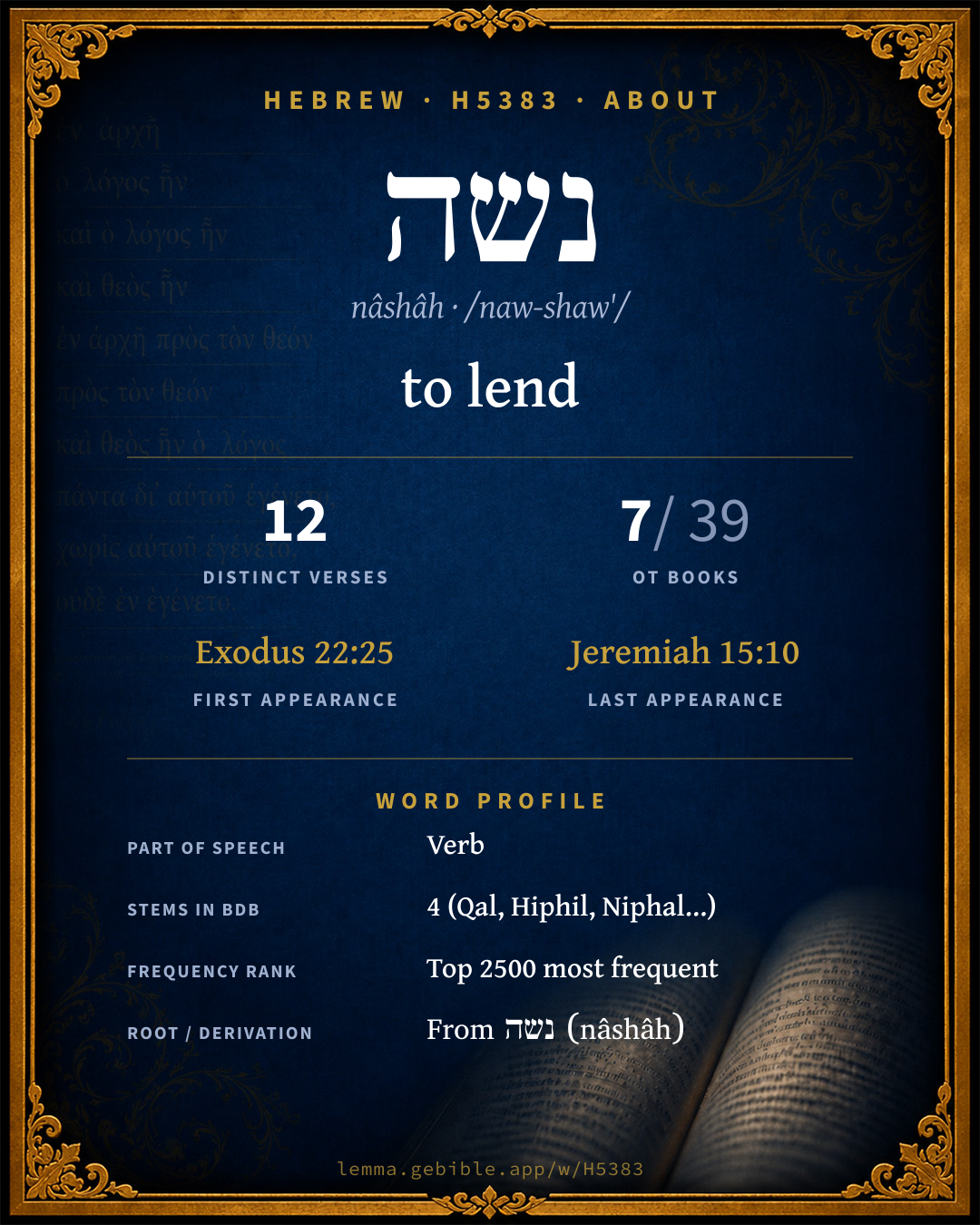
נָשָׁה
to lend
‘to lend’ is one of 2 main senses fuller range ↓
Full lexicon entry — Brown-Driver-Briggs (BDB)
From Brown-Driver-Briggs (BDB)
Where this word appears
See every Qal verb in the Hebrew Bible →
Grammar key — what these labels mean
Part of speech
- Verb
- An action or state-of-being word.
Stem
- Qal
- The basic, simple active stem — the plain form of the verb (“he wrote”). Here: ‘act.’
- Hiphil
- The causative active stem (“he caused / brought about”).
Form
- Participle Active
- A verbal adjective expressing ongoing or characteristic action (“writing / one who writes”).
- Imperfect
- An incomplete, ongoing, or future action (“he will / would write”).
- Perfect
- A completed action or state — Hebrew marks aspect (completeness) more than strict tense (“he wrote”).
State
- Absolute
- The independent form of a noun, not bound to a following word.
- Construct
- A noun bound to a following noun in a possessive / “of” relationship (the construct chain).
Person
- 2nd Person
- The one addressed (“you”).
- 3rd Person
- The one spoken about (“he / she / it / they”).
- 1st Person
- The speaker (“I / we”).
Gender
- Masculine
- Grammatically masculine.
- Common
- Either gender — not distinguished for this form.
Number
- Plural
- More than one (in Hebrew, generally three or more).
- Singular
- One.
2 distinct verses where H5383 appears in the Hiphil stem, across 1 book. Filtered view — show all forms. Click any verse to open its interlinear word-by-word view. Verse text shown in the World English Bible for context — . Each verse’s Hebrew form is shown with its reference; the English is not keyword-highlighted, since the data carries no word-level English alignment. Use “Compare translations” on any verse to read it across multiple English versions. This concordance covers the Hebrew Bible; Septuagint (Greek Old Testament) occurrences are not indexed here.
Deuteronomy 2 verses
- Deuteronomy 15:2 יַשֶּׁ֖ה Hiphil impf 3ms This is the manner of the release: every creditor shall release that which he has lent to his neighbor; he shall not exact it of his neighbor and his brother; because Yahweh's release has been proclaimed.
- Deuteronomy 24:10 תַשֶּׁ֥ה Hiphil impf 2ms When you do lend your neighbor any manner of loan, you shall not go into his house to get his pledge.
About this entry
At a glance — auto-summarized from this page’s data, not written by a person. Every figure links to its source below. This summary describes the numbers; it doesn’t interpret them.
נשה — transliterated nâshâh — is a Hebrew verb carrying the sense “to lend.” As a verb its force shifts by stem, across 4 stems (Qal, Hiphil, and more). The Hebrew Bible uses it across 12 verses — uncommon. More than a quarter of its appearances fall in Deuteronomy. It first appears in Exodus 22:25. See the sense tree, 12-verse concordance, and the renderings breakdown below.
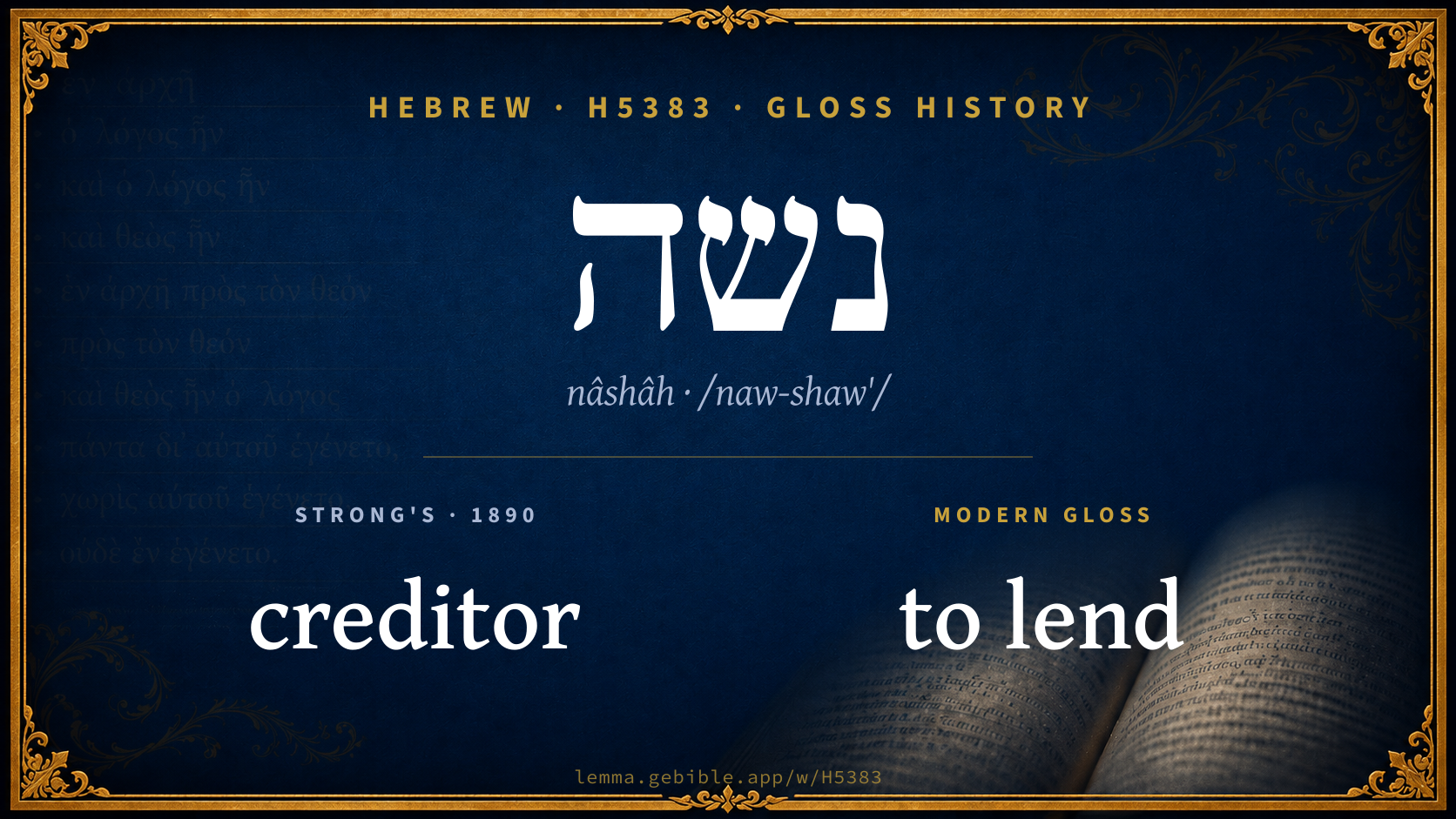
Gloss history
Strong's 1890 vs modern scholarship
About this word
Strong's H5383 catalogs a Hebrew word from the Hebrew Old Testament.
These counts are not copied from any lexicon or concordance. They are computed here, from the morphology-tagged Hebrew Old Testament. What Lemma adds →
- 12
- distinct verses
- The word appears in 12 distinct verses.
- 7 / 39
- OT books
- The word appears in 7 of 39 Old Testament books.
- #1,910
- by frequency
- Top 2500 most frequent Hebrew words (rank 1,910 of 8,640 Hebrew words by occurrence).
View all 12 occurrences in the concordance →
Most concentrated in
- Deuteronomy 3 verses 25%
- Nehemiah 3 verses 25%
- Isaiah 2 verses 17%
By section of the Old Testament
By traditional corpus
Conventional, traditional groupings — biblical authorship is debated, so this is a traditional corpus grouping, not an authorship claim. Each share is this word’s portion of its verses in that division of the Hebrew canon. Each figure is a share of the word’s 12 distinct verses.
- Torah (Pentateuch) 4 verses · 33%
- Prophets (Nevi'im) 4 verses · 33%
- Writings (Ketuvim) 4 verses · 33%
How translations render this word
Counts come from each version’s own published word-to-Strong’s tagging or interlinear alignment — an approximate guide to how each version renders this word, not a word-level alignment the data otherwise carries. Because each total is that version’s own tagged count, the per-version totals vary from one another and need not match the appearance or distinct-verse counts above. These counts may also differ from a printed concordance because Lemma counts each distinctly tagged rendering and does not collapse phrase taggings into a single head-word total. This is a fixed set of word-tagged versions (KJV, ASV, BSB, ULT) and does not change with the reading translation you choose elsewhere. Each version’s license is shown beside its name below (and on Sources).
BDB lists this Strong’s number as 5 distinct words (homographs). Each count above pools all of them and is not split by sense — see the Senses section below. A low-frequency rendering may belong to a different one of those words, not the primary meaning.
- King James Version†: Thou dost lend 2×
- American Standard Version†: Thou dost lend 2×
- Berean Standard Bible†: Borrowed 1×, Creditor 1×, Creditors 1×
- unfoldingWord Literal Text†: Are lending 3×, Creditor 2×
King James Version Public Domain
Renders H5383 across 12† tagged occurrences — most commonly:
Plus 10 renderings that appear only once — usually multi-word phrases or single function words the recovered tagging swept in, not distinct renderings. Not rendered by a distinct English word in 1 further occurrence.
American Standard Version Public Domain
Renders H5383 across 13† tagged occurrences — most commonly:
Plus 11 renderings that appear only once — usually multi-word phrases or single function words the recovered tagging swept in, not distinct renderings.
Berean Standard Bible Public Domain
Renders H5383 across 11† tagged occurrences — most commonly:
Not rendered by a distinct English word in 1 further occurrence.
unfoldingWord Literal Text CC BY-SA 4.0
Renders H5383 across 14† tagged occurrences — most commonly:
Plus 9 renderings that appear only once — usually multi-word phrases or single function words the recovered tagging swept in, not distinct renderings.
10 senses and sub-senses in the full BDB
Hebrew verbs can shift meaning by stem (binyan): Qal is the basic action, Niphal is often passive or reflexive, Piel often intensifies or makes it factitive, and Hiphil is typically causative. The senses below are grouped under the stem BDB assigns to each.
What do BDB’s symbols mean?
BDB uses these scholarly abbreviations:
| Symbol | Meaning |
|---|---|
| 𝔊 | the Septuagint (the ancient Greek translation, LXX) |
| 𝔙 | the Vulgate (the Latin translation) |
| 𝔖 | the Syriac version (the Peshitta) |
| 𝔗 | the Targum (the Aramaic translation) |
| ψ | the Psalms |
| √ | root (the underlying root or stem) |
| ‖ | parallel passage (a synonymous or contrasted parallel) |
| † | the dagger: every passage where the word occurs is cited |
The 10 senses and sub-senses the full Brown-Driver-Briggs lexicon distinguishes for this word, in lexicon order (not ranked by frequency), with BDB’s own verbatim wording and sub-sense lettering. Shown in Hebrew script with BDB’s own scholarly abbreviations. The condensed entry is in the Lexicon Entry tab. See also the Forms in the corpus table below.
נשה I lend on interest or usury, be a creditor (cf. Arabic نَسَأَ postpone, delay
Qal
- Pt. act. נֹשֶׁא (anal. ל׳ ה) 1 S 22:2 every man that had a creditor; אֲשֶׁר נשֶׁא בוֹ Is 24:2 against whom is a creditor, and pl. נֹשְׁאִים Ne 5:7 Kt (נֹשִׁים Qr, from נָשָׁה), + acc. cogn. מַשָּׁא. e.g. 1 Samuel 22:2
Hiphil
- Impf. 3 ms. לֹא־יַשִּׁיא אוֹיֵב בּוֹ ψ 89:23 an enemy shall not act the creditor against him, make exactions of him (‖ יְעַנֶּנּוּ).—1 K 8:31 2 Ch 6:22 v. נשׂא Qal 1 b (5). e.g. Psalms 89:23
נשה II only Niph.Hiph. beguile, deceive
Niphal
- Pf. 3 pl. נִשְּׁאוּ Is 19:13 the princes have been beguiled (‖ נוֹאֲלוּ, הִתְעוּ). e.g. Isaiah 19:13
Hiphil
- Pf. הִשִּׁיא Je 49:16, sf. הִשִּׁאַ֫נִי Gn 3:13, הִשִּׁיאֶ֑ךָ Ob 3; 2 ms. הִשֵּׁאתָ Je 4:10; 3 pl. sf. הִשִּׁיא֫וּךָ Ob 7; Impf. only juss. יַשִּׁיא 2 Ch 32:15, so ψ 55:16 Qr (v. infr.); יַשִּׁ(י)א 2 K 18:29 Is 36:14, sf. יַשִּׁאֲךָ 2 K 19:10 Is 37:10; 2 mpl. תַּשִּׁאוּ Je 37:9; Inf. abs. הַשֵּׁא Je 4:10;—beguile, usually c. acc. pers. Gn 3:13 (J; not elsewhere Hex); Je 49:16 Ob 3, 7; אַל־יַשִּׁאֲךָ 2 K 19:10 let not thy God beguile thee = Is 37:10, of Hezekiah 2 Ch 32:15 (cf. infr.), אַל־תַּשִּׁאוּ נַפְשֹׁתֵיכֶם Je 37:9 do not deceive yourselves; also sq. ל pers. אַל־יַשִּׁא לָכֶם 2 K 18:29 = Is 36:14 (= 2 Ch 32:15, v. supr.), Je 29:8; הַשֵּׁא הִשֵּׁאתָ לָעָם הַזֶּה 4:10 thou hast utterly beguiled this people; ישׁימות עָלֵימוֹ ψ 55:16 Kt appar. = desolations (be) upon them! (but elsewhere only in n.pr.loc., cf. p. 445 supr.), יַשִּׁיא מָוֶת עלימו Ew Ol Pe De Now Hup, cf. 𝔊, let death (beguile them, i.e.) come deceitfully upon them! Brüll Che, cf. Bae, conj. plausibly יַשִּׁיא מָוֶת יִבְלָעֵמוֹ. e.g. Jeremiah 49:16
נשה III forget, v. II. נָשָׁה.
נשה IV lend, become a creditor (cf. I. נשׁא)
Qal
- Pf. 1 s. נָשִׁ֫יתִי Je 15:10; 3 pl. נָשׁוּ v 10; Pt. נֹשֶׁה Ex 22:24 + 4 times; pl. נֹשִׁים Ne 5:10, 11 + v 7 Qr (Kt נֹשְׁאִים, v. I. נשׁא), sf. נוֹשַׁי Is 50:1;—lend, usually c. ב pers.: לֹא־נָשִׁיתִי וְלֹא־נָשׁוּ־בִי Je 15:10 I have not lent, and they have not lent to me, Dt 24:11 Ne 5:7 (Qr; + acc. cogn.), v 10, 11 (both + acc. rei); pt. as subst. creditor, usurer Ex 22:24 (E), 2 K 4:1 Is 24:2; 50:1 ψ 109:11. e.g. Jeremiah 15:10
Hiphil
- Impf. 3 ms. יַשֶּׁה בְּ Dt 15:2 who lendeth to his neighbour; 2 ms. תַּשֶּׁה בְּ 24:10 when thou lendest to thy neighbour (+ acc. cogn.). e.g. Deuteronomy 15:2
נשה V forget (NH id.
Qal
- Pf. 1 s. וְנָשִׁיתִי אֶתְכֶם נָשֹׁא Je 23:39 I will forget you finally (but 𝔊 𝔙 𝔖 Che Gie וְנָשָׂאתִי, sq. וְנָטַשְׁתִּי as v 33 b, v. iii. מַשָּׂא); נָשִׁיתִי טוֹבָה La 3:17 I have forgotten prosperity; Impf. 1 s. הַאֶשֶּׁה shall I forget? i.e. overlook, read by We Mi 6:10 plausibly for MT הַאִשׁ; Inf. abs. נָשֹׁא (ל׳ א) Je 23:39 (v. supr.). e.g. Jeremiah 23:39
Niphal
- Impf. 2 ms. sf. תִּנָּשֵׁנִי Is 44:21 thou shalt not be forgotten of me, bu dub.; Ges§ 117 x תִּנְשֵׁנִי (Qal); CheHpt. תִּטְּשֵׁנִי (cf. Dt 32:15). e.g. Isaiah 44:21
Piel
- Pf. 3 ms. sf. נַשַּׁ֫נִי Gn 41:51 (E) God hath made me forget + acc. rei (—ַin 1st syllable only here, infl. of מְנַשֶּׁה Ges§ 52 m). e.g. Genesis 41:51
Hiphil
- Pf. 3 ms. sf. הִשָּׁהּ חָכְמָה Jb 39:17 God caused her (the ostrich) to forget wisdom, i.e. did not endow her with it. Impf. יַשֶּׁה לְךָ מִן־ Jb 11:6 Eloah allows a part of thy guilt to be forgotten thee, i.e. does not reckon it to thee in full (𝔊 = יִשְׁוֶה לְךָ מֵאֱלוֹהַּ כַּעֲוֹנֶ֑ךָ [Du] there is equivalent to thee from Eloah, according to thine iniquity, cf. Bi Che Job and Sol.; Bu reads נָשָׁה for יַשֶּׁה; Du rejects ver. as gloss). e.g. Job 39:17
Senses from the full Brown-Driver-Briggs lexicon (Brown, Driver, Briggs; Oxford 1906 — public domain), digitized via Sefaria, supplemented by the OpenScriptures HebrewLexicon (CC BY 4.0). Full attribution on Sources.
Word origin
I. vb. lend on interest or usury, be a creditor (cf. Arabic نَسَأَ postpone, delay; sell on credit; ‖ form of I. נָשָׁה, v. Ges§ 75 oo);—
II. vb. only Niph.Hiph. beguile, deceive;—(kindred with I. שׁוא, from which, however, the forms can hardly be derived (conj. WeComp 2. 351));—
III. forget, v. II. נָשָׁה.
I. vb. lend, become a creditor (cf. I. נשׁא);—
II. vb. forget (NH id.; Assyrian nišîtu perhaps forgottenness DlHWB 486; Aramaic נְשָׁא (especially Ithpe., Aph.), ܢܫܳܐ forget; Arabic نَسِىَ forget, neglect; cf. Ethiopic ናሕሰየ ignoscere, condonare, indulgere Di 633);—
— Brown-Driver-Briggs (Oxford 1906, public domain), digitized via Sefaria, supplemented by the OpenScriptures HebrewLexicon (CC BY 4.0). See Sources.
Derived from נשה (nâshâh) (H5382) — to forget.
Jastrow Dictionary
A second Hebrew/Aramaic lexicon for comparison, covering Aramaic and post-biblical (Talmudic, Targumic, Midrashic) usage that the biblical-Hebrew BDB does not. Matched by lemma rather than by Strong’s number, so a lemma may carry more than one Jastrow headword (shown separately below), and the entries cover usage well beyond the Bible.
נָשָׁה
- , v. נשי
נָשֶׁה
- preced.) movable; גִּיד הַנָּ׳, v. גִּיד.
A Dictionary of the Targumim, the Talmud Babli and Yerushalmi, and the Midrashic Literature (Marcus Jastrow; London, Luzac, 1903) — Public Domain. Digitized via Sefaria. Digitized via Sefaria. Full attribution on Sources.
Forms in the corpus
The 13 distinct written forms H5383 takes in the Hebrew Bible, most frequent first — each parse links to that stem’s occurrences in the concordance. Hebrew forms include their vowel points and cantillation, so a single lemma takes many written forms.
Same root — word family
Other BDB entries built from the same root as H5383, grouped by Strong’s listed origin. These share a root / origin per the lexicon — not necessarily a shared meaning. Each links to that word’s own entry.
Derives from
Shares the same root
Derived from this word
Proper names from this root
People and places named from this root — a name, not an additional meaning of the word.
Compare all same-root words → Showing 4 of 9 — not the complete family. 2 of the same-root words are proper names (people or places). They share a root, not necessarily a meaning.
Septuagint verse parallels
This word appears in 8 verses that also exist in the Greek Old Testament (Septuagint), out of the 12 Hebrew verses it occurs in. You can read those verses in Greek by switching the Old Testament edition to the Septuagint.
Read these verses in the Septuagint
This is a verse-level parallel only — the same verses exist in both the Hebrew and Greek Old Testaments. No word-level Hebrew↔Greek correspondence is claimed: the data carries no such alignment, so no Greek word is shown as this Hebrew word’s translation. Coverage is not total — the Septuagint omits the deuterocanon and renumbers the Psalms, so some Hebrew verses have no direct Greek parallel.