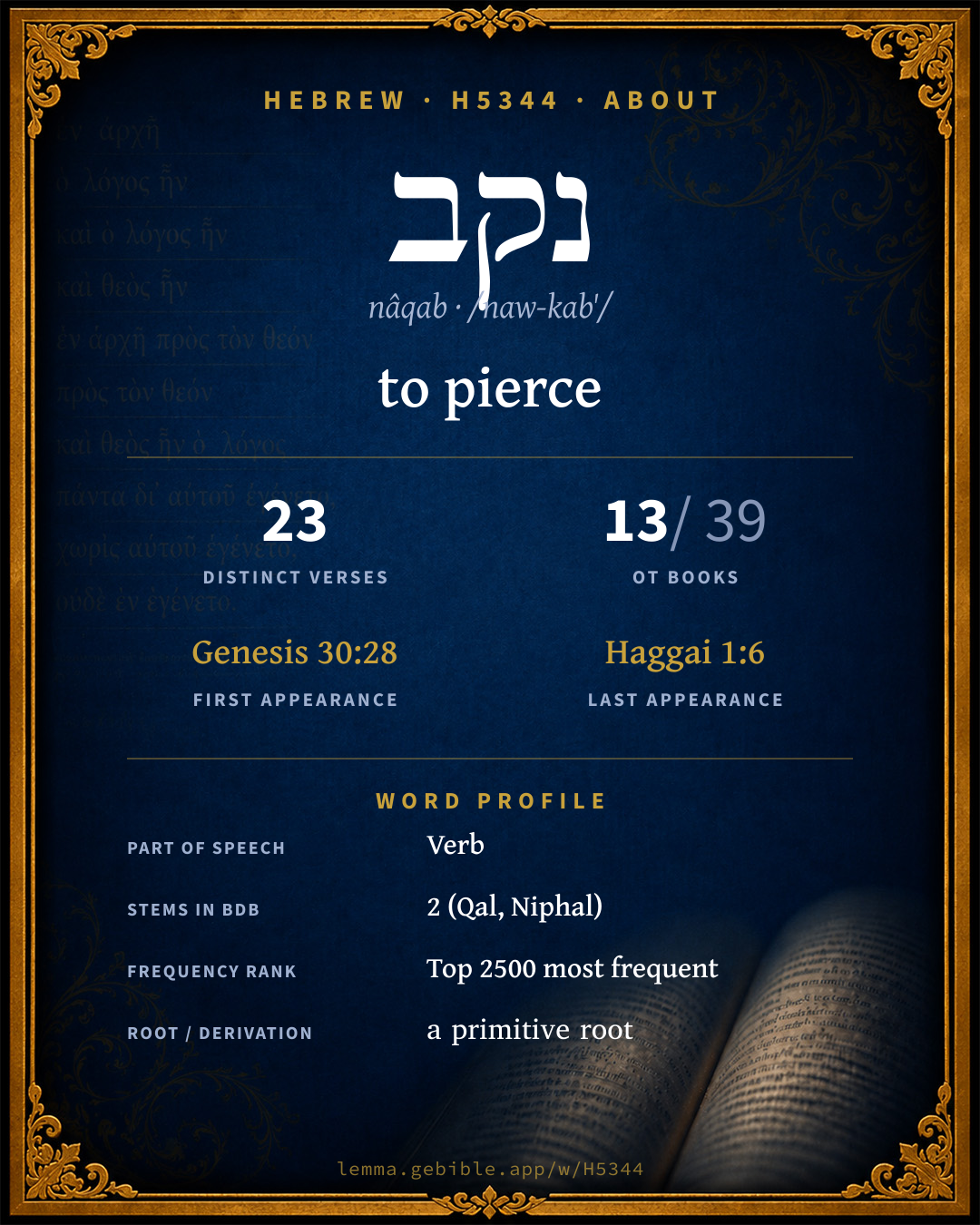
נָקַב
to pierce
also: perforate, bore, appoint fuller range ↓
Full lexicon entry — Brown-Driver-Briggs (BDB)
From Brown-Driver-Briggs (BDB)
Where this word appears
Grammar key — what these labels mean
Part of speech
- Verb
- An action or state-of-being word.
Stem
- Niphal
- Usually the simple passive or reflexive of the Qal (“he was written”).
- Qal
- The basic, simple active stem — the plain form of the verb (“he wrote”). Here: ‘pierce’
Form
- Perfect
- A completed action or state — Hebrew marks aspect (completeness) more than strict tense (“he wrote”).
- Imperfect
- An incomplete, ongoing, or future action (“he will / would write”).
- Sequential Perfect
- A perfect with prefixed waw continuing a preceding imperfect or command (waw-consecutive perfect).
- Sequential Imperfect
- An imperfect with prefixed waw — the standard past-narrative form (waw-consecutive imperfect).
- Participle Active
- A verbal adjective expressing ongoing or characteristic action (“writing / one who writes”).
- Infinitive Construct
- A bound verbal noun, frequently with prepositions (“to write / in writing”).
- Participle Passive
- A verbal adjective expressing action received (“written”).
- Imperative
- A direct command (“write!”).
State
- Absolute
- The independent form of a noun, not bound to a following word.
- Construct
- A noun bound to a following noun in a possessive / “of” relationship (the construct chain).
Person
- 3rd Person
- The one spoken about (“he / she / it / they”).
- 1st Person
- The speaker (“I / we”).
- 2nd Person
- The one addressed (“you”).
Gender
- Common
- Either gender — not distinguished for this form.
- Masculine
- Grammatically masculine.
Number
- Plural
- More than one (in Hebrew, generally three or more).
- Singular
- One.
Every verse where H5344 appears in the Book of 2 Kings — 2 distinct verses. Click any verse to open its interlinear word-by-word view. Verse text shown in the World English Bible for context — . Each verse’s Hebrew form is shown with its reference; the English is not keyword-highlighted, since the data carries no word-level English alignment. Use “Compare translations” on any verse to read it across multiple English versions. This concordance covers the Hebrew Bible; Septuagint (Greek Old Testament) occurrences are not indexed here.
2 Kings
- 2 Kings 12:9 וַ/יִּקֹּ֥ב conj + Qal wimpf 3ms But Jehoiada the priest took a chest, and bored a hole in the lid of it, and set it beside the altar, on the right side as one comes into the house of Yahweh: and the priests who kept the threshold put therein all the money that was brought into the house of Yahweh.
- 2 Kings 18:21 וּ/נְקָבָ֑/הּ conj + Qal wpf 3ms + sfx pers 3fs Now, behold, you trust on the staff of this bruised reed, even on Egypt; whereon if a man lean, it will go into his hand, and pierce it: so is Pharaoh king of Egypt to all who trust on him.
About this entry
At a glance — auto-summarized from this page’s data, not written by a person. Every figure links to its source below. This summary describes the numbers; it doesn’t interpret them.
At its core, נקב (nâqab) means “to pierce.” It first appears in Genesis 30:28. It turns up in 23 verses across 13 books, an uncommon footprint. Different stems carry different senses — BDB groups them under 2 stems, among them Qal and Niphal. It clusters with מקבה, מקבת and נקבה under a shared root. Each statement above links to its evidence; the full detail follows below.
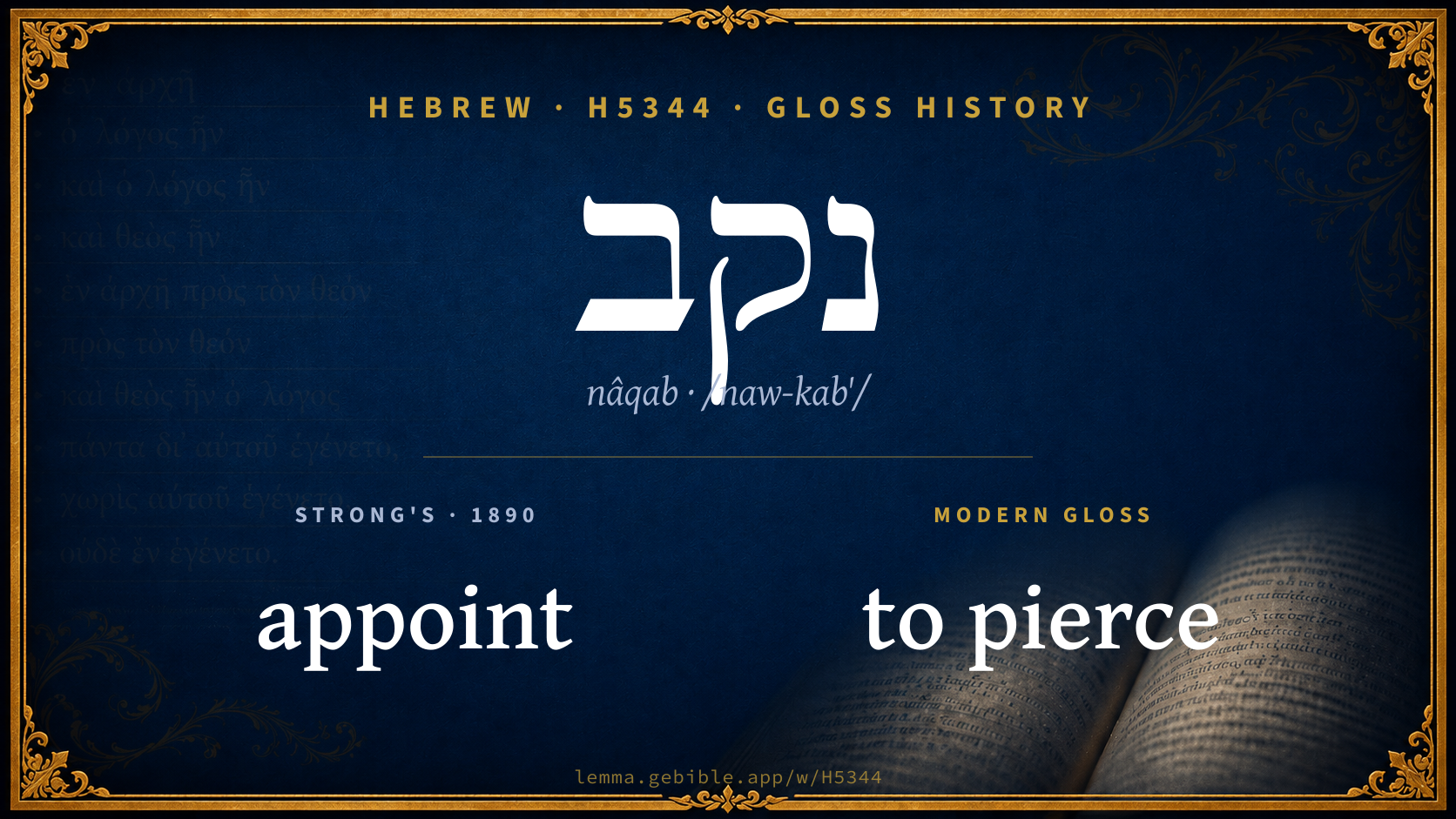
Gloss history
Strong's 1890 vs modern scholarship
About this word
Strong's H5344 catalogs a Hebrew word from the Hebrew Old Testament.
These counts are not copied from any lexicon or concordance. They are computed here, from the morphology-tagged Hebrew Old Testament. What Lemma adds →
- 23
- distinct verses
- The word appears in 23 distinct verses.
- 13 / 39
- OT books
- The word appears in 13 of 39 Old Testament books.
- #1,327
- by frequency
- Top 2500 most frequent Hebrew words (rank 1,327 of 8,640 Hebrew words by occurrence).
View all 23 occurrences in the concordance →
By section of the Old Testament
By traditional corpus
Conventional, traditional groupings — biblical authorship is debated, so this is a traditional corpus grouping, not an authorship claim. Each share is this word’s portion of its verses in that division of the Hebrew canon. Each figure is a share of the word’s 23 distinct verses.
- Writings (Ketuvim) 10 verses · 43%
- Prophets (Nevi'im) 7 verses · 30%
- Torah (Pentateuch) 6 verses · 26%
How translations render this word
Counts come from each version’s own published word-to-Strong’s tagging or interlinear alignment — an approximate guide to how each version renders this word, not a word-level alignment the data otherwise carries. Because each total is that version’s own tagged count, the per-version totals vary from one another and need not match the appearance or distinct-verse counts above. These counts may also differ from a printed concordance because Lemma counts each distinctly tagged rendering and does not collapse phrase taggings into a single head-word total. This is a fixed set of word-tagged versions (KJV, ASV, BSB, ULT) and does not change with the reading translation you choose elsewhere. Each version’s license is shown beside its name below (and on Sources).
BDB lists this Strong’s number as 2 distinct words (homographs). Each count above pools all of them and is not split by sense — see the Senses section below. A low-frequency rendering may belong to a different one of those words, not the primary meaning.
- King James Version†: Were expressed 4×, Curse 2×, Pierce 2×
- American Standard Version†: Were mentioned 3×, Pierce 2×, Shall curse 2×
- Berean Standard Bible†: Designated 3×, Or pierce 2×, Were designated 2×
- unfoldingWord Literal Text†: Were designated 4×, Pierces it 2×, Were marked 2×
King James Version Public Domain
Renders H5344 across 25† tagged occurrences — most commonly:
Plus 17 renderings that appear only once — usually multi-word phrases or single function words the recovered tagging swept in, not distinct renderings.
American Standard Version Public Domain
Renders H5344 across 24† tagged occurrences — most commonly:
Plus 17 renderings that appear only once — usually multi-word phrases or single function words the recovered tagging swept in, not distinct renderings.
Berean Standard Bible Public Domain
Renders H5344 across 19† tagged occurrences — most commonly:
Plus 10 renderings that appear only once — usually multi-word phrases or single function words the recovered tagging swept in, not distinct renderings.
unfoldingWord Literal Text CC BY-SA 4.0
Renders H5344 across 28† tagged occurrences — most commonly:
Plus 18 renderings that appear only once — usually multi-word phrases or single function words the recovered tagging swept in, not distinct renderings.
Senses in the full BDB
Hebrew verbs can shift meaning by stem (binyan): Qal is the basic action, Niphal is often passive or reflexive, Piel often intensifies or makes it factitive, and Hiphil is typically causative. The senses below are grouped under the stem BDB assigns to each.
What do BDB’s symbols mean?
BDB uses these scholarly abbreviations:
| Symbol | Meaning |
|---|---|
| 𝔊 | the Septuagint (the ancient Greek translation, LXX) |
| 𝔙 | the Vulgate (the Latin translation) |
| 𝔖 | the Syriac version (the Peshitta) |
| 𝔗 | the Targum (the Aramaic translation) |
| ψ | the Psalms |
| √ | root (the underlying root or stem) |
| ‖ | parallel passage (a synonymous or contrasted parallel) |
| † | the dagger: every passage where the word occurs is cited |
The 5 senses and sub-senses the full Brown-Driver-Briggs lexicon distinguishes for this word, in lexicon order (not ranked by frequency), with BDB’s own verbatim wording and sub-sense lettering. Shown in Hebrew script with BDB’s own scholarly abbreviations. The condensed entry is in the Lexicon Entry tab. See also the Forms in the corpus table below.
נקב I pierce (NH id.
Qal
- Pf. 3 fs. sf. נְקָבָהּ 2 K 18:21; Is 36:6; 2 ms. נָקַבְתָּ Hb 3:14; Impf. יִנְקָב־ Jb 40:24, וַיִּקֹּב 2 K 12:10; sf. יִקֳּבֶ֫נּוּ Is 62:2; 2 ms. תִּקֹּב Jb 40:26; Imv. ms. נָקְבָה Gn 30:28; Pt. pass. נָקוּב Hg 1:6; pl. cstr. נְקֻבֵי Am 6:1;— e.g. 2 Kings 18:21
- 1. pierce, bore, c. acc. 2 K 18:21 = Is 36:6, Hb 3:14 (all in fig.), Jb 40:24, 26; c. acc. cogn. + ב, וְיִּקֹּב חֹר בְּדַלְתּוֹ 2 K 12:10 and he bored a hole in its lid; צְרוֹר נָקוּב Hg 1:6 a bag pierced, i.e. with a hole in it. e.g. 2 Kings 18:21
- 2. prick off, designate, wages Gn 30:28 (J), name Is 62:2 (י׳ subj.; cf. Niph.); pt. pass. noted, distinguished Am 6:1. e.g. Genesis 30:28
Niphal
- Pf. 3 pl. in phr. נִקְּבוּ בְשֵׁמוֹת (אֲשֶׁר) who were pricked off, designated, by name Nu 1:17; 1 Ch 12:32 (v 31 van d. H), 16:41; 2 Ch 28:15; 31:19, cf. Ezr 8:20. e.g. Numbers 1:17
נקב II curse (perhaps akin to I. נקב
Qal
- Inf. sf. נָקְבוֹ שֵׁם Lv 24:16; Pt. נֹקֵב שֵׁם י׳ v 16 (on text v. Di, GeiUrschrift 274 DalmanAdonai 44 f.). e.g. Leviticus 24:16
Senses from the full Brown-Driver-Briggs lexicon (Brown, Driver, Briggs; Oxford 1906 — public domain), digitized via Sefaria, supplemented by the OpenScriptures HebrewLexicon (CC BY 4.0). Full attribution on Sources.
Word origin
I. vb. pierce (NH id.; SI 1.1.4 הנקבה the piercing, boring through; Aramaic נְקַב, ܢܩܰܒ id.; נֶקְבָּא hole, etc.; Sinait. n.pr.m. נקבו Eut 441, 2, נקיבו Eut 99, 2; 153, 2 (Lzb 325.326 Cook 83); Assyrian naḳbu, depth, spring of water; Arabic نَقَبَ perforate, pierce, scrutinize, etc., نَقِيبَةٌ sagacity, etc., نَقِيبٌ leader, chief (one who scrutinizes));—
II. vb. curse (perhaps akin to I. נקב; perhaps secondary format. from קָבַב, q.v. for forms יִקֹּב, קֹב, etc.);—
— Brown-Driver-Briggs (Oxford 1906, public domain), digitized via Sefaria, supplemented by the OpenScriptures HebrewLexicon (CC BY 4.0). See Sources.
Origin: a primitive root
Jastrow Dictionary
A second Hebrew/Aramaic lexicon for comparison, covering Aramaic and post-biblical (Talmudic, Targumic, Midrashic) usage that the biblical-Hebrew BDB does not. Matched by lemma rather than by Strong’s number, so a lemma may carry more than one Jastrow headword (shown separately below), and the entries cover usage well beyond the Bible.
נָקַב
- 1. to bore, perforate. Snh. 97ᵇ מקרא זה נוֹקֵב וכ׳ this verse bores and penetrates to the depth. Ib. 6ᵇ, a. e. יִקּוֹב הדין וכ׳, v. דִּין II; a. e.—Part. pass. נָקוּב; f. נְקוּבָה; pl. נְקוּבִים, נְקוּבִין; נְקוּבוֹת. Y. Keth. XII, 35ᵃ top; Y. Kil. IX, 32ᵇ top; (Gen. R. s. 100 נקופה), v. אָרוֹן. Cant. R. to VIII, 5 מצאתי חככם נ׳ וכ׳ I found your palate perforated, unable to receive blessings.—Esp. נקובה the case of an animal found to have a vital organ perforated. Ḥull. III, 1 נְקוּבַת הושט, v. וֶשֶׁט. Ib. 43ᵃ; a. fr.—Esp. (נְקָבִים) נְקוּבִים female parts. Y. Meg. I, 71ᵈ bot. (reported as one of the changes adopted in the Greek translation of the Pentateuch, ref. to Gen. I, 27, a. V, 2) זכר ונְקוּבָיו בראם a male with corresponding female parts created he them; Gen. R. s. 8; Mekh. Bo, s. 14 (v. Gen. R. l. c., beg.).—[Y. Meg. I, 71ᶜ לנקוביו, v. נֶקֶב.]—2) (cmp. אָרַר) to curse, blaspheme. Snh. 56ᵃ (ref. to Lev. XXIV, 16) ממאי דהאי נוֹקֵב וכ׳ whence do you prove that this noḳeb is used in the sense of blasphemy?… perhaps it means to perforate? Ib. למימרא דנוקב וכ׳ to indicate that noḳeb means curse. e.g. Genesis 1:27
- 3. to point out, to pronounce. Ib. אימא פרושי שמיה חוא I might say, noḳeb means uttering His name (the Tetragrammaton)? Tanḥ. Emor 24 התחיל לִנְקוֹב וכ׳ he began to pronounce the Name and curse Him.—[Midr. Till. to Ps. I ונקובות ידים; ed. Bub. נקיבת ירק, read: קְנִיבַת ירק, v. קְנִיבָה.]
- to be perforated, punctured. Ḥull. III, 1 הריאה שנִיקְּבָה if a lung is found to be perforated. Ib. עד שתִּינָּקֵב וכ׳ until the puncture reaches &c. Ib. 43ᵃ נ׳ זה בלא זה if only one of the two is perforated. Bekh. 44ᵇ אם נִקְּבוּ זה וכ׳ if there is a perforation going from one channel to the other; a. fr.
נְקַב
- , to perforate. Targ. II Kings XII, 10; a. fr.—Ḥull. 48ᵃ אי האי נְקִיב וכ׳ whether this lobe is perforated or the other; a. e.
- same. Ib.ᵇ נַקּוּבֵי נקיב ואתאי the needle perforated (the entrails) and came into the lungs.
- to be perforated Ib. Ib. 45ᵃ; a. e.
נֶקֶב
- preced.) hole, perforation, incision. Ḥull. 45ᵃ נ׳ אחד ארוך one lengthy incision; a. fr.—Pl. נְקָבִים, נְקָבִין. Ib. נ׳ שיש בהן חסרון perforations connected with loss of substance (holes); נ׳ שאין בהן חסרון mere punctures. Bekh. 44ᵇ שני נ׳ יש בו וכ׳ two channels are in the membrum. Gen. R. s. 1, beg.; a. fr.—Esp. the organs of the extremities, urinary organ &c. Tosef. Ber. II, 18 ויהא צריך לנְקָבָיו when needing to ease himself; Ber. 23ᵃ; Y. Meg. I, 71ᶜ לנְקוּבָיו. Sabb. 152ᵃ; a. fr.
A Dictionary of the Targumim, the Talmud Babli and Yerushalmi, and the Midrashic Literature (Marcus Jastrow; London, Luzac, 1903) — Public Domain. Digitized via Sefaria. Digitized via Sefaria. Full attribution on Sources.
Forms in the corpus
The 20 distinct written forms H5344 takes in the Hebrew Bible, most frequent first — each parse links to that stem’s occurrences in the concordance. Hebrew forms include their vowel points and cantillation, so a single lemma takes many written forms.
Same root — word family
Other BDB entries built from the same root as H5344, grouped by Strong’s listed origin. These share a root / origin per the lexicon — not necessarily a shared meaning. Each links to that word’s own entry.
Derived from this word
Compare all same-root words → They share a root, not necessarily a meaning.
Septuagint verse parallels
This word appears in 23 verses that also exist in the Greek Old Testament (Septuagint), out of the 23 Hebrew verses it occurs in. You can read those verses in Greek by switching the Old Testament edition to the Septuagint.
Read these verses in the Septuagint
- Genesis 30:28
- Leviticus 24:11
- Numbers 1:17
- 2 Kings 12:9
- 1 Chronicles 12:31
- 2 Chronicles 28:15
- Ezra 8:20
- Job 3:8
- Proverbs 11:26
- Isaiah 36:6
- Amos 6:1
- Habakkuk 3:14
This is a verse-level parallel only — the same verses exist in both the Hebrew and Greek Old Testaments. No word-level Hebrew↔Greek correspondence is claimed: the data carries no such alignment, so no Greek word is shown as this Hebrew word’s translation. Coverage is not total — the Septuagint omits the deuterocanon and renumbers the Psalms, so some Hebrew verses have no direct Greek parallel.