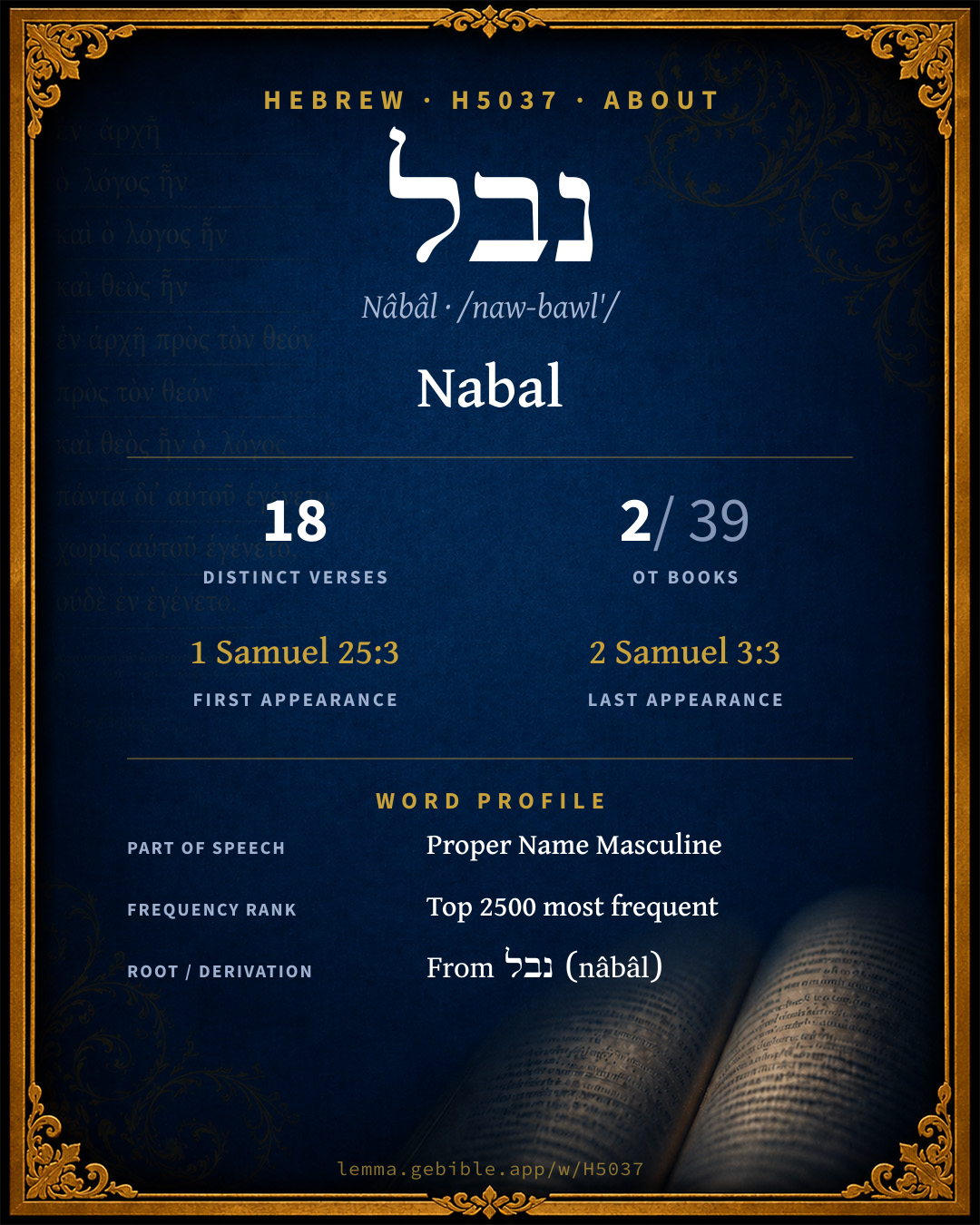
נָבָל
Nabal
BDB lists 2 entries for ‘Nabal’ fuller range ↓
Full lexicon entry — Brown-Driver-Briggs (BDB)
From Brown-Driver-Briggs (BDB)
Where this word appears
Grammar key — what these labels mean
Part of speech
- Noun
- A naming word — a person, place, thing, or idea.
Noun type
- Proper
- A name of a specific person, place, or people (e.g. Abraham, Zion, Israel).
Every verse where H5037 appears in the Book of 1 Samuel — 16 distinct verses. Click any verse to open its interlinear word-by-word view. Verse text shown in the World English Bible for context — . Each verse’s Hebrew form is shown with its reference; the English is not keyword-highlighted, since the data carries no word-level English alignment. Use “Compare translations” on any verse to read it across multiple English versions. This concordance covers the Hebrew Bible; Septuagint (Greek Old Testament) occurrences are not indexed here.
1 Samuel
- 1 Samuel 25:3 נָבָ֔ל n Proper Now the name of the man was Nabal; and the name of his wife Abigail; and the woman was of good understanding, and of a beautiful face: but the man was churlish and evil in his doings; and he was of the house of Caleb.
- 1 Samuel 25:4 נָבָ֖ל n Proper David heard in the wilderness that Nabal was shearing his sheep.
- 1 Samuel 25:5 נָבָ֔ל n Proper David sent ten young men, and David said to the young men, Go up to Carmel, and go to Nabal, and greet him in my name:
- 1 Samuel 25:9 נָבָ֛ל n Proper When David's young men came, they spoke to Nabal according to all those words in the name of David, and ceased.
- 1 Samuel 25:10 נָבָ֜ל n Proper Nabal answered David's servants, and said, Who is David? and who is the son of Jesse? there are many servants now-a-days who break away every man from his master.
- 1 Samuel 25:14 נָבָ֔ל n Proper But one of the young men told Abigail, Nabal's wife, saying, Behold, David sent messengers out of the wilderness to Greet our master; and he railed at them.
- 1 Samuel 25:19 נָבָ֖ל n Proper She said to her young men, Go on before me; behold, I come after you. But she didn't tell her husband, Nabal.
- 1 Samuel 25:25 נָבָ֗ל נָבָ֣ל n Proper n Proper Please don't let my lord regard this worthless fellow, even Nabal; for as his name is, so is he; Nabal is his name, and folly is with him: but I your handmaid didn't see the young men of my lord, whom you did send.
- 1 Samuel 25:26 כְ/נָבָל֙ prep + n Proper Now therefore, my lord, as Yahweh lives, and as your soul lives, seeing Yahweh has withheld you from blood guiltiness, and from avenging yourself with your own hand, now therefore let your enemies, and those who seek evil to my lord, be as Nabal.
- 1 Samuel 25:34 לְ/נָבָ֛ל prep + n Proper For in very deed, as Yahweh, the God of Israel, lives, who has withheld me from hurting you, except you had hurried and come to meet me, surely there wouldn't have been left to Nabal by the morning light so much as one man-child.
- 1 Samuel 25:36 נָבָ֡ל נָבָל֙ n Proper n Proper Abigail came to Nabal; and, behold, he held a feast in his house, like the feast of a king; and Nabal's heart was merry within him, for he was very drunken: therefore she told him nothing, less or more, until the morning light.
- 1 Samuel 25:37 מִ/נָּבָ֔ל prep + n Proper It happened in the morning, when the wine was gone out of Nabal, that his wife told him these things, and his heart died within him, and he became as a stone.
- 1 Samuel 25:38 נָבָ֖ל n Proper It happened about ten days after, that Yahweh struck Nabal, so that he died.
- 1 Samuel 25:39 נָבָל֒ נָבָ֗ל נָבָ֔ל n Proper n Proper n Proper When David heard that Nabal was dead, he said, Blessed be Yahweh, who has pleaded the cause of my reproach from the hand of Nabal, and has kept back his servant from evil: and the evil-doing of Nabal has Yahweh returned on his own head. David sent and spoke concerning Abigail, to take her to him as wife.
- 1 Samuel 27:3 נָבָ֖ל n Proper David lived with Achish at Gath, he and his men, every man with his household, even David with his two wives, Ahinoam the Jezreelitess, and Abigail the Carmelitess, Nabal's wife.
- 1 Samuel 30:5 נָבָ֥ל n Proper David's two wives were taken captive, Ahinoam the Jezreelitess, and Abigail the wife of Nabal the Carmelite.
About this entry
At a glance — auto-summarized from this page’s data, not written by a person. Every figure links to its source below. This summary describes the numbers; it doesn’t interpret them.
“Nabal” is the headline sense of the Hebrew name נבל (Nâbâl). More than three-quarters of its appearances fall in 1 Samuel. The Hebrew Bible uses it across 18 verses — uncommon. Its earliest occurrence is 1 Samuel 25:3. See 18-verse concordance and the renderings breakdown below.
Gloss history
Strong's 1890 vs modern scholarship
About this word
Strong's H5037 catalogs a Hebrew word from the Hebrew Old Testament.
These counts are not copied from any lexicon or concordance. They are computed here, from the morphology-tagged Hebrew Old Testament. What Lemma adds →
- 18
- distinct verses
- The word appears in 18 distinct verses.
- 2 / 39
- OT books
- The word appears in 2 of 39 Old Testament books.
- #1,412
- by frequency
- Top 2500 most frequent Hebrew words (rank 1,412 of 8,640 Hebrew words by occurrence).
View all 18 occurrences in the concordance →
By traditional corpus
Conventional, traditional groupings — biblical authorship is debated, so this is a traditional corpus grouping, not an authorship claim. Each share is this word’s portion of its verses in that division of the Hebrew canon. Each figure is a share of the word’s 18 distinct verses.
- Prophets (Nevi'im) 18 verses · 100%
How translations render this word
Counts come from each version’s own published word-to-Strong’s tagging or interlinear alignment — an approximate guide to how each version renders this word, not a word-level alignment the data otherwise carries. Because each total is that version’s own tagged count, the per-version totals vary from one another and need not match the appearance or distinct-verse counts above. These counts may also differ from a printed concordance because Lemma counts each distinctly tagged rendering and does not collapse phrase taggings into a single head-word total. This is a fixed set of word-tagged versions (KJV, ASV, BSB, ULT) and does not change with the reading translation you choose elsewhere. Each version’s license is shown beside its name below (and on Sources).
BDB lists this Strong’s number as 2 distinct words (homographs). Each count above pools all of them and is not split by sense — see the Senses section below. A low-frequency rendering may belong to a different one of those words, not the primary meaning.
- King James Version†: Nabal 15×, Nabal's 4×
- American Standard Version†: Nabal 18×
- Berean Standard Bible†: Nabal 16×
- unfoldingWord Literal Text†: Nabal 20×
King James Version Public Domain
Renders H5037 across 22† tagged occurrences — most commonly:
Plus 3 renderings that appear only once — usually multi-word phrases or single function words the recovered tagging swept in, not distinct renderings.
American Standard Version Public Domain
Renders H5037 across 22† tagged occurrences — most commonly:
Plus 4 renderings that appear only once — usually multi-word phrases or single function words the recovered tagging swept in, not distinct renderings.
Berean Standard Bible Public Domain
Renders H5037 across 21† tagged occurrences — most commonly:
Plus 5 renderings that appear only once — usually multi-word phrases or single function words the recovered tagging swept in, not distinct renderings. Not rendered by a distinct English word in 1 further occurrence.
unfoldingWord Literal Text CC BY-SA 4.0
Renders H5037 across 22† tagged occurrences — most commonly:
Plus 2 renderings that appear only once — usually multi-word phrases or single function words the recovered tagging swept in, not distinct renderings.
Senses in BDB
The 2 senses BDB distinguishes for this word, in lexicon order (not ranked by frequency or importance). The full entry — with sub-senses — is in the Lexicon Entry tab.
- Nabhal or Nabal = "fool"
- a man of Carmel who spurned David's messengers…
Word origin
I. adj. foolish, senseless, especially of the man who has no perception of ethical and religious claims, and with collat. idea of ignoble, disgraceful;—abs. נ׳ 2 S 3:33 + 14 times; mpl. נְבָלִים 13:13 Ez 13:3 (𝔊 Co מִלִּבָּם); fpl. נְבָלוֹת Jb 2:10;—senseless, especially of religious and moral insensibility: עַם נ׳ Dt 32:6 (of Isr., unappreciative of J.’s benefits; opp. חָכָם), so of heathen nation ψ 74:18 (blaspheming name of י׳), גּוֹי נ׳ Dt 32:21 (‖ לֹא עָם); הַנְּבִאִים הַנּ׳ Ez 13:3 (si vera l., v. supr.); elsewhere as subst. (impious and presumptuous) fool, Is 32:5 (opp. נָדִיב noble-minded), characterized as at once irreligious and churlish, v 6; denying God ψ 14:1 = 53:2; insulting God 74:22, and God’s servant 39:9; Pr 17:7 arrogant speech becometh not the (impious and presumptuous) fool (whose faults it only makes the more conspicuous), much less do lying lips him that is noble (נדיב), v 21 (‖ כְּסִיל), 30:22 ונבל כי ישׂבע לחם (one of the things under which the earth trembles), בְּנֵי נָבָל Jb 30:8 i.e. ignoble men (‖ בְּנֵי בְלִי־שֵׁם); as one who might be expected to have a contumelious end, הַכְּמוֹת נ׳ ימות אבנר 2 S 3:33 was Abner (destined) to die, as a נ׳ dieth? of the man who amasses riches unjustly ובאחריתו יהיה נבל Je 17:11 i.e. will prove himself to be a נ׳; as acting immorally (with collat. idea of disgracefully) 2 S 13:13 ואתה תהיה כְּאַחַד הַנְּבָלִים בישׂראל (cf. נְבָלָה); f. only in כְּדַבֵּר אַחַת הַנְּבָלוֹת Jb 2:10 (of Job’s wife). Cf. Dr Dt 22:21, 32:6, 15, 21; Psalt. 457.
II. n.pr.m. (on popular etymol. see 1 S 25:25 infr.);—a churlish man of Carmel, whose widow David married 1 S 25:3, 4, 5, 9, 10, 14, 19, 25(×2) (כִּשְׁמוֹ כֶּן־ה֔וּא נָבָל שְׁמוֹ וּנְבָלָה עִמּוֹ), v 26 + 10 times 1 S + 2 S 2:2; 3:3. 𝔊 Ναβαλ.
— Brown-Driver-Briggs (Oxford 1906, public domain), digitized via Sefaria, supplemented by the OpenScriptures HebrewLexicon (CC BY 4.0). See Sources.
Derived from נבל (nâbâl) (H5036) — foolish.
Jastrow Dictionary
A second Hebrew/Aramaic lexicon for comparison, covering Aramaic and post-biblical (Talmudic, Targumic, Midrashic) usage that the biblical-Hebrew BDB does not. Matched by lemma rather than by Strong’s number, so a lemma may carry more than one Jastrow headword (shown separately below), and the entries cover usage well beyond the Bible.
נָבֵל
- to fade, shrivel, decay. Y. R. Hash. I, 56ᵈ bot. הֶעָלֶה נוֹבֵל, v. בּוּל III. Erub. 54ᵃ הללו נוֹבְלִין, v. הָלָה. Gen. R. s. 53 (ref. to Is. XL, 7) יבש חצירו … ונ׳ ציצו וכ׳ Abimelech’s grass is dried up and his flower has faded, but &c.; a. e.—V. נוֹבֶלֶת. e.g. Isaiah 40:7
- 1. to cause fading; to ruin, deface; to disgrace. Y. Shebi. I, beg. 33ᵃ מיכן ואילך הוא מְנַבֵּל פירותיו after that time (by ploughing an orchard field after the Feast of Weeks) he causes deterioration of his fruits. Ib. IV, 35ᵇ bot.; Y. Maas. Sh. V, beg. 55ᵈ אילן שהוא מנבל פירותיו a tree which fails to mature its fruits; (Ḥull. 77ᵇ; Sabb. 67ᵃ שמַשִּׁיר, v. נָשַׁר). Y. Sabb. IX, 11ᵈ; Y. Ab. Zar. III, 43ᵃ bot. צאהו נַבְּלֵיהוּ treat him (the idol) like excrements, make him abominable (change his name cacophemistically). Cant. R. to V, 16 מנבל את עצמו בטיט he begrimes himself by working in clay. Ib. אל תְּנַבְּלוּ וכ׳ do not degrade yourselves by any evil thing (ref. to Lev. XI, 43; XIX, 28); Num. R. s. 10, beg. Ib. (ed. Amst. p. 240ᵇ) המְנַבֶּלֶת עצמה who neglects her appearance, opp. מקשטת. Ber. 63ᵇ (ref. to Prov. XXX, 32 נָבַלְתָּ) כל המנבל עצמו על וכ׳ he who lowers himself (exposes his ignorance) for the sake of learning, shall finally be raised; Midr. Prov. to ch. XXX אם נִבֵּל וכ׳; Gen. R. s. 81 אם נִבַּלְתָּ עצמך; Ab. d’R. N. ch. XI אם מנבל אדם עצמו וכ׳ if a man makes himself look offensive (through privations) &c.—Midr. Prov. l. c. (ref. to Prov. l. c.) זו יון שגזרו לנַבֵּל נשותיהן וכ׳ (not לבטל) that means the Greeks who decreed to disgrace Israel’s women; a. fr.—נ׳ פיו to make one’s mouth turpid, to talk obscenely. Sabb. 33ᵃ; Keth. 8ᵇ; a. e. e.g. Leviticus 11:43
- 2. (denom. of נְבֵלָה) to make an animal ritually forbidden by unskillful slaughtering. Tosef. B. Kam. X, 10 המוסר … ונִיבְּלָהּ if one entrusts his animal to a slaughterer, and he makes it unfit, v. infra.
- 1. to be defaced, degraded, disgraced. Y. Yeb. XII, end, 13ᵃ מי גרם לך להִתְנַבֵּל וכ׳ what was the cause of thy disgrace (exposure of thy ignorance) in the Law?; Gen. R. l. c. Y. Keth. IV, 28ᵈ top. יִתְנַבְּלוּ הן וכ׳ they and their offspring shall be disgraced; a. e.
- 2. to become ritually forbidden (נְבֵלָה) by unskillful slaughtering. Ḥull. VI, 2 השוחט ונִתְנַבְּלָה בידו if one cuts an animal and it becomes unfit under his hand; ib. V, 3; Tosef. ib. V (VI), 3; a. e.
נְבֵל
- , to be soiled. Y. Kil. IX, 32ᵃ bot. דלא יִנְבְּלוּן מאנוי that his garments may not be soiled.
- to disgrace, make vile. Targ. Am. VI, 8. Targ. Nah. III, 6; a. e.
נָבָל I
- (b. h.) pr. n. m. Nabal the Carmelite. Gen. R. s. 85. Koh. R. to VII, 1, end; a. fr.
נָבָל II
- (נבל) Nabal (Filth), name of the genius of poverty. Pes. 111ᵇ, v. אִיסְרָא II.
נֶבֶל
- 1. leather bottle. Lev. R. s. 5 (ref. to Am. VI, 5) שהיו פורטים … אלא בנ׳ they opened their mouths with words of levity, saying, David recited his songs only with the bottle (wine). e.g. Amos 6:5
- 2. a hollow musical instrument, lyre (with a leather body). Y. Succ. V, 55ᶜ bot. היא נ׳ היא כנור וכ׳ nebel and kinnor (cithern) are the same, with the only difference of more strings (for the former). Ib. למה נקרא נ̇ב̇ל̇ שהוא מ̇ל̇ב̇ין וכ׳, v. לָבַן II; ע"י עור שאינו עבוד וכ׳ on account of the untanned skin and the larger number of strings it shames &c. Arakh. II, 6 לא היו אומרים בנ׳ וכ׳ they (the Levite boys) sang without accompaniment of nebel or kinnor; ib. 13ᵇ למימרא דנ׳ לחוד וכ׳ does this intimate that nebel and kinnor are not the same?; a. e.
- 3. a leather wind-instrument, a sort of bellows. Ib. (ref. to Ps. XXXIII, 2 sq.) לעוה"ב איידי דנפישי נימין דידיה נפיש קליה כי נ׳ קרי ליה נ׳ because the kinnor of the future will have numerous strings (ten strings), and its sound will be loud like that of the nebel, it is called nebel.—Pl. נְבָלִים. Ib. II, 3. Kel. XV, 6 נִבְלֵי השרה the instruments for secular music; נ׳ בני לוי those of the Levites (in the Temple). Ib. XXIV, 14, v. מִטְפַּחַת. e.g. Psalms 33:2
נֵבֶל
- 1. lyre, nebel. Targ. Is. V, 12. Targ. O. Gen. IV, 21; a. e.—Pl. נִבְלִין, נִבְלַיָּא, נִי׳. Targ. I Sam. X, 5. Targ. Is. XXII, 24; a. e.
- 2. (from its shape, cmp. Sm. Dict. Ant. s. v. Tela, Amer. ed. 1858, p. 955, explaining pecten and jugum) the upright loom. Y. Kil. IX, 32ᵃ top דלא מוקמה נ׳ דעמר וכ׳ not to put up a loom for wool in front of a loom for linen, on account of the fringes (which may become mixed).
A Dictionary of the Targumim, the Talmud Babli and Yerushalmi, and the Midrashic Literature (Marcus Jastrow; London, Luzac, 1903) — Public Domain. Digitized via Sefaria. Digitized via Sefaria. Full attribution on Sources.
Forms in the corpus
The 13 distinct written forms H5037 takes in the Hebrew Bible, most frequent first — each parse links to that state’s occurrences in the concordance. Hebrew forms include their vowel points and cantillation, so a single lemma takes many written forms.
| Form | Parsing | Example | Uses |
|---|---|---|---|
| נָבָ֔ל | Noun, Proper | 1 Samuel 25:3 | 4 |
| נָבָ֖ל | Noun, Proper | 1 Samuel 25:4 | 4 |
| נָבָ֗ל | Noun, Proper | 1 Samuel 25:25 | 2 |
| נָבָ֣ל | Noun, Proper | 1 Samuel 25:25 | 2 |
| נָבָ֥ל | Noun, Proper | 1 Samuel 30:5 | 2 |
| כְ/נָבָל֙ | Noun, Proper | 1 Samuel 25:26 | 1 |
| לְ/נָבָ֛ל | Noun, Proper | 1 Samuel 25:34 | 1 |
| מִ/נָּבָ֔ל | Noun, Proper | 1 Samuel 25:37 | 1 |
| נָבָ֛ל | Noun, Proper | 1 Samuel 25:9 | 1 |
| נָבָ֜ל | Noun, Proper | 1 Samuel 25:10 | 1 |
| נָבָ֡ל | Noun, Proper | 1 Samuel 25:36 | 1 |
| נָבָל֒ | Noun, Proper | 1 Samuel 25:39 | 1 |
| נָבָל֙ | Noun, Proper | 1 Samuel 25:36 | 1 |
Same root — word family
Other BDB entries built from the same root as H5037, grouped by Strong’s listed origin. These share a root / origin per the lexicon — not necessarily a shared meaning. Each links to that word’s own entry.
Derives from
Shares the same root
Proper names from this root
People and places named from this root — a name, not an additional meaning of the word.
Compare all same-root words → Showing 4 of 5 — not the complete family. 1 of the same-root words is a proper name (a person or place). They share a root, not necessarily a meaning.
Bible dictionary
Public-domain dictionary articles matched to this entry by name (Nabal). A biblical name can be shared by more than one person or place, so an article may treat several.
Easton's Bible Dictionary · M. G. Easton, 1897
Foolish, a descendant of Caleb who dwelt at Maon (1 Sam. 25), the modern Main, 7 miles south-east of Hebron. He was "very great, and he had 3,000 sheep and 1,000 goats...but the man was churlish and evil in his doings." During his wanderings David came into that district, and hearing that Nabal was about to shear his sheep, he sent ten of his young men to ask "whatsoever cometh unto thy hand for thy servants." Nabal insultingly resented the demand, saying, "Who is David, and who is the son of Jesse?" (1 Sam. 25:10, 11). One of the shepherds that stood by and saw the reception David's messengers had met with, informed Abigail, Nabal's wife, who at once realized the danger that threatened her household. She forthwith proceeded to the camp of David, bringing with her ample stores of provisions (25:18). She so courteously and persuasively pled her cause that David's anger was appeased, and he said to her, "Blessed be the Lord God of Israel which sent thee this day to meet me."
On her return she found her husband incapable from drunkenness of understanding the state of matters, and not till the following day did she explain to him what had happened. He was stunned by a sense of the danger to which his conduct had exposed him. "His heart died within him, and he became as a stone." and about ten days after "the Lord smote Nabal that he died" (1 Sam. 25:37, 38). Not long after David married Abigail (q.v.).
Smith's Bible Dictionary · William Smith, 1863
(fool) was a sheepmaster on the confines of Judea and the desert, in that part of the country which bore from its great conqueror the name of Caleb. (1 Samuel 25:3; 30:14) (B.C. about 1055.) His residence was on the southern Carmel, in the pasture lands of Maon. His wealth, as might be expected from his abode, consisted chiefly of sheep and goats. It was the custom of the shepherds to drive them into the wild downs on the slopes of Carmel; and it was whilst they were on one of these pastoral excursions that they met a band of outlaws, who showed them unexpected kindness, protecting them by day and night, and never themselves committing any depredations. (1 Samuel 25:7,15,18) Once a year there was a grand banquet on Carmel, "like the feast of a king." ch. (1 Samuel 25:2,4; 36) It was on one of these occasions that ten youths from the chief of the freebooters approached Nabal, enumerated the services of their master, and ended by claiming, with a mixture of courtesy and defiance characteristic of the East, "whatsoever cometh into thy hand for thy servants and for thy son David." The great sheepmaster peremptorily refused. The moment that the messengers were gone, the shepherds that stood by perceived the danger that their master and themselves would incur. To Nabal himself they durst not speak. ch. (1 Samuel 25:17) To his wife, as to the good angel of the household, one of the shepherds told the state of affairs. She, with the offerings usual on such occasions, with her attendants running before her, rode down the hill toward David's encampment. David had already made the fatal vow of extermination. ch. (1 Samuel 26:22) At this moment, as it would seem, Abigail appeared, threw herself on her face before him, and poured forth her petition in language which in both form and expression almost assumes the tone of poetry. She returned with the news of David's recantation of his vow. Nabal was then at the height of his orgies and his wife dared not communicate to him either his danger or his escape. ch. (1 Samuel 28:36) At break of day she told him both. The stupid reveller was suddenly roused to a sense of that which impended over him. "His heart died within him, and he be came as a stone." It was as if a stroke of apoplexy or paralysis had fallen upon him. Ten days he lingered "and the Lord smote Nabal, and he died." ch. (1 Samuel 25:37,38)
Hitchcock's Bible Names Dictionary · Roswell D. Hitchcock, 1869
fool; senseless
Classic public-domain reference works; full attribution on Sources.
Septuagint verse parallels
This word appears in 18 verses that also exist in the Greek Old Testament (Septuagint), out of the 18 Hebrew verses it occurs in. You can read those verses in Greek by switching the Old Testament edition to the Septuagint.
Read these verses in the Septuagint
This is a verse-level parallel only — the same verses exist in both the Hebrew and Greek Old Testaments. No word-level Hebrew↔Greek correspondence is claimed: the data carries no such alignment, so no Greek word is shown as this Hebrew word’s translation. Coverage is not total — the Septuagint omits the deuterocanon and renumbers the Psalms, so some Hebrew verses have no direct Greek parallel.