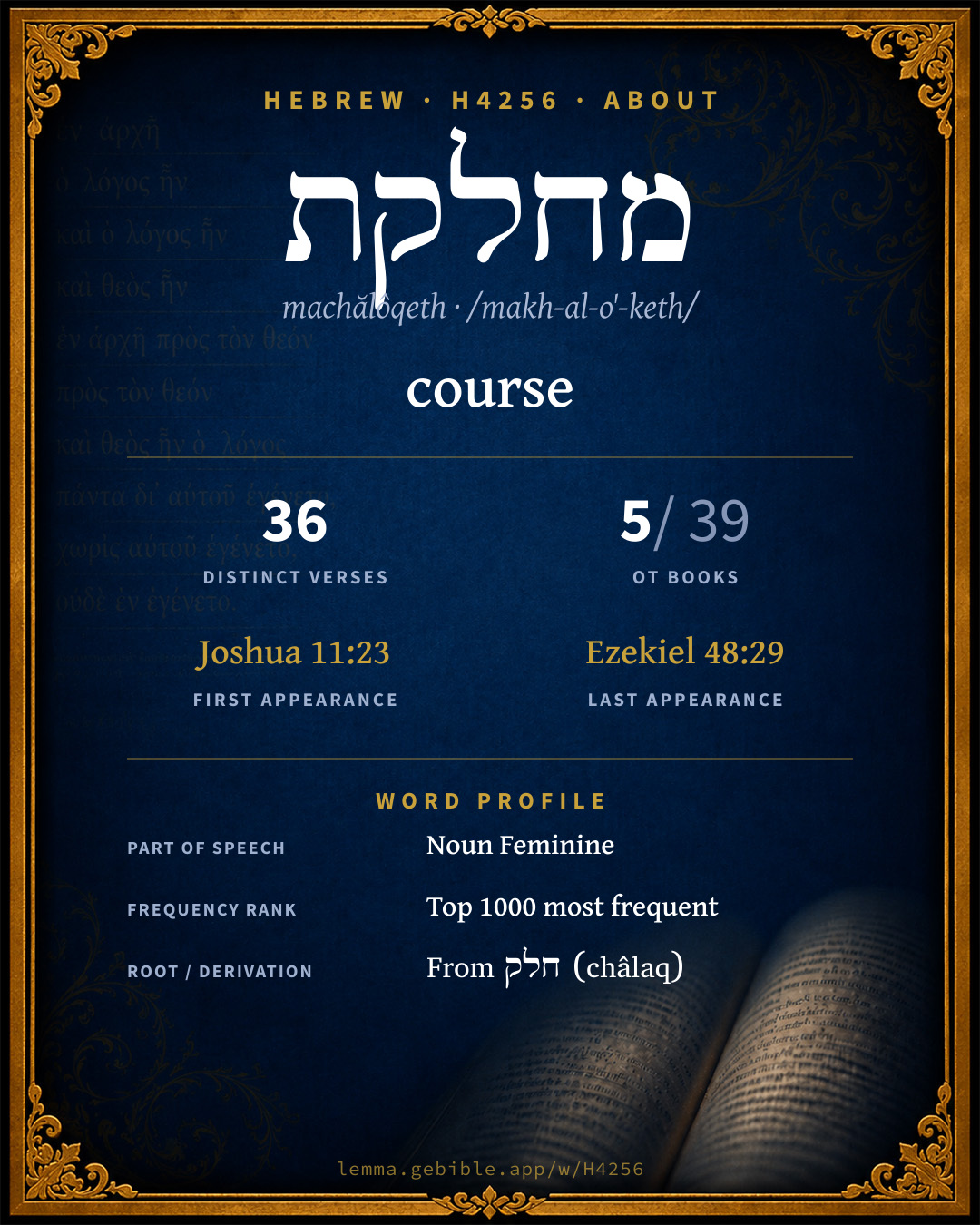
מַחֲלֹ֫קֶת
course
also: division, class, share, allotment fuller range ↓
Full lexicon entry — Brown-Driver-Briggs (BDB)
From Brown-Driver-Briggs (BDB)
Where this word appears
See every Construct-state word in the Hebrew Bible →
Grammar key — what these labels mean
Part of speech
- Noun
- A naming word — a person, place, thing, or idea.
Noun type
- Common
- A common noun — a general class of person, place, or thing (“king,” “city,” “water”), not a specific name.
State
- Construct
- A noun bound to a following noun in a possessive / “of” relationship (the construct chain).
- Absolute
- The independent form of a noun, not bound to a following word.
Gender
- Feminine
- Grammatically feminine.
Number
- Singular
- One.
- Plural
- More than one (in Hebrew, generally three or more).
Grammatical forms
- Noun, Common, Feminine, Plural, Construct 18 times (43%)
- Noun, Common, Feminine, Singular, Construct 15 times (36%)
- Noun, Common, Feminine, Plural, Absolute 7 times (17%)
- Noun, Common, Feminine, Singular, Absolute 2 times (5%)
Parsed forms decoded from the imported morphology (morphhb / Westminster Leningrad Codex — WLC text public domain, morphhb tagging CC BY 4.0), counted across 42 parsed occurrences — not distinct verses.
Every verse where H4256 appears — 36 distinct verses across 5 books. Click any verse to open its interlinear word-by-word view. Verse text shown in the World English Bible for context — . Each verse’s Hebrew form is shown with its reference; the English is not keyword-highlighted, since the data carries no word-level English alignment. Use “Compare translations” on any verse to read it across multiple English versions. This concordance covers the Hebrew Bible; Septuagint (Greek Old Testament) occurrences are not indexed here.
Joshua 3 verses
- Joshua 11:23 כְּ/מַחְלְקֹתָ֖/ם prep + n c fp cs + sfx pers 3mp So Joshua took the whole land, according to all that Yahweh spoke to Moses; and Joshua gave it for an inheritance to Israel according to their divisions by their tribes. The land had rest from war.
- Joshua 12:7 כְּ/מַחְלְקֹתָֽ/ם prep + n c fp cs + sfx pers 3mp These are the kings of the land whom Joshua and the children of Israel struck beyond the Jordan westward, from Baal Gad in the valley of Lebanon even to Mount Halak, that goes up to Seir; and Joshua gave it to the tribes of Israel for a possession according to their divisions;
- Joshua 18:10 כְּ/מַחְלְקֹתָֽ/ם prep + n c fp cs + sfx pers 3mp Joshua cast lots for them in Shiloh before Yahweh: and there Joshua divided the land to the children of Israel according to their divisions.
1 Chronicles 22 verses
- 1 Chronicles 23:6 מַחְלְק֑וֹת n c fp David divided them into divisions according to the sons of Levi: Gershon, Kohath, and Merari.
- 1 Chronicles 24:1 מַחְלְקוֹתָ֑/ם n c fp cs + sfx pers 3mp Thes were the divisions of the sons of Aaron. The sons of Aaron: Nadab and Abihu, Eleazar and Ithamar.
- 1 Chronicles 26:1 לְ/מַחְלְק֖וֹת prep + n c fp For the divisions of the doorkeepers: of the Korahites, Meshelemiah the son of Kore, of the sons of Asaph.
- 1 Chronicles 26:12 מַחְלְק֨וֹת n c fp cs Of these were the divisions of the doorkeepers, even of the chief men, having offices like their brothers, to minister in the house of Yahweh.
- 1 Chronicles 26:19 מַחְלְקוֹת֙ n c fp cs These were the divisions of the doorkeepers; of the sons of the Korahites, and of the sons of Merari.
- 1 Chronicles 27:1 הַֽ/מַּחְלְק֗וֹת הַֽ/מַּחֲלֹ֨קֶת֙ ptcl def.art + n c fp ptcl def.art + n c fs Now the children of Israel after their number, the heads of fathers' [houses] and the captains of thousands and of hundreds, and their officers who served the king, in any matter of the divisions which came in and went out month by month throughout all the months of the year--of every division were twenty-four thousand.
- 1 Chronicles 27:2 הַ/מַּחֲלֹ֤קֶת מַֽחֲלֻקְתּ֔/וֹ ptcl def.art + n c fs n c fs cs + sfx pers 3ms Over the first division for the first month was Jashobeam the son of Zabdiel: and in his division were twenty-four thousand.
- 1 Chronicles 27:4 מַחֲלֹ֣קֶת וּ/מַ֣חֲלֻקְתּ֔/וֹ מַחֲלֻקְתּ֔/וֹ n c fs cs conj + n c fs cs + sfx pers 3ms n c fs cs + sfx pers 3ms Over the division of the second month was Dodai the Ahohite, and his division; and Mikloth the ruler: and in his division were twenty-four thousand.
- 1 Chronicles 27:5 מַחֲלֻקְתּ֔/וֹ n c fs cs + sfx pers 3ms The third captain of the host for the third month was Benaiah, the son of Jehoiada the priest, chief: and in his division were twenty-four thousand.
- 1 Chronicles 27:6 וּ/מַ֣חֲלֻקְתּ֔/וֹ conj + n c fs cs + sfx pers 3ms This is that Benaiah, who was the mighty man of the thirty, and over the thirty: and [of] his division was Ammizabad his son.
- 1 Chronicles 27:7 מַחֲלֻקְתּ֔/וֹ n c fs cs + sfx pers 3ms The fourth [captain] for the fourth month was Asahel the brother of Joab, and Zebadiah his son after him: and in his division were twenty-four thousand.
- 1 Chronicles 27:8 מַחֲלֻקְתּ֔/וֹ n c fs cs + sfx pers 3ms The fifth captain for this fifth month was Shamhuth the Izrahite: and in his division were twenty-four thousand.
- 1 Chronicles 27:9 מַחֲלֻקְתּ֔/וֹ n c fs cs + sfx pers 3ms The sixth [captain] for the sixth month was Ira the son of Ikkesh the Tekoite: and in his division were twenty-four thousand.
- 1 Chronicles 27:10 מַחֲלֻקְתּ֔/וֹ n c fs cs + sfx pers 3ms The seventh [captain] for the seventh month was Helez the Pelonite, of the children of Ephraim: and in his division were twenty-four thousand.
- 1 Chronicles 27:11 מַחֲלֻקְתּ֔/וֹ n c fs cs + sfx pers 3ms The eighth [captain] for the eighth month was Sibbecai the Hushathite, of the Zerahites: and in his division were twenty-four thousand.
- 1 Chronicles 27:12 מַחֲלֻקְתּ֔/וֹ n c fs cs + sfx pers 3ms The ninth [captain] for the ninth month was Abiezer the Anathothite, of the Benjamites: and in his division were twenty-four thousand.
- 1 Chronicles 27:13 מַֽחֲלֻקְתּ֔/וֹ n c fs cs + sfx pers 3ms The tenth [captain] for the tenth month was Maharai the Netophathite, of the Zerahites: and in his division were Twenty-four thousand.
- 1 Chronicles 27:14 מַחֲלֻקְתּ֔/וֹ n c fs cs + sfx pers 3ms The eleventh [captain] for the eleventh month was Benaiah the Pirathonite, of the children of Ephraim: and in his division were twenty-four thousand.
- 1 Chronicles 27:15 מַחֲלֻקְתּ֔/וֹ n c fs cs + sfx pers 3ms The twelfth [captain] for the twelfth month was Heldai the Netophathite, of Othniel: and in his division were twenty-four thousand.
- 1 Chronicles 28:1 הַ/מַּחְלְק֣וֹת ptcl def.art + n c fp David assembled all the princes of Israel, the princes of the tribes, and the captains of the companies who served the king by division, and the captains of thousands, and the captains of hundreds, and the rulers over all the substance and possessions of the king and of his sons, with the officers, and the mighty men, even all the mighty men of valor, to Jerusalem.
- 1 Chronicles 28:13 וּֽ/לְ/מַחְלְקוֹת֙ conj + prep + n c fp cs also for the divisions of the priests and the Levites, and for all the work of the service of the house of Yahweh, and for all the vessels of service in the house of Yahweh;
- 1 Chronicles 28:21 מַחְלְקוֹת֙ n c fp cs Behold, there are the divisions of the priests and the Levites, for all the service of the house of God: and there shall be with you in all manner of work every willing man who has skill, for any manner of service: also the captains and all the people will be entirely at your command.
2 Chronicles 9 verses
- 2 Chronicles 5:11 לְ/מַחְלְקֽוֹת prep + n c fp It happened, when the priests were come out of the holy place, (for all the priests who were present had sanctified themselves, and did not keep their divisions;
- 2 Chronicles 8:14 מַחְלְק֨וֹת בְּ/מַחְלְקוֹתָ֖/ם n c fp cs prep + n c fp cs + sfx pers 3mp He appointed, according to the ordinance of David his father, the divisions of the priests to their service, and the Levites to their offices, to praise, and to minister before the priests, as the duty of every day required; the doorkeepers also by their divisions at every gate: for so had David the man of God commanded.
- 2 Chronicles 23:8 הַֽ/מַּחְלְקֽוֹת ptcl def.art + n c fp So the Levites and all Judah did according to all that Jehoiada the priest commanded: and they took every man his men, those who were to come in on the Sabbath; with those who were to go out on the Sabbath; for Jehoiada the priest didn't dismiss the shift.
- 2 Chronicles 31:2 מַחְלְק֣וֹת מַחְלְקוֹתָ֞/ם n c fp cs n c fp cs + sfx pers 3mp Hezekiah appointed the divisions of the priests and the Levites after their divisions, every man according to his service, both the priests and the Levites, for burnt offerings and for peace-offerings, to minister, and to give thanks, and to praise in the gates of the camp of Yahweh.
- 2 Chronicles 31:15 בְּ/מַחְלְק֔וֹת prep + n c fp Under him were Eden, and Miniamin, and Jeshua, and Shemaiah, Amariah, and Shecaniah, in the cities of the priests, in their office of trust, to give to their brothers by divisions, as well to the great as to the small:
- 2 Chronicles 31:16 כְּ/מַחְלְקוֹתֵי/הֶֽם prep + n c fp cs + sfx pers 3mp besides those who were reckoned by genealogy of males, from three years old and upward, even everyone who entered into the house of Yahweh, as the duty of every day required, for their service in their offices according to their divisions;
- 2 Chronicles 31:17 בְּ/מַחְלְקוֹתֵי/הֶֽם prep + n c fp cs + sfx pers 3mp and those who were reckoned by genealogy of the priests by their fathers' houses, and the Levites from twenty years old and upward, in their offices by their divisions;
- 2 Chronicles 35:4 כְּ/מַחְלְקוֹתֵי/כֶ֑ם prep + n c fp cs + sfx pers 2mp Prepare yourselves after your fathers' houses by your divisions, according to the writing of David king of Israel, and according to the writing of Solomon his son.
- 2 Chronicles 35:10 מַחְלְקוֹתָ֖/ם n c fp cs + sfx pers 3mp So the service was prepared, and the priests stood in their place, and the Levites by their divisions, according to the king's commandment.
Nehemiah 1 verse
Ezekiel 1 verse
About this entry
At a glance — auto-summarized from this page’s data, not written by a person. Every figure links to its source below. This summary describes the numbers; it doesn’t interpret them.
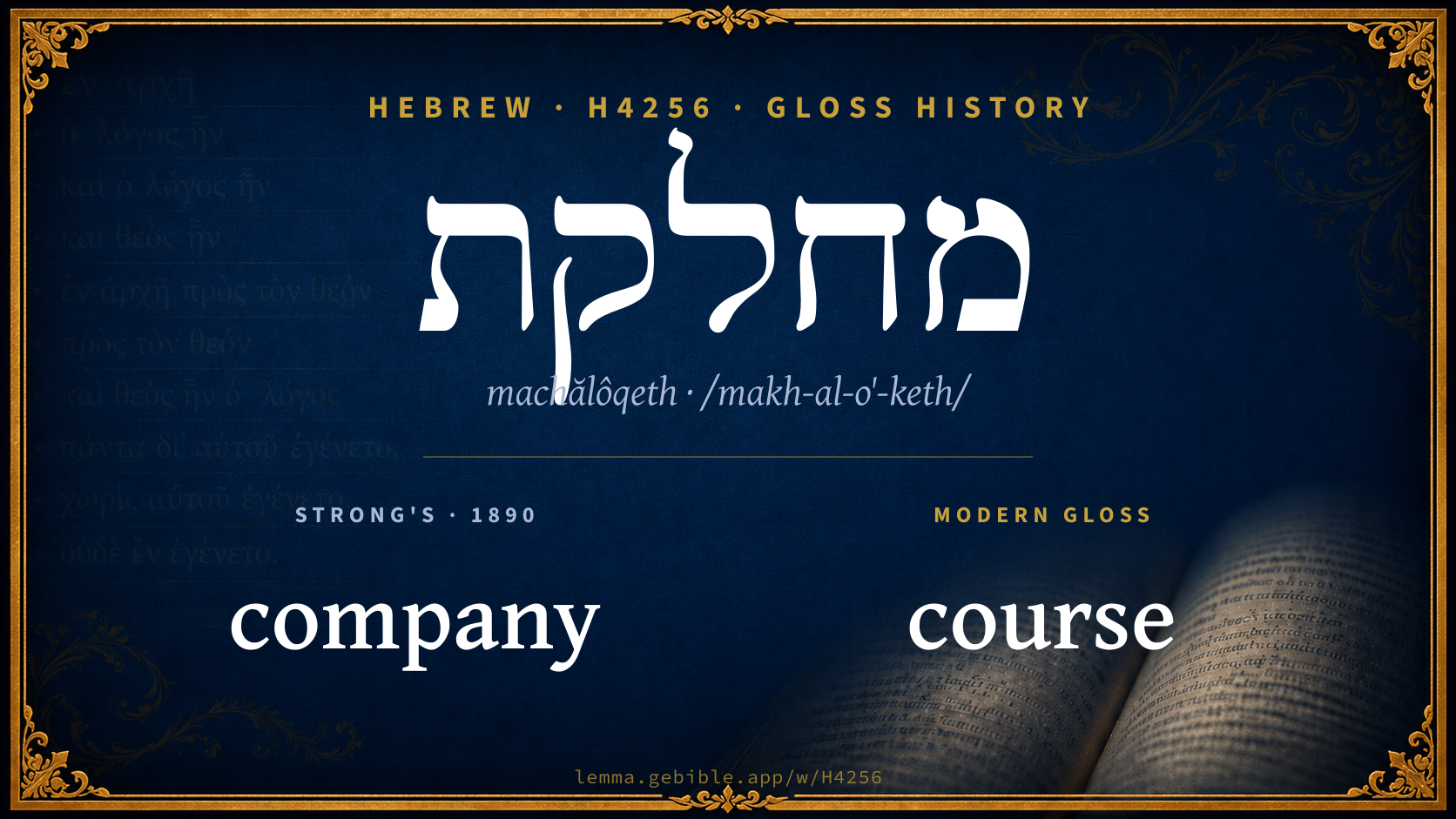
מחלקת (machălôqeth) is a Hebrew noun most often rendered “course.” 1 Chronicles dominates its distribution — 22 of 36 verses. Spanning 36 verses in 5 books, it ranks among the moderately common words of the Hebrew Bible. It also covers “division”, “class”, and “share”, alongside “course” — see its full sense range. Its English rendering has broadened — “course” classically, “divisions” (Berean Standard Bible) and “division” (unfoldingWord Literal Text) in modern versions; see the renderings breakdown. For the data behind this summary, explore the sense tree and the renderings breakdown below.
Gloss history
Strong's 1890 vs modern scholarship
About this word
Strong's H4256 catalogs a Hebrew word from the Hebrew Old Testament.
These counts are not copied from any lexicon or concordance. They are computed here, from the morphology-tagged Hebrew Old Testament. What Lemma adds →
- 36
- distinct verses
- The word appears in 36 distinct verses.
- 5 / 39
- OT books
- The word appears in 5 of 39 Old Testament books.
- #864
- by frequency
- Top 1000 most frequent Hebrew words (rank 864 of 8,640 Hebrew words by occurrence).
View all 36 occurrences in the concordance →
Most concentrated in
- 1 Chronicles 22 verses 61%
- 2 Chronicles 9 verses 25%
- Joshua 3 verses 8%
By section of the Old Testament
By traditional corpus
Conventional, traditional groupings — biblical authorship is debated, so this is a traditional corpus grouping, not an authorship claim. Each share is this word’s portion of its verses in that division of the Hebrew canon. Each figure is a share of the word’s 36 distinct verses.
- Writings (Ketuvim) 32 verses · 89%
- Prophets (Nevi'im) 4 verses · 11%
How translations render this word
Counts come from each version’s own published word-to-Strong’s tagging or interlinear alignment — an approximate guide to how each version renders this word, not a word-level alignment the data otherwise carries. Because each total is that version’s own tagged count, the per-version totals vary from one another and need not match the appearance or distinct-verse counts above. These counts may also differ from a printed concordance because Lemma counts each distinctly tagged rendering and does not collapse phrase taggings into a single head-word total. This is a fixed set of word-tagged versions (KJV, ASV, BSB, ULT) and does not change with the reading translation you choose elsewhere. Each version’s license is shown beside its name below (and on Sources).
- King James Version: Course 18×, Courses 10×, According to their divisions 3×
- American Standard Version: Course 15×, Courses 13×, According to their divisions 3×
- Berean Standard Bible: Divisions 17×, Division 15×, According to the allotments 2×
- unfoldingWord Literal Text: Division 16×, Divisions 11×, According to their divisions 5×
King James Version Public Domain
Renders H4256 across 43 tagged occurrences — most commonly:
Plus 12 renderings that appear only once — usually multi-word phrases or single function words the recovered tagging swept in, not distinct renderings.
American Standard Version Public Domain
Renders H4256 across 43 tagged occurrences — most commonly:
Plus 10 renderings that appear only once — usually multi-word phrases or single function words the recovered tagging swept in, not distinct renderings.
Berean Standard Bible Public Domain
Renders H4256 across 40 tagged occurrences — most commonly:
Plus 4 renderings that appear only once — usually multi-word phrases or single function words the recovered tagging swept in, not distinct renderings. Not rendered by a distinct English word in 2 further occurrences.
unfoldingWord Literal Text CC BY-SA 4.0
Renders H4256 across 45 tagged occurrences — most commonly:
Plus 6 renderings that appear only once — usually multi-word phrases or single function words the recovered tagging swept in, not distinct renderings.
Senses in the full BDB
What do BDB’s symbols mean?
BDB uses these scholarly abbreviations:
| Symbol | Meaning |
|---|---|
| 𝔊 | the Septuagint (the ancient Greek translation, LXX) |
| 𝔙 | the Vulgate (the Latin translation) |
| 𝔖 | the Syriac version (the Peshitta) |
| 𝔗 | the Targum (the Aramaic translation) |
| ψ | the Psalms |
| √ | root (the underlying root or stem) |
| ‖ | parallel passage (a synonymous or contrasted parallel) |
| † | the dagger: every passage where the word occurs is cited |
The 2 senses and sub-senses the full Brown-Driver-Briggs lexicon distinguishes for this word, in lexicon order (not ranked by frequency), with BDB’s own verbatim wording and sub-sense lettering. Shown in Hebrew script with BDB’s own scholarly abbreviations. The condensed entry is in the Lexicon Entry tab. See also the Forms in the corpus table below.
- 1. division, part, of land assigned to the several tribes of Isr. Jos 11:23; 12:7 (both D) 18:10 (JE; others, divisions of Isr., but v.) Ez 48:29. e.g. Joshua 11:23
- 2. techn. term of organization of priests and Levites (late), 1 Ch 23:6; 24:1; 26:1, 12, 19 2 Ch 8:14(×2); 31:2(×2); 35:4, 10 Ne 11:36 + 26 times in Ch., + (of royal officials) 1 Ch 28:1.—סֶלַע הַמַּחְלְקוֹת n.pr. 1 S 23:28 was popularly connected with this √, = rock of divisions, where Saul and David parted from neighbourhood of each other (Dr) so Vrss Th al.; Bö Klo, where their forces lay divided from each other; orig. connex. was perhaps with II. חלק, smooth, slippery; Ges De W Ke al. expl. here as rock of escapes, but this meaning for חלק dubious. e.g. 1 Chronicles 23:6
Senses from the full Brown-Driver-Briggs lexicon (Brown, Driver, Briggs; Oxford 1906 — public domain), digitized via Sefaria, supplemented by the OpenScriptures HebrewLexicon (CC BY 4.0). Full attribution on Sources.
Word origin
n.f. division, course (almost wholly Chr.)—מ׳ abs. 1 Ch 27:1, 2; cstr. 1 Ch 27:4; sf. מַחֲלֻקְתּוֹ 1 Ch 27:2 + 14 times 1 Ch 27; abs. מַחְלְקוֹת 1 Ch 23:6 + 6 times Ch + 1 S 23:28 (v. infr.); cstr. id. 1 Ch 26:12 + 5 times Ch + Ne 11:36; sf. מַהְלְקוֹתֵיכֶם 2 Ch 35:4; מַחְלְקוֹתֵיהֶם 2 Ch 31:16, 17; מַחְלְקוֹתָם 1 Ch 24:1 + 3 times in Ch; מַחְלְקֹתָם Jos 11:23; 12:7; 18:10 Ez 48:29;—
— Brown-Driver-Briggs (Oxford 1906, public domain), digitized via Sefaria, supplemented by the OpenScriptures HebrewLexicon (CC BY 4.0). See Sources.
Derived from חלק (châlaq) (H2505) — to divide.
Jastrow Dictionary
A second Hebrew/Aramaic lexicon for comparison, covering Aramaic and post-biblical (Talmudic, Targumic, Midrashic) usage that the biblical-Hebrew BDB does not. Matched by lemma rather than by Strong’s number, so a lemma may carry more than one Jastrow headword (shown separately below), and the entries cover usage well beyond the Bible.
מחלקות
- , v. מַחֲלוֹקֶת
A Dictionary of the Targumim, the Talmud Babli and Yerushalmi, and the Midrashic Literature (Marcus Jastrow; London, Luzac, 1903) — Public Domain. Digitized via Sefaria. Digitized via Sefaria. Full attribution on Sources.
Forms in the corpus
The 28 distinct written forms H4256 takes in the Hebrew Bible, most frequent first — each parse links to that state’s occurrences in the concordance. Hebrew forms include their vowel points and cantillation, so a single lemma takes many written forms.
Same root — word family
Other BDB entries built from the same root as H4256, grouped by Strong’s listed origin. These share a root / origin per the lexicon — not necessarily a shared meaning. Each links to that word’s own entry.
Derives from
Shares the same root
- חלק chêleq H2506 portion
- חלק chălâq H2508 possession
- חלק châlâq H2509 flattering
- חלק challâq H2511 smooth
- חלק challuq H2512 smooth
- חלקה chălaqqâh H2514 flattery
- חלקלקה chălaqlaqqâh H2519 flattery
Derived from this word
Proper names from this root
People and places named from this root — a name, not an additional meaning of the word.
Compare all same-root words → Showing 4 of 11 — not the complete family. 1 of the same-root words is a proper name (a person or place). They share a root, not necessarily a meaning.
Septuagint verse parallels
This word appears in 35 verses that also exist in the Greek Old Testament (Septuagint), out of the 36 Hebrew verses it occurs in. You can read those verses in Greek by switching the Old Testament edition to the Septuagint.
Read these verses in the Septuagint
This is a verse-level parallel only — the same verses exist in both the Hebrew and Greek Old Testaments. No word-level Hebrew↔Greek correspondence is claimed: the data carries no such alignment, so no Greek word is shown as this Hebrew word’s translation. Coverage is not total — the Septuagint omits the deuterocanon and renumbers the Psalms, so some Hebrew verses have no direct Greek parallel.