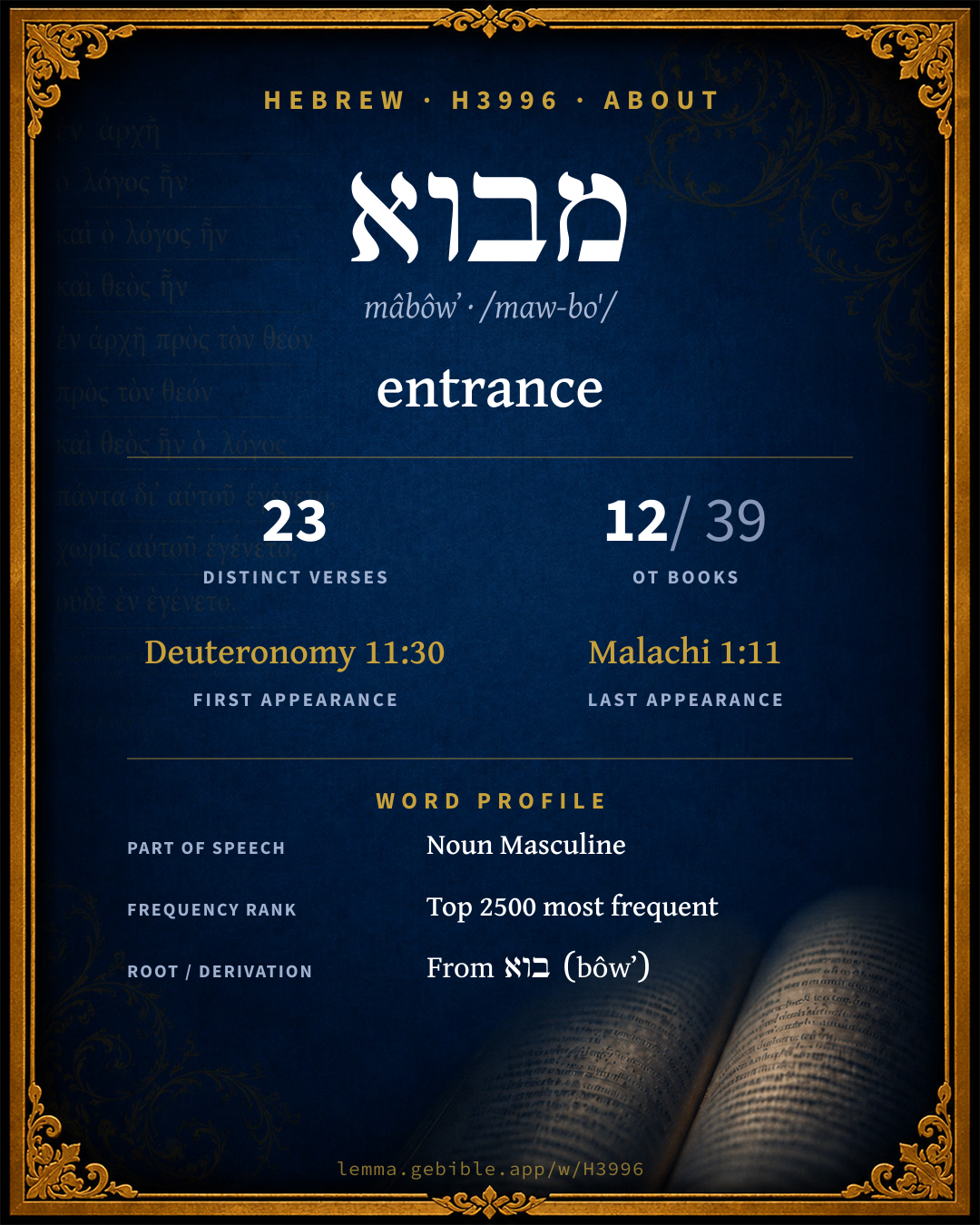
מָבוֹא
entrance
also: a coming in, entering fuller range ↓
Full lexicon entry — Brown-Driver-Briggs (BDB)
From Brown-Driver-Briggs (BDB)
Where this word appears
See every Construct-state word in the Hebrew Bible →
Grammar key — what these labels mean
Part of speech
- Noun
- A naming word — a person, place, thing, or idea.
Noun type
- Common
- A common noun — a general class of person, place, or thing (“king,” “city,” “water”), not a specific name.
State
- Construct
- A noun bound to a following noun in a possessive / “of” relationship (the construct chain).
- Absolute
- The independent form of a noun, not bound to a following word.
Gender
- Masculine
- Grammatically masculine.
Number
- Singular
- One.
- Plural
- More than one (in Hebrew, generally three or more).
18 distinct verses where H3996 appears in the Construct state, across 11 books. Filtered view — show all forms. Click any verse to open its interlinear word-by-word view. Verse text shown in the World English Bible for context — . Each verse’s Hebrew form is shown with its reference; the English is not keyword-highlighted, since the data carries no word-level English alignment. Use “Compare translations” on any verse to read it across multiple English versions. This concordance covers the Hebrew Bible; Septuagint (Greek Old Testament) occurrences are not indexed here.
Deuteronomy 1 verse
Joshua 2 verses
- Joshua 1:4 מְב֣וֹא n c ms cs From the wilderness, and this Lebanon, even to the great river, the river Euphrates, all the land of the Hittites, and to the great sea toward the going down of the sun, shall be your border.
- Joshua 23:4 מְב֥וֹא n c ms cs Behold, I have allotted to you these nations that remain, to be an inheritance for your tribes, from the Jordan, with all the nations that I have cut off, even to the great sea toward the going down of the sun.
Judges 2 verses
- Judges 1:24 מְב֣וֹא n c ms cs The watchers saw a man come forth out of the city, and they said to him, Show us, we pray you, the entrance into the city, and we will deal kindly with you.
- Judges 1:25 מְב֣וֹא n c ms cs He shown them the entrance into the city; and they struck the city with the edge of the sword; but they let the man go and all his family.
2 Kings 2 verses
- 2 Kings 11:16 מְב֥וֹא n c ms cs So they made way for her; and she went by the way of the horses' entry to the king's house: and there was she slain.
- 2 Kings 16:18 מְב֤וֹא n c ms cs The covered way for the Sabbath that they had built in the house, and the king's entry outside, turned he to the house of Yahweh, because of the king of Assyria.
1 Chronicles 1 verse
2 Chronicles 1 verse
Psalms 3 verses
- Psalms 50:1 מְבֹאֽ/וֹ n c ms cs + sfx pers 3ms The Mighty One, God, Yahweh, speaks, And calls the earth from sunrise to sunset.
- Psalms 104:19 מְבוֹאֽ/וֹ n c ms cs + sfx pers 3ms He appointed the moon for seasons. The sun knows when to set.
- Psalms 113:3 מְבוֹא֑/וֹ n c ms cs + sfx pers 3ms From the rising of the sun to the going down of the same, Yahweh's name is to be praised.
Proverbs 1 verse
Ezekiel 3 verses
- Ezekiel 26:10 כִּ/מְבוֹאֵ֖י prep + n c mp cs By reason of the abundance of his horses their dust shall cover you: your walls shall shake at the noise of the horsemen, and of the wagons, and of the chariots, when he shall enter into your gates, as men enter into a city in which is made a breach.
- Ezekiel 33:31 כִּ/מְבוֹא prep + n c ms cs They come to you as the people comes, and they sit before you as my people, and they hear your words, but don't do them; for with their mouth they show much love, but their heart goes after their gain.
- Ezekiel 44:5 לִ/מְב֣וֹא prep + n c ms cs Yahweh said to me, Son of man, mark well, and see with your eyes, and hear with your ears all that I tell you concerning all the ordinances of the house of Yahweh, and all the laws of it; and mark well the entrance of the house, with every exit of the sanctuary.
Zechariah 1 verse
Malachi 1 verse
About this entry
At a glance — auto-summarized from this page’s data, not written by a person. Every figure links to its source below. This summary describes the numbers; it doesn’t interpret them.
The Hebrew noun מבוא centers on the idea of “entrance.” Debuting at Deuteronomy 11:30, it then recurs through the corpus. Spanning 23 verses in 12 books, it ranks among the uncommon words of the Hebrew Bible. Alongside “entrance” the lexicon also lists “a coming in” and “entering” — part of its full sense range. Sharing its root, it stands alongside בוא, באה and תבואה. For the data behind this summary, explore the sense tree and the renderings breakdown below.
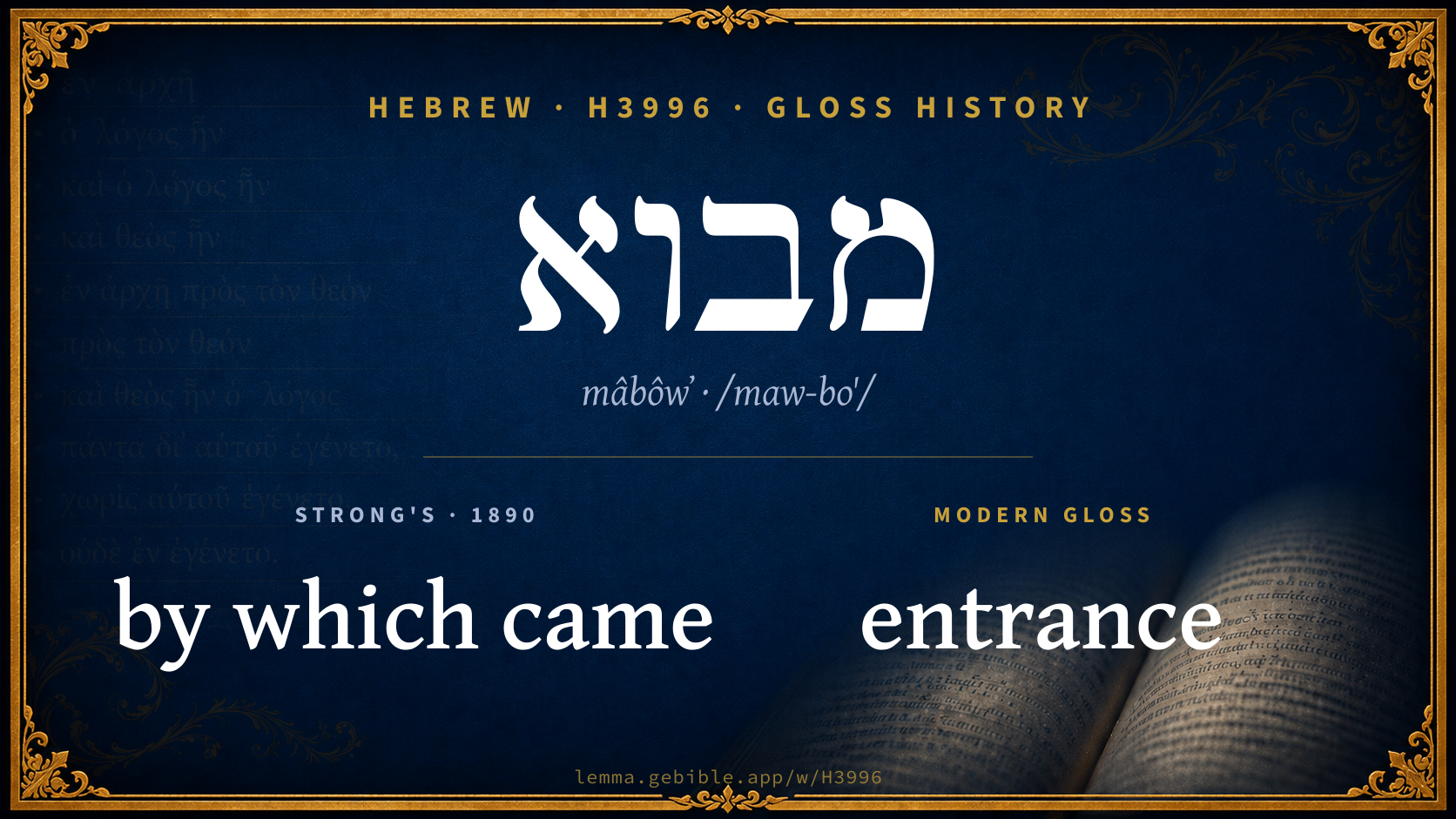
Gloss history
Strong's 1890 vs modern scholarship
About this word
Strong's H3996 catalogs a Hebrew word from the Hebrew Old Testament.
These counts are not copied from any lexicon or concordance. They are computed here, from the morphology-tagged Hebrew Old Testament. What Lemma adds →
- 23
- distinct verses
- The word appears in 23 distinct verses.
- 12 / 39
- OT books
- The word appears in 12 of 39 Old Testament books.
- #1,368
- by frequency
- Top 2500 most frequent Hebrew words (rank 1,368 of 8,640 Hebrew words by occurrence).
View all 23 occurrences in the concordance →
By section of the Old Testament
By traditional corpus
Conventional, traditional groupings — biblical authorship is debated, so this is a traditional corpus grouping, not an authorship claim. Each share is this word’s portion of its verses in that division of the Hebrew canon. Each figure is a share of the word’s 23 distinct verses.
- Prophets (Nevi'im) 14 verses · 61%
- Writings (Ketuvim) 8 verses · 35%
- Torah (Pentateuch) 1 verse · 4%
How translations render this word
Counts come from each version’s own published word-to-Strong’s tagging or interlinear alignment — an approximate guide to how each version renders this word, not a word-level alignment the data otherwise carries. Because each total is that version’s own tagged count, the per-version totals vary from one another and need not match the appearance or distinct-verse counts above. These counts may also differ from a printed concordance because Lemma counts each distinctly tagged rendering and does not collapse phrase taggings into a single head-word total. This is a fixed set of word-tagged versions (KJV, ASV, BSB, ULT) and does not change with the reading translation you choose elsewhere. Each version’s license is shown beside its name below (and on Sources).
- King James Version: Going down 4×, Entry 3×, Entering in 2×
- American Standard Version: Entrance 4×, Going down 4×, Entry 2×
- Berean Standard Bible: Entrance 9×, Sets 3×, West 2×
- unfoldingWord Literal Text: Entrance of 7×, Setting 5×, Entrance 4×
King James Version Public Domain
Renders H3996 across 23 tagged occurrences — most commonly:
Plus 12 renderings that appear only once — usually multi-word phrases or single function words the recovered tagging swept in, not distinct renderings. Not rendered by a distinct English word in 1 further occurrence.
American Standard Version Public Domain
Renders H3996 across 23 tagged occurrences — most commonly:
Plus 13 renderings that appear only once — usually multi-word phrases or single function words the recovered tagging swept in, not distinct renderings.
Berean Standard Bible Public Domain
Renders H3996 across 23 tagged occurrences — most commonly:
Plus 9 renderings that appear only once — usually multi-word phrases or single function words the recovered tagging swept in, not distinct renderings.
unfoldingWord Literal Text CC BY-SA 4.0
Renders H3996 across 24 tagged occurrences — most commonly:
Plus 6 renderings that appear only once — usually multi-word phrases or single function words the recovered tagging swept in, not distinct renderings.
Senses in the full BDB
What do BDB’s symbols mean?
BDB uses these scholarly abbreviations:
| Symbol | Meaning |
|---|---|
| 𝔊 | the Septuagint (the ancient Greek translation, LXX) |
| 𝔙 | the Vulgate (the Latin translation) |
| 𝔖 | the Syriac version (the Peshitta) |
| 𝔗 | the Targum (the Aramaic translation) |
| ψ | the Psalms |
| √ | root (the underlying root or stem) |
| ‖ | parallel passage (a synonymous or contrasted parallel) |
| † | the dagger: every passage where the word occurs is cited |
The 2 senses and sub-senses the full Brown-Driver-Briggs lexicon distinguishes for this word, in lexicon order (not ranked by frequency), with BDB’s own verbatim wording and sub-sense lettering. Shown in Hebrew script with BDB’s own scholarly abbreviations. The condensed entry is in the Lexicon Entry tab. See also the Forms in the corpus table below.
- 1. entrance, i.e. place or way of entrance, into a city Ju 1:24, 25 1 Ch 4:39 Pr 8:3 (מ׳ פְּתָחִים); into buildings 2 K 11:16; 16:18 1 Ch 9:19 (שֹׁמְרֵי הַמָּבוֹא), 2 Ch 23:13, 15 Je 38:14 Ez 42:9; 46:19; v. also מְבוֹאֹת יָם entrance of (the) sea, gate of the sea, of situation of Tyre Ez 27:3. e.g. Judges 1:24
- 2. entering, act of entrance, by violence, in storm of city Ez 26:10; coming in or together, making a crowd, כִּמְבוֹא עָ֑ם Ez 33:31 sim. of eagerness to hear Yahweh’s word; in phrase אֶת־מוֹצָאֲךָ וְאֶת־מבואך 2 S 3:25 thy going out and thy coming in; mode of entering temple, or the people who enter Ez 44:5; particularly of sunset מְבוֹא הַשֶּׁמֶשׁ ψ 104:19; = west Dt 11:30; Jos 1:4; 23:4 הַיָּם הַגָּדוֹל מְבוֹא הַשֶּׁמֶשׁ = Mediterranean, Zc 8:7 אֶרֶץ מְבוֹא הַשֶּׁמֶשׁ (‖ אֶרֶץ מִזְרָח), Mal 1:11 ψ 50:1; 113:3 sunset = west, opp. sunrise = east; in phr. from E. to W., i. e. over the whole earth, everywhere on earth. e.g. Ezekiel 26:10
Senses from the full Brown-Driver-Briggs lexicon (Brown, Driver, Briggs; Oxford 1906 — public domain), digitized via Sefaria, supplemented by the OpenScriptures HebrewLexicon (CC BY 4.0). Full attribution on Sources.
Word origin
n.m. Je 38:14 entrance, a coming in, entering;—מ׳ abs. Je 38:14 + 3 times + Ez 42:9 Kt (Qr מֵבִיא wrong, cf. Co); cstr. מְבוֹא Dt 11:30 + 12 times; sf. מְבוֹאוֹ ψ 104:19 + 2 times; מְבֹאוֹ ψ 50:1; מבואך 2 S 3:25 Kt (Qr מוֹבָאֶ֑ךָ inexplicable cf. Dr); pl. cstr. מְבוֹאֵי Ez 26:10, מְבוֹאֹת Ez 27:3;—
— Brown-Driver-Briggs (Oxford 1906, public domain), digitized via Sefaria, supplemented by the OpenScriptures HebrewLexicon (CC BY 4.0). See Sources.
Derived from בוא (bôwʼ) (H935) — to enter.
Jastrow Dictionary
A second Hebrew/Aramaic lexicon for comparison, covering Aramaic and post-biblical (Talmudic, Targumic, Midrashic) usage that the biblical-Hebrew BDB does not. Matched by lemma rather than by Strong’s number, so a lemma may carry more than one Jastrow headword (shown separately below), and the entries cover usage well beyond the Bible.
בּוֹא
- 1. to enter, come. R. Hash. I, 2 בָּאֵי העולם those come into the world, i.e. mortals. Ḥull. 54ᵇ בּוֹאֲכֶם בשלום be welcome!—Tanḥ. Vaëra 14; Midr. Till. to Ps. LXXVIII, 47, a. e. (play on ב̇ח̇נ̇מ̇ל̇ ibid.) [ב̇א נ̇ח̇ מ̇ל̇] ב̇א ח̇ן̇ מ̇ל̇ it (the locust) comes, encamps [rests], and plucks. Y. Shebu. VIII, 38ᶜ top, a. e. במקום שבאת, v. גְּזֵרָה.—Y. Peah I, 15ᶜ top, a. fr. יָבֹא עלי אם וכ׳ may (evil) befall me, if—; cmp. אֲתָא; Koh. R. to X, 8 אם לא יבא וכ׳ (corr. acc.).
- 2. with על (b. h. to have sexual connection. Kerith. I, 1; a. fr.
- 3. with לְיַד or לִידֵי to fall into the power of.—Aboth II, 1 ואין אתה בא לידי עבירה and sin will have no power over thee. Yoma 86ᵇ בא לידו דבר וכ׳ (not באת) he had the power (the chance) to commit a sin &c.; Kidd. 39ᵇ; a. fr.—בּוֹא וראה come and see (I will prove). Yoma l. c.; a. fr.
- 1. to bring, carry. Gitt. I, 1 המֵבִיא וכ׳ he who brings (as a messenger) a letter of divorce from abroad; a. fr.
- 2. to offer. Bicc. I, 1; a. fr.
- 3. to draw an object toward’s one’s self, opp. הוֹלִיךְ, v. הָלַךְ. Ḥull. II, 3 הוליך ולא ה׳ he put the knife out (in slaughtering) but did not draw it backward; ה׳ ולא וכ׳ or drew it toward himself but did not then move forward; a. fr.
- 4. to bring about, produce, cause. Aboth I, 17 מביא חטא begets sin; a. fr.
- 5. to lead, procure admittance. Ab. Zar. 20ᵇ Torah מביאה לידי וכ׳ (v. supra) leads to careful conduct &c. Ib. 18ᵃ אתה מְבִיאֵנִי וכ׳ wilt thou procure me (promise me) admittance into the world to come?; a. fr.
מָבוֹא
- , pl. מְבוֹאוֹת, v. מָבוֹי.
A Dictionary of the Targumim, the Talmud Babli and Yerushalmi, and the Midrashic Literature (Marcus Jastrow; London, Luzac, 1903) — Public Domain. Digitized via Sefaria. Digitized via Sefaria. Full attribution on Sources.
Forms in the corpus
The 16 distinct written forms H3996 takes in the Hebrew Bible, most frequent first — each parse links to that state’s occurrences in the concordance. Hebrew forms include their vowel points and cantillation, so a single lemma takes many written forms.
Same root — word family
Other BDB entries built from the same root as H3996, grouped by Strong’s listed origin. These share a root / origin per the lexicon — not necessarily a shared meaning. Each links to that word’s own entry.
Derives from
Shares the same root
Derived from this word
Compare all same-root words → Showing 4 of 6 — not the complete family. They share a root, not necessarily a meaning.
Septuagint verse parallels
This word appears in 23 verses that also exist in the Greek Old Testament (Septuagint), out of the 23 Hebrew verses it occurs in. You can read those verses in Greek by switching the Old Testament edition to the Septuagint.
Read these verses in the Septuagint
- Deuteronomy 11:30
- Joshua 1:4
- Judges 1:24
- 2 Kings 11:16
- 1 Chronicles 4:39
- 2 Chronicles 23:13
- Psalms 50:1
- Proverbs 8:3
- Jeremiah 38:14
- Ezekiel 26:10
- Zechariah 8:7
- Malachi 1:11
This is a verse-level parallel only — the same verses exist in both the Hebrew and Greek Old Testaments. No word-level Hebrew↔Greek correspondence is claimed: the data carries no such alignment, so no Greek word is shown as this Hebrew word’s translation. Coverage is not total — the Septuagint omits the deuterocanon and renumbers the Psalms, so some Hebrew verses have no direct Greek parallel.