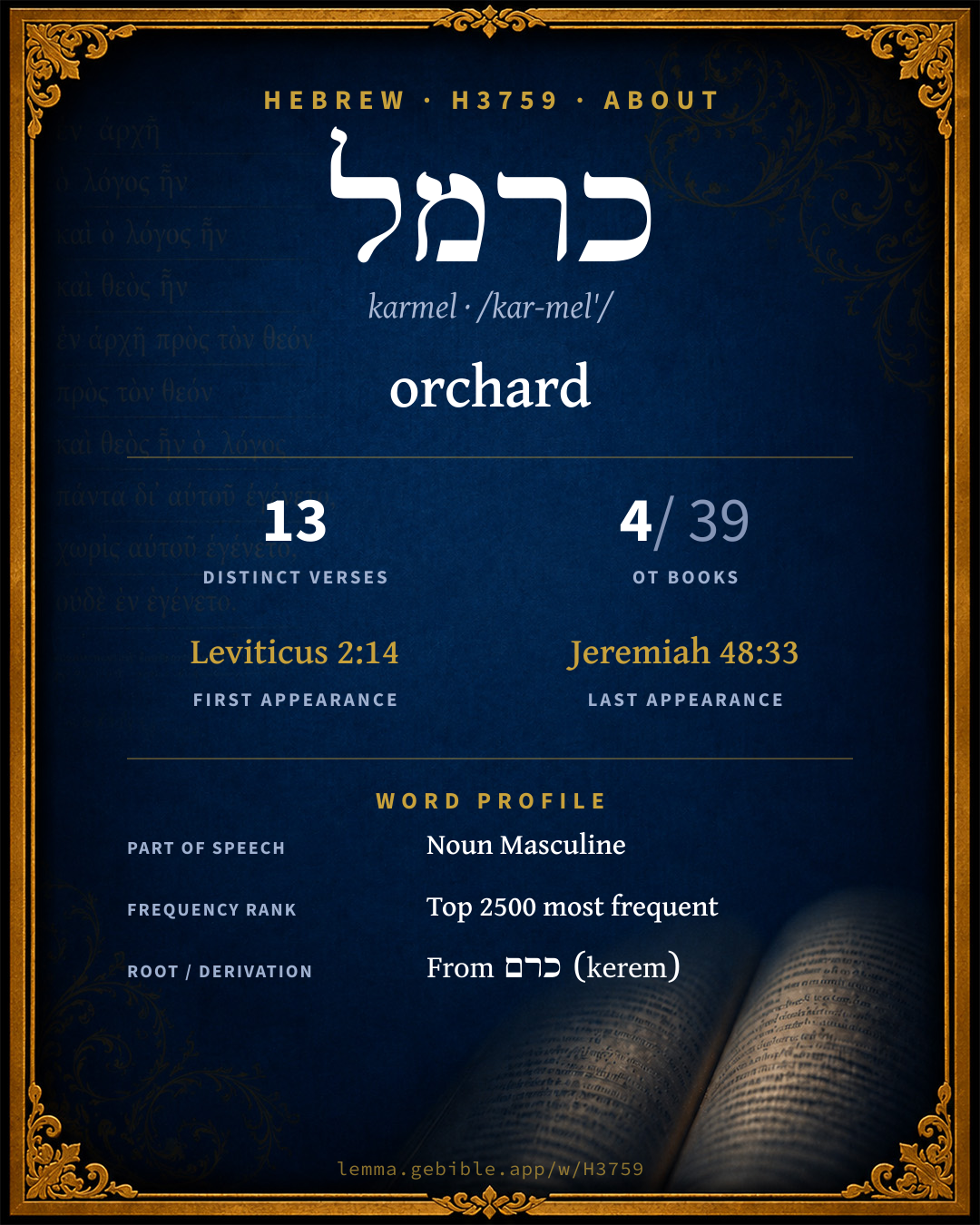
כַּרְמֶל
orchard
also: plantation, garden-land, fruit orchard fuller range ↓
Full lexicon entry — Brown-Driver-Briggs (BDB)
From Brown-Driver-Briggs (BDB)
Where this word appears
See every Absolute-state word in the Hebrew Bible →
Grammar key — what these labels mean
Part of speech
- Noun
- A naming word — a person, place, thing, or idea.
Noun type
- Common
- A common noun — a general class of person, place, or thing (“king,” “city,” “water”), not a specific name.
State
- Absolute
- The independent form of a noun, not bound to a following word.
- Construct
- A noun bound to a following noun in a possessive / “of” relationship (the construct chain).
Gender
- Masculine
- Grammatically masculine.
Number
- Singular
- One.
3 distinct verses where H3759 appears in the Construct state, across 2 books. Filtered view — show all forms. Click any verse to open its interlinear word-by-word view. Verse text shown in the World English Bible for context — . Each verse’s Hebrew form is shown with its reference; the English is not keyword-highlighted, since the data carries no word-level English alignment. Use “Compare translations” on any verse to read it across multiple English versions. This concordance covers the Hebrew Bible; Septuagint (Greek Old Testament) occurrences are not indexed here.
2 Kings 1 verse
Isaiah 2 verses
- Isaiah 10:18 וְ/כַרְמִלּ֔/וֹ conj + n c ms cs + sfx pers 3ms He will consume the glory of his forest, and of his fruitful field, both soul and body: and it shall be as when a standard-bearer faints.
- Isaiah 37:24 כַּרְמִלּֽ/וֹ n c ms cs + sfx pers 3ms By your servants have you defied the Lord, and have said, With the multitude of my chariots am I come up to the height of the mountains, to the innermost parts of Lebanon; and I will cut down the tall cedars of it, and the choice fir trees of it; and I will enter into its farthest height, the forest of its fruitful field;
About this entry
At a glance — auto-summarized from this page’s data, not written by a person. Every figure links to its source below. This summary describes the numbers; it doesn’t interpret them.
“orchard” is the headline sense of the Hebrew noun כרמל (karmel). Older and newer Bibles part ways — “fruitful field” in the King James Version, “orchard” (Berean Standard Bible) and “agricultural land” (unfoldingWord Literal Text) in modern versions. See the renderings breakdown. It appears 13 verses across 4 books of the Hebrew Bible, among its uncommon vocabulary. More than a third of its appearances fall in Isaiah. Not a single-sense word: its full sense range also takes in “plantation”, “garden-land”, and “fruit orchard”. The sections below give every sense, occurrence, and version rendering.
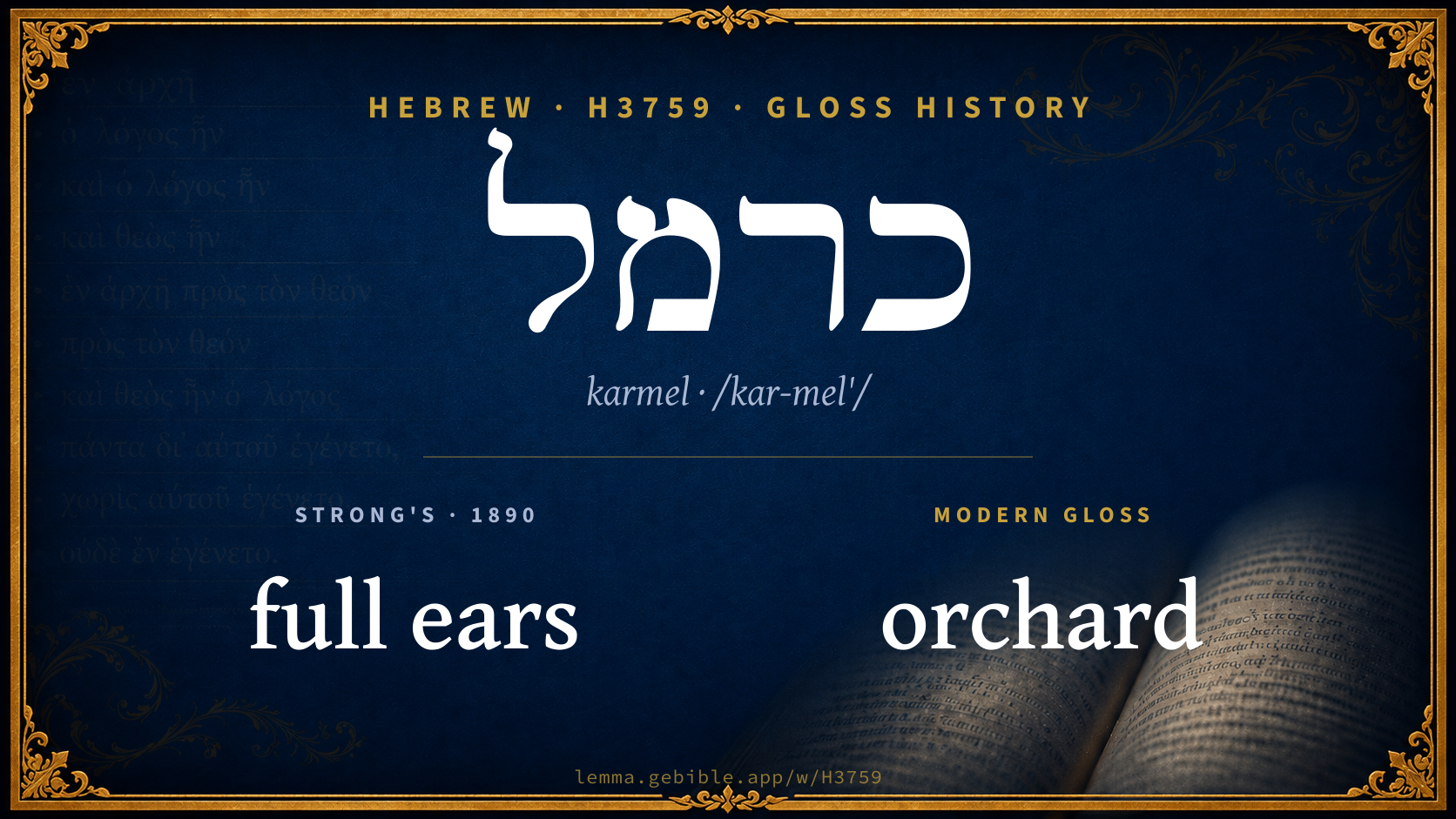
Gloss history
Strong's 1890 vs modern scholarship
About this word
Strong's H3759 catalogs a Hebrew word from the Hebrew Old Testament.
These counts are not copied from any lexicon or concordance. They are computed here, from the morphology-tagged Hebrew Old Testament. What Lemma adds →
- 13
- distinct verses
- The word appears in 13 distinct verses.
- 4 / 39
- OT books
- The word appears in 4 of 39 Old Testament books.
- #1,752
- by frequency
- Top 2500 most frequent Hebrew words (rank 1,752 of 8,640 Hebrew words by occurrence).
View all 13 occurrences in the concordance →
By section of the Old Testament
By traditional corpus
Conventional, traditional groupings — biblical authorship is debated, so this is a traditional corpus grouping, not an authorship claim. Each share is this word’s portion of its verses in that division of the Hebrew canon. Each figure is a share of the word’s 13 distinct verses.
- Prophets (Nevi'im) 11 verses · 85%
- Torah (Pentateuch) 2 verses · 15%
How translations render this word
Counts come from each version’s own published word-to-Strong’s tagging or interlinear alignment — an approximate guide to how each version renders this word, not a word-level alignment the data otherwise carries. Because each total is that version’s own tagged count, the per-version totals vary from one another and need not match the appearance or distinct-verse counts above. These counts may also differ from a printed concordance because Lemma counts each distinctly tagged rendering and does not collapse phrase taggings into a single head-word total. This is a fixed set of word-tagged versions (KJV, ASV, BSB, ULT) and does not change with the reading translation you choose elsewhere. Each version’s license is shown beside its name below (and on Sources).
BDB lists this Strong’s number as 2 distinct words (homographs). Each count above pools all of them and is not split by sense — see the Senses section below. A low-frequency rendering may belong to a different one of those words, not the primary meaning.
- King James Version†: Fruitful field 5×, Plentiful field 2×
- American Standard Version†: Fruitful field 6×
- Berean Standard Bible†: Orchard 6×
- unfoldingWord Literal Text†: Agricultural land 7×, Fresh grain 2×, Garden 2×
King James Version Public Domain
Renders H3759 across 13† tagged occurrences — most commonly:
Plus 6 renderings that appear only once — usually multi-word phrases or single function words the recovered tagging swept in, not distinct renderings.
American Standard Version Public Domain
Renders H3759 across 13† tagged occurrences — most commonly:
Plus 7 renderings that appear only once — usually multi-word phrases or single function words the recovered tagging swept in, not distinct renderings.
Berean Standard Bible Public Domain
Renders H3759 across 16† tagged occurrences — most commonly:
Plus 10 renderings that appear only once — usually multi-word phrases or single function words the recovered tagging swept in, not distinct renderings. Not rendered by a distinct English word in 1 further occurrence.
unfoldingWord Literal Text CC BY-SA 4.0
Renders H3759 across 14† tagged occurrences — most commonly:
Plus 3 renderings that appear only once — usually multi-word phrases or single function words the recovered tagging swept in, not distinct renderings.
Senses in the full BDB
What do BDB’s symbols mean?
BDB uses these scholarly abbreviations:
| Symbol | Meaning |
|---|---|
| 𝔊 | the Septuagint (the ancient Greek translation, LXX) |
| 𝔙 | the Vulgate (the Latin translation) |
| 𝔖 | the Syriac version (the Peshitta) |
| 𝔗 | the Targum (the Aramaic translation) |
| ψ | the Psalms |
| √ | root (the underlying root or stem) |
| ‖ | parallel passage (a synonymous or contrasted parallel) |
| † | the dagger: every passage where the word occurs is cited |
The 4 senses and sub-senses the full Brown-Driver-Briggs lexicon distinguishes for this word, in lexicon order (not ranked by frequency), with BDB’s own verbatim wording and sub-sense lettering. Shown in Hebrew script with BDB’s own scholarly abbreviations. The condensed entry is in the Lexicon Entry tab. See also the Forms in the corpus table below.
כרמל I
- 1. garden-land, Is 16:10 (‖ כְּרָמִים), 10:18 (‖ יַעַר), 29:17(×2) (opp. לְבָנוֹן, יַעַר), 32:15(×2) (opp. מִדְבָּר, יַעַר), v 16 Je 4:26 (opp. מִדְבָּר), 48:33 2 Ch 26:10 (opp. הֶהָרִים); אֶרֶץ הַכּ׳ Je 2:7 the country of garden-land, i.e. fertile; יַעַר כַּרְמִלּוֹ 2 K 19:23 = Is 37:24, the garden-like forest of it (viz. of Lebanon). On Mi 7:14 v. ii. כַּרְמֶל. e.g. Isaiah 16:10
- 2. by meton. (fresh) fruit, garden-growth, 2 K 4:42 (+ לֶחֶם שְׂעוֹרִים); Lv 2:14 (+ אָבִיב קָלוּי בָּאֵשׁ, and גֶּרֶשׂ, q.v.), לֶחֶם וְקָלִי וכי Lv 23:14. e.g. 2 Kings 4:42
כרמל II mont. et urb. Carmel
- 1. mt.-promontory on Mediterranean, with fertile slopes, Tel el-Amarna (Ginti-)Kirmil, Jastrow JBL xi. 1892, 115; Jos 19:26, הַר־הַכּ׳ 1 K 18:19, 20 2 K 2:25; 4:25; רֹאשׁ הַכּ׳ Am 1:2; 9:3; 1 K 18:42; c. art. also Jos 12:22; and, + בָּשָׁן, Je 50:19, as pasturage (in fig. of Isr. as flock of י׳), cf. (כ׳ without art.) Mi 7:14 (less prob. rend. garden-land, i. כַּרְמֶל, so We GASm); הַכּ׳ Is 35:2 (+ הַלְּבָנוֹן, הַשָּׁרוֹן); כ׳ Is 33:9 (+ לְבָנוֹן, הַשָּׁרוֹן and בָּשָׁן, marking extent of land), Na 1:4 (+ לְבָנוֹן, בָּשָׁן); כְּכַרְמֶל בַּיָּם Je 46:18 (sim. of Nebuchad.); Ct 7:6 רֹאשֵׁךְ עָלַיִךְ כַּכּ׳ (but v. כַּרְמִיל);—on Carmel v. GASmG. 337 ff. BuhlG. 23. e.g. Joshua 19:26
- 2. city, 3 h. S. of Hebron, כַּרְמֶל Jos 15:55; בַּכּ׳ 1 S 25:2(×2), 7; כַּרְמֶ֫לָה v 5 (= to Carmel); הַכַּרְמֶ֫לָה 15:12; 25:40.—Mod. Kurmul, RobBR i. 492–498, ii. 97 BuhlG. 163. e.g. Joshua 15:55
Senses from the full Brown-Driver-Briggs lexicon (Brown, Driver, Briggs; Oxford 1906 — public domain), digitized via Sefaria, supplemented by the OpenScriptures HebrewLexicon (CC BY 4.0). Full attribution on Sources.
Word origin
I. n.m. Is 29:17 1. plantation, garden-land. 2. fruit, garden-growth (ל + כֶּרֶם, cf. Ges§ 85, 52 Sta§ 299);—abs. כ׳ Is 16:10 + 12 times; sf. כַּרְמִלּוֹ Is 10:18 + 2 times;—
II. n.pr.mont. et urb. Carmel:—
— Brown-Driver-Briggs (Oxford 1906, public domain), digitized via Sefaria, supplemented by the OpenScriptures HebrewLexicon (CC BY 4.0). See Sources.
Derived from כרם (kerem) (H3754) — vineyard.
Jastrow Dictionary
A second Hebrew/Aramaic lexicon for comparison, covering Aramaic and post-biblical (Talmudic, Targumic, Midrashic) usage that the biblical-Hebrew BDB does not. Matched by lemma rather than by Strong’s number, so a lemma may carry more than one Jastrow headword (shown separately below), and the entries cover usage well beyond the Bible.
כַּרְמֶל
- v. כֶּרֶם)
- 1. a well-cultivated plot; whence (sub. גרש) (grist of) early ripened and tender barley. Men. 66ᵇ; Sifra Vayikra, N’dabah, ch. XIV, Par. 13 (ref. to Lev. II, 14). כ̇ר̇מ̇ל̇ ר̇ך̇ ומ̇ל̇ soft yet brittle; Y. Sabb. I, 2ᵈ bot. [read:] רך מל לא לח וכ׳ soft yet brittle, neither green nor dry, but between the two. Sifra l. c.; Men. l. c. (another explan.) כ̇ר̇ מ̇ל̇א rounded and full. e.g. Leviticus 2:14
- 2. pr. n. Carmel; (prob. everywhere) Mount Carmel. Y. Succ. III, 53ᵈ כשעוה וכשושנת כ׳ of the color of wax or of the lily of Carmel (v. יְרַקְרַק); (Tosef. Neg. I, 5 כשעוה וכקורמל, Var. וכקורמן; R. S. to Neg. XI, 4 וכקורמין).—Y. Ber. I, 2ᵇ bot. ראש הר הכ׳; Sabb. 35ᵃ ראש הכ׳ (Ms. M. ראש הר הכ׳) the summit of M. C. Gen. R. s. 99; Mekh. Yithro, Baḥod., s. 5 (alluding to Jer. XLVI, 18) תבור … וכ׳ מאספמיא Tabor came (to the desert for the law-giving) from Beth-Elim and C. from Ispamia; Meg. 29ᵃ e.g. Jeremiah 46:18
A Dictionary of the Targumim, the Talmud Babli and Yerushalmi, and the Midrashic Literature (Marcus Jastrow; London, Luzac, 1903) — Public Domain. Digitized via Sefaria. Digitized via Sefaria. Full attribution on Sources.
Forms in the corpus
The 13 distinct written forms H3759 takes in the Hebrew Bible, most frequent first — each parse links to that state’s occurrences in the concordance. Hebrew forms include their vowel points and cantillation, so a single lemma takes many written forms.
| Form | Parsing | Example | Uses |
|---|---|---|---|
| הַ/כַּרְמֶ֔ל | Noun, Common, Masculine, Singular, Absolute | Isaiah 16:10 | 2 |
| וְ/הַ/כַּרְמֶ֖ל | Noun, Common, Masculine, Singular, Absolute | Isaiah 29:17 | 2 |
| כַּרְמִלּֽ/וֹ | Noun, Common, Masculine, Singular, Construct | 2 Kings 19:23 | 2 |
| בַּ/כַּרְמֶ֥ל | Noun, Common, Masculine, Singular, Absolute | Isaiah 32:16 | 1 |
| הַ/כַּרְמֶ֖ל | Noun, Common, Masculine, Singular, Absolute | Jeremiah 4:26 | 1 |
| ו/כרמל | Noun, Common, Masculine, Singular, Absolute | Isaiah 32:15 | 1 |
| וְ/כַרְמִלּ֔/וֹ | Noun, Common, Masculine, Singular, Construct | Isaiah 10:18 | 1 |
| וְ/כַרְמֶ֖ל | Noun, Common, Masculine, Singular, Absolute | 2 Kings 4:42 | 1 |
| וְ/כַרְמֶ֜ל | Noun, Common, Masculine, Singular, Absolute | Leviticus 23:14 | 1 |
| כַּרְמֶ֔ל | Noun, Common, Masculine, Singular, Absolute | Leviticus 2:14 | 1 |
| לַ/כַּרְמֶ֑ל | Noun, Common, Masculine, Singular, Absolute | Isaiah 29:17 | 1 |
| לַ/כַּרְמֶ֔ל | Noun, Common, Masculine, Singular, Absolute | Isaiah 32:15 | 1 |
| מִ/כַּרְמֶ֖ל | Noun, Common, Masculine, Singular, Absolute | Jeremiah 48:33 | 1 |
Same root — word family
Other BDB entries built from the same root as H3759, grouped by Strong’s listed origin. These share a root / origin per the lexicon — not necessarily a shared meaning. Each links to that word’s own entry.
Derives from
Shares the same root
Proper names from this root
People and places named from this root — a name, not an additional meaning of the word.
Compare all same-root words → Showing 4 of 5 — not the complete family. 2 of the same-root words are proper names (people or places). They share a root, not necessarily a meaning.
Septuagint verse parallels
This word appears in 12 verses that also exist in the Greek Old Testament (Septuagint), out of the 13 Hebrew verses it occurs in. You can read those verses in Greek by switching the Old Testament edition to the Septuagint.
Read these verses in the Septuagint
This is a verse-level parallel only — the same verses exist in both the Hebrew and Greek Old Testaments. No word-level Hebrew↔Greek correspondence is claimed: the data carries no such alignment, so no Greek word is shown as this Hebrew word’s translation. Coverage is not total — the Septuagint omits the deuterocanon and renumbers the Psalms, so some Hebrew verses have no direct Greek parallel.