
Joshua 19:17

Hebrew (Westminster Leningrad Codex) Joshua 19:17 appears in the Hebrew Old Testament. The text above is from the Westminster Leningrad Codex. Each word links to its Strong’s number, a concise gloss, and parsing drawn from the Open Scriptures Hebrew Bible morphology. Click any word for its full Brown-Driver-Briggs (BDB) entry.
Download image
Cite this verse

Joshua 19:17 (World English Bible). Public Domain. Lemma interlinear Bible study tool, https://lemma.gebible.app/v/joshua/19/17.

Show BibTeX & RIS
BibTeX
RIS
English Translation
The fourth lot came out for Issachar, even for the children of Issachar according to their families.
World English Bible · Public Domain
Download a study sheet

One document with this verse’s original text, its word-by-word gloss line, the meaning frame, cross-references with their text, attributed commentary, and full source and license credits — printable, and it pastes into notes with its structure intact.

This verse Autodidact and up

Study sheet (.html) Plain text (.txt)

A passage Seminary Student

Up to 50 verses in one chapter. A passage sheet keeps up to 6 commentary sources and 12 cross-references per verse, in the order this page ranks them, and says so on the sheet whenever that leaves anything out. Ask for a single verse and you get the Autodidact verse sheet above.

Everything on this page stays free to read, with no account — the sheet is a download of what is already on screen, not access to it.

Want to remove ads? Support Godless Engineer
Compare translations 3

The same verse in 3 English versions, stacked beneath the original-language interlinear above. Click any original word for its lexicon entry.

Each is an independent rendering of the whole verse — the interlinear is not word-aligned to these translations.

Highlighted words mark where these versions differ — a whole-verse word diff, not a word-by-word alignment.

  • World English Bible Public Domain
    The fourth lot came out for Issachar, even for the children of Issachar according to their families.
  • King James Version Public Domain
    And the fourth lot came out to Issachar, for the children of Issachar according to their families.
  • unfoldingWord Literal Text CC BY-SA 4.0
    The fourth lot came out for Issachar, for the sons of Issachar according to their clans.

unfoldingWord Literal Text — © unfoldingWord, licensed CC BY-SA 4.0. Word-aligned USFM3 via Door43 (git.door43.org/unfoldingWord/en_ult).

Versions to compare (up to 4)

3 of 4 selected

Show all 18 translations

Every available English version of this verse, each an independent rendering of the whole verse.

  • World English Bible Public Domain
    The fourth lot came out for Issachar, even for the children of Issachar according to their families.
  • Berean Standard Bible Public Domain
    The fourth lot came out for the clans of the tribe of Issachar:
  • Majority Standard Bible Public Domain
    The fourth lot came out for the clans of the tribe of Issachar:
  • King James Version Public Domain
    And the fourth lot came out to Issachar, for the children of Issachar according to their families.
  • American Standard Version (1901) Public Domain
    The fourth lot came out for Issachar, even for the children of Issachar according to their families.
  • Revised Version (1885) Public Domain
    The fourth lot came out for Issachar, even for the children of Issachar according to their families.
  • Geneva Bible (1599) Public Domain
    The fourth lot came out to Issachar, euen for the children of Issachar according to their families.
  • Douay-Rheims (1899) Public Domain
    The fourth lot came out to Issachar by their kindreds.
  • Young's Literal Translation Public Domain
    For Issachar hath the fourth lot gone out, for the sons of Issachar, for their families;
  • Literal Standard Version CC BY-SA 4.0
    The fourth lot has gone out for Issachar, for the sons of Issachar, for their families;
  • Unlocked Literal Bible CC BY-SA 4.0
    The fourth casting of lots fell to Issachar, clan by clan.
  • unfoldingWord Literal Text CC BY-SA 4.0
    The fourth lot came out for Issachar, for the sons of Issachar according to their clans.
  • Darby Bible Public Domain
    The fourth lot came forth to Issachar, for the children of Issachar according to their families.
  • World Messianic Bible Public Domain
    The fourth lot came out for Issachar, even for the children of Issachar according to their families.
  • Webster's Bible Public Domain
    And the fourth lot came out to Issachar, for the children of Issachar according to their families.
  • Free Bible Version CC BY-SA 4.0
    The fourth lot cast went to the tribe of Issachar, by families.
  • Bible in Basic English Public Domain
    For Issachar the fourth heritage came out, for the children of Issachar by their families;
  • JPS Tanakh (1917) Public Domain
    The fourth lot came out for Issachar, even for the children of Issachar according to their families.

Literal Standard Version (2020), Covenant Press — licensed CC BY-SA 4.0. Text via the HelloAO Bible API (eBible.org). Unlocked Literal Bible (unfoldingWord) — licensed CC BY-SA 4.0. Text via the HelloAO Bible API (eBible.org). unfoldingWord Literal Text — © unfoldingWord, licensed CC BY-SA 4.0. Word-aligned USFM3 via Door43 (git.door43.org/unfoldingWord/en_ult). Free Bible Version, Dr. Jonathan Gallagher — licensed CC BY-SA 4.0. Text via the HelloAO Bible API (eBible.org).

Word by word

More ways to search: Search by grammar → Find every occurrence → Compare this word →

Practice this passage: Drill this verse → Learn its vocabulary →

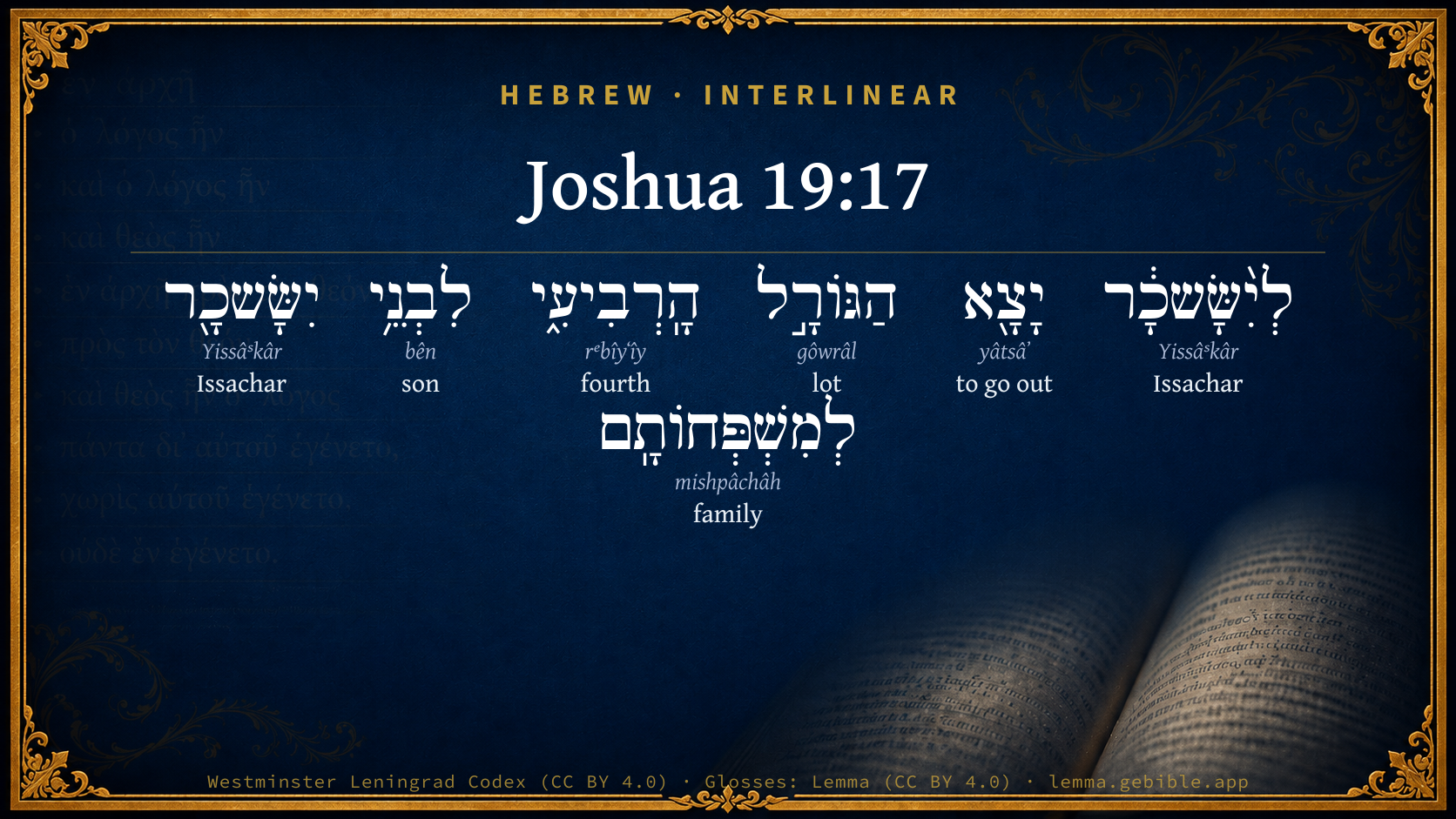
לְיִ֨שָּׂשכָ֔ר
Yissâˢkâr
H3485
“to/for · Issachar”
Preposition + Noun, Proper
Part of Speech
Preposition + Noun
Type
Proper
Full BDB Definition

Origin: from H5375 and H7939

TWOT: None

Issachar = "there is recompense" - the 9th son of Jacob and the 5th by Leah his first wife and the progenitor of a tribe by his name (noun proper masculine) - a Korahite Levite and the 7th son of Obed-edom and doorkeeper to the temple (noun proper masculine) - the tribe descended from Issachar the son of Jacob (noun proper collective) - the territory allocated to the descendants of Issachar when they entered the land of Canaan (noun proper locative)
  1. יָצָ֖א yâtsâʼ H3318 “to go out” Verb, Qal, Perfect, 3rd Person, Masculine, Singular
  2. הַגּוֹרָ֣ל gôwrâl H1486 “the · lot” Particle, Definite Article + Noun, Common, Masculine, Singular, Absolute
  3. הָֽרְבִיעִ֑י rᵉbîyʻîy H7243 “the · fourth” Particle, Definite Article + Adjective, Ordinal number, Masculine, Singular, Absolute
  4. לִבְנֵ֥י bên H1121 “to/for · sons of” Preposition + Noun, Common, Masculine, Plural, Construct
  5. יִשָּׂשכָ֖ר Yissâˢkâr H3485 “Issachar” Noun, Proper
  6. לְמִשְׁפְּחוֹתָֽם mishpâchâh H4940 “to/for · families · their” Preposition + Noun, Common, Feminine, Plural, Construct + Suffix, Personal, 3rd Person, Masculine, Plural

About this verse

These counts appear in no published source. They are computed here, from the morphology-tagged text and Lemma’s own curated glosses. What Lemma adds →

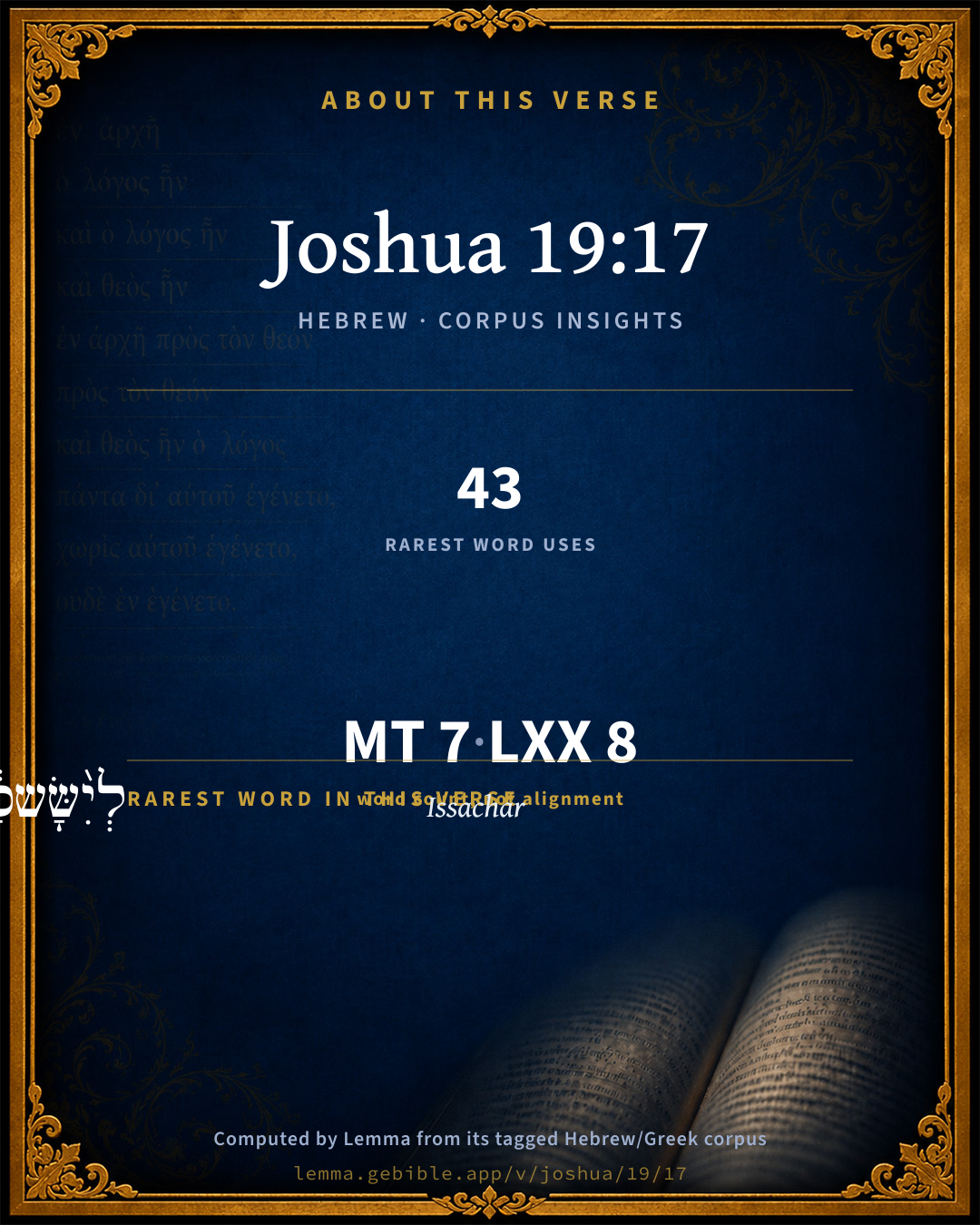
7
words
6
distinct lemmas
Historical
section

Shared distinctive vocabulary

לְיִ֨שָּׂשכָ֔ר Issachar H3485 occurs in 40 verses of the Hebrew Bible. Also found in:

Grammatical profile

  • 1 verb
  • 5 nouns
  • 1 adjective

Verb forms

  • יָצָ֖א Qal · Perfect

Repetition

A word recurs within this verse — often emphatic in Hebrew:

  • לְיִ֨שָּׂשכָ֔ר Issachar H3485 ×2

Hebrew & Septuagint length

In English translation the verse runs 17 words from the Hebrew and 8 from the Septuagint (LXX English) — the Septuagint runs noticeably shorter here. See the side-by-side →

A rough comparison of the two English renderings, which tokenize alike — not a word-level alignment.

Word counts can differ between the Hebrew and the Greek without any difference in meaning — e.g. the Hebrew direct-object marker אֵת has no separate Greek word, and Greek often adds the article ὁ.

In the original languages it is 7 Hebrew tokens and 8 Greek tokens — but the two are counted differently (Hebrew bundles its prefixes and suffixes into one token; the Greek is in lemma form), so that isn’t a like-for-like length.

Hebrew and Greek witnesses Masoretic Hebrew ↔ Greek Septuagint

The same verse in the two great witnesses to the Old Testament, shown verse-for-verse.

Here the Septuagint runs noticeably shorter than the Hebrew — LXX2012 (modern English Septuagint) 8 words vs World English Bible 17. A rough length comparison of the two English translations, not a word-level alignment — read both below.

These are two independent witnesses, not word-aligned to each other, and the Septuagint is shown in lemma (dictionary) form.

Hebrew Joshua 19:17 Masoretic · Westminster Leningrad Codex

לְיִ֨שָּׂשכָ֔ר יָצָ֖א הַגּוֹרָ֣ל הָֽרְבִיעִ֑י לִבְנֵ֥י יִשָּׂשכָ֖ר לְמִשְׁפְּחוֹתָֽם

The fourth lot came out for Issachar, even for the children of Issachar according to their families.

World English Bible · Public Domain

Greek LXX Joshua 19:17 Septuagint · lemma form

καί ὁ ισσαχαρ ἐκἔρχομαι ὁ κλῆρος ὁ τέταρτος

And the fourth lot came out to Issachar.

LXX2012 (modern English Septuagint) · Public Domain

On this verse, Keil & Delitzsch discusses the Septuagint’s reading. Read the note in Commentary ↓

Hebrew: Westminster Leningrad Codex (CC BY 4.0). Greek: Septuagint (public domain); English from LXX2012 (modern English Septuagint) (Public Domain). How the Septuagint differs from the Hebrew →

Targum (Aramaic paraphrase)

1

The Targum is the ancient Jewish Aramaic paraphrase of the Hebrew Scriptures — an interpretive translation, not the Hebrew text itself. Onkelos (literal) and Pseudo-Jonathan (expansive) render the Torah, and Jonathan the Prophets. Coverage is partial: where no permissively-licensed English translation exists for a verse, only the Aramaic is shown. This is verse-level text, not a word-by-word alignment to the Hebrew.

  1. Targum Jonathan Prophets (Joshua–Malachi)
    לְיִשָׂשכָר נְפַק עַדְבָא רְבִיעָאָה לִבְנֵי יִשָׂשכָר לְזַרְעֲיָתְהוֹן:

    (no public-domain English translation for this verse)

    Targum Jonathan — Aramaic: “Mikraot Gedolot” (public domain). English: “Sefaria Community Translation” (CC0 1.0 (public-domain dedication)); “London "Chaldee Paraphrase," 1871” (public domain). Text via Sefaria.

Commentary

Notes on Joshua 19:17 from classic Christian and Jewish commentators (each source and its license shown beneath its notes). The classic Christian expositions comment on the surrounding passage and are grouped to its opening verse, so a note may address several verses; the Jewish commentaries on the Tanakh (Rashi and others) are per-verse, so they appear only where the commentator wrote on this verse.

Lemma curates 59 commentaries, every one of them public domain or Creative Commons licensed, each selected and text-cleaned for this edition rather than reprinted as found. About our sources →

Jamieson, Fausset & Brown

Robert Jamieson, A. R. Fausset & David Brown

OF ISSACHAR. (Jos 19:17-23)

the fourth lot came out to Issachar--Instead of describing the boundaries of this tribe, the inspired historian gives a list of its principal cities. These cities are all in the eastern part of the plain of Esdraelon.

Jamieson, Fausset & Brown — Commentary Critical and Explanatory on the Whole Bible (1871) — public domain (CC PDM 1.0). Text via the HelloAO Bible API.

Whedon's Commentary on the Bible

Daniel D. Whedon

ISSACHAR’S LOT, Jos_19:17-23.

The territory of this tribe was bounded on the north by Zebulun, on the east by the Jordan, and on the south and west by Manasseh. It took in a large portion of the most beautiful and desirable parts of the great plain of Esdraelon. For the sake of securing themselves in so desirable a portion as the fertile plain of Esdraelon the children of Issachar became humbly subservient to the Canaanites of the adjacent fortified towns, and to the proud country of Phenicia on the near seacoast. They assumed a position of almost slavish servitude to them, becoming their common carriers, mule-drivers, and servants of all work, thereby fulfilling the prophecy of the dying Jacob: “Issachar is a strong ass couching down between two burdens: and he saw that rest was good, and the land that it was pleasant, and bowed his shoulder to bear, and became a servant to tribute.” Gen_49:14-15.

Daniel D. Whedon (gen. ed.), Commentary on the Old and New Testaments (1874–1909) — public domain. Text from a community e-Sword module.

Tyndale Open Study Notes

Tyndale Open Resources

19:17-23 The land given to the tribe of Issachar included much of the fertile Jezreel Valley. During Old Testament times, this valley was largely a swamp surrounded by prosperous and important cities. This area was a center of Canaanite strength, so this small tribe had trouble gaining a foothold at first.

Tyndale Open Study Notes — © Tyndale Open Resources, licensed CC BY-SA 4.0. Text via the HelloAO Bible API.

Matthew Henry's Commentary

The lot of Issachar ran from Jordan in the east to the great sea in the west, Manasseh on the south, and Zebulun on the north. A numerous tribe, Num 26:25. Tola, one of the judges, was of this tribe, Jdg 10:1. So was Baasha, one of the kings of Israel, Kg1 15:27. The most considerable places in this tribe were, 1. Jezreel, in which was Ahab's palace, and near it Naboth's vineyard. 2. Shunem, where lived that good Shunamite that entertained Elisha. 3. The river Kishon, on the banks of which, in this tribe, Sisera was beaten by Deborah and Barak. 4. The mountains of Gilboa, on which Saul and Jonathan were slain, which were not far from Endor, where Saul consulted the witch. 5. The valley of Megiddo, where Josiah was slain near Hadad-rimmon, Kg2 23:29; Zac 12:11.

Matthew Henry's Commentary on the Whole Bible (1708–1710) — public domain (CC PDM 1.0). Text via the HelloAO Bible API.

Adam Clarke's Commentary

Verse 17. The fourth lot came out to Issachar] It is remarkable, that though Issachar was the eldest brother, yet the lot of Zebulun was drawn before his lot; and this is the order in which Jacob himself mentions them, Ge 49:13-14, though no reason appears, either here or in the place above, why this preference should be given to the younger; but that the apparently fortuitous lot should have distinguished them just as the prophetic Jacob did, is peculiarly remarkable. Known unto God are all his works from the beginning: he has reasons for his conduct, which in many cases are too great for any of his creatures to comprehend, but he works all things after the counsel of his own will, which is ever right and good; and in this case his influence may be as easily seen in the decision by the lot, as on the mind of the patriarch Jacob, when he predicted what should befall his children in the latter days, and his providence continued to ripen, and bring forward what his judgment had deemed right to be done.

Adam Clarke's Commentary on the Bible (1810–1826) — public domain. Text from a community e-Sword/MySword module.

Ellicott's Commentary for English Readers

(17) The fourth lot . . . to Issachar.—These two tribes were located next to the house of Joseph on the north. It should be remembered that Issachar and Zebulun had been associated with Judah to form the same camp and division of the army in the wilderness. This association, lasting forty years, must have created many ties between these two tribes and their leader Judah. It was no ordinary wisdom that placed the descendants of Rachel (Ephraim, Benjamin, and Manasseh) between Judah on the south and Judah’s two associates on the north—to cement the union of all Israel, and as far as possible to prevent discord.

With regard to Judah and Zebulun, it is noticeable that we find their union reproduced in the earthly history of our Lord. Mary, who was of the house of David, and Joseph of the same lineage, are found dwelling in Nazareth, in the tribe of Zebulun. Thus the north and the south alike had “part in David,” and inheritance in David’s Son. There is a Bethlehem (Jos_19:15) in Zebulun as well as in Judah. The name is not found in any other tribe.

A Bible Commentary for English Readers, edited by Charles John Ellicott (1878–1897) — public domain. Text from a community e-Sword module.

The Cambridge Bible for Schools and Colleges

gen. ed. J. J. S. Perowne

17–23. Inheritance of the Tribe of Issachar

17. And the fourth lot] came forth to the tribe of Issachar, whose place during the journey to Canaan had been on the east of the tabernacle, side by side with his brothers Judah and Zebulun, the group moving foremost in the march (Num_2:5; Num_10:15).

The Cambridge Bible for Schools and Colleges (gen. ed. J. J. S. Perowne; Cambridge University Press, 1878–1918) — public domain. Text from a community e-Sword module.

John Gill's Exposition

And their border was towards Jezreel,.... Which was a royal seat in the time of Ahab, Kg1 21:1; and according to Jerom was near to Maximianopolis; See Gill on Hos 1:5; and the same writer (u) says in his day a large village of this name was shown in the great plain between Scythopolis and Legion (he means the plain of Jezreel), and it was the border of Issachar:

and Chesulloth was different from the Chislothtabor, Jos 19:12; that, as Masius observes, was to the north, this to the south of Mount Tabor:

and Shunem is a place well known for being the dwelling place of a certain woman in the times of Elisha, whose son the prophet raised from the dead, Kg2 4:8; Jerom calls it Sonam, where was the Shunammite woman; but this city here seems to be what he calls Salem, in the tribe of Issachar; and he adds, that there was shown in his day a village by this name, five miles from Mount Tabor to the south (w): according to Bunting (x), it was forty eight miles from Jerusalem to the north, not far from Nain.

(u) De loc. Heb. fol. 92. I. (w) De loc. Heb. fol. 94. K. L. (x) Travels, p. 143.

John Gill's Exposition of the Whole Bible (1746–1763) — public domain (CC PDM 1.0). Text via the HelloAO Bible API.

Haydock's Catholic Bible Commentary

Issachar. The reason why he has been placed after his younger brother, Zabulon, both here and in the blessing of Jacob, is not known.

George Leo Haydock (1774–1849), Haydock's Catholic Family Bible and Commentary, 1859 edition — public domain. Excludes Psalms (Douay-Rheims chapter numbering differs from Protestant) and Deuterocanonical books (Catholic canon only).

Keil & Delitzsch

C. F. Keil & F. Delitzsch

The Inheritance of Issachar. - In this instance only towns are given, and the boundaries are not delineated, with the exception of the eastern portion of the northern boundary and the boundary line; at the same time, they may easily be traced from the boundaries of the surrounding tribes. Issachar received for the most part the large and very fertile plain of Jezreel (see at Jos 17:16, and Ritter, Erdk. xvi. pp. 689ff.), and was bounded on the south by Manasseh, on the west by Manasseh and Asher, on the north by Zebulun, and farther east by Naphtali also, and on the east by the Jordan.

Jos 19:18

"And their boundary was towards Jezreel," i.e., their territory extended beyond Jezreel. Jezreel, the summer residence of Ahab and his house (Kg1 18:45-46, etc.), was situated upon a mountain, with an extensive and splendid prospect over the large plain that was called by its name. It was afterwards called Esdraela, a place described in the Onom. (s. v. Jezreel) as standing between Scythopolis and Legio; it is the present Zern, on the north-west of the mountains of Gilboa (see Seetzen, ii. pp. 155-6; Rob. iii. pp. 161ff.; Van de Velde, R. ii. pp. 320ff.). Chesulloth, possibly the same as Chisloth-tabor (see at Jos 19:12). Sunem, the home of Abishag (Kg1 1:3-15, etc.), also mentioned in Sa1 28:4 and Kg2 4:8, was situated, according to the Onom., five Roman miles (two hours) to the south of Tabor; it is the present Solam or Sulem, at the south-western foot of the Duhy or Little Hermon, an hour and a half to the north of Jezreel (see Rob. iii. pp. 170ff.; Van de Velde, R. ii. p. 323).

Jos 19:19

Haphraim, according to the Onom. (s. v. Aphraim) villa Affaraea, six Roman miles to the north of Legio, is identified by Knobel with the village of Afuleh, on the west of Sulem, and more than two hours to the north-east of Legun (Rob. iii. pp. 163, 181). Sion, according to the Onom. villa juxta montem Thabor, has not yet been discovered. Anaharath is supposed by Knobel to be Na'urah, on the eastern side of the Little Hermon (Bibl. Res. p. 337); but he regards the text as corrupt, and following the Cod. Al. of the lxx, which has Ῥενάθ and Ἀῤῥανέθ, maintains that the reading should be Archanath, to which Arneh on the north of Jenin in the plain corresponds (Seetzen, ii. p. 156; Rob. iii. p. 157). But the circumstance that the Cod. Al. has two names instead of one makes its reading very suspicious.

Jos 19:20

Harabbit is supposed by Knobel to be Araboneh, on the north-east of Arneh, at the southern foot of Gilboa (Rob. iii. p. 157). Kishion, which was given up to the Levites (Jos 21:28) and is erroneously written Kedesh in Ch1 6:57, is unknown. This also applies to Abez or Ebez, which is never mentioned again.

Jos 19:21

Remeth, for which Jarmuth stands in the list of Levitical towns in Jos 21:29, and Ramoth in Ch1 6:58, is also unknown.

(Note: Knobel imagines Remeth, whose name signifies height, to be the village of Wezar, on one of the western peaks of Gilboa (Seetzen, ii. p. 156; Rob. iii. p. 166, and Bibl. Res. p. 339), as the name also signifies "a lofty, inaccessible mountain, or a castle situated upon a mountain." This is certainly not impossible, but it is improbable. For this Mahometan village evidently derived its name from the fact that it has the appearance of a fortification when seen from a distance (see Ritter, Erdk. xv. p. 422). The name has nothing in common therefore with the Hebrew Remeth, and the travellers quoted by him say nothing at all about the ruins which he mentions in connection with Wezar (Wusar).)

En-gannim, which was also allotted to the Levites (Jos 21:29; also Ch1 6:73, where it is called Anem), has been associated by Robinson (iii. p. 155) with the Γιναία of Josephus, the present Jenin. The name En-gannim signifies fountain of gardens, and Jenin stands at the southern side of the plain of Jezreel in the midst of gardens and orchards, which are watered by a copious spring (see Seetzen, ii. pp. 156ff.); "unless perhaps the place referred to is the heap of ruins called Um el Ghanim, on the south-east of Tabor, mentioned by Berggren, ii. p. 240, and Van de Velde, Mem. p. 142" (Knobel). En-chadda and Beth-pazzez are only mentioned here, and have not yet been discovered. According to Knobel, the former of the two may possibly be either the place by Gilboa called Judeideh, with a fountain named Ain Judeideh (Rob. Bibl. Res. p. 337), or else Beit-kad or Kadd near Gilboa, mentioned by Seetzen (ii. p. 159) and Robinson (iii. p. 157).

Jos 19:22-23

"And the boundary touched Tabor, Sahazim, and Beth-shemesh." Tabor is not the mountain of that name, but a town upon the mountain, which was given to the Levites, though not by Issachar but by Zebulun (Ch1 6:62), and was fortified afresh in the Jewish wars (Josephus, Bell. Jud. iv. 1, 8). In this passage, however, it appears to be reckoned as belonging to Issachar, since otherwise there are not sixteen cities named. At the same time, as there are several discrepancies between the numbers given and the names actually mentioned, it is quite possible that in this instance also the number sixteen is incorrect. In any case, Tabor was upon the border of Zebulun (Jos 19:12), so that it might have been allotted to this tribe. There are still the remains of old walls and ruins or arches, houses, and other buildings to be seen upon Mount Tabor; and round the summit there are the foundations of a thick wall built of large and to a great extent fluted stones (see Rob. iii. pp. 453ff.; Seetzen, ii. p. 148; Buckingham, Syr. i. pp. 83ff.). The places which follow are to be sought for on the east of Tabor towards the Jordan, as the boundary terminated at the Jordan. Sachazim (Shahazimah) Knobel connects with el Hazetheh, as the name, which signifies heights, points to a town situated upon hills; and el Hezetheh stands upon the range of hills, bounding the low-lying land of Ard el Hamma, which belonged to Naphtali. The reason is a weak one, though the situation would suit. There is more probability in the conjecture that Beth-shemesh, which remained in the hands of the Canaanites (Jdg 1:33), has been preserved in the ruined village of Bessum (Rob. iii. p. 237), and that this new name is only a corruption of the old one, like Beth-shean and Beisan. It is probable that the eastern portion of the northern boundary of Issachar, towards Naphtali, ran in a north-easterly direction from Tabor through the plain to Kefr Sabt, and thence to the Jordan along the Wady Bessum. It is not stated how far the territory of Issachar ran down the valley of the Jordan (see the remarks on Jos 17:11).

Keil & Delitzsch — Biblical Commentary on the Old Testament (1861–1891) — public domain (CC PDM 1.0). Text via the HelloAO Bible API. (Old Testament only.)

unfoldingWord translationNotes

Door43 World Missions Community

The fourth casting of lots

See how you translated this phrase in Joshua 19:1.

The fourth

number four in a list (See: Ordinal Numbers)

Chesulloth ... Shunem ... Hapharaim ... Shion ... Anaharath

These are names of cities. (See: How to Translate Names)

translationWords

Issachar

Jezreel

unfoldingWord translationNotes — © Distant Shores Media and the Door43 World Missions Community, licensed CC BY-SA 4.0. Source: git.door43.org/Door43/en_tn.

Lesson kit

Teaching starters — assembled from the data on this page, not authored interpretation. Every prompt links to the verse data it draws on. Edit before teaching.

Joshua, in the Historical, opens this verse with 7 words (6 distinct Hebrew lemmas). Its most distinctive word is Yissâˢkâr (“Issachar”). The Greek Septuagint runs shorter here. A historical commentator’s framing appears above. Read the whole chapter for the surrounding context.

Discussion questions

  1. The word Yissâˢkâr carries the sense “Issachar.” How does it shape the verse?
  2. Genesis 30:18 shares the word «Issachar» with this verse. How do the two illuminate each other?
  3. “Issachar” occurs 2× in this one verse. What is the effect of the repetition?
  4. Compared with the Hebrew, the Septuagint runs shorter here. What questions does that raise?
  5. These translations render this verse differently. What is at stake in choosing one wording over another?
  6. The verb «יָצָ֖א» is Qal Perfect. How does its form color the action?
  7. Reading how Jamieson, Fausset & Brown and Whedon's Commentary on the Bible read this verse, where do the two commentators agree and where do they part?

Things to notice

Reading settings

Reading text

Shown beneath each verse's original-language words.

Old Testament
Old Testament edition

Read the OT as the Masoretic Hebrew (MT) or the Greek Septuagint (LXX).

English shown for the Greek Septuagint (in the Hebrew ↔ Greek comparison).

Comparing translations? Open the Compare panel on any verse page to stack up to four side by side.