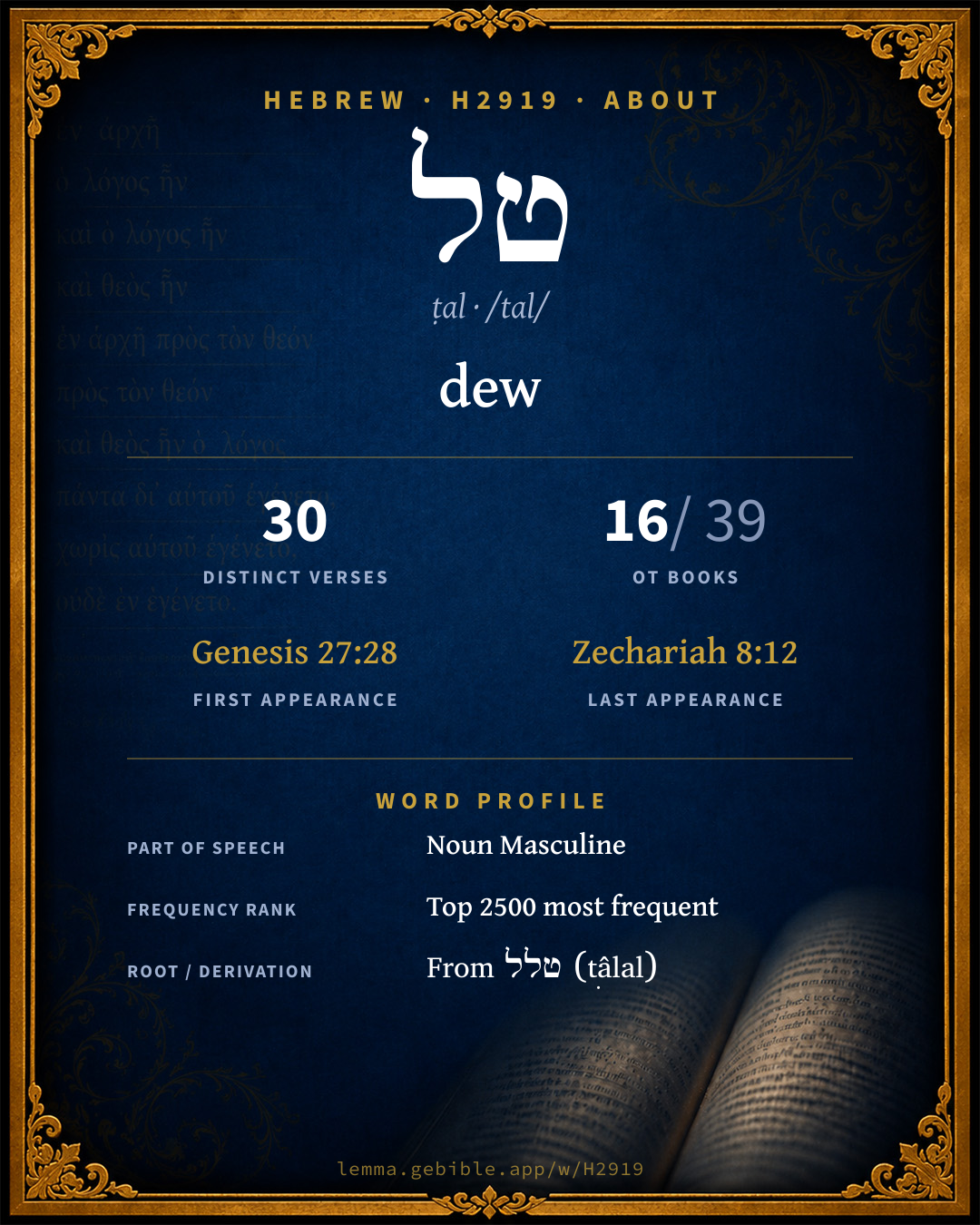
טַל
dew
Full lexicon entry — Brown-Driver-Briggs (BDB)
From Brown-Driver-Briggs (BDB)
Where this word appears
Grammar key — what these labels mean
Part of speech
- Noun
- A naming word — a person, place, thing, or idea.
Noun type
- Common
- A common noun — a general class of person, place, or thing (“king,” “city,” “water”), not a specific name.
State
- Absolute
- The independent form of a noun, not bound to a following word.
- Construct
- A noun bound to a following noun in a possessive / “of” relationship (the construct chain).
Gender
- Masculine
- Grammatically masculine.
Number
- Singular
- One.
Every verse where H2919 appears in the Book of Judges — 4 distinct verses. Click any verse to open its interlinear word-by-word view. Verse text shown in the World English Bible for context — . Each verse’s Hebrew form is shown with its reference; the English is not keyword-highlighted, since the data carries no word-level English alignment. Use “Compare translations” on any verse to read it across multiple English versions. This concordance covers the Hebrew Bible; Septuagint (Greek Old Testament) occurrences are not indexed here.
Judges
- Judges 6:37 טַל֩ n c ms behold, I will put a fleece of wool on the threshing floor; if there be dew on the fleece only, and it be dry on all the ground, then shall I know that you will save Israel by my hand, as you have spoken.
- Judges 6:38 טַל֙ n c ms It was so; for he rose up early on the next day, and pressed the fleece together, and wrung the dew out of the fleece, a bowl full of water.
- Judges 6:39 טָּֽל n c ms Gideon said to God, Don't let your anger be kindled against me, and I will speak but this once: Please let me make a trial just this once with the fleece; let it now be dry only on the fleece, and on all the ground let there be dew.
- Judges 6:40 טָֽל n c ms God did so that night: for it was dry on the fleece only, and there was dew on all the ground.
About this entry
At a glance — auto-summarized from this page’s data, not written by a person. Every figure links to its source below. This summary describes the numbers; it doesn’t interpret them.
טל (ṭal) is a Hebrew noun most often rendered “dew.” It first appears in Genesis 27:28. It turns up in 30 verses across 16 books, a moderately common footprint. From the same root come טלל, טלל and טל. For the data behind this summary, explore the sense tree and the renderings breakdown below.
Gloss history
Strong's 1890 vs modern scholarship
About this word
Strong's H2919 catalogs a Hebrew word from the Hebrew Old Testament.
These counts are not copied from any lexicon or concordance. They are computed here, from the morphology-tagged Hebrew Old Testament. What Lemma adds →
- 30
- distinct verses
- The word appears in 30 distinct verses.
- 16 / 39
- OT books
- The word appears in 16 of 39 Old Testament books.
- #1,120
- by frequency
- Top 2500 most frequent Hebrew words (rank 1,120 of 8,640 Hebrew words by occurrence).
View all 30 occurrences in the concordance →
Most concentrated in
- Judges 4 verses 13%
- Deuteronomy 3 verses 10%
- Hosea 3 verses 10%
By section of the Old Testament
By traditional corpus
Conventional, traditional groupings — biblical authorship is debated, so this is a traditional corpus grouping, not an authorship claim. Each share is this word’s portion of its verses in that division of the Hebrew canon. Each figure is a share of the word’s 30 distinct verses.
- Prophets (Nevi'im) 15 verses · 50%
- Torah (Pentateuch) 8 verses · 27%
- Writings (Ketuvim) 7 verses · 23%
How translations render this word
Counts come from each version’s own published word-to-Strong’s tagging or interlinear alignment — an approximate guide to how each version renders this word, not a word-level alignment the data otherwise carries. Because each total is that version’s own tagged count, the per-version totals vary from one another and need not match the appearance or distinct-verse counts above. These counts may also differ from a printed concordance because Lemma counts each distinctly tagged rendering and does not collapse phrase taggings into a single head-word total. This is a fixed set of word-tagged versions (KJV, ASV, BSB, ULT) and does not change with the reading translation you choose elsewhere. Each version’s license is shown beside its name below (and on Sources).
BDB lists this Strong’s number as 2 distinct words (homographs). Each count above pools all of them and is not split by sense — see the Senses section below. A low-frequency rendering may belong to a different one of those words, not the primary meaning.
- King James Version†: Dew 22×
- American Standard Version†: Dew 20×
- Berean Standard Bible†: Dew 24×, Is like the dew 2×, Like dew 2×
- unfoldingWord Literal Text†: Dew 21×, Like the dew 3×, Dew of 2×
King James Version Public Domain
Renders H2919 across 31† tagged occurrences — most commonly:
Plus 9 renderings that appear only once — usually multi-word phrases or single function words the recovered tagging swept in, not distinct renderings.
American Standard Version Public Domain
Renders H2919 across 31† tagged occurrences — most commonly:
Plus 11 renderings that appear only once — usually multi-word phrases or single function words the recovered tagging swept in, not distinct renderings.
Berean Standard Bible Public Domain
Renders H2919 across 31† tagged occurrences — most commonly:
Plus 3 renderings that appear only once — usually multi-word phrases or single function words the recovered tagging swept in, not distinct renderings.
unfoldingWord Literal Text CC BY-SA 4.0
Renders H2919 across 36† tagged occurrences — most commonly:
Plus 6 renderings that appear only once — usually multi-word phrases or single function words the recovered tagging swept in, not distinct renderings.
Senses in BDB
The 1 sense BDB distinguishes for this word, in lexicon order (not ranked by frequency or importance). The full entry — with sub-senses — is in the Lexicon Entry tab.
- dew, night mist
Word origin
n.m. Ju 6:37 night-mist, dew (NH טַל dew; Aramaic ܛܰܠܴܐ, טַלָּא dew; Arabic طَلٌّ light rain, dew; Ethiopic ጠል dew)—ט׳ abs. 1 S 1:21 + 12 times; טָ֑ל Ju 6:13 + 9 times; cstr. טַל Gn 27:28 + 4 times; sf. טַלֶּ֑ךָ Is 26:19, טַלָּם Zc 8:12;—night-mist, taking place of our dew (v. Che Is 18:4 & ψ 110:3; Lane 1862, NeilPal. Explored 129); as coming from the sky and bringing fertility, טַל הַשָּׁמַיִם Gn 27:28 (God gives it, נתן), & v 39 (+ מֵעָ֑ל), cf. Dt 33:28 (heavens distil it, ערף), Hg 1:10 Zc 8:12 (heavens give it, נתן); in Dt 33:13 read perh. מֵעָ֑ל for מִטַּל (v. ‖ Gn 49:25 and Di); clouds distil it (רעף) Pr 3:20; sq. עַל, it descends (ירד) upon the camp Nu 11:9 (JE); it is upon the ground Ju 6:39, 40, cf. 2 S 1:21 (+ מָטָר); upon the fleece Ju 6:37; is wrung out (מוץ) of the fleece v 38; remains through the night (לון) Jb 29:19, cf. שִׁכְבַת הַטּ׳ the lying of dew = the dew lying Ex 16:13, 14 (P; it goes up (עלה) in morning); it is in drops מִי הוֹלִיד אֶגְלֵי טָ֑ל Jb 38:28; covers the head of one out at night Ct 5:2; it comes (היה) by word of prophet 1 K 17:1 (+ מָטָר); sim. of stealthy approach כַּאֲשֶׁר יִפֹּל הַטַּל עַל־הָאֲדָמָה 2 S 17:12; sim. denoting welcome and gentle refreshment, of speech, which distils (נזל) like it Dt 32:2 (poem; ‖ שְׂעִירִים, רְבִיבִים); of fraternal unity כְּטַל חֶרְמוֹן ψ 133:3 (ירד על); of king’s favour Pr 19:12 (על); of י׳’s kindness Ho 14:6; כְּעָב טַל Is 18:4 like a mist-cloud, of י׳’s quiet watching; of Jacob’s influence among nations Mi 5:6 (ט׳ מֵאֵת י׳; ‖ רְבִיבִים); טַל אוֹרֹת טַלָּ֑ךָ Is 26:19 a dew of light is thy dew (v i. אוֹרָה p. 21b supr. and BaudStud. Sem. Rel. ii. 264 f.); as transitory, כַּטַּל מַשְׁכִּים הֹלֵךְ Ho 6:4 like the dew early departing, so 13:3 (both ‖ עֲנַן־בֹּקֶר); fig. of young warriors of king established by י׳, with flashing weapons, like dewdrops טַל יַלְדֻתֶ֑ךָ ψ 110:3.
— Brown-Driver-Briggs (Oxford 1906, public domain), digitized via Sefaria, supplemented by the OpenScriptures HebrewLexicon (CC BY 4.0). See Sources.
Derived from טלל (ṭâlal) (H2926) — to roof.
Jastrow Dictionary
A second Hebrew/Aramaic lexicon for comparison, covering Aramaic and post-biblical (Talmudic, Targumic, Midrashic) usage that the biblical-Hebrew BDB does not. Matched by lemma rather than by Strong’s number, so a lemma may carry more than one Jastrow headword (shown separately below), and the entries cover usage well beyond the Bible.
טַל
- [hanging drop, cmp. טִלְטוּלַיָּא,] dew. Taan. 3ᵃ בטל וברוחות וכ׳ as to mentioning dew and winds in the prayer &c.—Ib. 3ᵇ טל דברכה a fructifying dew; a. fr.—Pl. טְלָלִים, טְלָלֵין. Ḥag. 12ᵇ עליית ט׳ the upper chamber (store) of dews, v. אֲגָלִים. Lev. R. s. 28 ט׳ קשים injurious dews; a. fr.
טַל ²
- Targ. Is. XVIII, 4. Targ. O. Gen. XXVII, 28; a. fr.—Pl. טַלִּין. Targ. Y. Gen. l. c.; a. e.
A Dictionary of the Targumim, the Talmud Babli and Yerushalmi, and the Midrashic Literature (Marcus Jastrow; London, Luzac, 1903) — Public Domain. Digitized via Sefaria. Digitized via Sefaria. Full attribution on Sources.
Forms in the corpus
The 26 distinct written forms H2919 takes in the Hebrew Bible, most frequent first — each parse links to that state’s occurrences in the concordance. Hebrew forms include their vowel points and cantillation, so a single lemma takes many written forms.
Same root — word family
Other BDB entries built from the same root as H2919, grouped by Strong’s listed origin. These share a root / origin per the lexicon — not necessarily a shared meaning. Each links to that word’s own entry.
Derives from
Shares the same root
Derived from this word
Compare all same-root words → They share a root, not necessarily a meaning.
Septuagint verse parallels
This word appears in 30 verses that also exist in the Greek Old Testament (Septuagint), out of the 30 Hebrew verses it occurs in. You can read those verses in Greek by switching the Old Testament edition to the Septuagint.
Read these verses in the Septuagint
- Genesis 27:28
- Exodus 16:13
- Numbers 11:9
- Deuteronomy 32:2
- Judges 6:37
- 2 Samuel 1:21
- 1 Kings 17:1
- Job 29:19
- Psalms 110:3
- Proverbs 3:20
- Song of Solomon 5:2
- Isaiah 18:4
This is a verse-level parallel only — the same verses exist in both the Hebrew and Greek Old Testaments. No word-level Hebrew↔Greek correspondence is claimed: the data carries no such alignment, so no Greek word is shown as this Hebrew word’s translation. Coverage is not total — the Septuagint omits the deuterocanon and renumbers the Psalms, so some Hebrew verses have no direct Greek parallel.