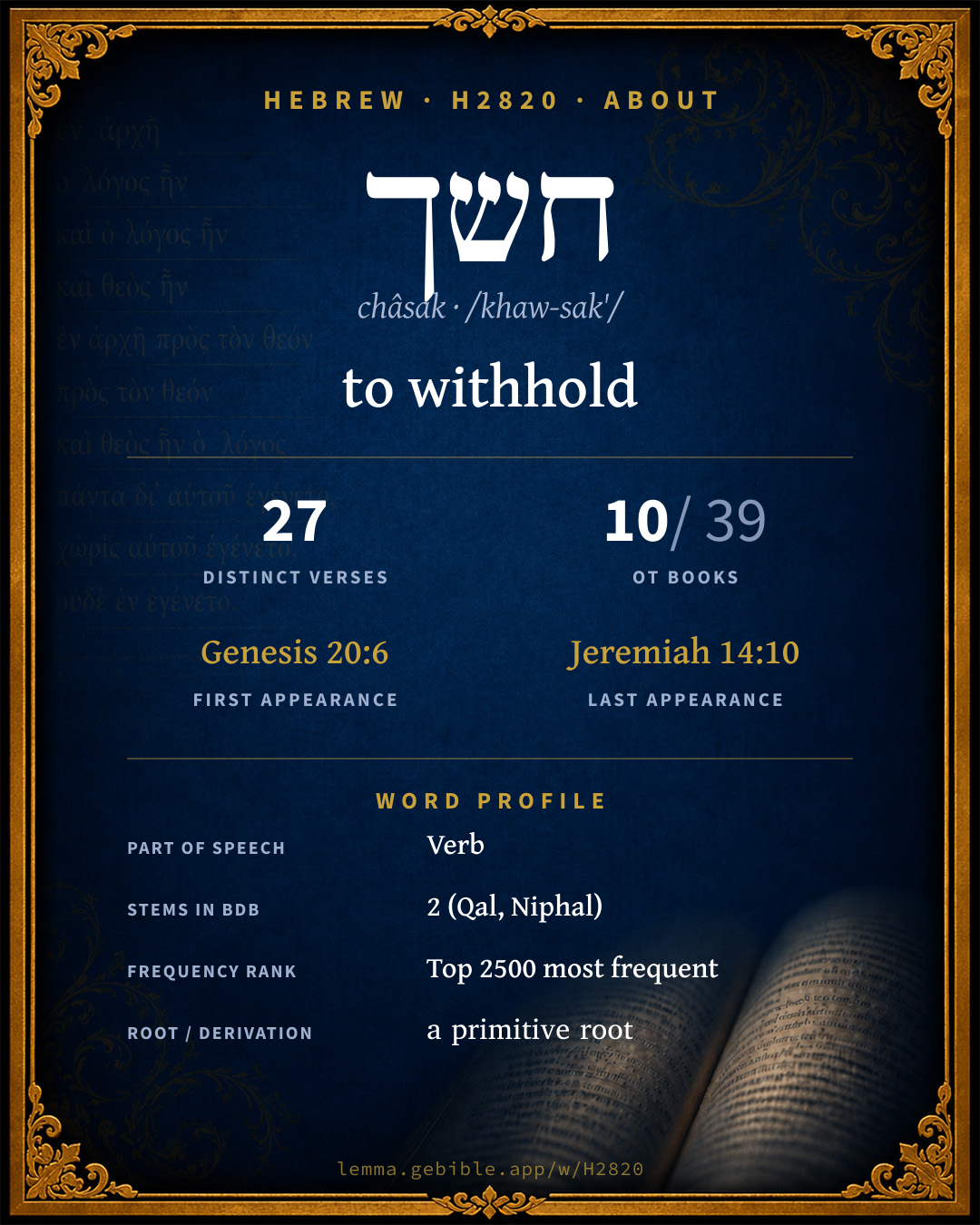
חָשַׂךְ
to withhold
also: restrain, hold back, keep in check, refrain fuller range ↓
Full lexicon entry — Brown-Driver-Briggs (BDB)
From Brown-Driver-Briggs (BDB)
Where this word appears
Grammar key — what these labels mean
Part of speech
- Verb
- An action or state-of-being word.
Stem
- Qal
- The basic, simple active stem — the plain form of the verb (“he wrote”). Here: ‘withhold’
- Niphal
- Usually the simple passive or reflexive of the Qal (“he was written”).
Form
- Perfect
- A completed action or state — Hebrew marks aspect (completeness) more than strict tense (“he wrote”).
- Imperfect
- An incomplete, ongoing, or future action (“he will / would write”).
- Participle Active
- A verbal adjective expressing ongoing or characteristic action (“writing / one who writes”).
- Sequential Imperfect
- An imperfect with prefixed waw — the standard past-narrative form (waw-consecutive imperfect).
- Jussive
- A third- or second-person volitional form expressing wish or command (“let him write”).
- Imperative
- A direct command (“write!”).
State
- Absolute
- The independent form of a noun, not bound to a following word.
Person
- 3rd Person
- The one spoken about (“he / she / it / they”).
- 2nd Person
- The one addressed (“you”).
- 1st Person
- The speaker (“I / we”).
Gender
- Masculine
- Grammatically masculine.
- Common
- Either gender — not distinguished for this form.
- Feminine
- Grammatically feminine.
Number
- Singular
- One.
- Plural
- More than one (in Hebrew, generally three or more).
Every verse where H2820 appears in the Book of Jeremiah — 1 distinct verse. Click any verse to open its interlinear word-by-word view. Verse text shown in the World English Bible for context — . Each verse’s Hebrew form is shown with its reference; the English is not keyword-highlighted, since the data carries no word-level English alignment. Use “Compare translations” on any verse to read it across multiple English versions. This concordance covers the Hebrew Bible; Septuagint (Greek Old Testament) occurrences are not indexed here.
Jeremiah
About this entry
At a glance — auto-summarized from this page’s data, not written by a person. Every figure links to its source below. This summary describes the numbers; it doesn’t interpret them.
חשך — transliterated châsak — is a Hebrew verb carrying the sense “to withhold.” Its earliest occurrence is Genesis 20:6. Spanning 27 verses in 10 books, it ranks among the moderately common words of the Hebrew Bible. Its uses concentrate in Job (26% of all occurrences). As a verb its force shifts by stem, across 2 stems (Qal, Niphal, and more). See the sense tree, 27-verse concordance, and the renderings breakdown below.
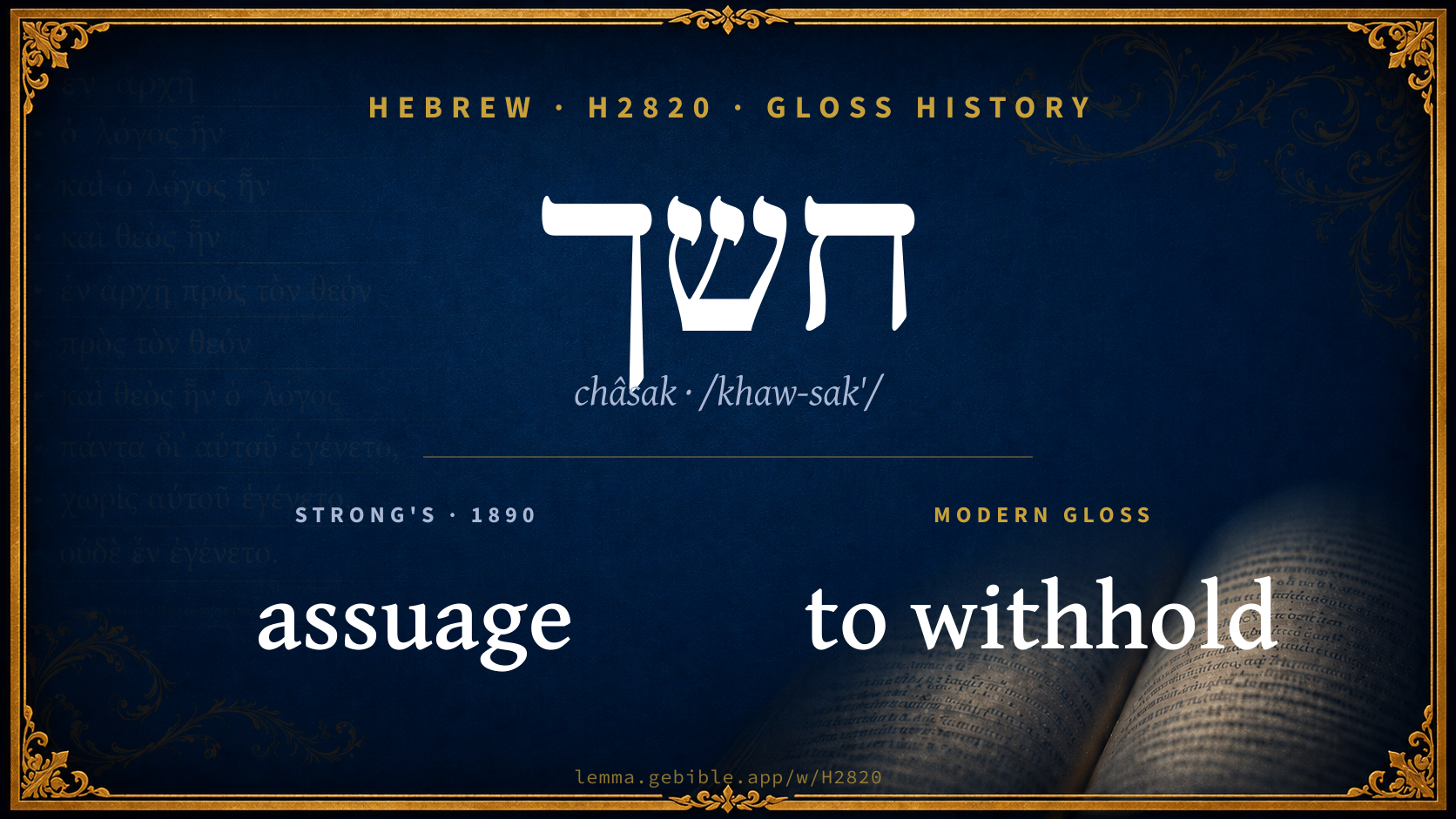
Gloss history
Strong's 1890 vs modern scholarship
About this word
Strong's H2820 catalogs a Hebrew word from the Hebrew Old Testament.
These counts are not copied from any lexicon or concordance. They are computed here, from the morphology-tagged Hebrew Old Testament. What Lemma adds →
- 27
- distinct verses
- The word appears in 27 distinct verses.
- 10 / 39
- OT books
- The word appears in 10 of 39 Old Testament books.
- #1,226
- by frequency
- Top 2500 most frequent Hebrew words (rank 1,226 of 8,640 Hebrew words by occurrence).
View all 27 occurrences in the concordance →
By section of the Old Testament
By traditional corpus
Conventional, traditional groupings — biblical authorship is debated, so this is a traditional corpus grouping, not an authorship claim. Each share is this word’s portion of its verses in that division of the Hebrew canon. Each figure is a share of the word’s 27 distinct verses.
- Writings (Ketuvim) 16 verses · 59%
- Prophets (Nevi'im) 7 verses · 26%
- Torah (Pentateuch) 4 verses · 15%
How translations render this word
Counts come from each version’s own published word-to-Strong’s tagging or interlinear alignment — an approximate guide to how each version renders this word, not a word-level alignment the data otherwise carries. Because each total is that version’s own tagged count, the per-version totals vary from one another and need not match the appearance or distinct-verse counts above. These counts may also differ from a printed concordance because Lemma counts each distinctly tagged rendering and does not collapse phrase taggings into a single head-word total. This is a fixed set of word-tagged versions (KJV, ASV, BSB, ULT) and does not change with the reading translation you choose elsewhere. Each version’s license is shown beside its name below (and on Sources).
- King James Version: Spare 3×, Spareth 2×, Withheld 2×
- American Standard Version: He that spareth 2×, Spare 2×, Withheld 2×
- Berean Standard Bible: Hold back 2×, Restrain 2×, Withheld 2×
- unfoldingWord Literal Text: Withheld 3×, And 2×, Refrain 2×
King James Version Public Domain
Renders H2820 across 27 tagged occurrences — most commonly:
Plus 20 renderings that appear only once — usually multi-word phrases or single function words the recovered tagging swept in, not distinct renderings. Not rendered by a distinct English word in 1 further occurrence.
American Standard Version Public Domain
Renders H2820 across 27 tagged occurrences — most commonly:
Plus 21 renderings that appear only once — usually multi-word phrases or single function words the recovered tagging swept in, not distinct renderings.
Berean Standard Bible Public Domain
Renders H2820 across 27 tagged occurrences — most commonly:
Plus 21 renderings that appear only once — usually multi-word phrases or single function words the recovered tagging swept in, not distinct renderings. Not rendered by a distinct English word in 1 further occurrence.
unfoldingWord Literal Text CC BY-SA 4.0
Renders H2820 across 41 tagged occurrences — most commonly:
Plus 30 renderings that appear only once — usually multi-word phrases or single function words the recovered tagging swept in, not distinct renderings.
9 senses and sub-senses in the full BDB
Hebrew verbs can shift meaning by stem (binyan): Qal is the basic action, Niphal is often passive or reflexive, Piel often intensifies or makes it factitive, and Hiphil is typically causative. The senses below are grouped under the stem BDB assigns to each.
What do BDB’s symbols mean?
BDB uses these scholarly abbreviations:
| Symbol | Meaning |
|---|---|
| 𝔊 | the Septuagint (the ancient Greek translation, LXX) |
| 𝔙 | the Vulgate (the Latin translation) |
| 𝔖 | the Syriac version (the Peshitta) |
| 𝔗 | the Targum (the Aramaic translation) |
| ψ | the Psalms |
| √ | root (the underlying root or stem) |
| ‖ | parallel passage (a synonymous or contrasted parallel) |
| † | the dagger: every passage where the word occurs is cited |
The 9 senses and sub-senses the full Brown-Driver-Briggs lexicon distinguishes for this word, in lexicon order (not ranked by frequency), with BDB’s own verbatim wording and sub-sense lettering. Shown in Hebrew script with BDB’s own scholarly abbreviations. The condensed entry is in the Lexicon Entry tab. See also the Forms in the corpus table below.
Qal
- Pf. חָשַׂךְ Gn 39:9 + 4 times (+ Ez 30:18 Ba; v. חשׁך; Is 38:17 v. infr.), חָשָׂ֑ךְ Is 14:6, חָֽשְׂכוּ Jb 30:10, חָשָׂ֑כוּ Je 14:10, etc.; Impf. יַחְשׂךְ Jb 16:5 + 2 times; 2 ms. תַּחְשׂךְ Is 58:1, תַּחְשׂוֹךְ Pr 24:11; 2 fs. תַּחְשׂ֑כִי Is 54:2, etc.; Imv. חֲשׂךְ ψ 19:14; Pt. חֹשֵׂךְ Pr 10:19; 11:24; חוֹשֵׂךְ Pr 13:24; 17:27; sq.— e.g. Genesis 39:9
- 1.
- a. withhold, keep back, keep for oneself, acc., Gn 22:12 (E), v 16; 39:9 (sq. מִמֶּנִּי; both J); abs. Pr 21:26 (opp. נָתַן); withhold the rod (שׁבט) in discipline, Pr 13:24; no obj. expr. 11:24; 24:11. e.g. Genesis 22:12
- b. keep one from evil, calamity, Sheʾôl etc., c. acc. and מִן Gn 20:6 (E), 1 S 25:39 ψ 19:14; ח׳ מִמָּוֶת נַפְשָׁם ψ 78:50 cf. Jb 33:18 Is 38:7 (read חָשַׂכְתָּ or חֲשׂךְ for MT חָשַׁקְתָּ, v. חשׁק); abs. hinder (i.e. calamities from coming) Is 14:6; ח׳ לְמַטָּה מֵעֲוֹנֵנוּ Ezr 9:13 thou hast kept back, downward (= and kept down), part of our iniquity, i.e. hast not punished us according to our full desert. e.g. Genesis 20:6
- c. hold in check c. acc. 2 S 18:16 (or spare v. infr.); obj. רַגְלֵיהֶם Je 14:10; especially of keeping silence, obj. פִּי Jb 7:11 restrain my mouth, שׂפתים Pr 10:19, אמרים 17:27; מִפָּנַי לֹא ח׳ רֹק Jb 30:10 from my face they have not withheld spittle (= they have spit in my face). e.g. 2 Samuel 18:16
- d. refrain (from doing what is mentioned in the context), abs. Is 54:2; 58:1. e.g. Isaiah 54:2
- e. spare, c. acc. pers. 2 K 5:20 he hath spared Naaman מִקַּחַת so as not to take (= and hath not taken anything) out of his hand; perhaps also 2 S 18:16 Joab spared the people (v supr.). e.g. 2 Kings 5:20
- f. reserve for, c. acc. + לְ Jb 38:23. e.g. Job 38:23
- 2. (abs.) restrain, check (pain) i. e. assuage, so appar. MT Jb 16:5 (v. Di Kau; I would not restrain condolence of my lips, 𝔊 𝔖 Me, reading לא אחשׂך for יחשׂך).—Ez 30:18 v. חשׁך. e.g. Job 16:5
Niphal
- Impf. לְיוֹם אֵיד יֵחָשֶׂךְ־רָע Jb 21:30 at the day of calamity the wicked is spared (pass. of Qal 1 e); יֵחָשֵׂךְ Jb 16:6 be assuaged, of pain (pass. of Qal 2). e.g. Job 21:30
Senses from the full Brown-Driver-Briggs lexicon (Brown, Driver, Briggs; Oxford 1906 — public domain), digitized via Sefaria, supplemented by the OpenScriptures HebrewLexicon (CC BY 4.0). Full attribution on Sources.
Word origin
vb. withhold, refrain (NH חָסַךְ, Aramaic חֲסַךְ, ܚܣܰܟ Palm. חסך remit, spare, VogNos. 6, 15; Sab. משחכן weaned (child) DHMZMG 1875, 608)—
— Brown-Driver-Briggs (Oxford 1906, public domain), digitized via Sefaria, supplemented by the OpenScriptures HebrewLexicon (CC BY 4.0). See Sources.
Origin: a primitive root
Jastrow Dictionary
A second Hebrew/Aramaic lexicon for comparison, covering Aramaic and post-biblical (Talmudic, Targumic, Midrashic) usage that the biblical-Hebrew BDB does not. Matched by lemma rather than by Strong’s number, so a lemma may carry more than one Jastrow headword (shown separately below), and the entries cover usage well beyond the Bible.
חָשַׂךְ
- , v. חָסַךְ
חֲשַׂךְ
- (v. חָסַךְ) to spare, withhold. Targ. Prov. XIII, 24 חָשֵׂךְ, חָשֵׂיךְ (part.). Ib. XVII, 27.
- to deduct. Y. Pes. IV, end, 31ᶜ מַחְשַׂכְנָא (not מחשב׳), v. גּוֹדְלָנָא.
חָשַׁךְ
- [to be pressed, thick,] to be dark. Sabb. 34ᵃ; 51ᵃ משחָשְׁכָה; ib. IV, 2 משתֶּחְשַׁךְ when it darkens (at nightfall, v. חֲשֵׁיכָה). Snh. 22ᵃ עולם ח׳ בעדו the world around him is dark; Ab. Zar. 8ᵃ (some ed. חָשׁוּךְ). Ber. 16ᵇ אל יֶחְשְׁכוּ וכ׳ let not our eyes be obscured; a. fr. V. חָשׁוּךְ.
- 1. to be overtaken by (the Sabbath) nightfall. Sabb. XXIV, 1 מי שה׳ בדרך he who is on the road at nightfall (on Friday).
- 2. to wait for the nightfall, to make preparations to be ready for work on the exit of the Sabbath, v. חֲשִׁיכָה. Ib. XXIII, 3 אין מַחְשִׁיכִין על וכ׳ you must not, during the day, walk to the extreme end of the Sabbath limit to await the night there for the purpose of hiring workmen etc.; אבל מַחְשִׁיךְ הוא וכ׳ but one may do so for the purpose of going at nightfall to watch his field, and then he may also take his fruits home. Ib. להַחְשִׁיךְ עליו to await the night at the Sabbath limit for the purpose of doing it. Ib. 4; a. fr.
- 3. to darken, obscure. Cant. R. to I, 1 (ref. to חשכים, Prov. XXII, 29) that is Potifar שה׳ הקב"ה וכ׳ whose eyes the Lord darkened etc. Ex. R. s. 51 (ref. to חשכה, Gen. XV, 12) that is Media שהֶחְשִׁיכָה וכ׳ who made Israel’s eyes dim (with tears) by her decrees. Pesik. R. s. 47 (ref. to Job XXXVIII, 2) הֶחְשַׁכְתָּ וכ׳ (not החשב׳) thou hast obscured the council which I held in heavens (when the Lord vouched for Job’s integrity); a. fr. e.g. Proverbs 22:29
- 4. to become dark. Midr. Till. to Ps. XVIII, 12 (ref. to the versions חשכת, Ps. l. c., and חשרת II Sam. XXII, 12) when the clouds are laden with the waters, הן מַחְשִׁיכִין מן המים וכ׳ they receive a dark color from the waters, and afterwards they drop them as through a sieve. e.g. 2 Samuel 22:12
חֲשַׁךְ
- Targ. Job. XVIII, 6. Targ. Ex. X, 15; a. fr.—Taan. 10ᵃ חֲשׁוּךְ ענני וכ׳ when the clouds are dark, they contain much water.
- 1. to darken, obscure. Targ. Ps. CV, 28; a. e.
- 2. to do something at night, to be late. Tam. 27ᵇ חַשֵּׁיךְ תקין נפשך וכ׳ at bed-time attend to thy body, and in the morning etc. Ber. 8ᵃ מקדמי ומְחַשְּׁכֵי וכ׳ they go to Synagogue early and late. Ib. קדימו וחַשִּׁיכוּ ועיילו וכ׳ (Ms. M. ואַחְשִׁיכוּ, Af., v. Rabb. D. S. a. l.) go ye early and late to etc. Targ. Y. Deut. XXVIII, 65, v. מַחַשְׁכָן.
- 1. to obscure. Targ. Job XXXVIII, 2; a. e.
- 2. to do something late. Targ. I Sam. XVII, 16.—Ber. l. c., v. supra.
- to grow dark. Targ. Ps. LXIX, 24; a. e.—Snh. 96ᵃ עד דאתא איח׳ by the time he came it had grown dark.
חֲשַׁךְ ²
- (cmp. חסך) to be reduced, lean. Targ. Ps. XXXI, 11 (h. text עששו, v. Rashi a. l.)
- same. Targ. Job XXXIII, 21 Ms. (ed. שפיין).
חשֶׁךְ
- darkness. Ex. R. s. 14. Ḥag. 12ᵃ; a. v. fr.—הָרֵי ח׳ Dark Mountains, behind which the Amazons live (Amazonici Mountes, v. Sm. Class. Dict. s. v.). Lev. R. s. 27; Pesik. Shor, p. 74ᵃ; Tam. 32ᵃ. [The Jewish legend relating the meeting of Alexander the Great with the Amazons seems to point to Africa, v. קרטגינא).
A Dictionary of the Targumim, the Talmud Babli and Yerushalmi, and the Midrashic Literature (Marcus Jastrow; London, Luzac, 1903) — Public Domain. Digitized via Sefaria. Digitized via Sefaria. Full attribution on Sources.
Forms in the corpus
The 23 distinct written forms H2820 takes in the Hebrew Bible, most frequent first — each parse links to that stem’s occurrences in the concordance. Hebrew forms include their vowel points and cantillation, so a single lemma takes many written forms.
Septuagint verse parallels
This word appears in 25 verses that also exist in the Greek Old Testament (Septuagint), out of the 27 Hebrew verses it occurs in. You can read those verses in Greek by switching the Old Testament edition to the Septuagint.
Read these verses in the Septuagint
- Genesis 20:6
- 1 Samuel 25:39
- 2 Samuel 18:16
- 2 Kings 5:20
- Ezra 9:13
- Job 7:11
- Proverbs 10:19
- Isaiah 14:6
- Jeremiah 14:10
This is a verse-level parallel only — the same verses exist in both the Hebrew and Greek Old Testaments. No word-level Hebrew↔Greek correspondence is claimed: the data carries no such alignment, so no Greek word is shown as this Hebrew word’s translation. Coverage is not total — the Septuagint omits the deuterocanon and renumbers the Psalms, so some Hebrew verses have no direct Greek parallel.