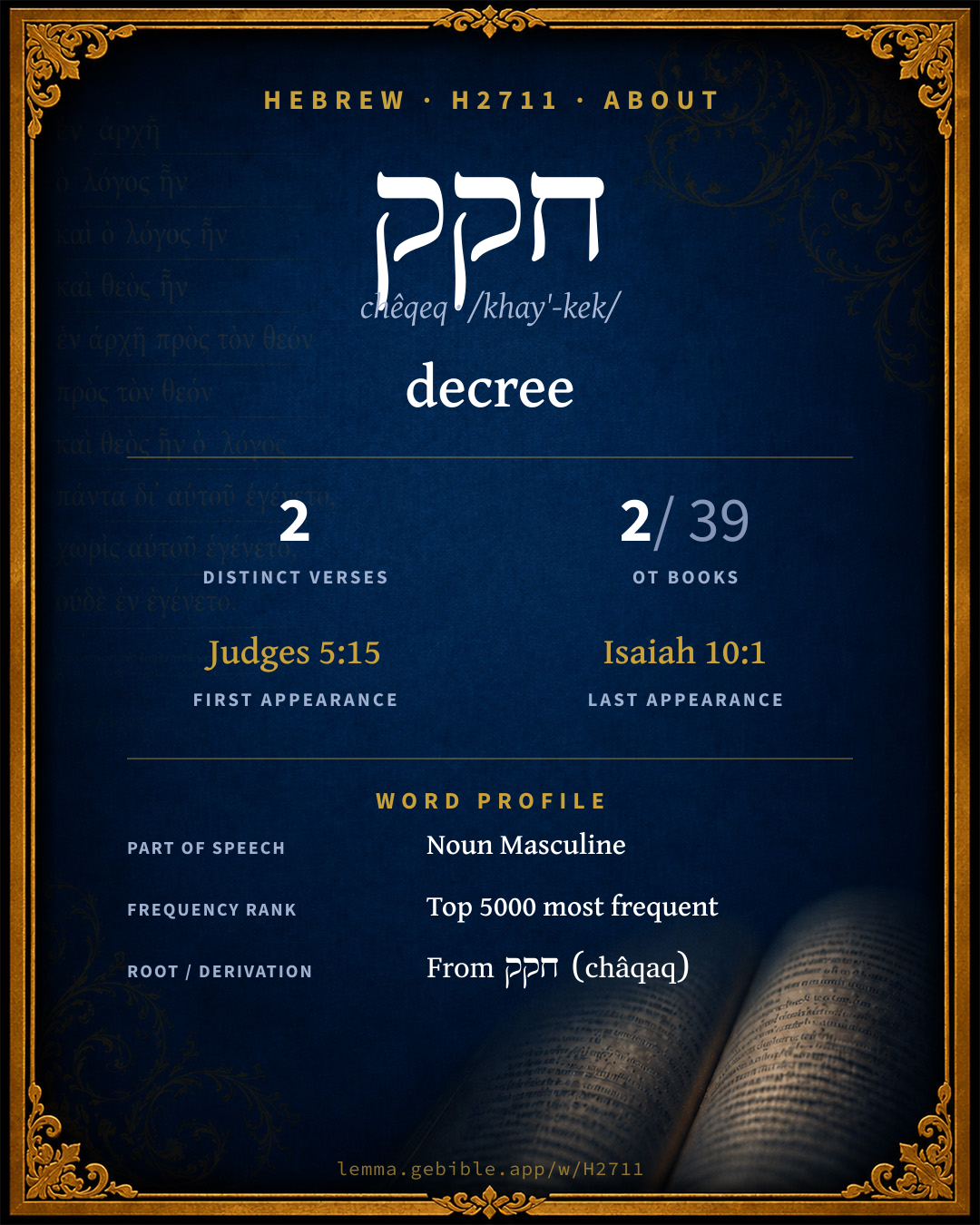
חֵקֶק
decree
Full lexicon entry — Brown-Driver-Briggs (BDB)
From Brown-Driver-Briggs (BDB)
Where this word appears
Grammar key — what these labels mean
Part of speech
- Noun
- A naming word — a person, place, thing, or idea.
Noun type
- Common
- A common noun — a general class of person, place, or thing (“king,” “city,” “water”), not a specific name.
State
- Construct
- A noun bound to a following noun in a possessive / “of” relationship (the construct chain).
Gender
- Masculine
- Grammatically masculine.
Number
- Plural
- More than one (in Hebrew, generally three or more).
Every verse where H2711 appears in the Book of Judges — 1 distinct verse. Click any verse to open its interlinear word-by-word view. Verse text shown in the World English Bible for context — . Each verse’s Hebrew form is shown with its reference; the English is not keyword-highlighted, since the data carries no word-level English alignment. Use “Compare translations” on any verse to read it across multiple English versions. This concordance covers the Hebrew Bible; Septuagint (Greek Old Testament) occurrences are not indexed here.
Judges
About this entry
At a glance — auto-summarized from this page’s data, not written by a person. Every figure links to its source below. This summary describes the numbers; it doesn’t interpret them.
“decree” is the headline sense of the Hebrew noun חקק (chêqeq). With only 2 verses it sits in the long tail of Hebrew Bible vocabulary. It clusters heavily in Judges, which alone accounts for 50% of its uses. First canonically at Judges 5:15, it enters the text early. From the same root come חקק, חק and חקק. For the data behind this summary, explore the sense tree and the renderings breakdown below.
Gloss history
Strong's 1890 vs modern scholarship
About this word
Strong's H2711 catalogs a Hebrew word from the Hebrew Old Testament.
These counts are not copied from any lexicon or concordance. They are computed here, from the morphology-tagged Hebrew Old Testament. What Lemma adds →
- 2
- distinct verses
- The word appears in 2 distinct verses.
- 2 / 39
- OT books
- The word appears in 2 of 39 Old Testament books.
- #4,807
- by frequency
- Top 5000 most frequent Hebrew words (rank 4,807 of 8,640 Hebrew words by occurrence).
View all 2 occurrences in the concordance →
By traditional corpus
Conventional, traditional groupings — biblical authorship is debated, so this is a traditional corpus grouping, not an authorship claim. Each share is this word’s portion of its verses in that division of the Hebrew canon. Each figure is a share of the word’s 2 distinct verses.
- Prophets (Nevi'im) 2 verses · 100%
How translations render this word
Counts come from each version’s own published word-to-Strong’s tagging or interlinear alignment — an approximate guide to how each version renders this word, not a word-level alignment the data otherwise carries. Because each total is that version’s own tagged count, the per-version totals vary from one another and need not match the appearance or distinct-verse counts above. These counts may also differ from a printed concordance because Lemma counts each distinctly tagged rendering and does not collapse phrase taggings into a single head-word total. This is a fixed set of word-tagged versions (KJV, ASV, BSB, ULT) and does not change with the reading translation you choose elsewhere. Each version’s license is shown beside its name below (and on Sources).
- King James Version: Decrees 1×, Thoughts 1×
- American Standard Version: Decrees 1×, Resolves 1×
- Berean Standard Bible: Indecision 1×, Statutes 1×
- unfoldingWord Literal Text: Decrees of 1×, Searchings of 1×
King James Version Public Domain
Renders H2711 across 2 tagged occurrences — most commonly:
American Standard Version Public Domain
Renders H2711 across 2 tagged occurrences — most commonly:
Berean Standard Bible Public Domain
Renders H2711 across 2 tagged occurrences — most commonly:
unfoldingWord Literal Text CC BY-SA 4.0
Renders H2711 across 2 tagged occurrences — most commonly:
18 senses and sub-senses in the full BDB
What do BDB’s symbols mean?
BDB uses these scholarly abbreviations:
| Symbol | Meaning |
|---|---|
| 𝔊 | the Septuagint (the ancient Greek translation, LXX) |
| 𝔙 | the Vulgate (the Latin translation) |
| 𝔖 | the Syriac version (the Peshitta) |
| 𝔗 | the Targum (the Aramaic translation) |
| ψ | the Psalms |
| √ | root (the underlying root or stem) |
| ‖ | parallel passage (a synonymous or contrasted parallel) |
| † | the dagger: every passage where the word occurs is cited |
The 18 senses and sub-senses the full Brown-Driver-Briggs lexicon distinguishes for this word, in lexicon order (not ranked by frequency), with BDB’s own verbatim wording and sub-sense lettering. Shown in Hebrew script with BDB’s own scholarly abbreviations. The condensed entry is in the Lexicon Entry tab.
- 1. prescribed task, assigned to Isr. in Egypt Ex 5:14 (E). e.g. Exodus 5:14
- 2. prescribed portion, or allowance of food Gn 47:22(×2) (J); Pr 30:8; 31:15; Ez 16:27; מחקי Jb 23:12 (RV; בְּחֵקִי in my bosom). e.g. Genesis 47:22
- 3. action prescribed for oneself, resolve: חִקֲקֵי לֵב Ju 5:15 resolves of mind ‖ חִקְרֵי לֵב v 16. e.g. Judges 5:15
- 4. prescribed due of the priests from offerings Lv 6:11; 10:13(×2), 14(×2) (P); due of י׳ Lv 6:15 (P); לח׳ עולם Ex 29:28; Lv 7:34; 10:15; Nu 18:8, 11, 19 (all P), Lv 24:9 (H); portion of oil for the תּרומה Ez 45:14. e.g. Leviticus 6:11
- 5. prescribed limit, boundary: of sea Je 5:22; Pr 8:29; 30:8; waters Jb 26:10; heavens ψ 148:6; land of Israel Mi 7:11; of time Jb 14:5, 13; so פָּֽעֲרָה פִיהָ לִבְלִי חֹ֑ק Is 5:14 She’ôl openeth wide her mouth, without limit. e.g. Jeremiah 5:22
- 6. enactment, decree, ordinance of either God or man:
- a. specific decree: law of fifth in Egypt Gn 47:26 (J); of passover Ex 12:24 (J); lament for Jephthah’s daughter Ju 11:39; for Josiah 2 Ch 35:25; חק ומשׁפט Ex 15:25; Jos 24:25 (both E), 1 S 30:25; חק עולם Ex 30:21; ‖ עֵדוּת, מִשְׁפָּט ψ 81:5, 6 (law of a festival). e.g. Genesis 47:26
- b. of י׳ in nature Jb 28:26. e.g. Job 28:26
- c. respecting Mess. king ψ 2:7; day of י׳ Zp 2:2 MT, but on text v. We and טֶרֶם (p. 382); covenant with Jacob ψ 105:10 = 1 Ch 16:17; destiny of man Jb 23:14. e.g. Psalms 2:7
- d. law in general עלי חק according to law, right ψ 94:20 (others against law); לַמֵּד ח׳ ומשׁפט Ezr 7:10; ‖ בּרית and תורות Is 24:5; ‖ עדות ψ 99:7. e.g. Psalms 94:20
- 7. pl. חֻקִּים enactments, statutes of a law:
- a. of י׳ in nature Je 31:36. e.g. Jeremiah 31:36
- b. of the prophets Zc 1:6. e.g. Zechariah 1:6
- c. conditions of deed of purchase Je 32:11. e.g. Jeremiah 32:11
- d. enactments ‖ מִשְׁפָּטִים: ancestral Ez 20:18; given by God as punishment for disobedience 20:25. e.g. Ezekiel 20:18
- e. decrees of unjust judges חִקֲקֵי־אָוֶן Is 10:1. e.g. Isaiah 10:1
- f. civil enactments prescribed by God: חֻקֵּי האלהים Ex 18:16 (E; ‖ תּוֹרֹתָיו), v 20 (E; ‖ id.) e.g. Exodus 18:16
- g. elsewhere of prescriptions of the several codes of Hex: Lv 10:11; Nu 30:17 (P), Dt 4:6; 6:24; 16:12 ψ 119:5 + 20 times, Mal 3:7; ‖ תּוֹרַת י׳ Am 2:4; ח׳ ותורות ψ 105:45; דברי הת׳ והח׳ Dt 17:19; ‖ ברית ψ 50:16; ח׳ וברית ועדות 2 K 17:15; usually either ‖ משׁפטים Dt 4:1, 5, 8, 14; 5:1; 11:32; 12:1; 26:16, 1 K 9:4 = 2 Ch 7:17, 1 Ch 22:13; Ez 11:12; 36:27, or else ח׳ ומשׁפטים combined with others synon. (usually preceding): e.g. דבר(ים) ψ 147:19; תורה 2 Ch 33:8; Mal 3:22; מצוה Dt 5:28; 6:1; 7:11; מצות Ne 1:7; 1 K 8:58; מצוה, תורה 2 Ch 19:10; עֵדֹת Dt 4:45; 6:20; sometimes foll.: e.g. תורות Lv 26:46; מצוה, תורה 2 K 17:37; or in different order, e.g. מ׳ ותורות ח׳ ומצות Ne 9:13; מצות ומ׳ וח׳ Ne 10:30; ח׳ ומצות ומ׳ Dt 26:17. Apart from משׁפטים it is combined with מצות, e.g. מ׳ וח׳ Ex 15:26 (R), Dt 27:10; ח׳ ומ׳ Dt 4:40; 1 K 3:14; 8:61; מ׳ וח׳ ותורה Ne 9:14; מ׳ ועדות וח׳ Dt 6:17; 1 Ch 29:19; 2 Ch 34:31; דברי מ׳ וח׳ Ezr 7:11; it is used c. vbs.: נתן Lv 26:46 + 3 times; צוּה Nu 30:17 + 9 times; למּד Dt 4:1 + 10 times; שׁמר Dt 26:17 + 16 times; עשׂה Dt 6:24 + 5 times; שׁמר לעשׂות Dt 11:32 + 4 times; הלך בְּ 1 K 8:61 + 3 times—[On usage of חֹק v. חֻקָּה ad fin.] e.g. Leviticus 10:11
Senses from the full Brown-Driver-Briggs lexicon (Brown, Driver, Briggs; Oxford 1906 — public domain), digitized via Sefaria, supplemented by the OpenScriptures HebrewLexicon (CC BY 4.0). Full attribution on Sources.
Word origin
n.m. Mi 7:11 something prescribed, a statute or due;—ח׳ Gn 47:22 + 22 times; חָק־ Ex 30:21 + 14 times; sf. חֻקִּי Pr 30:8 + 3 times; חָקְךָ Lv 10:13, 14 etc. + 4 times sfs.; pl. חֻקִּים Dt 4:5 + 31 times; cstr. חֻקֵּי Ex 18:16; חוּקֵּ֯י Ez 20:18; also חִקֲקֵי Ju 5:15; Is 10:1 (Ges§ 93, 1 R 7); חֻקָּו֯ Jb 14:5 etc. + 44 times sfs.—
— Brown-Driver-Briggs (Oxford 1906, public domain), digitized via Sefaria, supplemented by the OpenScriptures HebrewLexicon (CC BY 4.0). See Sources.
Derived from חקק (châqaq) (H2710) — to decree.
Jastrow Dictionary
A second Hebrew/Aramaic lexicon for comparison, covering Aramaic and post-biblical (Talmudic, Targumic, Midrashic) usage that the biblical-Hebrew BDB does not. Matched by lemma rather than by Strong’s number, so a lemma may carry more than one Jastrow headword (shown separately below), and the entries cover usage well beyond the Bible.
חָקַק
- to draw a circle, to limit;
- 1. (denom. of חֹק) to legislate. Y. Kil. I, 27ᵇ top, a. e. שחָקַקְתִּי, v. חוֹק. Num. R. s. 19, beg., v. חוּקָּה; a. fr.
- 2. to hollow out, to shape a receptacle. Y. Bets. I, 60ᵇ bot. קערה שחֲקָקָהּ קוף a dish which an ape has hollowed out.—Part. pass. חָקוּק, f. חֲקוּקָה. Tosef. B. Bath. III, 1; B. Bath. 65ᵇ, a. e. מכתשת הח׳ the mortar which has been hollowed out (of stone &c.), opp. הקבועה stationary in the ground.
- 3. to engrave, write with the stilus. Tanḥ. Ki Thissa 14, v. הָרַט. Gitt. 20ᵃ וכתב ולא וח׳ ‘he writes’ (Deut. XXIV, 1) but not ‘he engraves’ (on tablets &c.). Ib. חָק תוכות he chisels out the surroundings (making the letters come out in relief); חק יריכות he digs the sides, i.e. he engraves the letters. Gen. R. s. 68; s. 78 שאיקונין שלך חֲקוּקָה וכ׳ whose picture is engraven above (in the heavenly throne). Y. Yoma IV, beg. 41ᵇ חֲקוּקִים היו the inscriptions were engraven (not written with ink). Y. Ned. VI, 40ᵃ top מפני צלמי … שחקוקים וכ׳ on account of the Chaldean images which were engraven on the walls (Ez. XXIII, 14); a. e. e.g. Deuteronomy 24:1
- to be hollowed out. Y. Erub. II, 20ᵃ top אם תֵּיחָקֵק if the block be hollowed out. Sot. 36ᵇ שיֵחָקֵק על וכ׳ (not שיחקוק) to have his name engraven on the jewels &c.; a. e.
חֲקַק
- Lev. R. s. 6 נטל … וחַקְקֵיה he took a reed and hollowed it out. Ḥull. 25ᵃ; Sabb. 103ᵃ חַק קפיזא וכ׳ he hollowed out &c., v. חֲטַט I.—Part. pass. חָקִיק, חֲקִיק engraven, marked. Targ. Y. Ex. XXVIII, 11 (Ar. חקיין). Targ. Y. Lev. XIX, 28 (h. text קעקע). Targ. Cant. II, 9; a. fr.
- to be engraven, to engrave itself. Targ. Y. Ex. XX, 2; 3.
A Dictionary of the Targumim, the Talmud Babli and Yerushalmi, and the Midrashic Literature (Marcus Jastrow; London, Luzac, 1903) — Public Domain. Digitized via Sefaria. Digitized via Sefaria. Full attribution on Sources.
Same root — word family
Other BDB entries built from the same root as H2711, grouped by Strong’s listed origin. These share a root / origin per the lexicon — not necessarily a shared meaning. Each links to that word’s own entry.
Derives from
Shares the same root
Proper names from this root
People and places named from this root — a name, not an additional meaning of the word.
Compare all same-root words → 1 of the same-root words is a proper name (a person or place). They share a root, not necessarily a meaning.
Septuagint verse parallels
This word appears in 2 verses that also exist in the Greek Old Testament (Septuagint), out of the 2 Hebrew verses it occurs in. You can read those verses in Greek by switching the Old Testament edition to the Septuagint.
Read these verses in the Septuagint
This is a verse-level parallel only — the same verses exist in both the Hebrew and Greek Old Testaments. No word-level Hebrew↔Greek correspondence is claimed: the data carries no such alignment, so no Greek word is shown as this Hebrew word’s translation. Coverage is not total — the Septuagint omits the deuterocanon and renumbers the Psalms, so some Hebrew verses have no direct Greek parallel.