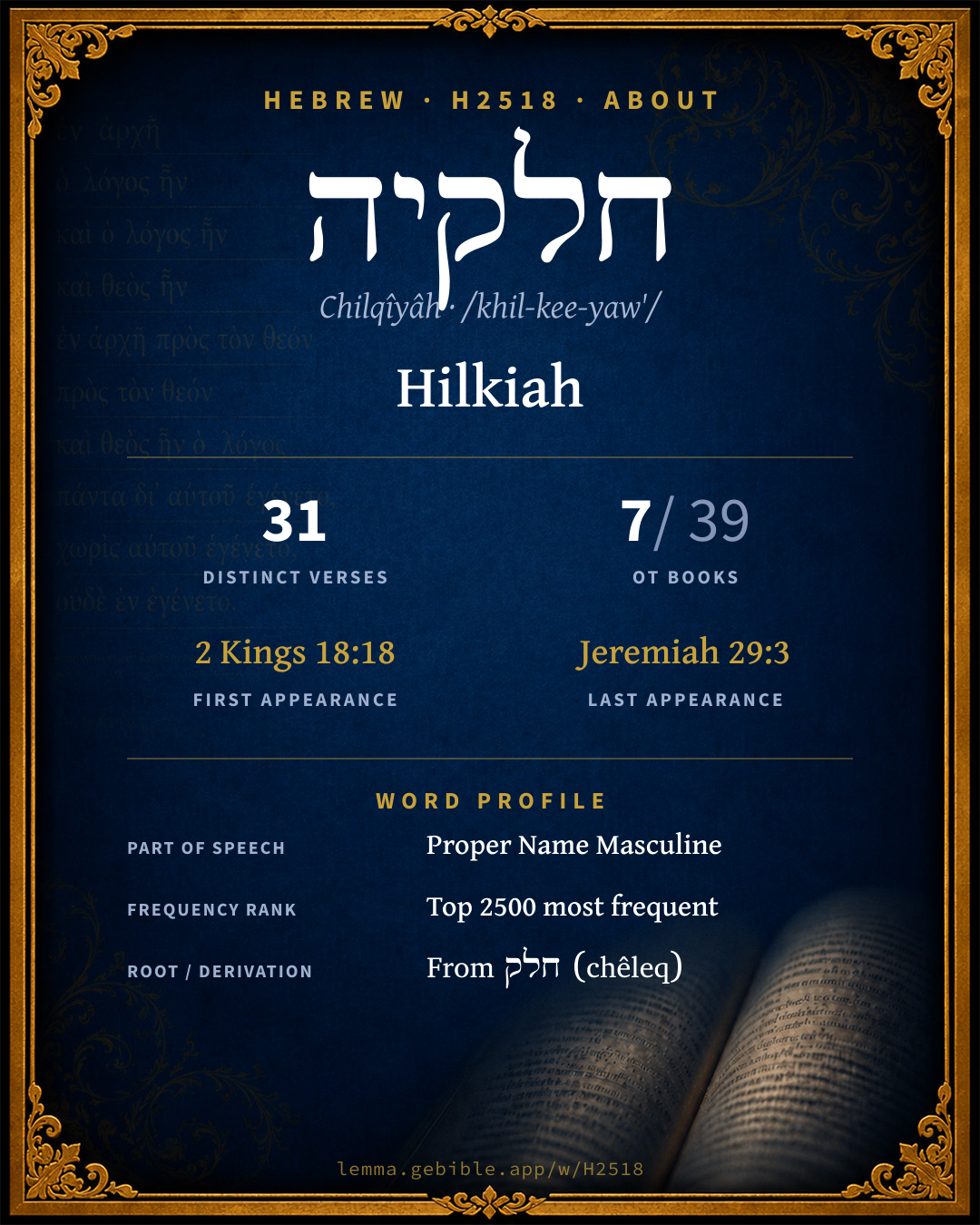
חִלְקִיָּהוּ
Hilkiah
BDB lists 8 entries for ‘Hilkiah’ fuller range ↓
Full lexicon entry — Brown-Driver-Briggs (BDB)
From Brown-Driver-Briggs (BDB)
Where this word appears
Grammar key — what these labels mean
Part of speech
- Noun
- A naming word — a person, place, thing, or idea.
Noun type
- Proper
- A name of a specific person, place, or people (e.g. Abraham, Zion, Israel).
Every verse where H2518 appears — 31 distinct verses across 7 books. Click any verse to open its interlinear word-by-word view. Verse text shown in the World English Bible for context — . Each verse’s Hebrew form is shown with its reference; the English is not keyword-highlighted, since the data carries no word-level English alignment. Use “Compare translations” on any verse to read it across multiple English versions. This concordance covers the Hebrew Bible; Septuagint (Greek Old Testament) occurrences are not indexed here.
2 Kings 10 verses
- 2 Kings 18:18 חִלְקִיָּ֖הוּ n Proper When they had called to the king, there came out to them Eliakim the son of Hilkiah, who was over the household, and Shebnah the scribe, and Joah the son of Asaph the recorder.
- 2 Kings 18:26 חִ֠לְקִיָּהוּ n Proper Then said Eliakim the son of Hilkiah, and Shebnah, and Joah, to Rabshakeh, Please speak to your servants in the Syrian language; for we understand it: and don't speak with us in the Jews' language, in the ears of the people who are on the wall.
- 2 Kings 18:37 חִלְקִיָּ֣ה n Proper Then came Eliakim the son of Hilkiah, who was over the household, and Shebna the scribe, and Joah the son of Asaph the recorder, to Hezekiah with their clothes torn, and told him the words of Rabshakeh.
- 2 Kings 22:4 חִלְקִיָּ֨הוּ֙ n Proper Go up to Hilkiah the high priest, that he may sum the money which is brought into the house of Yahweh, which the keepers of the threshold have gathered of the people:
- 2 Kings 22:8 חִלְקִיָּ֜הוּ חִלְקִיָּ֧ה n Proper n Proper Hilkiah the high priest said to Shaphan the scribe, I have found the book of the law in the house of Yahweh. Hilkiah delivered the book to Shaphan, and he read it.
- 2 Kings 22:10 חִלְקִיָּ֖ה n Proper Shaphan the scribe told the king, saying, Hilkiah the priest has delivered me a book. Shaphan read it before the king.
- 2 Kings 22:12 חִלְקִיָּ֣ה n Proper The king commanded Hilkiah the priest, and Ahikam the son of Shaphan, and Achbor the son of Micaiah, and Shaphan the scribe, and Asaiah the king's servant, saying,
- 2 Kings 22:14 חִלְקִיָּ֣הוּ n Proper So Hilkiah the priest, and Ahikam, and Achbor, and Shaphan, and Asaiah, went to Huldah the prophetess, the wife of Shallum the son of Tikvah, the son of Harhas, keeper of the wardrobe (now she lived in Jerusalem in the second quarter); and they talked with her.
- 2 Kings 23:4 חִלְקִיָּהוּ֩ n Proper The king commanded Hilkiah the high priest, and the priests of the second order, and the keepers of the threshold, to bring forth out of the temple of Yahweh all the vessels that were made for Baal, and for the Asherah, and for all the host of the sky, and he burned them outside of Jerusalem in the fields of the Kidron, and carried the ashes of them to Bethel.
- 2 Kings 23:24 חִלְקִיָּ֥הוּ n Proper Moreover those who had familiar spirits, and the wizards, and the teraphim, and the idols, and all the abominations that were seen in the land of Judah and in Jerusalem, did Josiah put away, that he might confirm the words of the law which were written in the book that Hilkiah the priest found in the house of Yahweh.
1 Chronicles 4 verses
- 1 Chronicles 6:13 חִלְקִיָּ֔ה וְ/חִלְקִיָּ֖ה n Proper conj + n Proper and Shallum became the father of Hilkiah, and Hilkiah became the father of Azariah,
- 1 Chronicles 6:45 חִלְקִיָּֽה n Proper the son of Hashabiah, the son of Amaziah, the son of Hilkiah,
- 1 Chronicles 9:11 חִלְקִיָּ֜ה n Proper and Azariah the son of Hilkiah, the son of Meshullam, the son of Zadok, the son of Meraioth, the son of Ahitub, the ruler of the house of God;
- 1 Chronicles 26:11 חִלְקִיָּ֤הוּ n Proper Hilkiah the second, Tebaliah the third, Zechariah the fourth: all the sons and brothers of Hosah were thirteen.
2 Chronicles 7 verses
- 2 Chronicles 34:9 חִלְקִיָּ֣הוּ n Proper They came to Hilkiah the high priest, and delivered the money that was brought into the house of God, which the Levites, the keepers of the threshold, had gathered of the hand of Manasseh and Ephraim, and of all the remnant of Israel, and of all Judah and Benjamin, and of the inhabitants of Jerusalem.
- 2 Chronicles 34:14 חִלְקִיָּ֣הוּ n Proper When they brought out the money that was brought into the house of Yahweh, Hilkiah the priest found the book of the law of Yahweh [given] by Moses.
- 2 Chronicles 34:15 חִלְקִיָּ֗הוּ חִלְקִיָּ֛הוּ n Proper n Proper Hilkiah answered Shaphan the scribe, I have found the book of the law in the house of Yahweh. Hilkiah delivered the book to Shaphan.
- 2 Chronicles 34:18 חִלְקִיָּ֖הוּ n Proper Shaphan the scribe told the king, saying, Hilkiah the priest has delivered me a book. Shaphan read therein before the king.
- 2 Chronicles 34:20 חִלְקִיָּ֡הוּ n Proper The king commanded Hilkiah, and Ahikam the son of Shaphan, and Abdon the son of Micah, and Shaphan the scribe, and Asaiah the king's servant, saying,
- 2 Chronicles 34:22 חִלְקִיָּ֜הוּ n Proper So Hilkiah, and they whom the king [had commanded], went to Huldah the prophetess, the wife of Shallum the son of Tokhath, the son of Hasrah, keeper of the wardrobe; (now she lived in Jerusalem in the second quarter;) and they spoke to her to that effect.
- 2 Chronicles 35:8 חִלְקִיָּ֨ה n Proper His princes gave for a freewill-offering to the people, to the priests, and to the Levites. Hilkiah and Zechariah and Jehiel, the rulers of the house of God, gave to the priests for the Passover offerings two thousand and six hundred [small cattle], and three hundred oxen.
Ezra 1 verse
Nehemiah 4 verses
- Nehemiah 8:4 וְ/חִלְקִיָּ֛ה conj + n Proper Ezra the scribe stood on a pulpit of wood, which they had made for the purpose; and beside him stood Mattithiah, and Shema, and Anaiah, and Uriah, and Hilkiah, and Maaseiah, on his right hand; and on his left hand, Pedaiah, and Mishael, and Malchijah, and Hashum, and Hashbaddanah, Zechariah, [and] Meshullam.
- Nehemiah 11:11 חִלְקִיָּ֜ה n Proper Seraiah the son of Hilkiah, the son of Meshullam, the son of Zadok, the son of Meraioth, the son of Ahitub, the ruler of the house of God,
- Nehemiah 12:7 חִלְקִיָּ֖ה n Proper Sallu, Amok, Hilkiah, Jedaiah. These were the chiefs of the priests and of their brothers in the days of Jeshua.
- Nehemiah 12:21 לְ/חִלְקִיָּ֣ה prep + n Proper of Hilkiah, Hashabiah; of Jedaiah, Nethanel.
Isaiah 3 verses
- Isaiah 22:20 חִלְקִיָּֽהוּ n Proper It shall happen in that day, that I will call my servant Eliakim the son of Hilkiah:
- Isaiah 36:3 חִלְקִיָּ֖הוּ n Proper Then came forth to him Eliakim the son of Hilkiah, who was over the household, and Shebna the scribe, and Joah, the son of Asaph, the recorder.
- Isaiah 36:22 חִלְקִיָּ֣הוּ n Proper Then came Eliakim the son of Hilkiah, who was over the household, and Shebna the scribe, and Joah, the son of Asaph, the recorder, to Hezekiah with their clothes torn, and told him the words of Rabshakeh.
Jeremiah 2 verses
- Jeremiah 1:1 חִלְקִיָּ֑הוּ n Proper The words of Jeremiah the son of Hilkiah, of the priests who were in Anathoth in the land of Benjamin:
- Jeremiah 29:3 חִלְקִיָּ֑ה n Proper by the hand of Elasah the son of Shaphan, and Gemariah the son of Hilkiah, (whom Zedekiah king of Judah sent to Babylon to Nebuchadnezzar king of Babylon), saying,
About this entry
At a glance — auto-summarized from this page’s data, not written by a person. Every figure links to its source below. This summary describes the numbers; it doesn’t interpret them.
“Hilkiah” is the headline sense of the Hebrew name חלקיה (Chilqîyâh). Scripture first uses it in 2 Kings 18:18. It appears 31 verses across 7 books of the Hebrew Bible, among its moderately common vocabulary. More than a quarter of its appearances fall in 2 Kings. The sections below give every occurrence and version rendering.
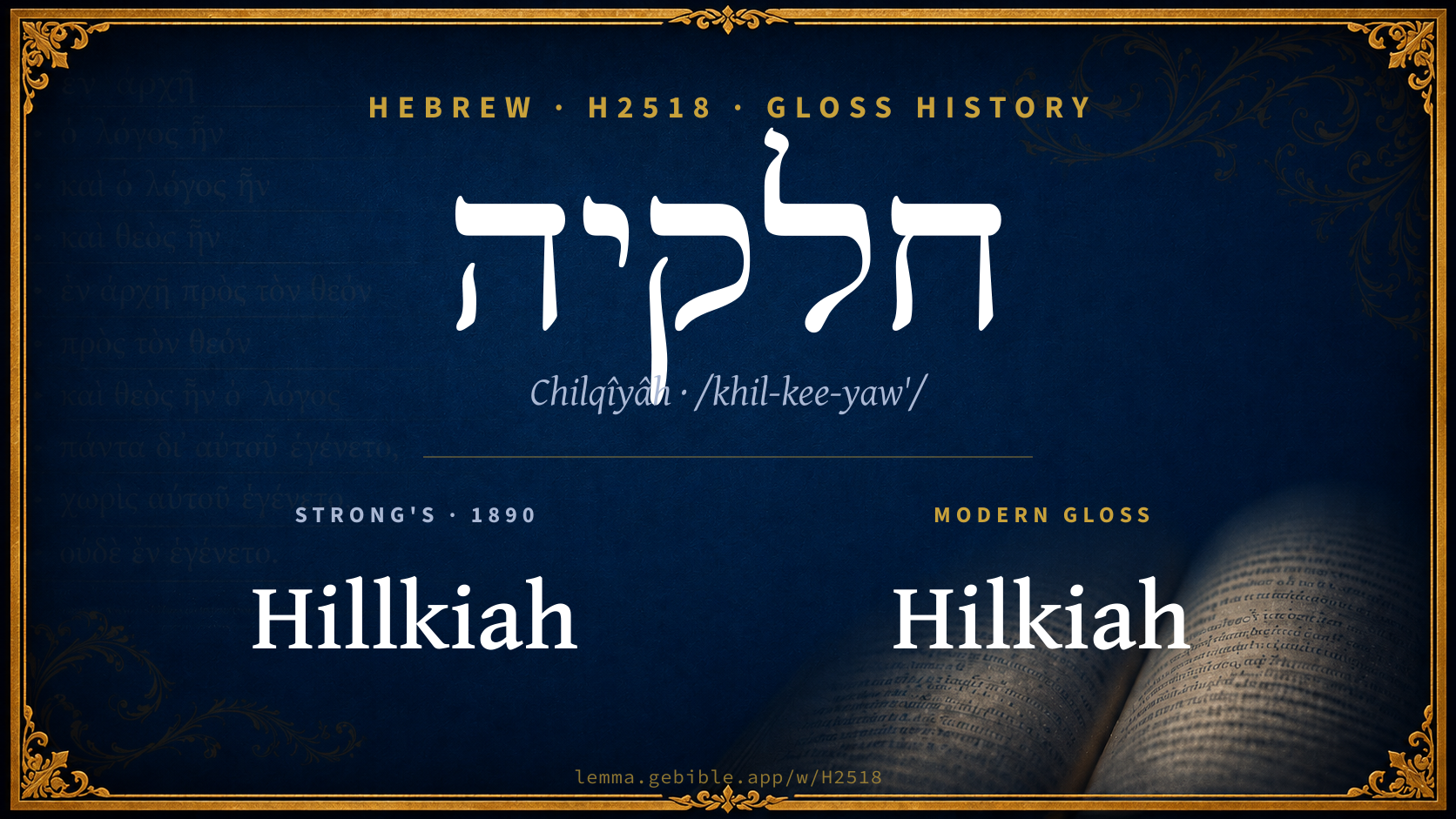
Gloss history
Strong's 1890 vs modern scholarship
About this word
Strong's H2518 catalogs a Hebrew word from the Hebrew Old Testament.
These counts are not copied from any lexicon or concordance. They are computed here, from the morphology-tagged Hebrew Old Testament. What Lemma adds →
- 31
- distinct verses
- The word appears in 31 distinct verses.
- 7 / 39
- OT books
- The word appears in 7 of 39 Old Testament books.
- #1,041
- by frequency
- Top 2500 most frequent Hebrew words (rank 1,041 of 8,640 Hebrew words by occurrence).
View all 31 occurrences in the concordance →
Most concentrated in
- 2 Kings 10 verses 32%
- 2 Chronicles 7 verses 23%
- 1 Chronicles 4 verses 13%
By section of the Old Testament
By traditional corpus
Conventional, traditional groupings — biblical authorship is debated, so this is a traditional corpus grouping, not an authorship claim. Each share is this word’s portion of its verses in that division of the Hebrew canon. Each figure is a share of the word’s 31 distinct verses.
- Writings (Ketuvim) 16 verses · 52%
- Prophets (Nevi'im) 15 verses · 48%
How translations render this word
Counts come from each version’s own published word-to-Strong’s tagging or interlinear alignment — an approximate guide to how each version renders this word, not a word-level alignment the data otherwise carries. Because each total is that version’s own tagged count, the per-version totals vary from one another and need not match the appearance or distinct-verse counts above. These counts may also differ from a printed concordance because Lemma counts each distinctly tagged rendering and does not collapse phrase taggings into a single head-word total. This is a fixed set of word-tagged versions (KJV, ASV, BSB, ULT) and does not change with the reading translation you choose elsewhere. Each version’s license is shown beside its name below (and on Sources).
- King James Version: Hilkiah 33×
- American Standard Version: Hilkiah 34×
- Berean Standard Bible: Hilkiah 30×, He 2×, Hilkiah’s 2×
- unfoldingWord Literal Text: Hilkiah 33×
King James Version Public Domain
Renders H2518 across 34 tagged occurrences — most commonly:
Plus 1 rendering that appears only once — usually multi-word phrases or single function words the recovered tagging swept in, not distinct renderings.
American Standard Version Public Domain
Renders H2518 across 34 tagged occurrences — most commonly:
Berean Standard Bible Public Domain
Renders H2518 across 34 tagged occurrences — most commonly:
unfoldingWord Literal Text CC BY-SA 4.0
Renders H2518 across 33 tagged occurrences — most commonly:
8 senses and sub-senses in the full BDB
What do BDB’s symbols mean?
BDB uses these scholarly abbreviations:
| Symbol | Meaning |
|---|---|
| 𝔊 | the Septuagint (the ancient Greek translation, LXX) |
| 𝔙 | the Vulgate (the Latin translation) |
| 𝔖 | the Syriac version (the Peshitta) |
| 𝔗 | the Targum (the Aramaic translation) |
| ψ | the Psalms |
| √ | root (the underlying root or stem) |
| ‖ | parallel passage (a synonymous or contrasted parallel) |
| † | the dagger: every passage where the word occurs is cited |
The 8 senses and sub-senses the full Brown-Driver-Briggs lexicon distinguishes for this word, in lexicon order (not ranked by frequency), with BDB’s own verbatim wording and sub-sense lettering. Shown in Hebrew script with BDB’s own scholarly abbreviations. The condensed entry is in the Lexicon Entry tab. See also the Forms in the corpus table below.
- 1. father of Eliakim, Hezekiah’s officer, חלקיהו 2 K 18:18, 26; Is 22:20; 36:3, 22; חלקיה 2 K 18:37. e.g. 2 Kings 18:18
- 2. high priest, Josiah’s time, חלקיהו 2 K 22:4, 8, 14; 23:4, 24; 2 Ch 34:9, 14, 15(×2), 18, 20, 22; חלקיה 2 K 22:8, 10, 12 1 Ch 5:39(×2) 9:11; 2 Ch 35:8; Ezr 7:1, cf. also Ne 11:11. e.g. 2 Kings 22:4
- 3. חלקיהו father of Jerem. Je 1:1.—The foll. are all חלקיה: e.g. Jeremiah 1:1
- 4. Levites:
- a. 1 Ch 6:30. e.g. 1 Chronicles 6:30
- b. 1 Ch 26:11. e.g. 1 Chronicles 26:11
- 5. a priest, contemp. of Ezra Ne 4:8; 12:7, 21. e.g. Nehemiah 4:8
- 6. father of Gemariah, an ambassador of Zedekiah to Nebuchadrezzar Je 29:3. e.g. Jeremiah 29:3
Senses from the full Brown-Driver-Briggs lexicon (Brown, Driver, Briggs; Oxford 1906 — public domain), digitized via Sefaria, supplemented by the OpenScriptures HebrewLexicon (CC BY 4.0). Full attribution on Sources.
Word origin
n.pr.m. (my portion is י׳) 𝔊 usually Χελκ(ε)ιας, Χελχιας;—
— Brown-Driver-Briggs (Oxford 1906, public domain), digitized via Sefaria, supplemented by the OpenScriptures HebrewLexicon (CC BY 4.0). See Sources.
Derived from חלק (chêleq) (H2506) — portion.
Jastrow Dictionary
A second Hebrew/Aramaic lexicon for comparison, covering Aramaic and post-biblical (Talmudic, Targumic, Midrashic) usage that the biblical-Hebrew BDB does not. Matched by lemma rather than by Strong’s number, so a lemma may carry more than one Jastrow headword (shown separately below), and the entries cover usage well beyond the Bible.
חִלְקִיָּה
- (b. h.) pr. n. m. Ḥilkiya, Hilkiah,
- 1. the high priest in the reign of Josiah. Meg. 14ᵇ; Yalk. Josh. 9; a. e.
- 2. father of Jeremiah the prophet. Num. R. s. 8, end. Snh. 95ᵃ, a. fr.
- 3. name of several Amoraim. Y. B. Bath. III, 14ᵃ; Bab. B. Bath. 39ᵇ.—Y. Shek. I, 46ᵇ; a. e. (v. Fr. M’bo p. 85ᵃ).—Kidd. 33ᵇ.—Yeb. 9ᵃ.—B. Mets. 96ᵇ; a. e.
A Dictionary of the Targumim, the Talmud Babli and Yerushalmi, and the Midrashic Literature (Marcus Jastrow; London, Luzac, 1903) — Public Domain. Digitized via Sefaria. Digitized via Sefaria. Full attribution on Sources.
Forms in the corpus
The 24 distinct written forms H2518 takes in the Hebrew Bible, most frequent first — each parse links to that state’s occurrences in the concordance. Hebrew forms include their vowel points and cantillation, so a single lemma takes many written forms.
| Form | Parsing | Example | Uses |
|---|---|---|---|
| חִלְקִיָּ֣הוּ | Noun, Proper | 2 Chronicles 34:9 | 4 |
| חִלְקִיָּ֖הוּ | Noun, Proper | 2 Chronicles 34:18 | 3 |
| חִלְקִיָּ֖ה | Noun, Proper | 2 Kings 22:10 | 2 |
| חִלְקִיָּ֜ה | Noun, Proper | 1 Chronicles 9:11 | 2 |
| חִלְקִיָּ֜הוּ | Noun, Proper | 2 Chronicles 34:22 | 2 |
| חִלְקִיָּ֣ה | Noun, Proper | 2 Kings 18:37 | 2 |
| חִלְקִיָּֽה | Noun, Proper | Ezra 7:1 | 2 |
| וְ/חִלְקִיָּ֖ה | Noun, Proper | 1 Chronicles 6:13 | 1 |
| וְ/חִלְקִיָּ֛ה | Noun, Proper | Nehemiah 8:4 | 1 |
| חִ֠לְקִיָּהוּ | Noun, Proper | 2 Kings 18:26 | 1 |
| חִלְקִיָּ֑ה | Noun, Proper | Jeremiah 29:3 | 1 |
| חִלְקִיָּ֑הוּ | Noun, Proper | Jeremiah 1:1 | 1 |
| חִלְקִיָּ֔ה | Noun, Proper | 1 Chronicles 6:13 | 1 |
| חִלְקִיָּ֗הוּ | Noun, Proper | 2 Chronicles 34:15 | 1 |
| חִלְקִיָּ֛הוּ | Noun, Proper | 2 Chronicles 34:15 | 1 |
| חִלְקִיָּ֡הוּ | Noun, Proper | 2 Chronicles 34:20 | 1 |
| חִלְקִיָּ֤הוּ | Noun, Proper | 1 Chronicles 26:11 | 1 |
| חִלְקִיָּ֥הוּ | Noun, Proper | 2 Kings 23:24 | 1 |
| חִלְקִיָּ֧ה | Noun, Proper | 2 Kings 22:8 | 1 |
| חִלְקִיָּ֨ה | Noun, Proper | 2 Chronicles 35:8 | 1 |
| חִלְקִיָּ֨הוּ֙ | Noun, Proper | 2 Kings 22:4 | 1 |
| חִלְקִיָּֽהוּ | Noun, Proper | Isaiah 22:20 | 1 |
| חִלְקִיָּהוּ֩ | Noun, Proper | 2 Kings 23:4 | 1 |
| לְ/חִלְקִיָּ֣ה | Noun, Proper | Nehemiah 12:21 | 1 |
Same root — word family
Other BDB entries built from the same root as H2518, grouped by Strong’s listed origin. These share a root / origin per the lexicon — not necessarily a shared meaning. Each links to that word’s own entry.
Derives from
Shares the same root
Proper names from this root
People and places named from this root — a name, not an additional meaning of the word.
Compare all same-root words → 1 of the same-root words is a proper name (a person or place). They share a root, not necessarily a meaning.
Bible dictionary
Public-domain dictionary articles matched to this entry by name (Hilkiah). A biblical name can be shared by more than one person or place, so an article may treat several.
Easton's Bible Dictionary · M. G. Easton, 1897
Portion of Jehovah. (1.) 1 Chr. 6:54. (2.) 1 Chr. 26:11. (3.) The father of Eliakim (2 Kings 18:18, 26, 37). (4.) The father of Gemariah (Jer. 29:3). (5.) The father of the prophet Jeremiah (1:1).
(6.) The high priest in the reign of Josiah (1 Chr. 6:13; Ezra 7:1). To him and his deputy (2 Kings 23:5), along with the ordinary priests and the Levites who had charge of the gates, was entrusted the purification of the temple in Jerusalem. While this was in progress, he discovered in some hidden corner of the building a book called the "book of the law" (2 Kings 22:8) and the "book of the covenant" (23:2). Some have supposed that this "book" was nothing else than the original autograph copy of the Pentateuch written by Moses (Deut. 31:9-26). This remarkable discovery occurred in the eighteenth year of Josiah's reign (B.C. 624), a discovery which permanently affected the whole subsequent history of Israel. (See JOSIAH; SHAPHAN.)
(7.) Neh. 12:7. (8.) Neh. 8:4.
Smith's Bible Dictionary · William Smith, 1863
(God is my portion)
+ Father of Eliakim. (2 Kings 18:37; Isaiah 22:20; 36:22) [Eliakim] + High priest in the reign of Josiah. (2 Kings 22:4) seq. 2Chr 34:9 Seq.; 1 Esd. 1:8. (B.C. 623.) His high priesthood was rendered particularly illustrious by the great reformation effected under it by King Josiah, by the solemn Passover kept at Jerusalem in the 18th year of that king's reign, and above all by the discovery which he made of the book of the law of Moses in the temple. + A Merarite Levite, son of Amzi (1 Chronicles 6:45) hebr. 30. + Another Merarite Levite, second son of Hosah. (1 Chronicles 26:11) + One of those who stood on the right hand of Ezra when he read the law to the people; doubtless a Levite, and probably a priest. (Nehemiah 8:4) (B.C 410.) + A priest of Anathoth, father of the prophet Jeremiah. (Jeremiah 1:1) (B.C. before 628.) + Father of Gemariah, who was one of Zedekiah's envoys to Babylon. (Jeremiah 29:3) (B.C. long before 587.)
Hitchcock's Bible Names Dictionary · Roswell D. Hitchcock, 1869
God is my portion
Classic public-domain reference works; full attribution on Sources.
Septuagint verse parallels
This word appears in 27 verses that also exist in the Greek Old Testament (Septuagint), out of the 31 Hebrew verses it occurs in. You can read those verses in Greek by switching the Old Testament edition to the Septuagint.
Read these verses in the Septuagint
This is a verse-level parallel only — the same verses exist in both the Hebrew and Greek Old Testaments. No word-level Hebrew↔Greek correspondence is claimed: the data carries no such alignment, so no Greek word is shown as this Hebrew word’s translation. Coverage is not total — the Septuagint omits the deuterocanon and renumbers the Psalms, so some Hebrew verses have no direct Greek parallel.