
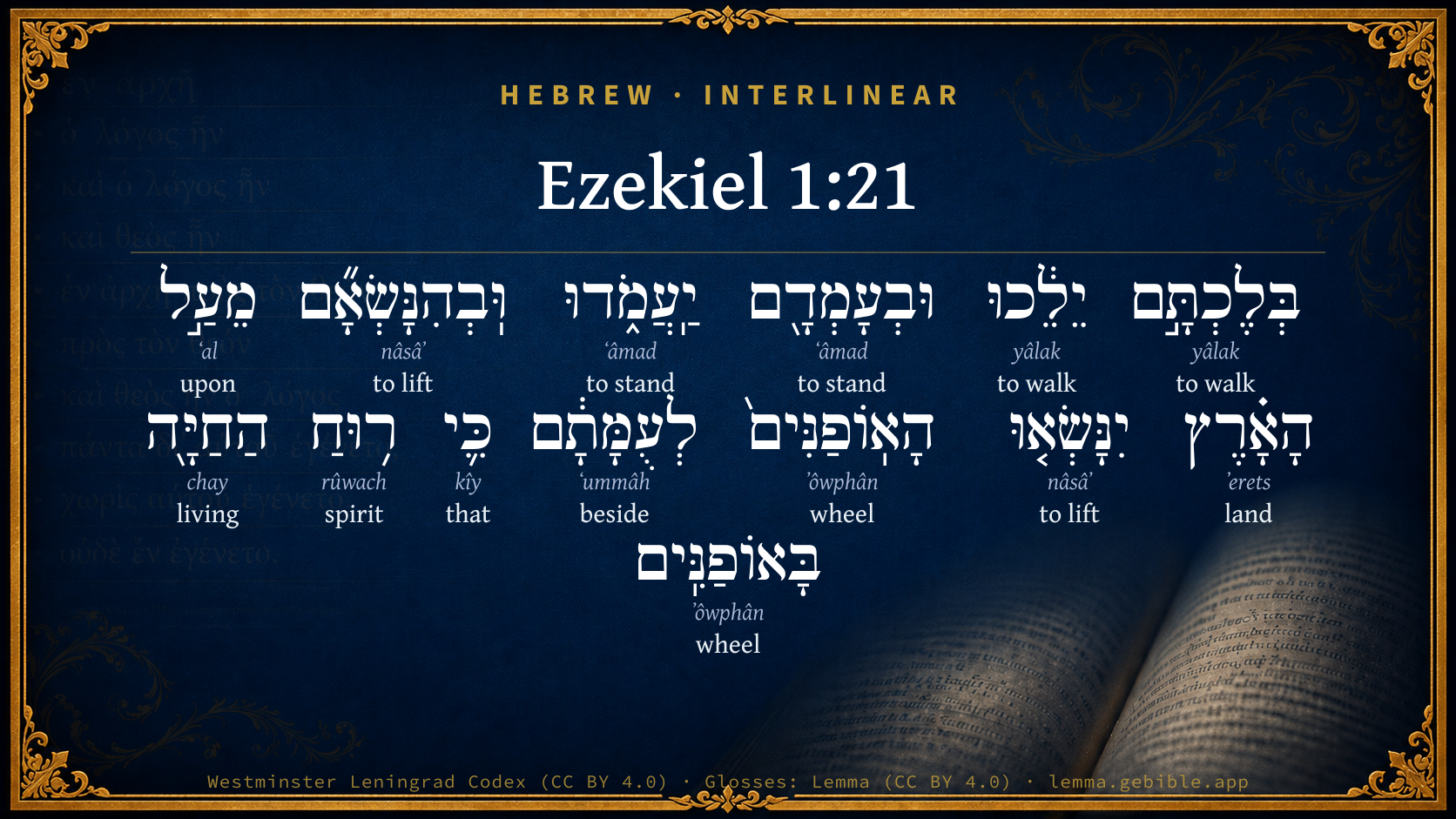
Ezekiel 1:21

Hebrew (Westminster Leningrad Codex) Ezekiel 1:21 appears in the Hebrew Old Testament. The text above is from the Westminster Leningrad Codex. Each word links to its Strong’s number, a concise gloss, and parsing drawn from the Open Scriptures Hebrew Bible morphology. Click any word for its full Brown-Driver-Briggs (BDB) entry.
Download image
Cite this verse

Ezekiel 1:21 (World English Bible). Public Domain. Lemma interlinear Bible study tool, https://lemma.gebible.app/v/ezekiel/1/21.

Show BibTeX & RIS
BibTeX
RIS
English Translation
When those went, these went; and when those stood, these stood; and when those were lifted up from the earth, the wheels were lifted up beside them: for the spirit of the living creature was in the wheels.
World English Bible · Public Domain
Download a study sheet

One document with this verse’s original text, its word-by-word gloss line, the meaning frame, cross-references with their text, attributed commentary, and full source and license credits — printable, and it pastes into notes with its structure intact.

This verse Autodidact and up

Study sheet (.html) Plain text (.txt)

A passage Seminary Student

Up to 50 verses in one chapter. A passage sheet keeps up to 6 commentary sources and 12 cross-references per verse, in the order this page ranks them, and says so on the sheet whenever that leaves anything out. Ask for a single verse and you get the Autodidact verse sheet above.

Everything on this page stays free to read, with no account — the sheet is a download of what is already on screen, not access to it.

Want to remove ads? Support Godless Engineer
Compare translations 3

The same verse in 3 English versions, stacked beneath the original-language interlinear above. Click any original word for its lexicon entry.

Each is an independent rendering of the whole verse — the interlinear is not word-aligned to these translations.

Highlighted words mark where these versions differ — a whole-verse word diff, not a word-by-word alignment.

  • World English Bible Public Domain
    When those went, these went; and when those stood, these stood; and when those were lifted up from the earth, the wheels were lifted up beside them: for the spirit of the living creature was in the wheels.
  • King James Version Public Domain
    When those went, these went; and when those stood, these stood; and when those were lifted up from the earth, the wheels were lifted up over against them: for the spirit of the living creature was in the wheels.
  • unfoldingWord Literal Text CC BY-SA 4.0
    Whenever the creatures moved, the wheels also moved; and when the creatures stood still, the wheels stood still; when the creatures rose up from the earth, the wheels rose up beside them, because the spirit of the living creature was in the wheels.

unfoldingWord Literal Text — © unfoldingWord, licensed CC BY-SA 4.0. Word-aligned USFM3 via Door43 (git.door43.org/unfoldingWord/en_ult).

Versions to compare (up to 4)

3 of 4 selected

Show all 18 translations

Every available English version of this verse, each an independent rendering of the whole verse.

  • World English Bible Public Domain
    When those went, these went; and when those stood, these stood; and when those were lifted up from the earth, the wheels were lifted up beside them: for the spirit of the living creature was in the wheels.
  • Berean Standard Bible Public Domain
    When the creatures moved, the wheels moved; when the creatures stood still, the wheels stood still; and when the creatures rose from the ground, the wheels rose alongside them, because the spirit of the living creatures was in the wheels.
  • Majority Standard Bible Public Domain
    When the creatures moved, the wheels moved; when the creatures stood still, the wheels stood still; and when the creatures rose from the ground, the wheels rose alongside them, because the spirit of the living creatures was in the wheels.
  • King James Version Public Domain
    When those went, these went; and when those stood, these stood; and when those were lifted up from the earth, the wheels were lifted up over against them: for the spirit of the living creature was in the wheels.
  • American Standard Version (1901) Public Domain
    When those went, these went; and when those stood, these stood; and when those were lifted up from the earth, the wheels were lifted up beside them: for the spirit of the living creature was in the wheels.
  • Revised Version (1885) Public Domain
    When those went, these went; and when those stood, these stood; and when those were lifted up from the earth, the wheels were lifted up beside them: for the spirit of the living creature was in the wheels.
  • Geneva Bible (1599) Public Domain
    When the beastes went, they went, and when they stoode, they stoode, and when they were lifted vp from the earth, the wheeles were lifted vp besides them: for the spirite of the beastes was in the wheeles.
  • Douay-Rheims (1899) Public Domain
    When those went these went, and when those stood these stood, and when those were lifted up from the earth, the wheels also were lifted up together, and followed them: for the spirit of life was in the wheels.
  • Young's Literal Translation Public Domain
    In their going, they go; and in their standing, they stand; and in their being lifted up from off the earth, lifted up are the wheels over-against them; for a living spirit `is' in the wheels.
  • Literal Standard Version CC BY-SA 4.0
    In their going, they go; and in their standing, they stand; and in their being lifted up from off the earth, the wheels are lifted up alongside them; for a living spirit [is] in the wheels.
  • Unlocked Literal Bible CC BY-SA 4.0
    Whenever the creatures moved, the wheels also moved; and when the creatures stood still, the wheels stood still; when the creatures rose up from the earth, the wheels rose up beside them, because the spirit of the living creature was in the wheels.
  • unfoldingWord Literal Text CC BY-SA 4.0
    Whenever the creatures moved, the wheels also moved; and when the creatures stood still, the wheels stood still; when the creatures rose up from the earth, the wheels rose up beside them, because the spirit of the living creature was in the wheels.
  • Darby Bible Public Domain
    When those went, they went; and when those stood, they stood; and when those were lifted up from the earth, the wheels were lifted up along with them: for the spirit of the living creature was in the wheels.
  • World Messianic Bible Public Domain
    When those went, these went. When those stood, these stood. When those were lifted up from the earth, the wheels were lifted up beside them; for the spirit of the living creature was in the wheels.
  • Webster's Bible Public Domain
    When those went, these went; and when those stood, these stood; and when those were lifted up from the earth, the wheels were lifted up over against them: for the spirit of the living creature was in the wheels.
  • Free Bible Version CC BY-SA 4.0
    When the beings moved, the wheels moved; when they stopped, the wheels stopped; and when they flew up from the ground, the wheels flew up beside them, because the Spirit of the beings was in the wheels to direct them.
  • Bible in Basic English Public Domain
    When these went on, the others went; and when these came to rest, the others came to rest; and when these were lifted up from the earth, the wheels were lifted up by their side: for the spirit of the living beings was in the wheels.
  • JPS Tanakh (1917) Public Domain
    When those went, these went, and when those stood, these stood; and when those were lifted up from the earth, the wheels were lifted up beside them; for the spirit of the living creature was in the wheels.

Literal Standard Version (2020), Covenant Press — licensed CC BY-SA 4.0. Text via the HelloAO Bible API (eBible.org). Unlocked Literal Bible (unfoldingWord) — licensed CC BY-SA 4.0. Text via the HelloAO Bible API (eBible.org). unfoldingWord Literal Text — © unfoldingWord, licensed CC BY-SA 4.0. Word-aligned USFM3 via Door43 (git.door43.org/unfoldingWord/en_ult). Free Bible Version, Dr. Jonathan Gallagher — licensed CC BY-SA 4.0. Text via the HelloAO Bible API (eBible.org).

Word by word

More ways to search: Search by grammar → Find every occurrence → Compare this word →

Practice this passage: Drill this verse → Learn its vocabulary →

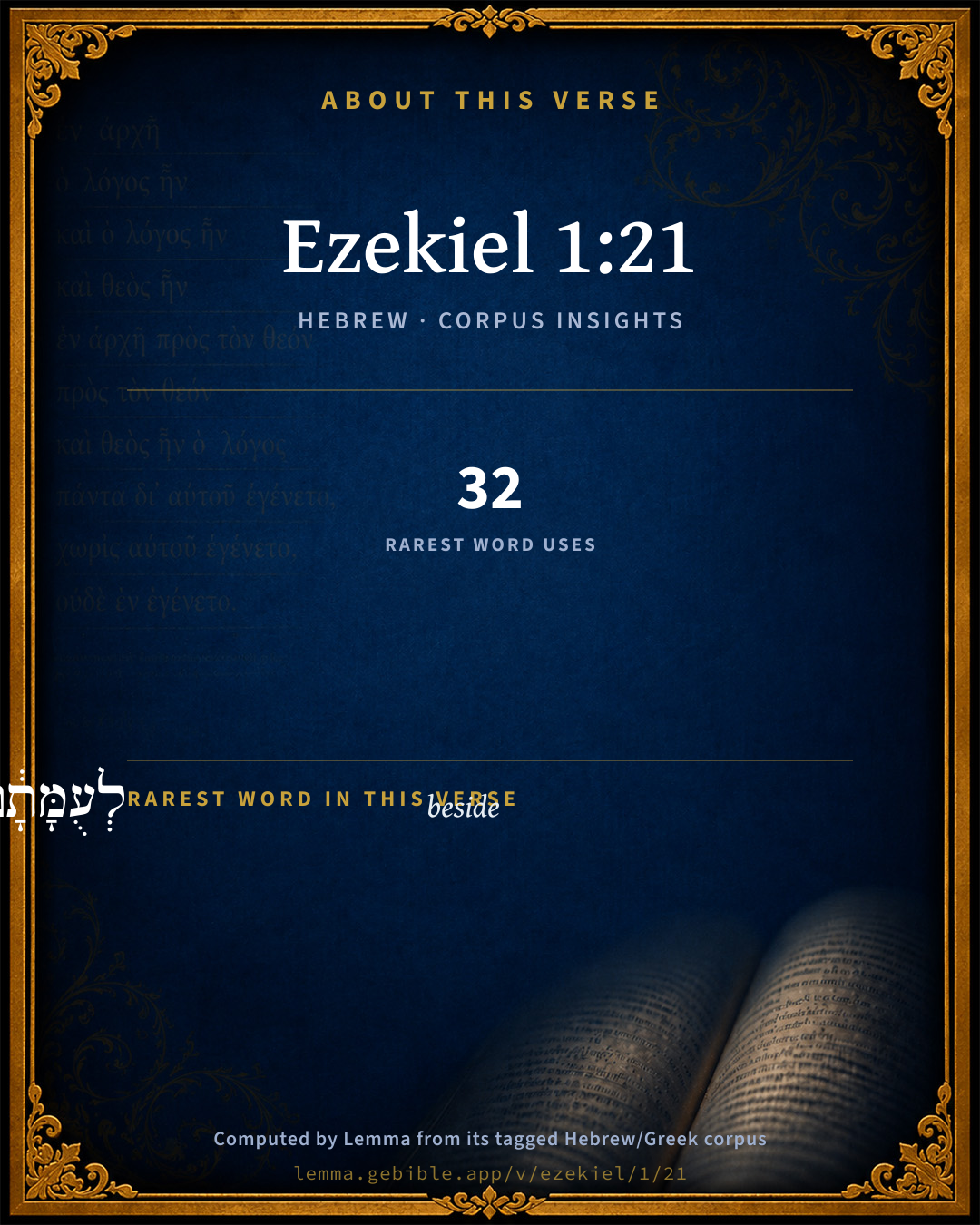
לְעֻמָּתָ֔ם
ʻummâh
H5980
“to/for · beside · their”
Preposition + Noun, Common, Feminine, Singular, Construct + Suffix, Personal, 3rd Person, Masculine, Plural
Part of Speech
Preposition + Noun
Type
Common
Gender
Feminine
Number
Singular
State
Construct
Full BDB Definition

Origin: from H6004

TWOT: 1640f

juxtaposition - used only as a preposition - close by, side by side with, alongside of, parallel with - agreeing with, corresponding to, exactly as, close beside - correspondingly to
  1. בְּלֶכְתָּ֣ם yâlak H3212 “in/at · to walk · them” Preposition + Verb, Qal, Infinitive Construct + Suffix, Personal, 3rd Person, Masculine, Plural
  2. יֵלֵ֔כוּ yâlak H3212 “to walk” Verb, Qal, Imperfect, 3rd Person, Masculine, Plural
  3. וּבְעָמְדָ֖ם ʻâmad H5975 “and · in/at · to stand · them” Conjunction + Preposition + Verb, Qal, Infinitive Construct + Suffix, Personal, 3rd Person, Masculine, Plural
  4. יַֽעֲמֹ֑דוּ ʻâmad H5975 “to stand” Verb, Qal, Imperfect, 3rd Person, Masculine, Plural
  5. וּֽבְהִנָּשְׂאָ֞ם nâsâʼ H5375 “and · in/at · to lift · them” Conjunction + Preposition + Verb, Niphal, Infinitive Construct + Suffix, Personal, 3rd Person, Masculine, Plural
  6. מֵעַ֣ל ʻal H5921 “from · upon” Preposition + Preposition
  7. הָאָ֗רֶץ ʼerets H776 “the · land” Particle, Definite Article + Noun, Common, Both, Singular, Absolute
  8. יִנָּשְׂא֤וּ nâsâʼ H5375 “to lift” Verb, Niphal, Imperfect, 3rd Person, Masculine, Plural
  9. הָאֽוֹפַנִּים֙ ʼôwphân H212 “the · wheels” Particle, Definite Article + Noun, Common, Masculine, Plural, Absolute
  10. כִּ֛י kîy H3588 “that” Conjunction
  11. ר֥וּחַ rûwach H7307 “spirit of” Noun, Common, Both, Singular, Construct
  12. הַחַיָּ֖ה chay H2416 “the · living” Particle, Definite Article + Noun, Common, Feminine, Singular, Absolute
  13. בָּאוֹפַנִּֽים ʼôwphân H212 “in/at the · wheels” Preposition, Determined + Noun, Common, Masculine, Plural, Absolute

About this verse

These counts appear in no published source. They are computed here, from the morphology-tagged text and Lemma’s own curated glosses. What Lemma adds →

14
words
10
distinct lemmas
Prophets
section

Shared distinctive vocabulary

לְעֻמָּתָ֔ם beside H5980 occurs in 28 verses of the Hebrew Bible. Also found in:

Grammatical profile

  • 6 verbs
  • 6 nouns
  • 1 preposition
  • 1 conjunction

Verb forms

  • בְּלֶכְתָּ֣ם Qal · Infinitive Construct
  • יֵלֵ֔כוּ Qal · Imperfect
  • וּבְעָמְדָ֖ם Qal · Infinitive Construct
  • יַֽעֲמֹ֑דוּ Qal · Imperfect
  • וּֽבְהִנָּשְׂאָ֞ם Niphal · Infinitive Construct
  • יִנָּשְׂא֤וּ Niphal · Imperfect

Repetition

Words recur within this verse — often emphatic in Hebrew:

  • בְּלֶכְתָּ֣ם to walk H3212 ×2
  • וּבְעָמְדָ֖ם to stand H5975 ×2
  • וּֽבְהִנָּשְׂאָ֞ם to lift H5375 ×2
  • הָאֽוֹפַנִּים֙ wheel H212 ×2

Hebrew & Septuagint length

In English translation the verse runs 38 words from the Hebrew and 36 from the Septuagint (LXX English) — closely comparable.

A rough comparison of the two English renderings, which tokenize alike — not a word-level alignment.

Word counts can differ between the Hebrew and the Greek without any difference in meaning — e.g. the Hebrew direct-object marker אֵת has no separate Greek word, and Greek often adds the article ὁ.

Cross-references

3

Topical passages linked to Ezekiel 1:21 in the Treasury of Scripture Knowledge — connected by theme and wording, ordered by reader-vote popularity; previews shown in the World English Bible.

  • Ezekiel 10:17 When they stood, these stood; and when they mounted up, these mounted up with them: for the spirit of the living creature was in them.
  • Ezekiel 1:19–20 When the living creatures went, the wheels went beside them; and when the living creatures were lifted up from the earth, the wheels were lifted up.
  • Romans 8:2 For the law of the Spirit of life in Christ Jesus made me free from the law of sin and of death.

Cross-references courtesy of OpenBible.info (CC BY 4.0).

Hebrew and Greek witnesses Masoretic Hebrew ↔ Greek Septuagint

The same verse in the two great witnesses to the Old Testament, shown verse-for-verse.

These are two independent witnesses, not word-aligned to each other, and the Septuagint is shown in lemma (dictionary) form.

Hebrew Ezekiel 1:21 Masoretic · Westminster Leningrad Codex

בְּלֶכְתָּ֣ם יֵלֵ֔כוּ וּבְעָמְדָ֖ם יַֽעֲמֹ֑דוּ וּֽבְהִנָּשְׂאָ֞ם מֵעַ֣ל הָאָ֗רֶץ יִנָּשְׂא֤וּ הָאֽוֹפַנִּים֙ לְעֻמָּתָ֔ם כִּ֛י ר֥וּחַ הַחַיָּ֖ה בָּאוֹפַנִּֽים

When those went, these went; and when those stood, these stood; and when those were lifted up from the earth, the wheels were lifted up beside them: for the spirit of the living creature was in the wheels.

World English Bible · Public Domain

Greek LXX Ezekiel 1:21 Septuagint · lemma form

ἐν ὁ πορεύομαι αὐτός πορεύομαι καί ἐν ὁ ἵστημι αὐτός ἵστημι καί ἐν ὁ ἐκαἴρω αὐτός ἀπό ὁ γῆ ἐκαἴρω σύν αὐτός ὅτι πνεῦμα ζωή εἰμί ἐν ὁ τροχός

When those went, the wheels went; and when those stood, the wheels stood; and when those lifted themselves off the earth, they were lifted off with them: for the spirit of life was in the wheels.

LXX2012 (modern English Septuagint) · Public Domain

Hebrew: Westminster Leningrad Codex (CC BY 4.0). Greek: Septuagint (public domain); English from LXX2012 (modern English Septuagint) (Public Domain). How the Septuagint differs from the Hebrew →

Targum (Aramaic paraphrase)

1

The Targum is the ancient Jewish Aramaic paraphrase of the Hebrew Scriptures — an interpretive translation, not the Hebrew text itself. Onkelos (literal) and Pseudo-Jonathan (expansive) render the Torah, and Jonathan the Prophets. Coverage is partial: where no permissively-licensed English translation exists for a verse, only the Aramaic is shown. This is verse-level text, not a word-by-word alignment to the Hebrew.

  1. Targum Jonathan Prophets (Joshua–Malachi)
    בְּמֵיזַלְהוֹן אָזְלִין וּבִמְקָמְהוֹן קְיָמִין וּבְאִתְרָמְהוֹן כְּמִלְרַע לְרוּם שְׁמַיָא מִתְרְמִין גַלְגְלַיָא לְקִבְלֵיהוֹן אֲרֵי כְּרוּחַ בִּרְיָתָא בְּגַלְגְלַיָא:

    (no public-domain English translation for this verse)

    Targum Jonathan — Aramaic: “Mikraot Gedolot” (public domain). English: “Sefaria Community Translation” (CC0 1.0 (public-domain dedication)); “London "Chaldee Paraphrase," 1871” (public domain). Text via Sefaria.

Commentary

Notes on Ezekiel 1:21 from classic Christian and Jewish commentators (each source and its license shown beneath its notes). The classic Christian expositions comment on the surrounding passage and are grouped to its opening verse, so a note may address several verses; the Jewish commentaries on the Tanakh (Rashi and others) are per-verse, so they appear only where the commentator wrote on this verse.

Lemma curates 59 commentaries, every one of them public domain or Creative Commons licensed, each selected and text-cleaned for this edition rather than reprinted as found. About our sources →

Trapp's Complete Commentary

John Trapp

Eze 1:21 When those went, [these] went; and when those stood, [these] stood; and when those were lifted up from the earth, the wheels were lifted up over against them: for the spirit of the living creature [was] in the wheels.

Ver. 21. When those went, these went; and when those stood, these stood.] This is but the same again as before, but more fully and plainly. See the similar passage in Joh 1:2.

John Trapp, A Commentary or Exposition upon All the Books of the Old and New Testament (1647–1656) — public domain. Text from a community e-Sword module.

Jamieson, Fausset & Brown

Robert Jamieson, A. R. Fausset & David Brown

over against--rather, "along with" [HENDERSON]; or, "beside" [FAIRBAIRN].

Jamieson, Fausset & Brown — Commentary Critical and Explanatory on the Whole Bible (1871) — public domain (CC PDM 1.0). Text via the HelloAO Bible API.

John Calvin's Commentaries

He continues the same sentence, that the wheels were fixed, not that they fell but stood without motion, which we know to be unnatural, for a wheel cannot stand on any part of its rim, but will either fall on one side or the other, or will roll on: for the Prophet says that the wheels were immovable. Whence it follows that their moving force was external to themselves. Afterwards he confirms the same by additional words. For as the living creatures and the wheels stood together, so they moved and were elevated together. Here the Prophet enlarges upon what he had just touched upon. For although the matter is obscure, yet this copiousness excites attention, and leads us to understand that the motion of the wheels is not uselessly transferred to the living creatures, and that the cause resides there: because if this had been said briefly, it might have been transmitted carelessly, but since the Prophet so often asserts the motion of the wheels to be derived from the living creatures, hence it follows that all changes of things which are seen in the world have their origin from some external source, as I have formerly said. The reason, too, is repeated — that the spirit of the living creatures or animals was in the wheels: for here as before there is an alteration in the number. Though the Prophet understood the spirit of the living creatures to be in the wheels, yet the wheels do not comprehend anything, but receive vigor, as the moon obtains its brightness from the sun. So we perceive that the wheels are impelled, not that the intelligence of the living creatures had been transfused through the wheels. For God does not give mind and judgment to either winter or summer, to either peace or war, to either the calm or the storm, the pestilence or anything else. What then? Neither air, nor earth, nor sea, have any rigor by themselves, unless so far as God by his angels directs the earth to this use, or while he bends the minds of men in one direction or the other, to either war or peace. Now, therefore, we clearly see the meaning of the spirit of the living creatures being in the wheels, viz., that God transfuses his influence through angels, so that not even a sparrow falls to the earth without his foresight, as Christ says, (Matthew 10:29; Luke 12:6.) Therefore, whenever the confusion of our affairs urges us to despair, let us try to remember this sentiment, that the spirit of the living creatures is in the wheels. And truly when we tremble in doubtful circumstances, what can we do but acquiesce in this doctrine — viz., that the end of everything will be according to God’s decree, because nothing is carried on without his permission, and that there, is no motion, no agitation under the heavens, unless he has inspired it by his angels. Now it follows —

John Calvin's Commentaries (1540-1563) — public domain. Text from the Calvin Translation Society English edition (1840s-50s) via the Christian Classics Ethereal Library (ccel.org). Calvin's coverage is partial (roughly two-thirds of the Bible); uncommented books and verses are honest gaps, never fabricated. The 19th-century editor's footnotes and remarks are omitted so the notes are faithfully Calvin's own voice.

John Gill's Exposition

When those went, these went; and when those stood, these stood,.... When ministers are active and lively, then the churches are; but when they are indolent, dull, and inactive, then the churches are so likewise:

and when those were lifted up from the earth, the wheels were lifted up over against them; See Gill on Eze 1:19;

for the spirit of the living creature was in the wheels; or, "the spirit of life", as in Eze 1:20; see Rev 11:11.

John Gill's Exposition of the Whole Bible (1746–1763) — public domain (CC PDM 1.0). Text via the HelloAO Bible API.

Matthew Poole's English Annotations

This verse is a confirmation and further illustration of what is said in the 20th, and being almost word for word the same with the 20th, needs no distinct paraphrase. I shall only note how God doth fully assert his over-ruling and ever-ruling wise providence in the affairs of his church and the world, both against,

1. The profane thoughts of atheists and epicures, which ever abound in those times, when sinners of the world and church are ripe for harvest.

2. Against the distrust and fears of his own suffering people.

Matthew Poole's English Annotations on the Holy Bible (1683–1685) — public domain. Text from a community e-Sword/MySword module.

The Pulpit Commentary

When those went, these went. The words, strictly speaking, add nothing to the previous description; but the prophet appears to have wished to combine what he had before said separately, so as to make the picture complete, before passing on to the yet more glorious vision that next met his gaze.

The Pulpit Commentary (1880–1919), ed. H.D.M. Spence-Jones & Joseph S. Exell — public domain. Text from a community e-Sword module.

John Wesley's Explanatory Notes

For - The same wisdom, power, and holiness of God, the same will and counsel of his, that guides and governs the angels, does by them order and dispose all the motions of the creatures in this lower world.

John Wesley, Explanatory Notes Upon the Whole Bible (1754–1765) — public domain. Text via the GEBible commentary corpus.

Rashi

Rabbi Shlomo Yitzchaki (Rashi)

When they would go Heb. בְּלֶכְתַּם, [i.e.,] the living beings.

they would go Heb. יֵלְכוּ [i.e.,] the wheels.

Rashi on the Tanakh — English translations: “The Judaica Press complete Tanach with Rashi, translated by A. J. Rosenberg” (CC BY 4.0); “Pentateuch with Rashi's commentary by M. Rosenbaum and A.M. Silbermann, 1929-1934” (public domain); “The Metsudah Tanach series, Lakewood, N.J” (CC BY 4.0); and “The Book of Joshua, Metsudah Publications, 1997” (CC BY 4.0). Text via Sefaria.

Lesson kit

Teaching starters — assembled from the data on this page, not authored interpretation. Every prompt links to the verse data it draws on. Edit before teaching.

Ezekiel, in the Prophets, opens this verse with 14 words (10 distinct Hebrew lemmas). Its most distinctive word is ʻummâh (“beside”). A historical commentator’s framing appears above. Read the whole chapter for the surrounding context.

Discussion questions

  1. What does “beside” (ʻummâh) contribute to the verse as a whole?
  2. How does Exodus 25:27, which shares the word «beside», read alongside this verse?
  3. What does the repetition of “to walk” (2× in this one verse) do in this verse?
  4. These translations render this verse differently; the difference is in the English rendering, not the original. What questions does that raise?
  5. «בְּלֶכְתָּ֣ם» is a Qal Infinitive Construct verb. How does that grammatical form shape the action described?
  6. Compare how Trapp's Complete Commentary and Jamieson, Fausset & Brown read this verse. Where do they agree or differ?

Things to notice

Reading settings

Reading text

Shown beneath each verse's original-language words.

Old Testament
Old Testament edition

Read the OT as the Masoretic Hebrew (MT) or the Greek Septuagint (LXX).

English shown for the Greek Septuagint (in the Hebrew ↔ Greek comparison).

Comparing translations? Open the Compare panel on any verse page to stack up to four side by side.