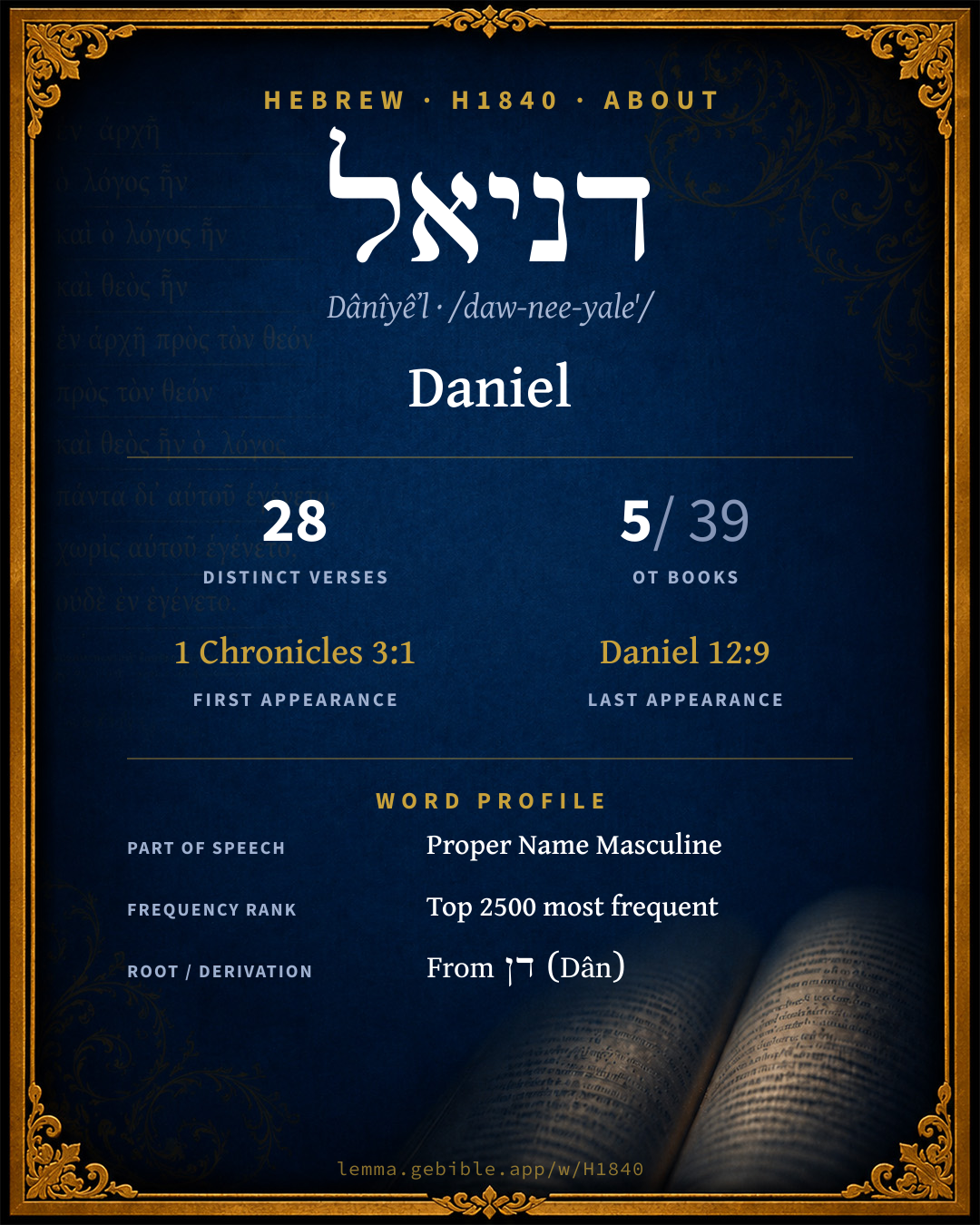
דָּנִאֵל
Daniel
BDB lists 4 entries for ‘Daniel’ fuller range ↓
Full lexicon entry — Brown-Driver-Briggs (BDB)
From Brown-Driver-Briggs (BDB)
Where this word appears
Grammar key — what these labels mean
Part of speech
- Noun
- A naming word — a person, place, thing, or idea.
Noun type
- Proper
- A name of a specific person, place, or people (e.g. Abraham, Zion, Israel).
Every verse where H1840 appears in the Book of Ezekiel — 3 distinct verses. Click any verse to open its interlinear word-by-word view. Verse text shown in the World English Bible for context — . Each verse’s Hebrew form is shown with its reference; the English is not keyword-highlighted, since the data carries no word-level English alignment. Use “Compare translations” on any verse to read it across multiple English versions. This concordance covers the Hebrew Bible; Septuagint (Greek Old Testament) occurrences are not indexed here.
Ezekiel
- Ezekiel 14:14 דנאל דָּנִיֵּ֣אל n Proper n Proper though these three men, Noah, Daniel, and Job, were in it, they should deliver but their own souls by their righteousness, says the Lord Yahweh.
- Ezekiel 14:20 דנאל דָּנִיֵּ֣אל n Proper n Proper though Noah, Daniel, and Job, were in it, as I live, says the Lord Yahweh, they should deliver neither son nor daughter; they should but deliver their own souls by their righteousness.
- Ezekiel 28:3 מ/דנאל מִ/דָּֽנִיֵּ֑אל prep + n Proper prep + n Proper behold, you are wiser than Daniel; there is no secret that is hidden from you;
About this entry
At a glance — auto-summarized from this page’s data, not written by a person. Every figure links to its source below. This summary describes the numbers; it doesn’t interpret them.
The Hebrew name דניאל centers on the idea of “Daniel.” The word gravitates to Daniel (79%), then Ezekiel and 1 Chronicles. It appears 28 verses across 5 books of the Hebrew Bible, among its moderately common vocabulary. Debuting at 1 Chronicles 3:1, it then recurs through the corpus. For the data behind this summary, explore 28-verse concordance and the renderings breakdown below.
Gloss history
Strong's 1890 vs modern scholarship
About this word
Strong's H1840 catalogs a Hebrew word from the Hebrew Old Testament.
These counts are not copied from any lexicon or concordance. They are computed here, from the morphology-tagged Hebrew Old Testament. What Lemma adds →
- 28
- distinct verses
- The word appears in 28 distinct verses.
- 5 / 39
- OT books
- The word appears in 5 of 39 Old Testament books.
- #1,086
- by frequency
- Top 2500 most frequent Hebrew words (rank 1,086 of 8,640 Hebrew words by occurrence).
View all 28 occurrences in the concordance →
Most concentrated in
- Daniel 22 verses 79%
- Ezekiel 3 verses 11%
- 1 Chronicles 1 verse 4%
By section of the Old Testament
By traditional corpus
Conventional, traditional groupings — biblical authorship is debated, so this is a traditional corpus grouping, not an authorship claim. Each share is this word’s portion of its verses in that division of the Hebrew canon. Each figure is a share of the word’s 28 distinct verses.
- Writings (Ketuvim) 25 verses · 89%
- Prophets (Nevi'im) 3 verses · 11%
How translations render this word
Counts come from each version’s own published word-to-Strong’s tagging or interlinear alignment — an approximate guide to how each version renders this word, not a word-level alignment the data otherwise carries. Because each total is that version’s own tagged count, the per-version totals vary from one another and need not match the appearance or distinct-verse counts above. These counts may also differ from a printed concordance because Lemma counts each distinctly tagged rendering and does not collapse phrase taggings into a single head-word total. This is a fixed set of word-tagged versions (KJV, ASV, BSB, ULT) and does not change with the reading translation you choose elsewhere. Each version’s license is shown beside its name below (and on Sources).
BDB lists this Strong’s number as 3 distinct words (homographs). Each count above pools all of them and is not split by sense — see the Senses section below. A low-frequency rendering may belong to a different one of those words, not the primary meaning.
- King James Version†: Daniel 19×, I daniel 5×
- American Standard Version†: Daniel 13×, I 5×, Me 2×
- Berean Standard Bible†: Daniel 2×
- unfoldingWord Literal Text†: Daniel 27×
King James Version Public Domain
Renders H1840 across 29† tagged occurrences — most commonly:
Plus 5 renderings that appear only once — usually multi-word phrases or single function words the recovered tagging swept in, not distinct renderings.
American Standard Version Public Domain
Renders H1840 across 28† tagged occurrences — most commonly:
Plus 8 renderings that appear only once — usually multi-word phrases or single function words the recovered tagging swept in, not distinct renderings. Not rendered by a distinct English word in 1 further occurrence.
Berean Standard Bible Public Domain
Renders H1840 across 3† tagged occurrences — most commonly:
Plus 1 rendering that appears only once — usually multi-word phrases or single function words the recovered tagging swept in, not distinct renderings.
unfoldingWord Literal Text CC BY-SA 4.0
Renders H1840 across 29† tagged occurrences — most commonly:
Plus 2 renderings that appear only once — usually multi-word phrases or single function words the recovered tagging swept in, not distinct renderings.
Senses in the full BDB
What do BDB’s symbols mean?
BDB uses these scholarly abbreviations:
| Symbol | Meaning |
|---|---|
| 𝔊 | the Septuagint (the ancient Greek translation, LXX) |
| 𝔙 | the Vulgate (the Latin translation) |
| 𝔖 | the Syriac version (the Peshitta) |
| 𝔗 | the Targum (the Aramaic translation) |
| ψ | the Psalms |
| √ | root (the underlying root or stem) |
| ‖ | parallel passage (a synonymous or contrasted parallel) |
| † | the dagger: every passage where the word occurs is cited |
The 4 senses and sub-senses the full Brown-Driver-Briggs lexicon distinguishes for this word, in lexicon order (not ranked by frequency), with BDB’s own verbatim wording and sub-sense lettering. Shown in Hebrew script with BDB’s own scholarly abbreviations. The condensed entry is in the Lexicon Entry tab. See also the Forms in the corpus table below.
- 1. son of David 1 Ch 3:1, דָּנִיֵּאל, but dub. cf. CheOP 106; 𝔊 Δαμνιηλ, 𝔊L & Codd. Δαλουια; ‖ 2 S 3:3 כִּלְאָב, 𝔊 Δαλουια KloSm proposes דֹּדִיָּה & in Ch דֹּדִיאֵל, but grounds precarious. e.g. 1 Chronicles 3:1
- 2. דָּנִיֵּאל priest of the line of Ithamar Ezr 8:2 Ne 10:7. e.g. Ezra 8:2
- 3. דָּנִאֵל a great sage Ez 28:3; classed with Noah and Job as models of righteousness Ez 14:14, 20; perhaps the same as e.g. Ezekiel 28:3
- 4. דָּנִיֵּאל, one of the noble young men taken into captivity by Nebuchadrezzar according to Dn 1:1–6, the hero of the book of Daniel, Dn 1:6 + 22 times (also frequently in Aramaic section). e.g. Daniel 1:1
Senses from the full Brown-Driver-Briggs lexicon (Brown, Driver, Briggs; Oxford 1906 — public domain), digitized via Sefaria, supplemented by the OpenScriptures HebrewLexicon (CC BY 4.0). Full attribution on Sources.
Word origin
later דָּנִיֵּאל n.pr.m. (cf. Ew§ 45 d; Ēl is my judge; on a possible connexion with Zend dânu, wise, or wisdom cf. CheOP 107; v. Palm. דנאל Vog93)—
— Brown-Driver-Briggs (Oxford 1906, public domain), digitized via Sefaria, supplemented by the OpenScriptures HebrewLexicon (CC BY 4.0). See Sources.
Derived from דן (Dân) (H1835) — Dan.
Jastrow Dictionary
A second Hebrew/Aramaic lexicon for comparison, covering Aramaic and post-biblical (Talmudic, Targumic, Midrashic) usage that the biblical-Hebrew BDB does not. Matched by lemma rather than by Strong’s number, so a lemma may carry more than one Jastrow headword (shown separately below), and the entries cover usage well beyond the Bible.
דָּנִיאֵל
- (b. h.) pr. n. m. Daniel,
- 1. the Babylonian exile. Snh. 93ᵃ; a. fr.—Erub. 21ᵃ בי כנישתא דד׳ a synagogue named from D., v. בַּרְנֵשׁ.—B. Bath. 14ᵇ; 15ᵃ the Book of Daniel
- 2. name of an Amora. Y. Succ. IV, 54ᵇ bot. Ḥull. 62ᵃ; a. fr.
A Dictionary of the Targumim, the Talmud Babli and Yerushalmi, and the Midrashic Literature (Marcus Jastrow; London, Luzac, 1903) — Public Domain. Digitized via Sefaria. Digitized via Sefaria. Full attribution on Sources.
Forms in the corpus
The 24 distinct written forms H1840 takes in the Hebrew Bible, most frequent first — each parse links to that state’s occurrences in the concordance. Hebrew forms include their vowel points and cantillation, so a single lemma takes many written forms.
| Form | Parsing | Example | Uses |
|---|---|---|---|
| דָּנִיֵּ֣אל | Noun, Proper | Daniel 1:6 | 5 |
| דָנִיֵּ֔אל | Noun, Proper | Daniel 8:1 | 2 |
| דָּֽנִיֵּ֔אל | Noun, Proper | Daniel 1:21 | 2 |
| דָּנִיֵּ֑אל | Noun, Proper | Daniel 12:9 | 2 |
| דנאל | Noun, Proper | Ezekiel 14:14 | 2 |
| דָֽנִיֵּ֗אל | Noun, Proper | Daniel 12:4 | 1 |
| דָֽנִיֵּאל֙ | Noun, Proper | Daniel 10:2 | 1 |
| דָנִיֵּ֖אל | Noun, Proper | Daniel 8:15 | 1 |
| דָנִיֵּ֗אל | Noun, Proper | Daniel 8:27 | 1 |
| דָנִיֵּ֤אל | Noun, Proper | Daniel 10:7 | 1 |
| דָנִיֵּאל֒ | Noun, Proper | Daniel 10:12 | 1 |
| דָּ֣נִיֵּ֔אל | Noun, Proper | Daniel 1:9 | 1 |
| דָּנִיֵּ֔אל | Noun, Proper | 1 Chronicles 3:1 | 1 |
| דָּנִיֵּ֕אל | Noun, Proper | Daniel 9:22 | 1 |
| דָּנִיֵּ֖אל | Noun, Proper | Daniel 1:11 | 1 |
| דָּנִיֵּ֥אל | Noun, Proper | Nehemiah 10:6 | 1 |
| דָּנִיֵּאל֙ | Noun, Proper | Daniel 1:8 | 1 |
| וְ/דָנִיֵּ֣אל | Noun, Proper | Daniel 1:17 | 1 |
| כְּ/דָנִיֵּ֣אל | Noun, Proper | Daniel 1:19 | 1 |
| לְ/דָ֣נִיֵּ֔אל | Noun, Proper | Daniel 1:10 | 1 |
| לְ/דָֽנִיֵּ֔אל | Noun, Proper | Daniel 10:1 | 1 |
| לְ/דָֽנִיֵּ֜אל | Noun, Proper | Daniel 1:7 | 1 |
| מ/דנאל | Noun, Proper | Ezekiel 28:3 | 1 |
| מִ/דָּֽנִיֵּ֑אל | Noun, Proper | Ezekiel 28:3 | 1 |
Same root — word family
Other BDB entries built from the same root as H1840, grouped by Strong’s listed origin. These share a root / origin per the lexicon — not necessarily a shared meaning. Each links to that word’s own entry.
Derives from
Proper names from this root
People and places named from this root — a name, not an additional meaning of the word.
- דני Dânîy H1839 Danites
- דן יען Dân Yaʻan H1842 Dan-jaan
- Δανιηλ Daniḗl G1158 Daniel
- דניאל Dânîyêʼl H1841 Daniel
Compare all same-root words → Showing 4 of 6 — not the complete family. 5 of the same-root words are proper names (people or places). They share a root, not necessarily a meaning.
Bible dictionary
Public-domain dictionary articles matched to this entry by name (Daniel). A biblical name can be shared by more than one person or place, so an article may treat several.
Easton's Bible Dictionary · M. G. Easton, 1897
God is my judge, or judge of God. (1.) David's second son, "born unto him in Hebron, of Abigail the Carmelitess" (1 Chr. 3:1). He is called also Chileab (2 Sam. 3:3).
(2.) One of the four great prophets, although he is not once spoken of in the Old Testament as a prophet. His life and prophecies are recorded in the Book of Daniel. He was descended from one of the noble families of Judah (Dan. 1:3), and was probably born in Jerusalem about B.C. 623, during the reign of Josiah. At the first deportation of the Jews by Nebuchadnezzar (the kingdom of Israel had come to an end nearly a century before), or immediately after his victory over the Egyptians at the second battle of Carchemish, in the fourth year of the reign of Jehoiakim (B.C. 606), Daniel and other three noble youths were carried off to Babylon, along with part of the vessels of the temple. There he was obliged to enter into the service of the king of Babylon, and in accordance with the custom of the age received the Chaldean name of Belteshazzar, i.e., "prince of Bel," or "Bel protect the king!" His residence in Babylon was very probably in the palace of Nebuchadnezzar, now identified with a mass of shapeless mounds called the Kasr, on the right bank of the river.
His training in the schools of the wise men in Babylon (Dan. 1:4) was to fit him for service to the empire. He was distinguished during this period for his piety and his stict observance of the Mosaic law (1:8-16), and gained the confidence and esteem of those who were over him. His habit of attention gained during his education in Jerusalem enabled him soon to master the wisdom and learning of the Chaldeans, and even to excel his compeers.
At the close of his three years of discipline and training in the royal schools, Daniel was distinguished for his proficiency in the "wisdom" of his day, and was brought out into public life. He soon became known for his skill in the interpretation of dreams (1:17; 2:14), and rose to the rank of governor of the province of Babylon, and became "chief of the governors" (Chald. Rab-signin) over all the wise men of Babylon. He made known and also interpreted Nebuchadnezzar's dream; and many years afterwards, when he was now an old man, amid the alarm and consternation of the terrible night of Belshazzar's impious feast, he was called in at the instance of the queen-mother (perhaps Nitocris, the daughter of Nebuchadnezzar) to interpret the mysterious handwriting on the wall. He was rewarded with a purple robe and elevation to the rank of "third ruler." The place of "second ruler" was held by Belshazzar as associated with his father, Nabonidus, on the throne (5:16). Daniel interpreted the handwriting, and "in that night was Belshazzar the king of the Chaldeans slain."
After the taking of Babylon, Cyrus, who was now master of all Asia from India to the Dardanelles, placed Darius (q.v.), a Median prince, on the throne, during the two years of whose reign Daniel held the office of first of the "three presidents" of the empire, and was thus practically at the head of affairs, no doubt interesting himself in the prospects of the captive Jews (Dan. 9), whom he had at last the happiness of seeing restored to their own land, although he did not return with them, but remained still in Babylon. His fidelity to God exposed him to persecution, and he was cast into a den of lions, but was miraculously delivered; after which Darius issued a decree enjoining reverence for "the God of Daniel" (6:26). He "prospered in the reign of Darius, and in the reign of Cyrus the Persian," whom he probably greatly influenced in the matter of the decree which put an end to the Captivity (B.C. 536).
He had a series of prophetic visions vouch-safed to him which opened up the prospect of a glorious future for the people of God, and must have imparted peace and gladness to his spirit in his old age as he waited on at his post till the "end of the days." The time and circumstances of his death are not recorded. He probably died at Susa, about eighty-five years of age.
Ezekiel, with whom he was contemporary, mentions him as a pattern of righteousness (14:14, 20) and wisdom (28:3). (See NEBUCHADNEZZAR.)
Smith's Bible Dictionary · William Smith, 1863
(judgment of God).
+ The second son of David, by Abigail the Carmelitess. (1 Chronicles 3:1) In (2 Samuel 3:3) he is called Chileab. (B.C. about 1051.) + The fourth of 'the greater prophets." Nothing is known of his parentage or family. He appears, however, to have been of royal or noble descent, (Daniel 1:3) and to have possessed considerable personal endowments. (Daniel 1:4) He was taken to Babylon in "the third year of Jehoiakim" (B.C. 604), and trained for the king's service. He was divinely supported in his resolve to abstain from the "king's meat" for fear of defilement. (Daniel 1:8-16) At the close of his three years discipline, (Daniel 1:5,18) Daniel had an opportunity of exercising his peculiar gift, (Daniel 1:17) of interpreting dreams, on the occasion of Nebuchadnezzar's decree against the Magi. (Daniel 2:14) ff. In consequence of his success he was made "ruler of the whole province of Babylon." (Daniel 2:48) He afterwards interpreted the second dream of Nebuchadnezzar, (Daniel 4:8-27) and the handwriting on the wall which disturbed the feast of Belshazzar. (Daniel 5:10-28) At the accession of Darius he was made first of the "three presidents" of the empire, (Daniel 6:2) and was delivered from the lion's den, into which he had been cast for his faithfulness to the rites of his faith. (Daniel 6:10-23) cf. Bel and Dr. 29-42. At the accession of Cyrus he still retained his prosperity, (Daniel 6:28) cf. Dani 1:21 Though he does not appear to have remained at Babylon, cf. (Daniel 1:21) and in "the third year of Cyrus" (B.C. 534) he saw his last recorded vision, on the banks of the Tigris. (Daniel 10:1,4) In the prophecies of Ezekiel mention is made of Daniel as a pattern of righteousness, (Ezekiel 14:14,20) and wisdom. (Ezekiel 28:3) The narrative in (Daniel 1:11) implies that Daniel was conspicuously distinguished for purity and knowledge at a very early age. + A descendant of Ithamar, who returned with Ezra. (Ezra 8:2) + A priest who sealed the covenant drawn up by Nehemiah, B.C. 445. (Nehemiah 10:6) He is perhaps the same as No. 3.
Hitchcock's Bible Names Dictionary · Roswell D. Hitchcock, 1869
judgment of God; God my judge
Classic public-domain reference works; full attribution on Sources.
Septuagint verse parallels
This word appears in 27 verses that also exist in the Greek Old Testament (Septuagint), out of the 28 Hebrew verses it occurs in. You can read those verses in Greek by switching the Old Testament edition to the Septuagint.
Read these verses in the Septuagint
This is a verse-level parallel only — the same verses exist in both the Hebrew and Greek Old Testaments. No word-level Hebrew↔Greek correspondence is claimed: the data carries no such alignment, so no Greek word is shown as this Hebrew word’s translation. Coverage is not total — the Septuagint omits the deuterocanon and renumbers the Psalms, so some Hebrew verses have no direct Greek parallel.