גַּת
Gath
BDB lists 2 entries for ‘Gath’ fuller range ↓
Full lexicon entry — Brown-Driver-Briggs (BDB)
From Brown-Driver-Briggs (BDB)
Where this word appears
Grammar key — what these labels mean
Part of speech
- Noun
- A naming word — a person, place, thing, or idea.
Noun type
- Proper
- A name of a specific person, place, or people (e.g. Abraham, Zion, Israel).
Every verse where H1661 appears in the Book of Joshua — 1 distinct verse. Click any verse to open its interlinear word-by-word view. Verse text shown in the World English Bible for context — . Each verse’s Hebrew form is shown with its reference; the English is not keyword-highlighted, since the data carries no word-level English alignment. Use “Compare translations” on any verse to read it across multiple English versions. This concordance covers the Hebrew Bible; Septuagint (Greek Old Testament) occurrences are not indexed here.
Joshua
About this entry
At a glance — auto-summarized from this page’s data, not written by a person. Every figure links to its source below. This summary describes the numbers; it doesn’t interpret them.
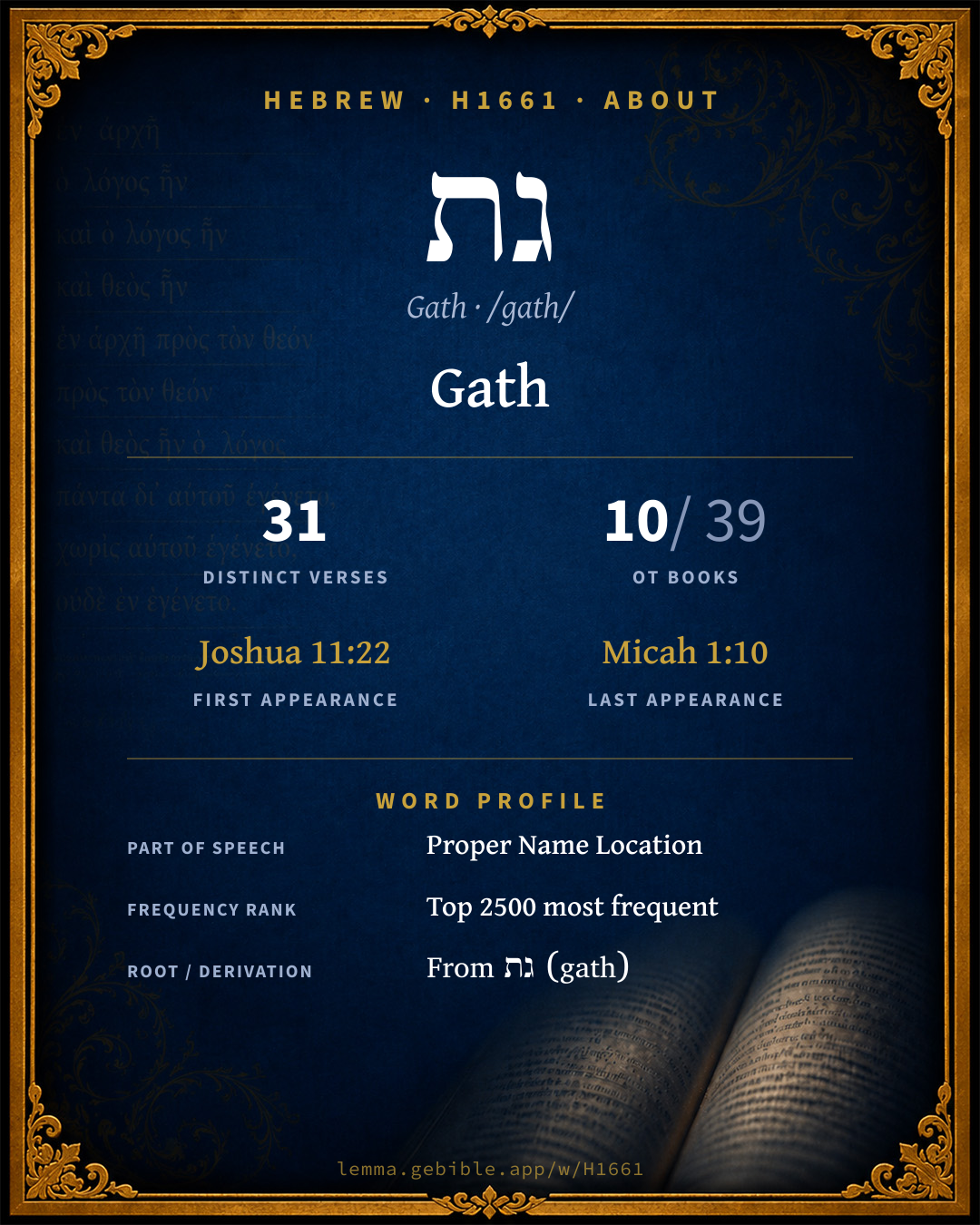
גת (Gath) is a Hebrew name most often rendered “Gath.” Debuting at Joshua 11:22, it then recurs through the corpus. The Hebrew Bible uses it across 31 verses — moderately common. 1 Samuel dominates its distribution — 12 of 31 verses. The sections below give every occurrence and version rendering.
Gloss history
Strong's 1890 vs modern scholarship
About this word
Strong's H1661 catalogs a Hebrew word from the Hebrew Old Testament.
These counts are not copied from any lexicon or concordance. They are computed here, from the morphology-tagged Hebrew Old Testament. What Lemma adds →
- 31
- distinct verses
- The word appears in 31 distinct verses.
- 10 / 39
- OT books
- The word appears in 10 of 39 Old Testament books.
- #1,064
- by frequency
- Top 2500 most frequent Hebrew words (rank 1,064 of 8,640 Hebrew words by occurrence).
View all 31 occurrences in the concordance →
Most concentrated in
- 1 Samuel 12 verses 39%
- 1 Chronicles 5 verses 16%
- 2 Samuel 4 verses 13%
By section of the Old Testament
By traditional corpus
Conventional, traditional groupings — biblical authorship is debated, so this is a traditional corpus grouping, not an authorship claim. Each share is this word’s portion of its verses in that division of the Hebrew canon. Each figure is a share of the word’s 31 distinct verses.
- Prophets (Nevi'im) 23 verses · 74%
- Writings (Ketuvim) 8 verses · 26%
How translations render this word
Counts come from each version’s own published word-to-Strong’s tagging or interlinear alignment — an approximate guide to how each version renders this word, not a word-level alignment the data otherwise carries. Because each total is that version’s own tagged count, the per-version totals vary from one another and need not match the appearance or distinct-verse counts above. These counts may also differ from a printed concordance because Lemma counts each distinctly tagged rendering and does not collapse phrase taggings into a single head-word total. This is a fixed set of word-tagged versions (KJV, ASV, BSB, ULT) and does not change with the reading translation you choose elsewhere. Each version’s license is shown beside its name below (and on Sources).
BDB lists this Strong’s number as 4 distinct words (homographs). Each count above pools all of them and is not split by sense — see the Senses section below. A low-frequency rendering may belong to a different one of those words, not the primary meaning.
- King James Version†: Gath 29×
- American Standard Version†: Gath 29×
- Berean Standard Bible†: Gath 31×
- unfoldingWord Literal Text†: Gath 30×
King James Version Public Domain
Renders H1661 across 33† tagged occurrences — most commonly:
Plus 4 renderings that appear only once — usually multi-word phrases or single function words the recovered tagging swept in, not distinct renderings.
American Standard Version Public Domain
Renders H1661 across 32† tagged occurrences — most commonly:
Plus 3 renderings that appear only once — usually multi-word phrases or single function words the recovered tagging swept in, not distinct renderings.
Berean Standard Bible Public Domain
Renders H1661 across 33† tagged occurrences — most commonly:
Plus 2 renderings that appear only once — usually multi-word phrases or single function words the recovered tagging swept in, not distinct renderings.
unfoldingWord Literal Text CC BY-SA 4.0
Renders H1661 across 32† tagged occurrences — most commonly:
Plus 2 renderings that appear only once — usually multi-word phrases or single function words the recovered tagging swept in, not distinct renderings.
Senses in the full BDB
What do BDB’s symbols mean?
BDB uses these scholarly abbreviations:
| Symbol | Meaning |
|---|---|
| 𝔊 | the Septuagint (the ancient Greek translation, LXX) |
| 𝔙 | the Vulgate (the Latin translation) |
| 𝔖 | the Syriac version (the Peshitta) |
| 𝔗 | the Targum (the Aramaic translation) |
| ψ | the Psalms |
| √ | root (the underlying root or stem) |
| ‖ | parallel passage (a synonymous or contrasted parallel) |
| † | the dagger: every passage where the word occurs is cited |
The 0 senses and sub-senses the full Brown-Driver-Briggs lexicon distinguishes for this word, in lexicon order (not ranked by frequency), with BDB’s own verbatim wording and sub-sense lettering. Shown in Hebrew script with BDB’s own scholarly abbreviations. The condensed entry is in the Lexicon Entry tab. See also the Forms in the corpus table below.
גת I wine-press.
גת II wine-press (contracted from גַּנְתְּ = יְגַנְתְּ)
גת III loc. (wine-press)
Senses from the full Brown-Driver-Briggs lexicon (Brown, Driver, Briggs; Oxford 1906 — public domain), digitized via Sefaria, supplemented by the OpenScriptures HebrewLexicon (CC BY 4.0). Full attribution on Sources.
Word origin
I. wine-press.
III. n.f. wine-press (contracted from גַּנְתְּ = יְגַנְתְּ)—abs. גַּת Ju 6:11 + 3 times; גִּתּוֹת Ne 13:15;—wine-press, lit. חֹבֵט חִטִּים בַּגַּת Ju 6:11 beating out wheat in the wine-press, to hide it from Midian; the juice of the grapes was pressed out by treading, דֹּרֵךְ בְּג֑ת Is 63:2 (in sim.), but also as acc. דֹּרְכִים גִּתּוֹת Ne 13:15; in fig. of judgment, גַּת דָּרַךְ אֲדֹנָי לִבְתוּלַת וגו׳ La 1:15 a wine-press hath Adonay trodden for the virgin daughter of Judah; also רְדוּ כִּי מָֽלְאָה גַּת Jo 4:13 (רדה only here with גַּת).—On the form and use of wine-press, and Heb. synonyms, v. Smith DB (art. wine-press) BenzArch.. 212 f. RobBR iii, 137 Schick ZPV x, 1887, 146, 150, and Pl. v. vii. Anderlind ZPV xi, 1888, 166 f.
IV. n.pr.loc. (wine-press)—Philistine city 𝔊 Γεθ, 𝔙 Geth, JosAnt. vi. 12, 2 etc., Γιττα (ed. Niese), exact site unknown (v. GASmGeog. 194 ff.), named with Gaza and Ashdod Jos 11:22 as home of remaining ʿAnaḳim; named with Ashdod, Gaza, Ashḳelon and ʿEḳron 1 S 6:17; with Ashḳelon 1 S 1:20; with Ashḳelon, Yabne and Ashdod 2 Ch 26:6; מֵעֶקְרוֹן וְעַד־גַּת 1 S 7:14, cf. 17:52b and also v 52a (read גַּת for גַּיְא 𝔊 We Dr); called גַּת פְּלִשְׁתִּים Am 6:2; built up by Rehoboam, according to 2 Ch 11:8; taken by Hazael 2 K 12:18; also 1 S 5:8; 17:4, 23 (of Goliath), cf. 2 S 21:20, 22 = 1 Ch 20:6, 8; 1 S 21:11, 13; 27:2, 3, 4, 11 2 S 15:18 1 K 2:39(×2), 40, 41 ψ 56:1 Mi 1:10, 14 1 Ch 7:21; 8:13, also 18:1 (but ‖ מֶתֶג אַמָּה 2 S 8:1; on change of this into reading in Ch v. We); c. ה loc., גַּ֫תָּה 1 K 2:40.
— Brown-Driver-Briggs (Oxford 1906, public domain), digitized via Sefaria, supplemented by the OpenScriptures HebrewLexicon (CC BY 4.0). See Sources.
Derived from גת (gath) (H1660) — winepress.
Jastrow Dictionary
A second Hebrew/Aramaic lexicon for comparison, covering Aramaic and post-biblical (Talmudic, Targumic, Midrashic) usage that the biblical-Hebrew BDB does not. Matched by lemma rather than by Strong’s number, so a lemma may carry more than one Jastrow headword (shown separately below), and the entries cover usage well beyond the Bible.
גַּת I
- Gath in Philistea. Snh. 102ᵃ; a. e.
גַּת II
- , with suffix גִּתּ־, גִּיתּ־ (contr. of גֶּנֶת) a marked-off space. Tosef. Ohol. XV, 7 ‘the court of a burying place’ זו הגת … לתוכה (R. S. to Ohol. XV, 8, ed. Zuck. לתוכו, Var. גל) is the marked space into which the caverns open.—Par. IV, 2 שרפה חוץ מגִּתָּהּ if he burnt the cow outside of the place selected for the purpose; Zeb. XIV, 1; Tosef. Par. III, 9 sq.—Pl. גִּתּוֹת, גִּיתּ׳. Par. l. c.
גַּת III
- , with suffix גִּתּ־, גִּיתּ־ (b. h.; vat for wine pressing; (שעת)הג׳ the season of wine pressing. Ab. Zar. V, 11 ג׳ של אבן a stone vat, של חרס an earthen. Ib. IV, 8, v. בָּעַט. Ḥag. III, 4 (24ᵇ) מניחה לג׳ הבאה he may reserve it for the next season (and give it to the priest). Ib. 25ᵇ דבר שאין לו ג׳ something which has no special manufacturing season (e.g. date wine); a. fr.—Lam. R. introd. 32 (play on מבליגֹיֹתֹיֹ, Jer. VIII, 18) עשיתי לביתי גִּותִּי I made my house my vat (cmp. Lam. I, 15).—Pl. גִּיתּוֹת, גִּתּ׳.—בית הגי׳ the press room. Tosef. Ter. III, 7; Y. ib. II, 41ᵇ bot. בית הגיתי׳ (corr. acc.)—Tosef. l. c. שתי ג׳ לבור וכ׳ two vats for one pit; a. fr. e.g. Jeremiah 8:18
A Dictionary of the Targumim, the Talmud Babli and Yerushalmi, and the Midrashic Literature (Marcus Jastrow; London, Luzac, 1903) — Public Domain. Digitized via Sefaria. Digitized via Sefaria. Full attribution on Sources.
Forms in the corpus
The 22 distinct written forms H1661 takes in the Hebrew Bible, most frequent first — each parse links to that state’s occurrences in the concordance. Hebrew forms include their vowel points and cantillation, so a single lemma takes many written forms.
| Form | Parsing | Example | Uses |
|---|---|---|---|
| בְּ/גַ֑ת | Noun, Proper | 1 Chronicles 20:6 | 4 |
| גַּ֖ת | Noun, Proper | 1 Kings 2:41 | 3 |
| גַּֽת | Noun, Proper | 1 Samuel 21:10 | 3 |
| בְּ/גַֽת | Noun, Proper | 1 Kings 2:39 | 2 |
| גַת֙ | Noun, Proper | 1 Chronicles 7:21 | 2 |
| גַּ֑ת | Noun, Proper | 1 Kings 2:39 | 2 |
| גַּ֥ת | Noun, Proper | 1 Chronicles 18:1 | 2 |
| בְ/גַ֔ת | Noun, Proper | 2 Samuel 1:20 | 1 |
| בְּ/גַ֛ת | Noun, Proper | 1 Samuel 27:3 | 1 |
| בְּ/גַ֥ת | Noun, Proper | Joshua 11:22 | 1 |
| בְּ/גַת֙ | Noun, Proper | Micah 1:10 | 1 |
| גַֽת | Noun, Proper | 1 Chronicles 8:13 | 1 |
| גַת | Noun, Proper | Amos 6:2 | 1 |
| גַּ֔ת | Noun, Proper | 1 Samuel 7:14 | 1 |
| גַּ֗ת | Noun, Proper | 2 Chronicles 26:6 | 1 |
| גַּ֣ת | Noun, Proper | 1 Samuel 5:8 | 1 |
| גַּ֨תָ/ה֙ | Noun, Proper | 1 Kings 2:40 | 1 |
| לְ/גַ֥ת | Noun, Proper | 1 Samuel 6:17 | 1 |
| מִ/גַּ֑ת | Noun, Proper | 1 Samuel 17:4 | 1 |
| מִ/גַּ֔ת | Noun, Proper | 2 Samuel 15:18 | 1 |
| מִ/גַּֽת | Noun, Proper | 1 Kings 2:40 | 1 |
| מִ/גַּת֙ | Noun, Proper | 1 Samuel 17:23 | 1 |
Same root — word family
Other BDB entries built from the same root as H1661, grouped by Strong’s listed origin. These share a root / origin per the lexicon — not necessarily a shared meaning. Each links to that word’s own entry.
Derives from
Proper names from this root
People and places named from this root — a name, not an additional meaning of the word.
- גתהחפר Gath-ha-Chêpher H1662 Gath-hepher
- גתים Gittayim H1664 Gittaim
- גתרמון Gath-Rimmôwn H1667 Gath-rimmon
- גתי Gittîy H1663 Gittite
Compare all same-root words → Showing 4 of 6 — not the complete family. 4 of the same-root words are proper names (people or places). They share a root, not necessarily a meaning.
Bible dictionary
Public-domain dictionary articles matched to this entry by name (Gath). A biblical name can be shared by more than one person or place, so an article may treat several.
Easton's Bible Dictionary · M. G. Easton, 1897
A wine-vat, one of the five royal cities of the Philistines (Josh. 13:3) on which the ark brought calamity (1 Sam. 5:8, 9; 6:17). It was famous also as being the birthplace or residence of Goliath (1 Sam. 17:4). David fled from Saul to Achish, king of Gath (1 Sam. 21:10; 27:2-4; Ps. 56), and his connection with it will account for the words in 2 Sam. 1:20. It was afterwards conquered by David (2 Sam. 8:1). It occupied a strong position on the borders of Judah and Philistia (1 Sam. 21:10; 1 Chr. 18:1). Its site has been identified with the hill called Tell esSafieh, the Alba Specula of the Middle Ages, which rises 695 feet above the plain on its east edge. It is noticed on monuments about B.C. 1500. (See METHEGAMMAH.)
Smith's Bible Dictionary · William Smith, 1863
(a wine press), one of the five royal cities of the Philistines; (Joshua 13:3; 1 Samuel 6:17) and the native place of the giant Goliath. (1 Samuel 17:4,23) It probably stood upon the conspicuous hill now called Tell-es-Safieh, upon the side of the plain of Philistia, at the foot of the mountains of Judah; 10 miles east of Ashdod, and about the same distance south by east of Ekron. It is irregular in form, and about 200 feet high. Gath occupied a strong position, (2 Chronicles 11:8) on the border of Judah and Philistia, (1 Samuel 21:10; 1 Chronicles 18:1) and from its strength and resources forming the key of both countries, it was the scene of frequent struggles, and was often captured and recaptured. (2 Kings 12:17; 2 Chronicles 11:8; 26:6; Amos 6:2) The ravages of war to which Gath was exposed appear to have destroyed it at a comparatively early period, as it is not mentioned among the other royal cities by the later prophets. (Zephaniah 2:4; Zechariah 9:5,6) It is familiar to the Bible student as the scene of one of the most romantic incidents in the life of King David. (1 Samuel 21:10-15)
Hitchcock's Bible Names Dictionary · Roswell D. Hitchcock, 1869
a wine-press
Classic public-domain reference works; full attribution on Sources.
Septuagint verse parallels
This word appears in 30 verses that also exist in the Greek Old Testament (Septuagint), out of the 31 Hebrew verses it occurs in. You can read those verses in Greek by switching the Old Testament edition to the Septuagint.
Read these verses in the Septuagint
- Joshua 11:22
- 1 Samuel 5:8
- 2 Samuel 1:20
- 1 Kings 2:39
- 2 Kings 12:17
- 1 Chronicles 7:21
- 2 Chronicles 11:8
- Psalms 56:1
- Amos 6:2
- Micah 1:10
This is a verse-level parallel only — the same verses exist in both the Hebrew and Greek Old Testaments. No word-level Hebrew↔Greek correspondence is claimed: the data carries no such alignment, so no Greek word is shown as this Hebrew word’s translation. Coverage is not total — the Septuagint omits the deuterocanon and renumbers the Psalms, so some Hebrew verses have no direct Greek parallel.