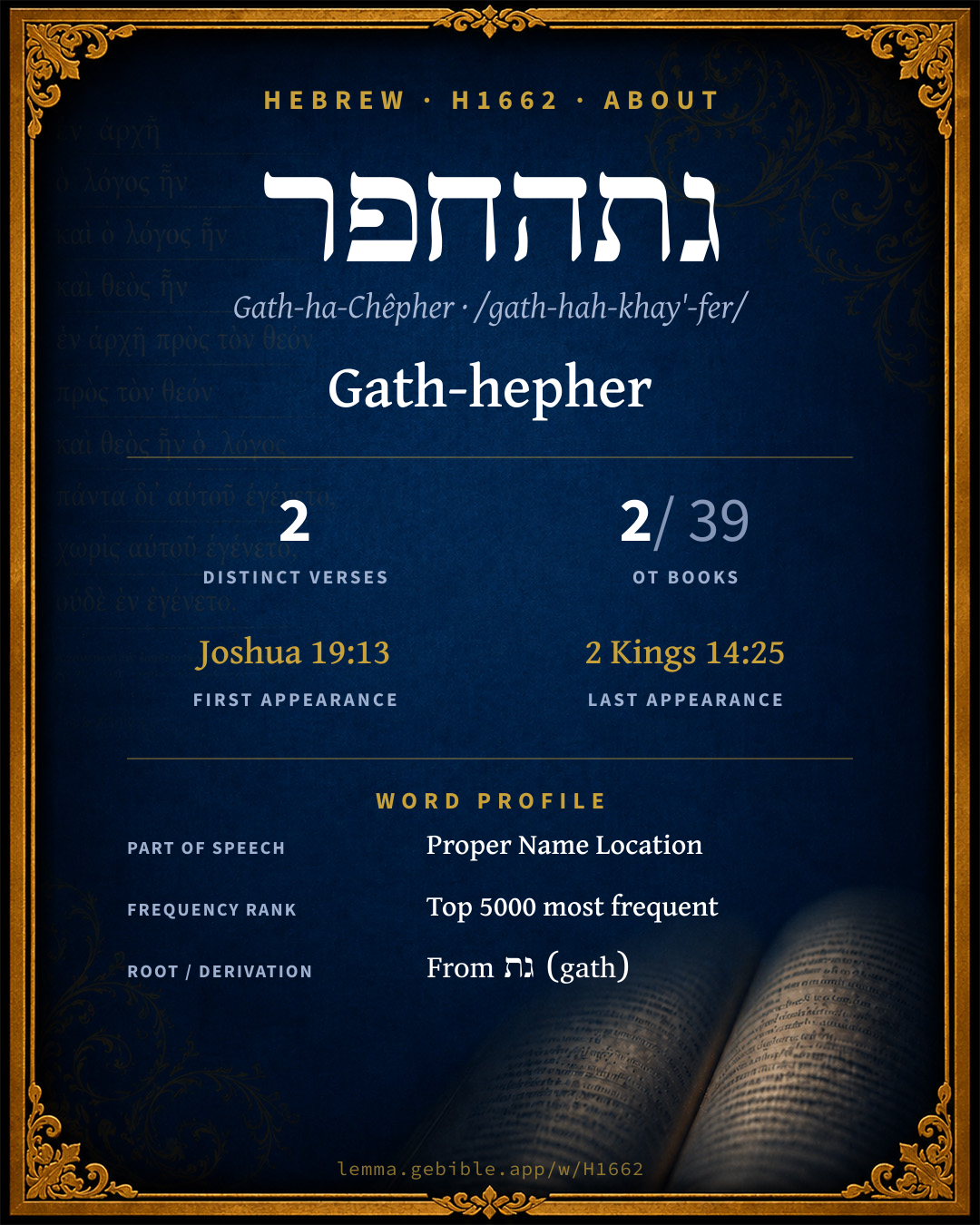
גַּת הַחֵ֫פֶר
Gath-hepher
BDB lists 2 entries for ‘Gath-hepher’ fuller range ↓
Full lexicon entry — Brown-Driver-Briggs (BDB)
From Brown-Driver-Briggs (BDB)
Where this word appears
Grammar key — what these labels mean
Part of speech
- Noun
- A naming word — a person, place, thing, or idea.
Noun type
- Proper
- A name of a specific person, place, or people (e.g. Abraham, Zion, Israel).
Every verse where H1662 appears — 2 distinct verses across 2 books. Click any verse to open its interlinear word-by-word view. Verse text shown in the World English Bible for context — . Each verse’s Hebrew form is shown with its reference; the English is not keyword-highlighted, since the data carries no word-level English alignment. Use “Compare translations” on any verse to read it across multiple English versions. This concordance covers the Hebrew Bible; Septuagint (Greek Old Testament) occurrences are not indexed here.
Joshua 1 verse
2 Kings 1 verse
About this entry
At a glance — auto-summarized from this page’s data, not written by a person. Every figure links to its source below. This summary describes the numbers; it doesn’t interpret them.
גתהחפר (Gath-ha-Chêpher) is a Hebrew name most often rendered “Gath-hepher.” It is rare — just 2 verses in the entire Hebrew Bible. It clusters heavily in Joshua, which alone accounts for 50% of its uses. Scripture first uses it in Joshua 19:13. For the data behind this summary, explore 2-verse concordance and the renderings breakdown below.
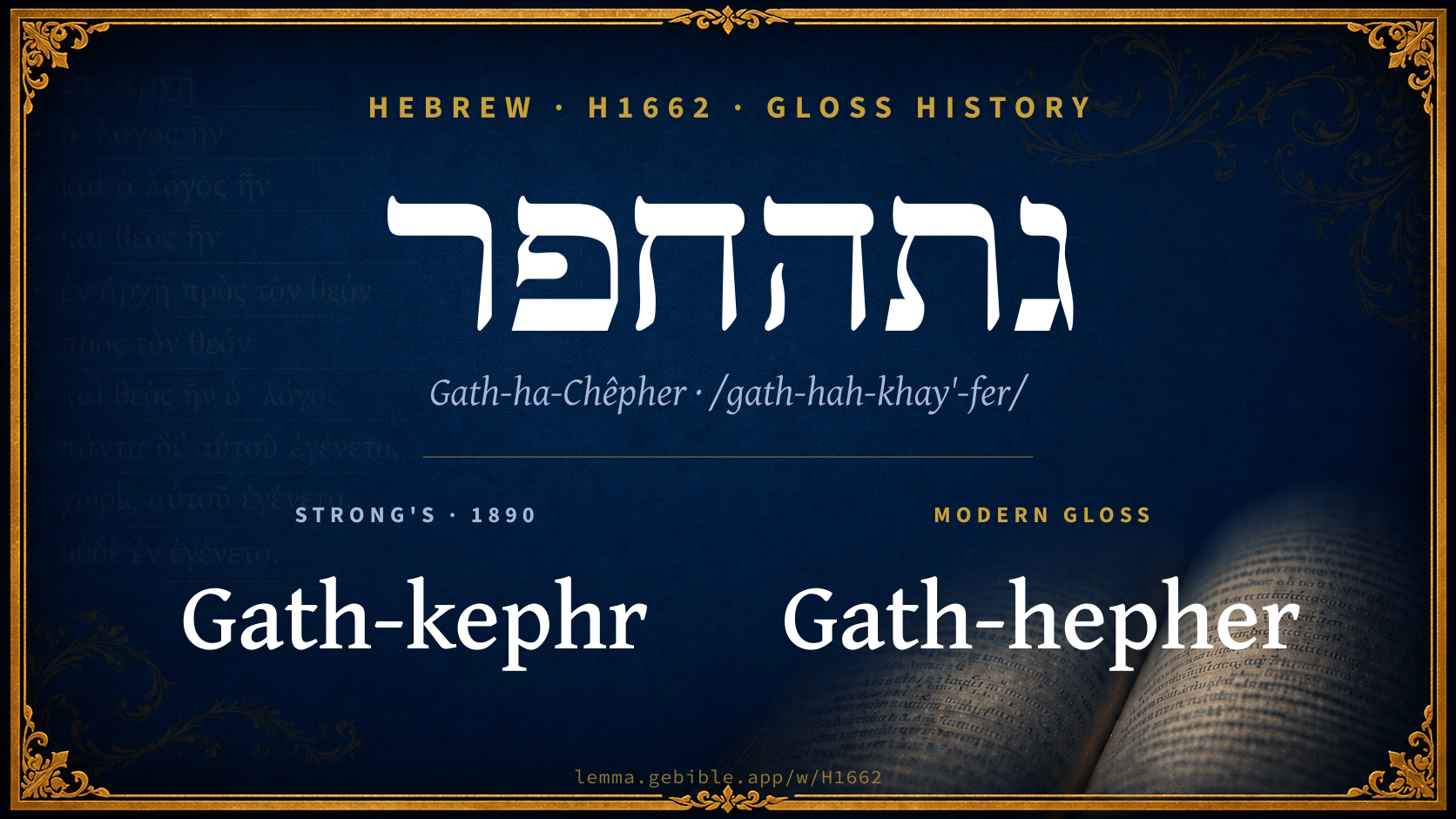
Gloss history
Strong's 1890 vs modern scholarship
About this word
Strong's H1662 catalogs a Hebrew word from the Hebrew Old Testament.
These counts are not copied from any lexicon or concordance. They are computed here, from the morphology-tagged Hebrew Old Testament. What Lemma adds →
- 2
- distinct verses
- The word appears in 2 distinct verses.
- 2 / 39
- OT books
- The word appears in 2 of 39 Old Testament books.
- #3,696
- by frequency
- Top 5000 most frequent Hebrew words (rank 3,696 of 8,640 Hebrew words by occurrence).
View all 2 occurrences in the concordance →
By traditional corpus
Conventional, traditional groupings — biblical authorship is debated, so this is a traditional corpus grouping, not an authorship claim. Each share is this word’s portion of its verses in that division of the Hebrew canon. Each figure is a share of the word’s 2 distinct verses.
- Prophets (Nevi'im) 2 verses · 100%
How translations render this word
Counts come from each version’s own published word-to-Strong’s tagging or interlinear alignment — an approximate guide to how each version renders this word, not a word-level alignment the data otherwise carries. Because each total is that version’s own tagged count, the per-version totals vary from one another and need not match the appearance or distinct-verse counts above. These counts may also differ from a printed concordance because Lemma counts each distinctly tagged rendering and does not collapse phrase taggings into a single head-word total. This is a fixed set of word-tagged versions (KJV, ASV, BSB, ULT) and does not change with the reading translation you choose elsewhere. Each version’s license is shown beside its name below (and on Sources).
BDB lists this Strong’s number as 4 distinct words (homographs). Each count above pools all of them and is not split by sense — see the Senses section below. A low-frequency rendering may belong to a different one of those words, not the primary meaning.
- King James Version†: Gittahhepher 1×, Was of gathhepher 1×
- American Standard Version†: Gath-hepher 1×, Was of gath-hepher 1×
- Berean Standard Bible†: Gath-hepher 2×
- unfoldingWord Literal Text†: Gath hepher 2×
King James Version Public Domain
Renders H1662 across 2† tagged occurrences — most commonly:
American Standard Version Public Domain
Renders H1662 across 2† tagged occurrences — most commonly:
Berean Standard Bible Public Domain
Renders H1662 across 2† tagged occurrences — most commonly:
unfoldingWord Literal Text CC BY-SA 4.0
Renders H1662 across 4† tagged occurrences — most commonly:
Plus 2 renderings that appear only once — usually multi-word phrases or single function words the recovered tagging swept in, not distinct renderings.
Senses in the full BDB
What do BDB’s symbols mean?
BDB uses these scholarly abbreviations:
| Symbol | Meaning |
|---|---|
| 𝔊 | the Septuagint (the ancient Greek translation, LXX) |
| 𝔙 | the Vulgate (the Latin translation) |
| 𝔖 | the Syriac version (the Peshitta) |
| 𝔗 | the Targum (the Aramaic translation) |
| ψ | the Psalms |
| √ | root (the underlying root or stem) |
| ‖ | parallel passage (a synonymous or contrasted parallel) |
| † | the dagger: every passage where the word occurs is cited |
The 0 senses and sub-senses the full Brown-Driver-Briggs lexicon distinguishes for this word, in lexicon order (not ranked by frequency), with BDB’s own verbatim wording and sub-sense lettering. Shown in Hebrew script with BDB’s own scholarly abbreviations. The condensed entry is in the Lexicon Entry tab. See also the Forms in the corpus table below.
גתהחפר I wine-press.
גתהחפר II wine-press (contracted from גַּנְתְּ = יְגַנְתְּ)
גתהחפר III loc. (wine-press)
Senses from the full Brown-Driver-Briggs lexicon (Brown, Driver, Briggs; Oxford 1906 — public domain), digitized via Sefaria, supplemented by the OpenScriptures HebrewLexicon (CC BY 4.0). Full attribution on Sources.
Word origin
I. wine-press.
III. n.f. wine-press (contracted from גַּנְתְּ = יְגַנְתְּ)—abs. גַּת Ju 6:11 + 3 times; גִּתּוֹת Ne 13:15;—wine-press, lit. חֹבֵט חִטִּים בַּגַּת Ju 6:11 beating out wheat in the wine-press, to hide it from Midian; the juice of the grapes was pressed out by treading, דֹּרֵךְ בְּג֑ת Is 63:2 (in sim.), but also as acc. דֹּרְכִים גִּתּוֹת Ne 13:15; in fig. of judgment, גַּת דָּרַךְ אֲדֹנָי לִבְתוּלַת וגו׳ La 1:15 a wine-press hath Adonay trodden for the virgin daughter of Judah; also רְדוּ כִּי מָֽלְאָה גַּת Jo 4:13 (רדה only here with גַּת).—On the form and use of wine-press, and Heb. synonyms, v. Smith DB (art. wine-press) BenzArch.. 212 f. RobBR iii, 137 Schick ZPV x, 1887, 146, 150, and Pl. v. vii. Anderlind ZPV xi, 1888, 166 f.
IV. n.pr.loc. (wine-press)—Philistine city 𝔊 Γεθ, 𝔙 Geth, JosAnt. vi. 12, 2 etc., Γιττα (ed. Niese), exact site unknown (v. GASmGeog. 194 ff.), named with Gaza and Ashdod Jos 11:22 as home of remaining ʿAnaḳim; named with Ashdod, Gaza, Ashḳelon and ʿEḳron 1 S 6:17; with Ashḳelon 1 S 1:20; with Ashḳelon, Yabne and Ashdod 2 Ch 26:6; מֵעֶקְרוֹן וְעַד־גַּת 1 S 7:14, cf. 17:52b and also v 52a (read גַּת for גַּיְא 𝔊 We Dr); called גַּת פְּלִשְׁתִּים Am 6:2; built up by Rehoboam, according to 2 Ch 11:8; taken by Hazael 2 K 12:18; also 1 S 5:8; 17:4, 23 (of Goliath), cf. 2 S 21:20, 22 = 1 Ch 20:6, 8; 1 S 21:11, 13; 27:2, 3, 4, 11 2 S 15:18 1 K 2:39(×2), 40, 41 ψ 56:1 Mi 1:10, 14 1 Ch 7:21; 8:13, also 18:1 (but ‖ מֶתֶג אַמָּה 2 S 8:1; on change of this into reading in Ch v. We); c. ה loc., גַּ֫תָּה 1 K 2:40.
— Brown-Driver-Briggs (Oxford 1906, public domain), digitized via Sefaria, supplemented by the OpenScriptures HebrewLexicon (CC BY 4.0). See Sources.
Derived from גת (gath) (H1660) — winepress.
Forms in the corpus
The 4 distinct written forms H1662 takes in the Hebrew Bible, most frequent first — each parse links to that state’s occurrences in the concordance. Hebrew forms include their vowel points and cantillation, so a single lemma takes many written forms.
| Form | Parsing | Example | Uses |
|---|---|---|---|
| גִּתָּ֥/ה | Noun, Proper | Joshua 19:13 | 1 |
| הַחֵֽפֶר | Noun, Proper | 2 Kings 14:25 | 1 |
| חֵ֖פֶר | Noun, Proper | Joshua 19:13 | 1 |
| מִ/גַּ֥ת | Noun, Proper | 2 Kings 14:25 | 1 |
Same root — word family
Other BDB entries built from the same root as H1662, grouped by Strong’s listed origin. These share a root / origin per the lexicon — not necessarily a shared meaning. Each links to that word’s own entry.
Derives from
Proper names from this root
People and places named from this root — a name, not an additional meaning of the word.
Compare all same-root words → Showing 4 of 5 — not the complete family. 3 of the same-root words are proper names (people or places). They share a root, not necessarily a meaning.
Bible dictionary
Public-domain dictionary articles matched to this entry by name (Gath-hepher). A biblical name can be shared by more than one person or place, so an article may treat several.
Easton's Bible Dictionary · M. G. Easton, 1897
Wine-press of the well, a town of Lower Galilee, about 5 miles from Nazareth; the birthplace of Jonah (2 Kings 14:25); the same as Gittah-hepher (Josh. 19:13). It has been identified with the modern el-Meshed, a village on the top of a rocky hill. Here the supposed tomb of Jonah, Neby Yunas, is still pointed out.
Classic public-domain reference works; full attribution on Sources.
Septuagint verse parallels
This word appears in 2 verses that also exist in the Greek Old Testament (Septuagint), out of the 2 Hebrew verses it occurs in. You can read those verses in Greek by switching the Old Testament edition to the Septuagint.
Read these verses in the Septuagint
This is a verse-level parallel only — the same verses exist in both the Hebrew and Greek Old Testaments. No word-level Hebrew↔Greek correspondence is claimed: the data carries no such alignment, so no Greek word is shown as this Hebrew word’s translation. Coverage is not total — the Septuagint omits the deuterocanon and renumbers the Psalms, so some Hebrew verses have no direct Greek parallel.