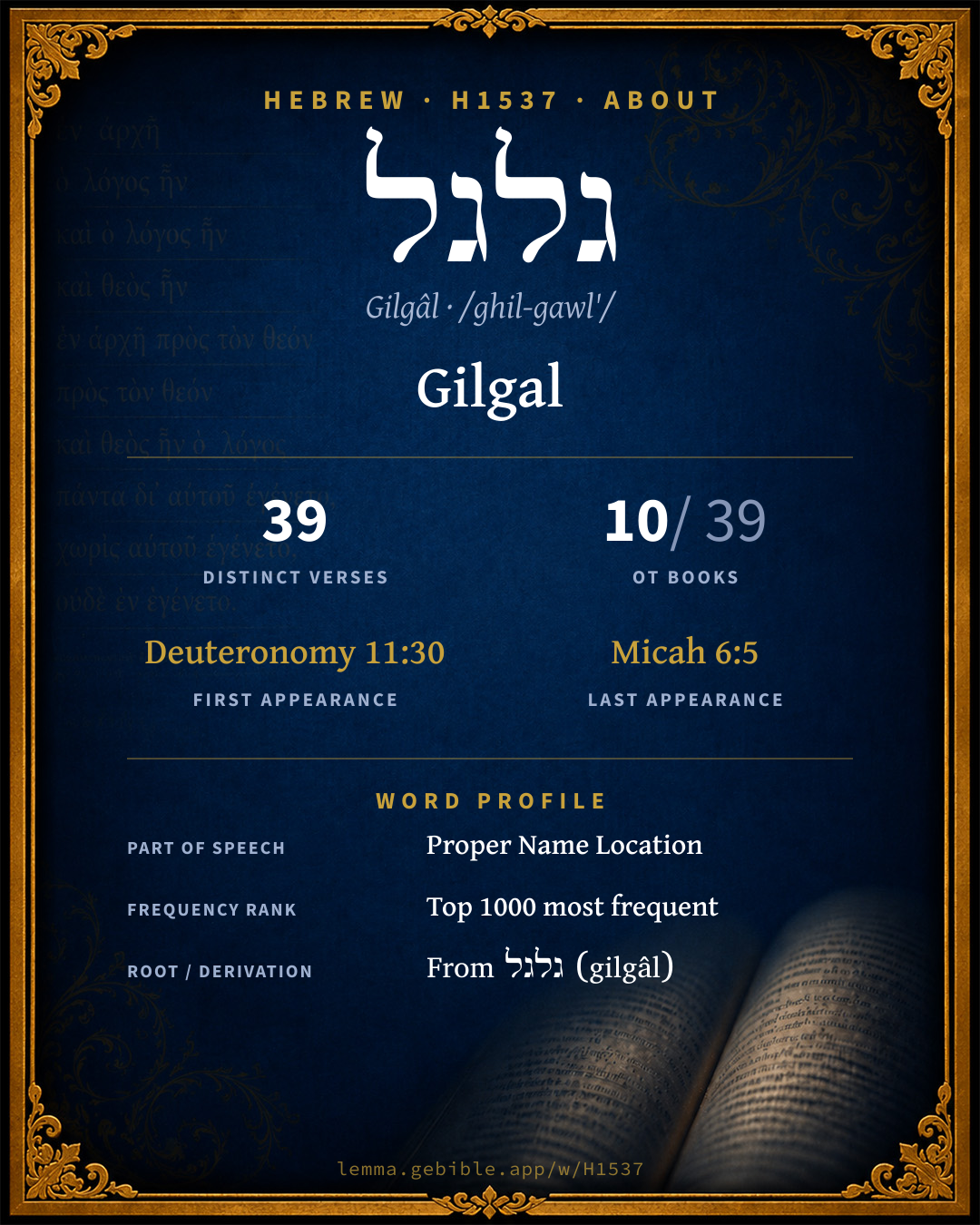
גִּלְגָּל
Gilgal
BDB lists 4 entries for ‘Gilgal’ fuller range ↓
Full lexicon entry — Brown-Driver-Briggs (BDB)
From Brown-Driver-Briggs (BDB)
Where this word appears
Grammar key — what these labels mean
Part of speech
- Noun
- A naming word — a person, place, thing, or idea.
Noun type
- Proper
- A name of a specific person, place, or people (e.g. Abraham, Zion, Israel).
Every verse where H1537 appears in the Book of Deuteronomy — 1 distinct verse. Click any verse to open its interlinear word-by-word view. Verse text shown in the World English Bible for context — . Each verse’s Hebrew form is shown with its reference; the English is not keyword-highlighted, since the data carries no word-level English alignment. Use “Compare translations” on any verse to read it across multiple English versions. This concordance covers the Hebrew Bible; Septuagint (Greek Old Testament) occurrences are not indexed here.
Deuteronomy
About this entry
At a glance — auto-summarized from this page’s data, not written by a person. Every figure links to its source below. This summary describes the numbers; it doesn’t interpret them.
At its core, גלגל (Gilgâl) means “Gilgal.” It first appears in Deuteronomy 11:30. It turns up in 39 verses across 10 books, a moderately common footprint. The word gravitates to Joshua (33%), then 1 Samuel and Hosea. Each statement above links to its evidence; the full detail follows below.
Gloss history
Strong's 1890 vs modern scholarship
About this word
Strong's H1537 catalogs a Hebrew word from the Hebrew Old Testament.
These counts are not copied from any lexicon or concordance. They are computed here, from the morphology-tagged Hebrew Old Testament. What Lemma adds →
- 39
- distinct verses
- The word appears in 39 distinct verses.
- 10 / 39
- OT books
- The word appears in 10 of 39 Old Testament books.
- #891
- by frequency
- Top 1000 most frequent Hebrew words (rank 891 of 8,640 Hebrew words by occurrence).
View all 39 occurrences in the concordance →
By section of the Old Testament
By traditional corpus
Conventional, traditional groupings — biblical authorship is debated, so this is a traditional corpus grouping, not an authorship claim. Each share is this word’s portion of its verses in that division of the Hebrew canon. Each figure is a share of the word’s 39 distinct verses.
- Prophets (Nevi'im) 37 verses · 95%
- Torah (Pentateuch) 1 verse · 3%
- Writings (Ketuvim) 1 verse · 3%
How translations render this word
Counts come from each version’s own published word-to-Strong’s tagging or interlinear alignment — an approximate guide to how each version renders this word, not a word-level alignment the data otherwise carries. Because each total is that version’s own tagged count, the per-version totals vary from one another and need not match the appearance or distinct-verse counts above. These counts may also differ from a printed concordance because Lemma counts each distinctly tagged rendering and does not collapse phrase taggings into a single head-word total. This is a fixed set of word-tagged versions (KJV, ASV, BSB, ULT) and does not change with the reading translation you choose elsewhere. Each version’s license is shown beside its name below (and on Sources).
BDB lists this Strong’s number as 3 distinct words (homographs). Each count above pools all of them and is not split by sense — see the Senses section below. A low-frequency rendering may belong to a different one of those words, not the primary meaning.
- King James Version†: Gilgal 35×
- American Standard Version†: Gilgal 31×, Camp to gilgal 2×
- Berean Standard Bible†: Gilgal 38×
- unfoldingWord Literal Text†: Gilgal 39×
King James Version Public Domain
Renders H1537 across 41† tagged occurrences — most commonly:
Plus 6 renderings that appear only once — usually multi-word phrases or single function words the recovered tagging swept in, not distinct renderings.
American Standard Version Public Domain
Renders H1537 across 41† tagged occurrences — most commonly:
Plus 8 renderings that appear only once — usually multi-word phrases or single function words the recovered tagging swept in, not distinct renderings.
Berean Standard Bible Public Domain
Renders H1537 across 39† tagged occurrences — most commonly:
Plus 1 rendering that appears only once — usually multi-word phrases or single function words the recovered tagging swept in, not distinct renderings. Not rendered by a distinct English word in 1 further occurrence.
unfoldingWord Literal Text CC BY-SA 4.0
Renders H1537 across 41† tagged occurrences — most commonly:
Plus 2 renderings that appear only once — usually multi-word phrases or single function words the recovered tagging swept in, not distinct renderings.
Senses in the full BDB
What do BDB’s symbols mean?
BDB uses these scholarly abbreviations:
| Symbol | Meaning |
|---|---|
| 𝔊 | the Septuagint (the ancient Greek translation, LXX) |
| 𝔙 | the Vulgate (the Latin translation) |
| 𝔖 | the Syriac version (the Peshitta) |
| 𝔗 | the Targum (the Aramaic translation) |
| ψ | the Psalms |
| √ | root (the underlying root or stem) |
| ‖ | parallel passage (a synonymous or contrasted parallel) |
| † | the dagger: every passage where the word occurs is cited |
The 5 senses and sub-senses the full Brown-Driver-Briggs lexicon distinguishes for this word, in lexicon order (not ranked by frequency), with BDB’s own verbatim wording and sub-sense lettering. Shown in Hebrew script with BDB’s own scholarly abbreviations. The condensed entry is in the Lexicon Entry tab. See also the Forms in the corpus table below.
גלגל I [m.] wheel (on format. cf. BaNB 204) of cart, גִּלְגַּל עֶגְלָתוֹ Is 28
גלגל II loc. ( = (sacred) circle of stones
- 1. place E. of Jericho, where Isr. lay encamped Jos 4:19, 20; 5:9, 10; 9:6; 10:6, 7, 9, 15, 43; 14:6; cf. Mi 6:5 & Ju 3:19 הַפְּסִילִים אֲשֶׁר אֶת־הַגּ׳;? mod. Tell Juljul BdPal 169; perhaps also the place where sacrifices were offered 1 S 10:8; 11:14, 15(×2); 13:4, 7, 8, 12, 15 (in v 15 ins. also c. other words, Dr cf. We) 15:12, 21, 33; place of illicit sacrifice Ho 4:15; 9:15; 12:12 Am 4:4; 5:5(×2), named also Ju 2:1 1 S 7:16 2 S 19:16, 41;? = בֵּית הַגִּלְגָּל Ne 12:29. e.g. Joshua 4:19
- 2. place on border between Judah & Benjamin Jos 15:7 (= גְּלִילוֹת 18:17 cf. Di). e.g. Joshua 15:7
- 3. place in N. Isr., dwelling of prophets 2 K 2:1; 4:38, mod. Jiljilie S. from Nâbulus, SW. from Seilûn (Shiloh) cf. Di RiHWB 518. e.g. 2 Kings 2:1
- 4. place in N. Isr. near Mt. Gerizim and Mt. Ebal Dt 11:30, identif. with 3 by Ke RiHWB 518 SchenkelBL SS; but cf. Di. e.g. Deuteronomy 11:30
- 5. in phr. מֶלֶךְ גּוֹיִם לְגִלְגָּל Jos 12:23, in list of Canaanitish kings; prob. name of a (northern) district cf. Di (B βασιλέα Γεεὶ τῆς Γαλιλαίας—but 𝔊L & Codd. Γοειμ τῆς Γελγελ); Di comp. Is 8:23. e.g. Joshua 12:23
Senses from the full Brown-Driver-Briggs lexicon (Brown, Driver, Briggs; Oxford 1906 — public domain), digitized via Sefaria, supplemented by the OpenScriptures HebrewLexicon (CC BY 4.0). Full attribution on Sources.
Word origin
I. n.[m.] wheel (on format. cf. BaNB 204) of cart, גִּלְגַּל עֶגְלָתוֹ Is 28:28.
II. n.pr.loc. ( = (sacred) circle of stones; cf. Di on Jos 5:9, where word-play on roll away, off)—c.art.except Jos 5:9; 12:23;—
— Brown-Driver-Briggs (Oxford 1906, public domain), digitized via Sefaria, supplemented by the OpenScriptures HebrewLexicon (CC BY 4.0). See Sources.
Derived from גלגל (gilgâl) (H1536) — wheel.
Jastrow Dictionary
A second Hebrew/Aramaic lexicon for comparison, covering Aramaic and post-biblical (Talmudic, Targumic, Midrashic) usage that the biblical-Hebrew BDB does not. Matched by lemma rather than by Strong’s number, so a lemma may carry more than one Jastrow headword (shown separately below), and the entries cover usage well beyond the Bible.
גִּלְגֵּל
- 1. to roll, turn. Pirké́ d’R. El. ch. XXXVI לגַלְגֵּל וכ׳ to roll (move) the stone.—Y. Sabb. III, 6ᵃ top מְגַלְגְּלִין ביצה וכ׳ you may roll an egg (for roasting) on &c. Ḥall. III, 1 גִּלְגְּלָה (בחטים) when she has formed the dough (of wheat) by rolling; a. fr.—Part. pass. מְגוּלְגָּל, f. מְגוּלְגֶּלֶת; pl. מְגוּלְגָּלִים, מְגוּלְגָּלִין; מְגוּלְגָּלוֹת. 1) rolled. Pes. 7ᵃ עיסה מג׳ a formed dough. Y. Sot. I, 16ᶜ bot. ביצים מג׳ roasted eggs; a. fr.
- 2. rounded. B. Bath. 16ᵇ מה עדשה זו מְגוּלְגֶּלֶת אף אבילות מִגַּלְגֶּלֶת וכ׳ as the lentil is rounded, so does mourning roll and go around (different version in Ms., v. Rabb. D. S. a. l. note, a. in Yalk. Gen. 110, v. גַּלְגַּל). [Men. 86ᵃ, v. גִּרְגֵּר.].—2) (with על) to roll upon, to put on one’s shoulders, to burden, tax, assess. Keth. VIII, 1 (78ᵃ) אתם מגלגלים עלינו וכ׳ you burden us with old restrictive laws. Y. Shebi. IV, 35ᵇ אתם מג׳ וכ׳ ye impose upon us taxes &c. Y. B. Bath. I, beg. 12ᵈ מג׳ עליו וכ׳ you make him bear the expenses for &c.
- 3. to bring about, cause. Sabb. 32ᵃ; Tosef. Yoma V (IV), 12 מגלגלין זכות ע"י וכ׳ good things are brought about through the agency of good men &c.; a. fr.
- 4. (v. גָּלַל Nif.) to overcome (one’s own feelings), to put up with, bear with. Keth. 67ᵇ רצונך שתְּגַלְגֵּל עמי בעדשים will you bear with me when I offer you only lentils? ג׳ עמו וכ׳ he tried to live with him on lentils, and died. Ib. 111ᵃ ג׳ בעצמו he conquered his love and remained single. Y. ib. VII, beg. 31ᵇ מגלגלת עמו וכ׳ she has to bear with him thirty days longer. Y. Yeb. VIII, 8ᵈ top גַּלְגֵּל עמהן וכ׳ bear with them twelve months (give them time for reconsideration).
- , Nithpalp. נִתְגַּלְגֵּל
- 1. to be rolled. Erub. X, 3 נ׳ הספר מידו the scroll rolled out of his hands (down the roof). Ḥall. III, 1 עד שתִּתְגַּלְגֵּל בחטים in the case of wheat flour, until it (the dough) is rolled, v. supra. Y. Kil. IX, 32ᶜ top; Y. Keth. XII, 35ᵇ top מִתְגַּלְגְּלִין their bodies are rolled underground, v. גִּלְגּוּל. B. Kam. 17ᵇ ונתג׳ למקום אחר but the barrel rolled to another place. Pesik. R. s. 6 מא"י נִתְגַּלְגְלָה וכ׳ from Palestine it (the stone) rolled and arrived just for this momentary use; a. fr.
- 2. to be turned, changed, transferred, caused. Pirké d’R. El. ch. XLIX נתגלגלה המלכות על וכ׳ the royal dignity was transferred on Esther. Shebu. VII, 8 נ׳ לו שבועה וכ׳ if by chance an oath is imposed upon him in another law-suit (with the same persons), the court makes him swear by implication &c.; v. גִּלְגּוּל.
- 3. (of waters) to tower, gather. Pirké d’R. El. ch. V; ch. XXIII.
- 4. (with רחמים) to prevail (over hatred &c.), be moved. Pesik. R. s. 20 נִתְגַּלְגְּלוּ רחמיו וכ׳ the Lord’s compassion was moved. Tanḥ. Vayigg. 4; a. e.
- 5. to throw one’s self upon, to attack. Yalk. Is. 350 (ib. 288 נתגאה).
גַּלְגֵּל
- , to roll. Targ. Y. I Gen. XXVIII, 10 (II גלל). Ib. XXIX, 8 (O. גנדר); a. e.—Y. Shebu. VI, 37ᵃ wait עד דִּיגַלְגֵּל עלן וכ׳ until he heaps upon thee all his claims, and then swear concerning all of them. Ib. VII, end, 38ᵃ או אישתבע ליה כל דמְגַלְגֵּל עלך or thou must swear to him concerning all that he asks thee to swear to by implication.—Part. pass. Ber. 44ᵇ ביעתא מְגוּלְגַּלְתָּא an egg roasted in ashes, v. preced.
- ; אִתְגְּלַל (fr. גְּלַל), אִתְגּוֹלַל (Ithpolel of גּוּל)
- 1. as preced. Hithpalp. 3. Targ. Job XXX, 14.—2) (with רחמין) as preced. Hithpalp. 4. Targ. I Kings III, 26 איתגלגלו ed. Lag. (ed. אִיתְגְּלָלוּ). Targ. O. Gen. XLIII, 30 אִתְגּוֹלָלוּ). Targ. Hos. XI, 8 מתגללא ed. Lag. ed. אִתְגּוֹלָלוּ). Targ. Jer. XXXI, 20 אִתְגּוֹ׳. Targ. II Chr. XXXIII, 13. Targ. Y. Num. XXVI, 1; a. e.—3) to come about, to happen. B. Mets. 40ᵃ, a. e. איגלגל מילתא it so happened in the course of time.—4) (denom. of גולגלתא) to crown, adorn one’s self. Esth. R. to I, 4 whether with its own or with strange (feathers) מִתְגַּלְגְּלַת בת קבריא the raven will adorn itself; ib. 9.
גַּלְגַּל
- preced.)
- 1. wheel, esp. the wheel-work at wells, crane &c. Midd. V, 4. Tosef. B. Bath. II, 16 בית גולגל לרבים ed. Zuck. (Var. גילגל) a public well. B. Bath. IV, 5 את הג׳ the crane of the wine or oil press, v. חוּמַרְתָּא. Erub. X, 14; a. fr.
- 2. globe, celestial sphere, esp. the sphere of the zodiac. Yoma 20ᵇ, a. e. ג׳ חמה the revolution of the Sun. Pes. 94ᵇ ג׳ קבוע ומזלות וכ׳ the sphere of the zodiac is stationary, and the planets make the circuit; ג׳ חוזר וכ׳ the sphere (wheel) turns around and the planets are stationary; a. fr.—B. Bath. 16ᵇ Ms. M. מה עדש זה דומה לג׳ וכ׳ as the lentil resembles a sphere, so is mourning a sphere making a circuit in the world; (diff. in ed., v. גִּלְגֵּל); Yalk. Gen. 110 מה עדשים האלו ג׳ וכ׳.
- 3. the eye-ball. Gen. R. s. 42; Lev. R. s. 11; Ruth R. introd. 6 (ref. to עין משפט Gen. XIV, 7) ג׳ עינו של עולם the eye-ball of the world (Abraham). Snh. 108ᵃ בשביל ג׳ העין וכ׳ on account of (the covetousness of) the eye-ball (v. next w.); a. e.—Pl. גַּלְגִּלִּים. Makhsh. III, 8 wheel works. B. Bath. 58ᵃ שני גַּלְגִּלִּי חמה two Sun-globes.—Y. Nidd. III, 50ᶜ bot. ג׳ אדם וכ׳ the apples of man’s eyes are round.—Trnsf. the rotation of fortune, changes (v. B. Bath. 16ᵇ quot. above). Sabb. 151ᵇ (ref. to בִּגְלַל Deut. XV, 10) ג׳ הוא וכ׳ a wheel rotates in this world, i.e. changes of fortune take place constantly; Ex. R. s. 31, a. e.—3) (= גַּרְגַּר) globule, grain. Sabb. 64ᵇ; 65ᵃ, v. גַּרְגַּר.—Pl. as above. Y. Maasr. V, end, 52ᵃ; Tosef. ib. III, 14 Egyptian beans are those שגַּלְגִּלֵּיהֶן חדין (ed. Zuck. גלוגל׳, Var. גלגל הן, corr. acc.) whose globules are pointed. e.g. Genesis 14:7
גַּלְגַּל ²
- 1. wheel. Targ. Ezek. I, 15 sq. גִּילְ׳ ed. Lag. Targ. Ps. LXXXIII, 14; a. e.—Erub. 104ᵃ למימלא בגי׳ to fill (draw water) with the wheel. Lev. R. s. 34, v. אַנְטְלַיָּא.
- 2. globe, celestial sphere. Targ. Ps. LXXVII, 19. Targ. Job XXXVIII, 33.—B. Bath. 74ᵃ ג׳ דרקיע וכ׳ the sphere of the zodiac which turns around.
- 3. eye-ball. Targ. Ps. XVII, 8 גִּילְגוּל ed. Lag. (oth. ed. גִּלְגּוּל; Ms. גִּיגַּל).—Tam. 32ᵇ they handed him ג׳ דעינא Ar. (ed. גולגלתא incorr.) an eye-ball. Ib. גולגלתא דעינא וכ׳ (read גילגלא) the eye-ball of a mortal which is never satisfied. B. Bath. 73ᵇ
- 4. stubble. Targ. Is. XVII, 13.—Pl. גִּלְגְּלַיָּא, גִּילְ׳. Targ. Ezek. I, 16 sq.—Targ. Ex. XIV, 25 גִּלְגְּלֵי ed. Berl. (ed. a. Y. גַּלְגַּלֵי). Targ. Y. II ib. גֶּלְגְּלַיָּא; a. e.—Koh. R. to XII, 6; Lev. R. s. 18; a. e.—4) (v. next w.) a sort of girdle. Pl. גַּלְגְּלַיָּיה. Y. Sabb. VI, 8ᵇ bot. (transl. of גליונים, Is. III, 22), v. גִּלְיוֹן 3. e.g. Isaiah 3:22
A Dictionary of the Targumim, the Talmud Babli and Yerushalmi, and the Midrashic Literature (Marcus Jastrow; London, Luzac, 1903) — Public Domain. Digitized via Sefaria. Digitized via Sefaria. Full attribution on Sources.
Forms in the corpus
The 23 distinct written forms H1537 takes in the Hebrew Bible, most frequent first — each parse links to that state’s occurrences in the concordance. Hebrew forms include their vowel points and cantillation, so a single lemma takes many written forms.
| Form | Parsing | Example | Uses |
|---|---|---|---|
| הַ/גִּלְגָּ֔ל | Noun, Proper | Deuteronomy 11:30 | 4 |
| הַ/גִּלְגָּ֗ל | Noun, Proper | Hosea 4:15 | 4 |
| הַ/גִּלְגָּֽל | Noun, Proper | 1 Samuel 13:4 | 4 |
| בַּ/גִּלְגָּ֔ל | Noun, Proper | 1 Samuel 11:15 | 3 |
| בַּ/גִּלְגָּֽל | Noun, Proper | 1 Samuel 15:21 | 3 |
| הַ/גִּלְגָּ֑ל | Noun, Proper | 1 Samuel 11:14 | 3 |
| הַ/גִּלְגָּ֖ל | Noun, Proper | Amos 4:4 | 3 |
| הַ/גִּלְגָּֽלָ/ה | Noun, Proper | Joshua 10:15 | 2 |
| בַ/גִּלְגָּ֔ל | Noun, Proper | 1 Samuel 13:7 | 1 |
| בַּ/גִּלְגָּ֑ל | Noun, Proper | Joshua 5:10 | 1 |
| בַּ/גִּלְגָּ֖ל | Noun, Proper | Hosea 12:11 | 1 |
| בַּ/גִּלְגָּל֙ | Noun, Proper | Hosea 9:15 | 1 |
| גִּלְגָּ֔ל | Noun, Proper | Joshua 5:9 | 1 |
| הַ/גִּלְגָּ֔לָ/ה | Noun, Proper | 2 Samuel 19:40 | 1 |
| הַ/גִּלְגָּ֗לָ/ה | Noun, Proper | 2 Samuel 19:15 | 1 |
| הַ/גִּלְגָּ֣לָ/ה | Noun, Proper | Joshua 10:6 | 1 |
| הַ/גִּלְגָּ֨לָ/ה֙ | Noun, Proper | 2 Kings 4:38 | 1 |
| הַ/גִּלְגָּל֒ | Noun, Proper | 1 Samuel 10:8 | 1 |
| הַ/גִּלְגָּל֙ | Noun, Proper | Amos 5:5 | 1 |
| הַגִּלְגָּ֔ל | Noun, Proper | Nehemiah 12:29 | 1 |
| וְ/הַ/גִּלְגָּ֖ל | Noun, Proper | 1 Samuel 7:16 | 1 |
| וְ/הַ/גִּלְגָּל֙ | Noun, Proper | Amos 5:5 | 1 |
| לְ/גִלְגָּ֖ל | Noun, Proper | Joshua 12:23 | 1 |
Bible dictionary
Public-domain dictionary articles matched to this entry by name (Gilgal). A biblical name can be shared by more than one person or place, so an article may treat several.
Easton's Bible Dictionary · M. G. Easton, 1897
Rolling. (1.) From the solemn transaction of the reading of the law in the valley of Shechem between Ebal and Gerizim the Israelites moved forward to Gilgal, and there made a permanent camp (Josh. 9:6; 10:6). It was "beside the oaks of Moreh," near which Abraham erected his first altar (Gen. 12:6, 7). This was one of the three towns to which Samuel resorted for the administration of justice (1 Sam. 7:16), and here also he offered sacrifices when the ark was no longer in the tabernacle at Shiloh (1 Sam. 10:8; 13:7-9). To this place, as to a central sanctuary, all Israel gathered to renew their allegiance to Saul (11:14). At a later period it became the scene of idolatrous worship (Hos. 4:15; 9:15). It has been identified with the ruins of Jiljilieh, about 5 miles south-west of Shiloh and about the same distance from Bethel.
(2.) The place in "the plains of Jericho," "in the east border of Jericho," where the Israelites first encamped after crossing the Jordan (Josh. 4:19, 20). Here they kept their first Passover in the land of Canaan (5:10) and renewed the rite of circumcision, and so "rolled away the reproach" of their Egyptian slavery. Here the twelve memorial stones, taken from the bed of the Jordan, were set up; and here also the tabernacle remained till it was removed to Shiloh (18:1). It has been identified with Tell Jiljulieh, about 5 miles from Jordan.
(3.) A place, probably in the hill country of Ephraim, where there was a school of the prophets (2 Kings 4:38), and whence Elijah and Elisha, who resided here, "went down" to Bethel (2:1, 2). It is mentioned also in Deut. 11:30. It is now known as Jiljilia, a place 8 miles north of Bethel.
Smith's Bible Dictionary · William Smith, 1863
(a wheel; rolling).
+ The site of the first camp of the Israelites on the west of the Jordan, the place at which they passed the first night after crossing the river, and where the twelve stones were set up which had been taken from the bed of the stream, (Joshua 4:19,20) comp. Josh 4:3 Where also they kept the first passover in the land of Canaan ch. (Joshua 5:10) It was "in the east border of Jericho," apparently on a hillock or rising ground, (Joshua 5:3) comp. Josh 5:9 In the Arboth-Jericho (Authorized Version "the plains"), that is, the hot depressed district of the Ghor which lay between the town and the Jordan. ch. (Joshua 5:10) Here Samuel was judge, and Saul was made king. We again have a glimpse of it, some sixty years later, in the history of David's return to Jerusalem. (2 Samuel 19:40) A Gilgal is spoken of in (Joshua 15:7) in describing the north border of Judah. In (Joshua 18:17) it is given as Geliloth. Gilgal near Jericho is doubtless intended. + In (2 Kings 2:1,2; 4:38) is named a Gilgal visited by Elijah and Elisha. This could not be the Gilgal of the low plain of the Jordan, for the prophets are said to have gone down to Bethel, which is 3000 feet above the plain. It haa been identified with Jiljilia, about four miles from Bethel and Shiloh respectively. + The "king of the nations of Gilgal" or rather perhaps the "king of Goim at Gilgal," is mentioned in the catalogue of the chiefs overthrown bv Joshua. (Joshua 12:23) Possibly the site of this place is marked by the modern village Jiljulieh, about four miles south of Antipatris, which lies 16 miles northeast of Joppa. But another Gilgal, under the slightly-different form of Kilkilieh, lies about two miles east of Antipatris.
Hitchcock's Bible Names Dictionary · Roswell D. Hitchcock, 1869
wheel; rolling; heap
Classic public-domain reference works; full attribution on Sources.
Septuagint verse parallels
This word appears in 36 verses that also exist in the Greek Old Testament (Septuagint), out of the 39 Hebrew verses it occurs in. You can read those verses in Greek by switching the Old Testament edition to the Septuagint.
Read these verses in the Septuagint
- Deuteronomy 11:30
- Joshua 4:19
- Judges 2:1
- 1 Samuel 7:16
- 2 Samuel 19:15
- 2 Kings 2:1
- Hosea 4:15
- Amos 4:4
- Micah 6:5
This is a verse-level parallel only — the same verses exist in both the Hebrew and Greek Old Testaments. No word-level Hebrew↔Greek correspondence is claimed: the data carries no such alignment, so no Greek word is shown as this Hebrew word’s translation. Coverage is not total — the Septuagint omits the deuterocanon and renumbers the Psalms, so some Hebrew verses have no direct Greek parallel.