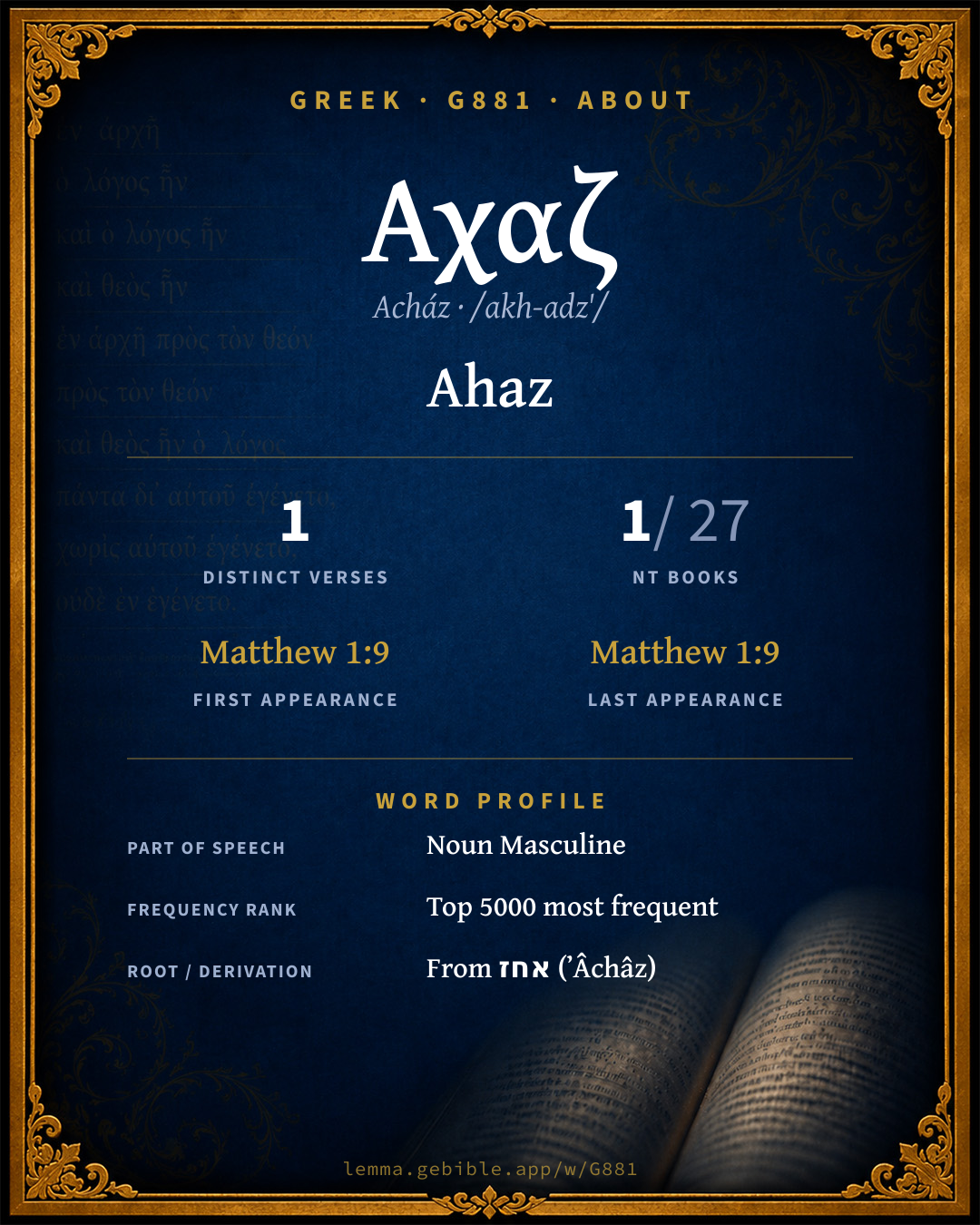
Ἀχάζ
Ahaz
Thayer's lists 2 entries for ‘Ahaz’ fuller range ↓
Full lexicon entry — Thayer's Greek Lexicon
From Thayer's Greek Lexicon
Where this word appears
Every verse where G881 appears — 1 distinct verse across 1 book. Click any verse to open its interlinear word-by-word view. Verse text shown in the World English Bible for context — . Each verse’s Greek form is shown with its reference; the English is not keyword-highlighted, since the data carries no word-level English alignment. Use “Compare translations” on any verse to read it across multiple English versions. This concordance covers the Greek New Testament; Septuagint (Greek Old Testament) occurrences of this word are not indexed here.
Matthew 1 verse
About this entry
At a glance — auto-summarized from this page’s data, not written by a person. Every figure links to its source below. This summary describes the numbers; it doesn’t interpret them.
Αχαζ (Acház) is a Greek name most often rendered “Ahaz.” It occurs a mere 1 verse across Scripture. Matthew dominates its distribution — 1 of 1 verses. Found nowhere else but Matthew 1:9. For the data behind this summary, explore 1-verse concordance and the renderings breakdown below.
Gloss history
Strong's 1890 vs modern scholarship
About this word
Strong's G881 catalogs a Greek word from the Greek New Testament.
These counts are not copied from any lexicon or concordance. They are computed here, from the morphology-tagged Greek New Testament. What Lemma adds →
- 1
- distinct verses
- The word appears in 1 distinct verse.
- 1 / 27
- NT books
- The word appears in 1 of 27 New Testament books.
- #2,678
- by frequency
- Top 5000 most frequent Greek words (rank 2,678 of 5,347 Greek words by occurrence).
View all 1 occurrence in the concordance →
Most concentrated in
- Matthew 1 verse 100%
By section of the New Testament
By traditional corpus
Conventional, traditional groupings — biblical authorship is debated, so this is a traditional corpus grouping, not an authorship claim. Some books belong to more than one corpus (Luke is in both the Gospels and the Lukan corpus, and so on), so these shares overlap and need not total 100%. Each figure is a share of the word’s 1 distinct verse.
- Gospels 1 verse · 100%
How translations render this word
Counts come from each version’s own published word-to-Strong’s tagging or interlinear alignment — an approximate guide to how each version renders this word, not a word-level alignment the data otherwise carries. Because each total is that version’s own tagged count, the per-version totals vary from one another and need not match the appearance or distinct-verse counts above. These counts may also differ from a printed concordance because Lemma counts each distinctly tagged rendering and does not collapse phrase taggings into a single head-word total. This is a fixed set of word-tagged versions (KJV, ASV, BSB, ULT) and does not change with the reading translation you choose elsewhere. Each version’s license is shown beside its name below (and on Sources).
- King James Version: Achaz 2×
- American Standard Version: Ahaz 2×
- Berean Standard Bible: Ahaz 2×
- unfoldingWord Literal Text: Ahaz 2×
King James Version Public Domain
Renders G881 across 2 tagged occurrences — most commonly:
American Standard Version Public Domain
Renders G881 across 2 tagged occurrences — most commonly:
Berean Standard Bible Public Domain
Renders G881 across 2 tagged occurrences — most commonly:
unfoldingWord Literal Text CC BY-SA 4.0
Renders G881 across 2 tagged occurrences — most commonly:
Senses in Thayer's
The 2 senses Thayer's distinguishes for this word, in lexicon order (not ranked by frequency or importance). The full entry — with sub-senses — is in the Lexicon Entry tab.
- Ahaz = "possessor"
- the eleventh king of Judah, son of Jotham
Word origin
Derived from אחז (ʼÂchâz) (H271) — Ahaz.
Of hebrew origin [ H271 ]; Achaz an Israelite : - Achaz.
— Strong’s Exhaustive Concordance (1890), public domain.
Forms in the corpus
The 2 distinct written forms G881 takes in the Greek New Testament, most frequent first — each parse links to that case’s occurrences in the concordance.
| Form | Parsing | Example | Uses |
|---|---|---|---|
| Ἀχάζ Acház | Noun, Proper, indeclinable | Matthew 1:9 | 1 |
| Ἀχὰζ Achàz | Noun, Proper, indeclinable | Matthew 1:9 | 1 |
Bible dictionary
Public-domain dictionary articles matched to this entry by name (Ahaz). A biblical name can be shared by more than one person or place, so an article may treat several.
Easton's Bible Dictionary · M. G. Easton, 1897
Possessor. (1.) A grandson of Jonathan (1 Chr. 8:35; 9:42).
(2.) The son and successor of Jotham, king of Judah (2 Kings 16; Isa. 7-9; 2 Chr. 28). He gave himself up to a life of wickedness and idolatry. Notwithstanding the remonstrances and warnings of Isaiah, Hosea, and Micah, he appealed for help against Rezin, king of Damascus, and Pekah, king of Israel, who threatened Jerusalem, to Tiglath-pileser, the king of Assyria, to the great injury of his kingdom and his own humilating subjection to the Assyrians (2 Kings 16:7, 9; 15:29). He also introduced among his people many heathen and idolatrous customs (Isa. 8:19; 38:8; 2 Kings 23:12). He died at the age of thirty-five years, after reigning sixteen years (B.C. 740-724), and was succeeded by his son Hezekiah. Because of his wickedness he was "not brought into the sepulchre of the kings."
Smith's Bible Dictionary · William Smith, 1863
(possessor), eleventh king of Judah, son of Jotham, reigned 741-726, about sixteen years. At the time of his accession, Rezin king of Damascus and Pekah king of Israel had recently formed a league against Judah, and they proceeded to lay siege to Jerusalem. Upon this Isaiah hastened to give advice and encouragement to Ahaz, and the allies failed in their attack on Jerusalem. Isai 7,8,9. But, the allies inflicted a most severe injury on Judah by the capture of Elath, a flourishing port on the Red Sea, while the Philistines invaded the west and south. 2Kin 16; 2Chr 28. Ahaz, having forfeited God's favor by his wickedness, sought deliverance from these numerous troubles by appealing to Tiglath-pileser king of Assyria, who forced him from his most formidable enemies. But Ahaz had to purchase this help at a costly price; he became tributary to Tiglath-pileser. He was weak, a gross idolater, and sought safety in heathen ceremonies, making his son pass through the fire to Molech, consulting wizards and necromancers. (Isaiah 8:19) and other idolatrous practices. (2 Kings 23:12) His only service of permanent value was the introduction of the sun-dial. He died at the age of 36, but was refused a burial with the kings his ancestors. (2 Chronicles 28:27)
+ Son of Micah. (1 Chronicles 8:35,36; 9:42)
Hitchcock's Bible Names Dictionary · Roswell D. Hitchcock, 1869
one that takes or possesses
Classic public-domain reference works; full attribution on Sources.
Septuagint usage
The same Greek word Αχαζ appears 38 times in the Greek Old Testament (Septuagint), across 37 verses in 7 books.
- 38
- LXX occurrences
- Tagged occurrences of this Greek word in the Septuagint.
- 37
- verses
- Distinct Septuagint verses containing this word.
- 7 / 39
- OT books
- The word appears in 7 of the 39 Old Testament books.
Sample Septuagint occurrences
- 2 Kings 15:38 αχαζ
- 1 Chronicles 3:13 αχαζ
- 2 Chronicles 27:8 αχαζ
- Isaiah 1:1 αχαζ
- Jeremiah 22:15 αχαζ
- Hosea 1:1 αχαζ
- Micah 1:1 αχαζ
Septuagint occurrences (same lexeme)
Every verse where the same Strong’s number (G881) appears in the Greek Septuagint. Verse text shown in the World English Bible for context; the Greek form is the matched word — the English is not keyword-highlighted.
- 2 Kings 15:38 αχαζ Jotham slept with his fathers, and was buried with his fathers in the city of David his father: and Ahaz his son reigned in his place.
- 2 Kings 16:1 αχαζ In the seventeenth year of Pekah the son of Remaliah Ahaz the son of Jotham king of Judah began to reign.
- 2 Kings 16:2 αχαζ Twenty years old was Ahaz when he began to reign; and he reigned sixteen years in Jerusalem: and he didn't do that which was right in the eyes of Yahweh his God, like David his father.
- 2 Kings 16:5 αχαζ Then Rezin king of Syria and Pekah son of Remaliah king of Israel came up to Jerusalem to war: and they besieged Ahaz, but could not overcome him.
- 2 Kings 16:7 αχαζ So Ahaz sent messengers to Tiglath Pileser king of Assyria, saying, I am your servant and your son: come up, and save me out of the hand of the king of Syria, and out of the hand of the king of Israel, who rise up against me.
- 2 Kings 16:8 αχαζ Ahaz took the silver and gold that was found in the house of Yahweh, and in the treasures of the king's house, and sent it for a present to the king of Assyria.
- 2 Kings 16:10 αχαζ King Ahaz went to Damascus to meet Tiglath Pileser king of Assyria, and saw the altar that was at Damascus; and king Ahaz sent to Urijah the priest the fashion of the altar, and the pattern of it, according to all the workmanship of it.
- 2 Kings 16:11 αχαζ Urijah the priest built an altar: according to all that king Ahaz had sent from Damascus, so did Urijah the priest make it against the coming of king Ahaz from Damascus.
- 2 Kings 16:15 αχαζ King Ahaz commanded Urijah the priest, saying, On the great altar burn the morning burnt offering, and the evening meal-offering, and the king's burnt offering, and his meal-offering, with the burnt offering of all the people of the land, and their meal-offering, and their drink-offerings; and sprinkle on it all the blood of the burnt offering, and all the blood of the sacrifice: but the brazen altar shall be for me to inquire by.
- 2 Kings 16:16 αχαζ Thus did Urijah the priest, according to all that king Ahaz commanded.
- 2 Kings 16:17 αχαζ King Ahaz cut off the panels of the bases, and removed the basin from off them, and took down the sea from off the brazen oxen that were under it, and put it on a pavement of stone.
- 2 Kings 16:19 αχαζ Now the rest of the acts of Ahaz which he did, aren't they written in the book of the chronicles of the kings of Judah?
- 2 Kings 16:20 αχαζ Ahaz slept with his fathers, and was buried with his fathers in the city of David: and Hezekiah his son reigned in his place.
- 2 Kings 17:1 αχαζ In the twelfth year of Ahaz king of Judah began Hoshea the son of Elah to reign in Samaria over Israel, [and reigned] nine years.
- 2 Kings 18:1 αχαζ Now it happened in the third year of Hoshea son of Elah king of Israel, that Hezekiah the son of Ahaz king of Judah began to reign.
- 2 Kings 23:12 αχαζ The altars that were on the roof of the upper chamber of Ahaz, which the kings of Judah had made, and the altars which Manasseh had made in the two courts of the house of Yahweh, did the king break down, and beat [them] down from there, and cast the dust of them into the brook Kidron.
- 1 Chronicles 3:13 αχαζ Ahaz his son, Hezekiah his son, Manasseh his son,
- 1 Chronicles 8:35 αχαζ The sons of Micah: Pithon, and Melech, and Tarea, and Ahaz.
- 1 Chronicles 8:36 αχαζ Ahaz became the father of Jehoaddah; and Jehoaddah became the father of Alemeth, and Azmaveth, and Zimri; and Zimri became the father of Moza.
- 1 Chronicles 9:42 αχαζ Ahaz became the father of Jarah; and Jarah became the father of Alemeth, and Azmaveth, and Zimri; and Zimri became the father of Moza;
- 2 Chronicles 27:8 αχαζ He was five and twenty years old when he began to reign, and reigned sixteen years in Jerusalem.
- 2 Chronicles 28:1 αχαζ Ahaz was twenty years old when he began to reign; and he reigned sixteen years in Jerusalem: and he didn't do that which was right in the eyes of Yahweh, like David his father;
- 2 Chronicles 28:16 αχαζ At that time did king Ahaz send to the kings of Assyria to help him.
- 2 Chronicles 28:19 αχαζ For Yahweh brought Judah low because of Ahaz king of Israel; for he had dealt wantonly in Judah, and trespassed severely against Yahweh.
- 2 Chronicles 28:21 αχαζ For Ahaz took away a portion out of the house of Yahweh, and out of the house of the king and of the princes, and gave it to the king of Assyria: but it didn't help him.
- 2 Chronicles 28:24 αχαζ Ahaz gathered together the vessels of the house of God, and cut in pieces the vessels of the house of God, and shut up the doors of the house of Yahweh; and he made him altars in every corner of Jerusalem.
- 2 Chronicles 28:27 αχαζ Ahaz slept with his fathers, and they buried him in the city, even in Jerusalem; for they didn't bring him into the tombs of the kings of Israel: and Hezekiah his son reigned in his place.
- 2 Chronicles 29:19 αχαζ Moreover all the vessels, which king Ahaz in his reign did cast away when he trespassed, have we prepared and sanctified; and, behold, they are before the altar of Yahweh.
- Isaiah 1:1 αχαζ The vision of Isaiah the son of Amoz, which he saw concerning Judah and Jerusalem, in the days of Uzziah, Jotham, Ahaz, and Hezekiah, kings of Judah.
- Isaiah 7:1 αχαζ It happened in the days of Ahaz the son of Jotham, the son of Uzziah, king of Judah, that Rezin the king of Syria, and Pekah the son of Remaliah, king of Israel, went up to Jerusalem to war against it, but could not prevail against it.
- Isaiah 7:3 αχαζ Then Yahweh said to Isaiah, "Go out now to meet Ahaz, you, and Shearjashub your son, at the end of the conduit of the upper pool, on the highway of the fuller's field.
- Isaiah 7:10 αχαζ Yahweh spoke again to Ahaz, saying,
- Isaiah 7:12 αχαζ But Ahaz said, "I will not ask, neither will I tempt Yahweh."
- Isaiah 14:28 αχαζ In the year that king Ahaz died was this burden.
- Jeremiah 22:15 αχαζ Shall you reign, because you strive to excel in cedar? Didn't your father eat and drink, and do justice and righteousness? then it was well with him.
- Hosea 1:1 αχαζ The word of Yahweh that came to Hosea the son of Beeri, in the days of Uzziah, Jotham, Ahaz, and Hezekiah, kings of Judah, and in the days of Jeroboam the son of Joash, king of Israel.
- Micah 1:1 αχαζ The word of Yahweh that came to Micah the Morashtite in the days of Jotham, Ahaz, and Hezekiah, kings of Judah, which he saw concerning Samaria and Jerusalem.
These are occurrences of the same Greek lexeme (G881) in the Septuagint — not a translation of any one Hebrew word. The store carries no word-level Hebrew↔Greek alignment, so no Hebrew original is asserted here. Counts come from the recovered LXX Strong's tagging — high-frequency vocabulary is well covered, while rare or late forms may be untagged — so they reflect tagged occurrences and may slightly undercount.