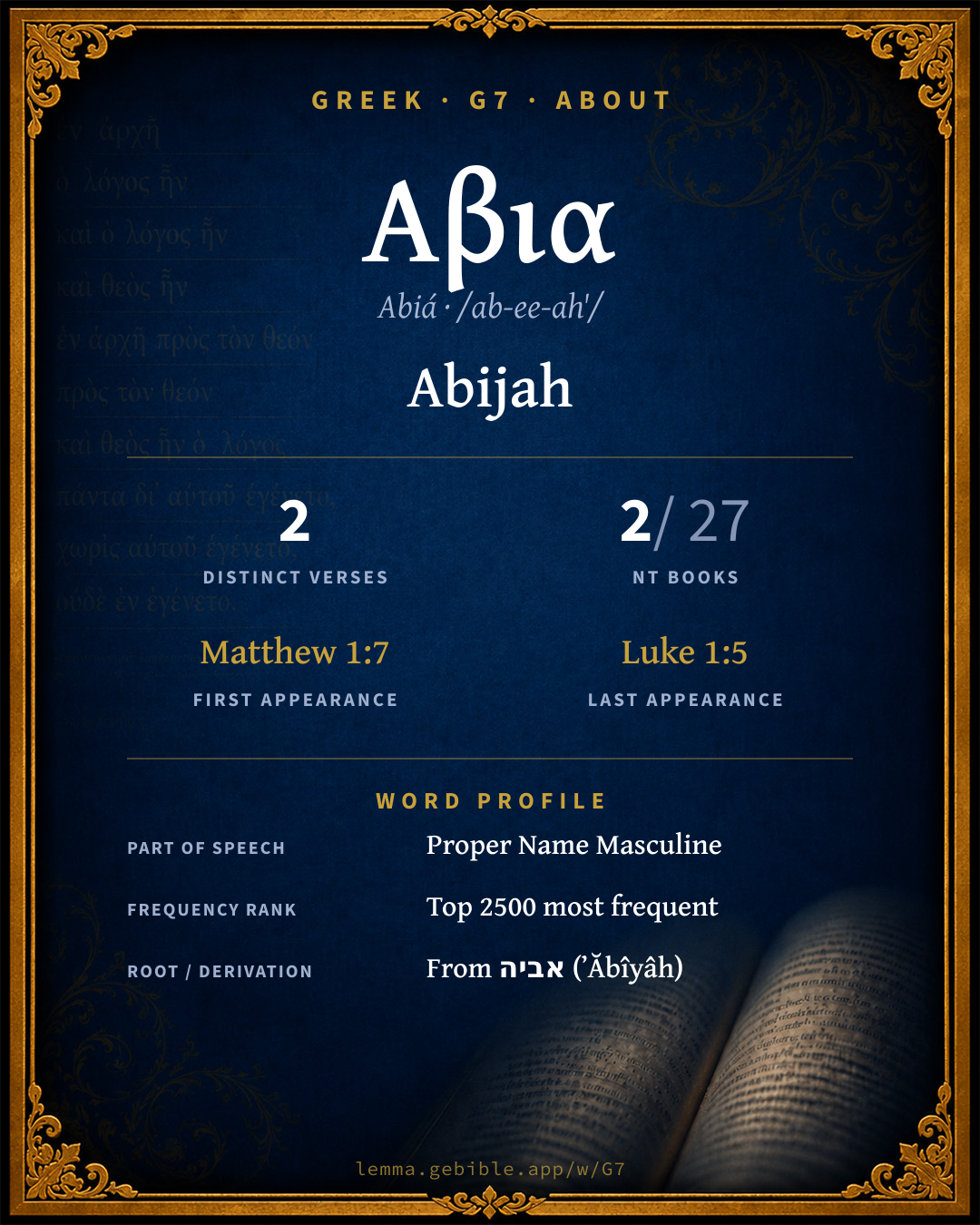
Ἀβιά
Abijah
Thayer's lists 3 entries for ‘Abijah’ fuller range ↓
Full lexicon entry — Thayer's Greek Lexicon
From Thayer's Greek Lexicon
Where this word appears
Every verse where G7 appears — 2 distinct verses across 2 books. Click any verse to open its interlinear word-by-word view. Verse text shown in the World English Bible for context — . Each verse’s Greek form is shown with its reference; the English is not keyword-highlighted, since the data carries no word-level English alignment. Use “Compare translations” on any verse to read it across multiple English versions. This concordance covers the Greek New Testament; Septuagint (Greek Old Testament) occurrences of this word are not indexed here.
Matthew 1 verse
Luke 1 verse
About this entry
At a glance — auto-summarized from this page’s data, not written by a person. Every figure links to its source below. This summary describes the numbers; it doesn’t interpret them.
Αβια — transliterated Abiá — is a Greek name carrying the sense “Abijah.” It is rare — just 2 verses in the entire Greek New Testament. Its uses cluster heavily in Matthew (50% of all occurrences). Debuting at Matthew 1:7, it then recurs through the corpus. See 2-verse concordance and the renderings breakdown below.
Gloss history
Strong's 1890 vs modern scholarship
About this word
Strong's G7 catalogs a Greek word from the Greek New Testament.
These counts are not copied from any lexicon or concordance. They are computed here, from the morphology-tagged Greek New Testament. What Lemma adds →
- 2
- distinct verses
- The word appears in 2 distinct verses.
- 2 / 27
- NT books
- The word appears in 2 of 27 New Testament books.
- #2,203
- by frequency
- Top 2500 most frequent Greek words (rank 2,203 of 5,347 Greek words by occurrence).
View all 2 occurrences in the concordance →
By traditional corpus
Conventional, traditional groupings — biblical authorship is debated, so this is a traditional corpus grouping, not an authorship claim. Some books belong to more than one corpus (Luke is in both the Gospels and the Lukan corpus, and so on), so these shares overlap and need not total 100%. Each figure is a share of the word’s 2 distinct verses.
- Gospels 2 verses · 100%
- Lukan (Luke–Acts) 1 verse · 50%
How translations render this word
Counts come from each version’s own published word-to-Strong’s tagging or interlinear alignment — an approximate guide to how each version renders this word, not a word-level alignment the data otherwise carries. Because each total is that version’s own tagged count, the per-version totals vary from one another and need not match the appearance or distinct-verse counts above. These counts may also differ from a printed concordance because Lemma counts each distinctly tagged rendering and does not collapse phrase taggings into a single head-word total. This is a fixed set of word-tagged versions (KJV, ASV, BSB, ULT) and does not change with the reading translation you choose elsewhere. Each version’s license is shown beside its name below (and on Sources).
- King James Version: Abia 3×
- American Standard Version: Abijah 3×
- Berean Standard Bible: Abijah 3×
- unfoldingWord Literal Text: Abijah 3×
King James Version Public Domain
Renders G7 across 3 tagged occurrences — most commonly:
American Standard Version Public Domain
Renders G7 across 3 tagged occurrences — most commonly:
Berean Standard Bible Public Domain
Renders G7 across 3 tagged occurrences — most commonly:
unfoldingWord Literal Text CC BY-SA 4.0
Renders G7 across 3 tagged occurrences — most commonly:
Senses in Thayer's
The 3 senses Thayer's distinguishes for this word, in lexicon order (not ranked by frequency or importance). The full entry — with sub-senses — is in the Lexicon Entry tab.
- Abijah = "my father is Jah (Jehovah)"
- a priest, the head of a priestly family from whom when David divided the priests into 24 classes, Abia was the 8th order
- son and successor to Rehoboam on the throne of Judah
Word origin
Derived from אביה (ʼĂbîyâh) (H29) — Abijah.
Of hebrew origin [ H29 ]; Abijah the name of two Israelites : - Abia.
— Strong’s Exhaustive Concordance (1890), public domain.
Forms in the corpus
The 2 distinct written forms G7 takes in the Greek New Testament, most frequent first — each parse links to that case’s occurrences in the concordance.
| Form | Parsing | Example | Uses |
|---|---|---|---|
| Ἀβιά Abiá | Noun, Proper, indeclinable | Matthew 1:7 | 2 |
| Ἀβιὰ Abià | Noun, Proper, indeclinable | Matthew 1:7 | 1 |
Bible dictionary
Public-domain dictionary articles matched to this entry by name (Abijah). A biblical name can be shared by more than one person or place, so an article may treat several.
Easton's Bible Dictionary · M. G. Easton, 1897
Father (i.e., "possessor or worshipper") of Jehovah. (1.) 1 Chr. 7:8. (2.) 1 Chr. 2:24.
(3.) The second son of Samuel (1 Sam. 8:2; 1 Chr. 6:28). His conduct, along with that of his brother, as a judge in Beer-sheba, to which office his father had appointed him, led to popular discontent, and ultimately provoked the people to demand a royal form of government.
(4.) A descendant of Eleazar, the son of Aaron, a chief of one of the twenty-four orders into which the priesthood was divided by David (1 Chr. 24:10). The order of Abijah was one of those which did not return from the Captivity (Ezra 2:36-39; Neh. 7:39-42; 12:1).
(5.) The son of Rehoboam, whom he succeeded on the throne of Judah (1 Chr. 3:10). He is also called Abijam (1 Kings 14:31; 15:1-8). He began his three years' reign (2 Chr. 12:16; 13:1, 2) with a strenuous but unsuccessful effort to bring back the ten tribes to their allegiance. His address to "Jeroboam and all Israel," before encountering them in battle, is worthy of being specially noticed (2 Chr. 13:5-12). It was a very bloody battle, no fewer than 500,000 of the army of Israel having perished on the field. He is described as having walked "in all the sins of his father" (1 Kings 15:3; 2 Chr. 11:20-22). It is said in 1 Kings 15:2 that "his mother's name was Maachah, the daughter of Abishalom;" but in 2 Chr. 13:2 we read, "his mother's name was Michaiah, the daughter of Uriel of Gibeah." The explanation is that Maachah is just a variation of the name Michaiah, and that Abishalom is probably the same as Absalom, the son of David. It is probable that "Uriel of Gibeah" married Tamar, the daughter of Absalom (2 Sam. 14:27), and by her had Maachah. The word "daughter" in 1 Kings 15:2 will thus, as it frequently elsewhere does, mean grand-daughter.
(6.) A son of Jeroboam, the first king of Israel. On account of his severe illness when a youth, his father sent his wife to consult the prophet Ahijah regarding his recovery. The prophet, though blind with old age, knew the wife of Jeroboam as soon as she approached, and under a divine impulse he announced to her that inasmuch as in Abijah alone of all the house of Jeroboam there was found "some good thing toward the Lord," he only would come to his grave in peace. As his mother crossed the threshold of the door on her return, the youth died, and "all Israel mourned for him" (1 Kings 14:1-18).
(7.) The daughter of Zechariah (2 Chr. 29:1; comp. Isa. 8:2), and afterwards the wife of Ahaz. She is also called Abi (2 Kings 18:2).
(8.) One of the sons of Becher, the son of Benjamin (1 Chr. 7:8). "Abiah," A.V.
Hitchcock's Bible Names Dictionary · Roswell D. Hitchcock, 1869
the Lord is my father
Classic public-domain reference works; full attribution on Sources.
Septuagint usage
The same Greek word Αβια appears 24 times in the Greek Old Testament (Septuagint), across 24 verses in 7 books.
- 24
- LXX occurrences
- Tagged occurrences of this Greek word in the Septuagint.
- 24
- verses
- Distinct Septuagint verses containing this word.
- 7 / 39
- OT books
- The word appears in 7 of the 39 Old Testament books.
Sample Septuagint occurrences
- 1 Samuel 8:2 αβια
- 2 Samuel 14:27 αβια
- 1 Kings 12:24 αβια
- 2 Kings 12:2 αβια
- 1 Chronicles 2:24 αβια
- 2 Chronicles 11:20 αβια
- Ezra 20:8 αβια
Septuagint occurrences (same lexeme)
Every verse where the same Strong’s number (G7) appears in the Greek Septuagint. Verse text shown in the World English Bible for context; the Greek form is the matched word — the English is not keyword-highlighted.
- 1 Samuel 8:2 αβια Now the name of his firstborn was Joel; and the name of his second, Abijah: they were judges in Beersheba.
- 2 Samuel 14:27 αβια To Absalom there were born three sons, and one daughter, whose name was Tamar: she was a woman of a beautiful face.
- 1 Kings 12:24 αβια Thus says Yahweh, You shall not go up, nor fight against your brothers the children of Israel: return every man to his house; for this thing is of me. So they listened to the word of Yahweh, and returned and went their way, according to the word of Yahweh.
- 2 Kings 12:2 αβια Jehoash did that which was right in the eyes of Yahweh all his days in which Jehoiada the priest instructed him.
- 1 Chronicles 2:24 αβια After that Hezron was dead in Caleb Ephrathah, then Abijah Hezron's wife bore him Ashhur the father of Tekoa.
- 1 Chronicles 3:10 αβια Solomon's son was Rehoboam, Abijah his son, Asa his son, Jehoshaphat his son,
- 1 Chronicles 6:13 αβια and Shallum became the father of Hilkiah, and Hilkiah became the father of Azariah,
- 1 Chronicles 24:10 αβια the seventh to Hakkoz, the eighth to Abijah,
- 2 Chronicles 11:20 αβια After her he took Maacah the daughter of Absalom; and she bore him Abijah, and Attai, and Ziza, and Shelomith.
- 2 Chronicles 11:22 αβια Rehoboam appointed Abijah the son of Maacah to be chief, [even] the prince among his brothers; for [he was minded] to make him king.
- 2 Chronicles 12:16 αβια Rehoboam slept with his fathers, and was buried in the city of David: and Abijah his son reigned in his place.
- 2 Chronicles 13:1 αβια In the eighteenth year of king Jeroboam began Abijah to reign over Judah.
- 2 Chronicles 13:2 αβια Three years reigned he in Jerusalem: and his mother's name was Micaiah the daughter of Uriel of Gibeah. There was war between Abijah and Jeroboam.
- 2 Chronicles 13:3 αβια Abijah joined battle with an army of valiant men of war, even four hundred thousand chosen men: and Jeroboam set the battle in array against him with eight hundred thousand chosen men, who were mighty men of valor.
- 2 Chronicles 13:4 αβια Abijah stood up on Mount Zemaraim, which is in the hill-country of Ephraim, and said, Hear me, Jeroboam and all Israel:
- 2 Chronicles 13:15 αβια Then the men of Judah gave a shout: and as the men of Judah shouted, it happened, that God struck Jeroboam and all Israel before Abijah and Judah.
- 2 Chronicles 13:17 αβια Abijah and his people killed them with a great slaughter: so there fell down slain of Israel five hundred thousand chosen men.
- 2 Chronicles 13:19 αβια Abijah pursued after Jeroboam, and took cities from him, Bethel with the towns of it, and Jeshanah with the towns of it, and Ephron with the towns of it.
- 2 Chronicles 13:20 αβια Neither did Jeroboam recover strength again in the days of Abijah: and Yahweh struck him, and he died.
- 2 Chronicles 13:21 αβια But Abijah grew mighty, and took to himself fourteen wives, and became the father of twenty-two sons, and sixteen daughters.
- 2 Chronicles 13:22 αβια The rest of the acts of Abijah, and his ways, and his sayings, are written in the commentary of the prophet Iddo.
- 2 Chronicles 13:23 αβια
- Ezra 20:8 αβια
- Ezra 22:17 αβια
These are occurrences of the same Greek lexeme (G7) in the Septuagint — not a translation of any one Hebrew word. The store carries no word-level Hebrew↔Greek alignment, so no Hebrew original is asserted here. Counts come from the recovered LXX Strong's tagging — high-frequency vocabulary is well covered, while rare or late forms may be untagged — so they reflect tagged occurrences and may slightly undercount.