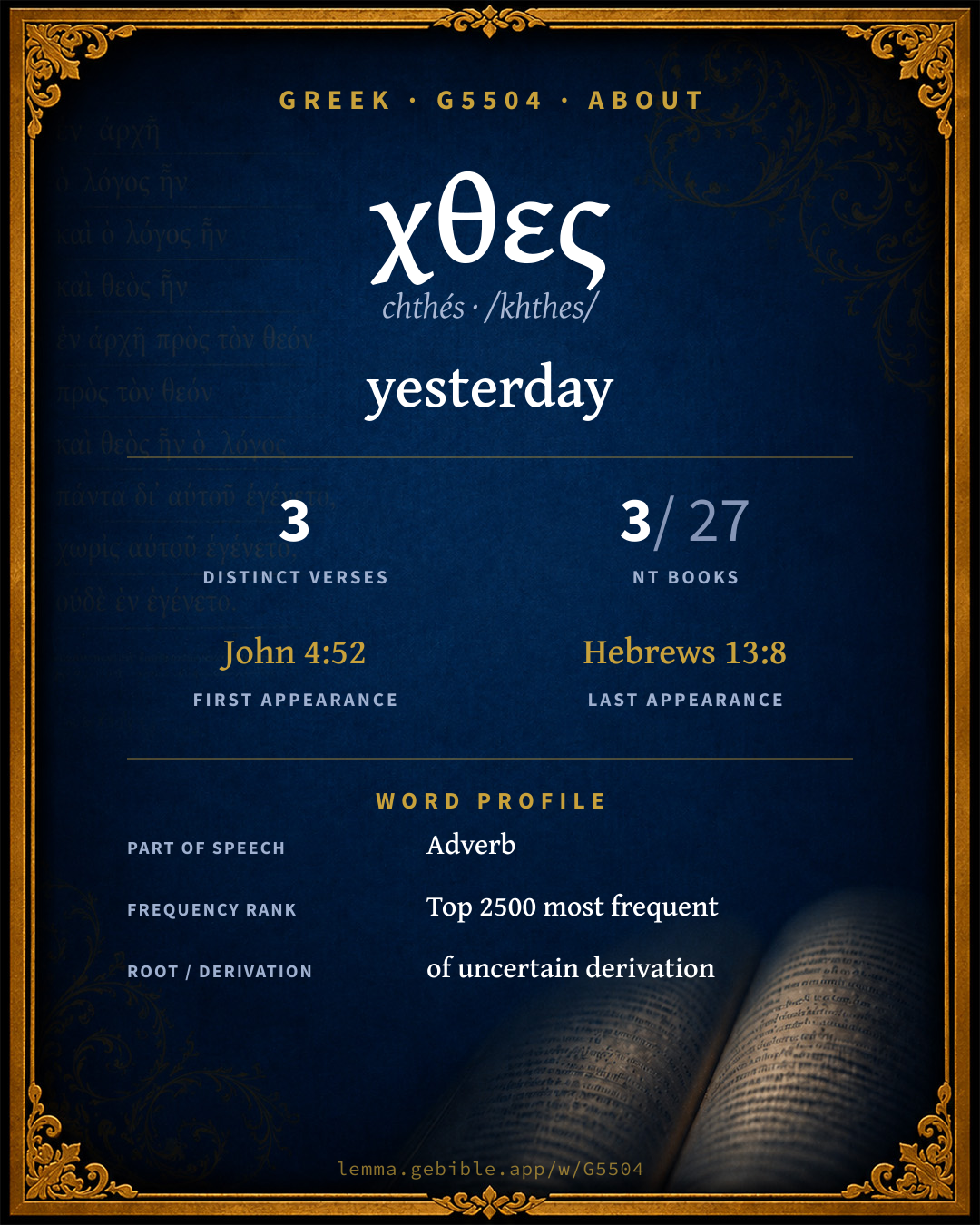
χθές
yesterday
Full lexicon entry — Thayer's Greek Lexicon
From Thayer's Greek Lexicon
Where this word appears
Grammar key — what these labels mean
Part of speech
- Adverb
- A word that modifies a verb, adjective, or other adverb.
Every verse where G5504 appears — 3 distinct verses across 3 books. Click any verse to open its interlinear word-by-word view. Verse text shown in the World English Bible for context — . Each verse’s Greek form is shown with its reference; the English is not keyword-highlighted, since the data carries no word-level English alignment. Use “Compare translations” on any verse to read it across multiple English versions. This concordance covers the Greek New Testament; Septuagint (Greek Old Testament) occurrences of this word are not indexed here.
John 1 verse
Acts 1 verse
Hebrews 1 verse
About this entry
At a glance — auto-summarized from this page’s data, not written by a person. Every figure links to its source below. This summary describes the numbers; it doesn’t interpret them.
At its core, χθες (chthés) means “yesterday.” It occurs a mere 3 verses across Scripture. The word gravitates to John (33%), then Acts and Hebrews. Scripture first uses it in John 4:52. Dig into 3-verse concordance and the renderings breakdown below.
Gloss history
Strong's 1890 vs modern scholarship
About this word
Strong's G5504 catalogs a Greek word from the Greek New Testament.
These counts are not copied from any lexicon or concordance. They are computed here, from the morphology-tagged Greek New Testament. What Lemma adds →
- 3
- distinct verses
- The word appears in 3 distinct verses.
- 3 / 27
- NT books
- The word appears in 3 of 27 New Testament books.
- #2,203
- by frequency
- Top 2500 most frequent Greek words (rank 2,203 of 5,347 Greek words by occurrence).
View all 3 occurrences in the concordance →
By section of the New Testament
By traditional corpus
Conventional, traditional groupings — biblical authorship is debated, so this is a traditional corpus grouping, not an authorship claim. Some books belong to more than one corpus (Luke is in both the Gospels and the Lukan corpus, and so on), so these shares overlap and need not total 100%. Each figure is a share of the word’s 3 distinct verses.
- Gospels 1 verse · 33%
- Lukan (Luke–Acts) 1 verse · 33%
- Johannine 1 verse · 33%
- Hebrews 1 verse · 33%
How translations render this word
Counts come from each version’s own published word-to-Strong’s tagging or interlinear alignment — an approximate guide to how each version renders this word, not a word-level alignment the data otherwise carries. Because each total is that version’s own tagged count, the per-version totals vary from one another and need not match the appearance or distinct-verse counts above. These counts may also differ from a printed concordance because Lemma counts each distinctly tagged rendering and does not collapse phrase taggings into a single head-word total. This is a fixed set of word-tagged versions (KJV, ASV, BSB, ULT) and does not change with the reading translation you choose elsewhere. Each version’s license is shown beside its name below (and on Sources).
- King James Version: Yesterday 3×
- American Standard Version: Yesterday 3×
- Berean Standard Bible: Yesterday 3×
- unfoldingWord Literal Text: Yesterday 3×
King James Version Public Domain
Renders G5504 across 3 tagged occurrences — most commonly:
American Standard Version Public Domain
Renders G5504 across 3 tagged occurrences — most commonly:
Berean Standard Bible Public Domain
Renders G5504 across 3 tagged occurrences — most commonly:
unfoldingWord Literal Text CC BY-SA 4.0
Renders G5504 across 3 tagged occurrences — most commonly:
Senses in Thayer's
The 1 sense Thayer's distinguishes for this word, in lexicon order (not ranked by frequency or importance). The full entry — with sub-senses — is in the Lexicon Entry tab.
- yesterday
Word origin
Origin: of uncertain derivation
Of uncertain derivation; yesterday; by extension in time past or hitherto : - yesterday.
— Strong’s Exhaustive Concordance (1890), public domain.
Septuagint usage
The same Greek word χθες appears 20 times in the Greek Old Testament (Septuagint), across 20 verses in 6 books.
- 20
- LXX occurrences
- Tagged occurrences of this Greek word in the Septuagint.
- 20
- verses
- Distinct Septuagint verses containing this word.
- 6 / 39
- OT books
- The word appears in 6 of the 39 Old Testament books.
Sample Septuagint occurrences
- Genesis 19:34 χθές
- Exodus 2:14 χθές
- Deuteronomy 4:42 χθές
- Joshua 3:4 χθές
- 1 Samuel 4:7 χθές
- Job 30:3 χθές
Septuagint occurrences (same lexeme)
Every verse where the same Strong’s number (G5504) appears in the Greek Septuagint. Verse text shown in the World English Bible for context; the Greek form is the matched word — the English is not keyword-highlighted.
- Genesis 19:34 χθές It came to pass on the next day, that the firstborn said to the younger, "Behold, I lay last night with my father. Let us make him drink wine again, tonight. You go in, and lie with him, that we may preserve our father's seed."
- Genesis 31:2 χθές Jacob saw the expression on Laban's face, and, behold, it was not toward him as before.
- Genesis 31:5 χθές and said to them, "I see the expression on your father's face, that it is not toward me as before; but the God of my father has been with me.
- Genesis 31:29 χθές It is in the power of my hand to hurt you, but the God of your father spoke to me last night, saying, 'Take heed to yourself that you don't speak to Jacob either good or bad.'
- Genesis 31:42 χθές Unless the God of my father, the God of Abraham, and the fear of Isaac, had been with me, surely now you would have sent me away empty. God has seen my affliction and the labor of my hands, and rebuked you last night."
- Exodus 2:14 χθές He said, "Who made you a prince and a judge over us? Do you plan to kill me, as you killed the Egyptian?" Moses was afraid, and said, "Surely this thing is known."
- Exodus 4:10 χθές Moses said to Yahweh, "Oh, Lord, I am not eloquent, neither before now, nor since you have spoken to your servant; for I am slow of speech, and of a slow tongue."
- Exodus 5:7 χθές "You shall no longer give the people straw to make brick, as before. Let them go and gather straw for themselves.
- Exodus 5:14 χθές The officers of the children of Israel, whom Pharaoh's taskmasters had set over them, were beaten, and demanded, "Why haven't you fulfilled your quota both yesterday and today, in making brick as before?"
- Exodus 21:29 χθές But if the bull had a habit of goring in the past, and it has been testified to its owner, and he has not kept it in, but it has killed a man or a woman, the bull shall be stoned, and its owner shall also be put to death.
- Exodus 21:36 χθές Or if it is known that the bull was in the habit of goring in the past, and its owner has not kept it in, he shall surely pay bull for bull, and the dead animal shall be his own.
- Deuteronomy 4:42 χθές that the manslayer might flee there, who kills his neighbor unawares, and didn't hate him in time past; and that fleeing to one of these cities he might live:
- Deuteronomy 19:4 χθές This is the case of the manslayer, that shall flee there and live: whoever kills his neighbor unawares, and didn't hate him in time past;
- Deuteronomy 19:6 χθές lest the avenger of blood pursue the manslayer, while his heart is hot, and overtake him, because the way is long, and strike him mortally; whereas he was not worthy of death, inasmuch as he didn't hate him in time past.
- Joshua 3:4 χθές Yet there shall be a space between you and it, about two thousand cubits by measure: don't come near to it, that you may know the way by which you must go; for you have not passed this way heretofore.
- Joshua 4:18 χθές It happened, when the priests who bore the ark of the covenant of Yahweh were come up out of the midst of the Jordan, and the soles of the priests' feet were lifted up to the dry ground, that the waters of the Jordan returned to their place, and went over all its banks, as before.
- 1 Samuel 4:7 χθές The Philistines were afraid, for they said, God is come into the camp. They said, Woe to us! for there has not been such a thing heretofore.
- 1 Samuel 10:11 χθές It happened, when all who knew him before saw that, behold, he prophesied with the prophets, then the people said one to another, What is this that is come to the son of Kish? Is Saul also among the prophets?
- 1 Samuel 14:21 χθές Now the Hebrews who were with the Philistines as before, and who went up with them into the camp, [from the country] round about, even they also [turned] to be with the Israelites who were with Saul and Jonathan.
- Job 30:3 χθές They are gaunt from lack and famine. They gnaw the dry ground, in the gloom of waste and desolation.
These are occurrences of the same Greek lexeme (G5504) in the Septuagint — not a translation of any one Hebrew word. The store carries no word-level Hebrew↔Greek alignment, so no Hebrew original is asserted here. Counts come from the recovered LXX Strong's tagging — high-frequency vocabulary is well covered, while rare or late forms may be untagged — so they reflect tagged occurrences and may slightly undercount.