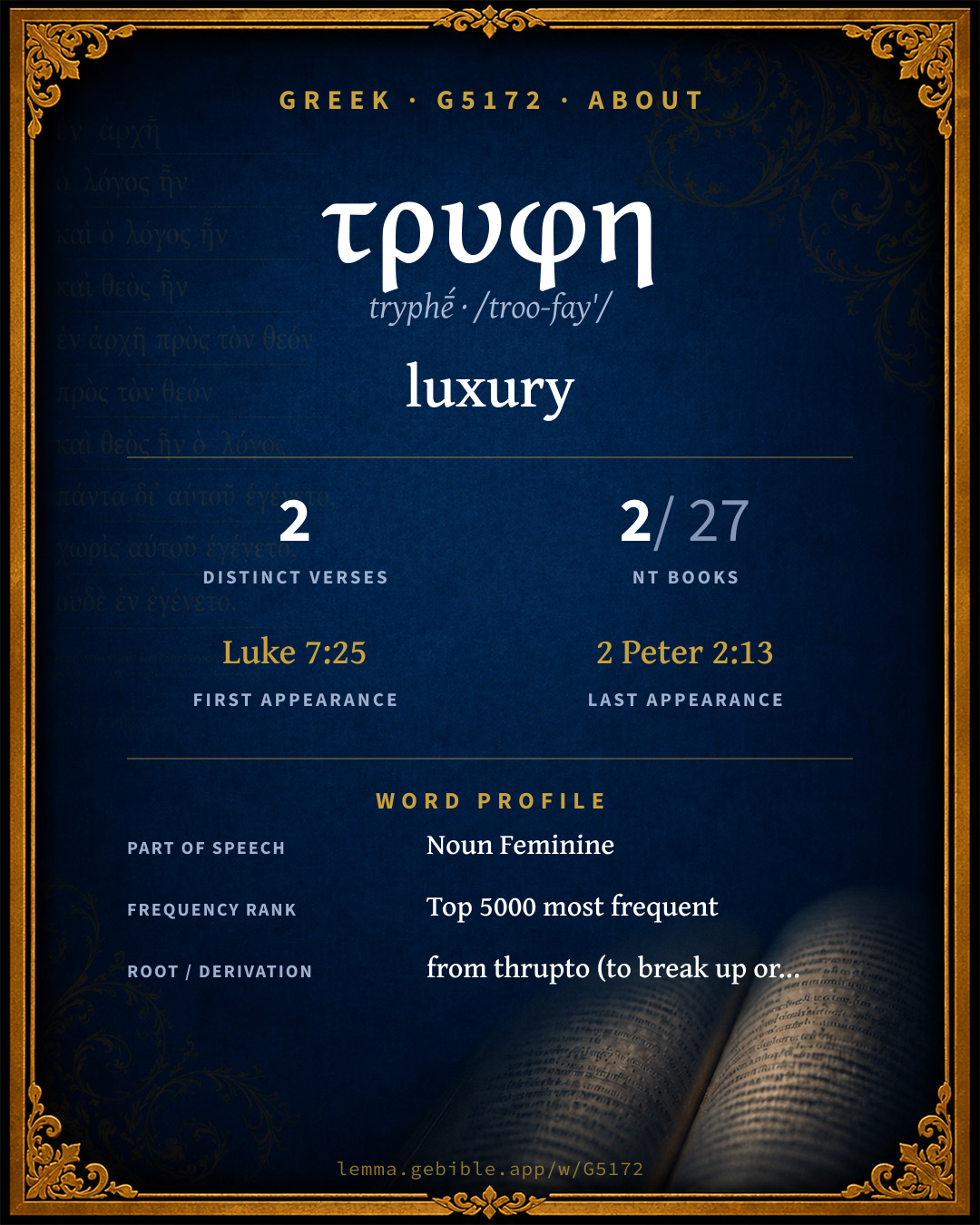
τρυφή
luxury
Full lexicon entry — Thayer's Greek Lexicon
From Thayer's Greek Lexicon
Where this word appears
See every Accusative-case word in the Greek New Testament →
Grammar key — what these labels mean
Part of speech
- Noun
- A naming word — a person, place, thing, or idea.
Case
- Accusative
- The case of the direct object and of extent.
- Dative
- The case of the indirect object, means, or location — “to / for / with / in.”
Gender
- Feminine
- Grammatically feminine.
Number
- Singular
- One.
Grammatical forms
- Noun, Accusative, Singular, Feminine 1 time (50%)
- Noun, Dative, Singular, Feminine 1 time (50%)
Parsed forms decoded from the imported morphology (Robinson–Tischendorf, public domain), counted across 2 parsed occurrences — not distinct verses.
Every verse where G5172 appears — 2 distinct verses across 2 books. Click any verse to open its interlinear word-by-word view. Verse text shown in the World English Bible for context — . Each verse’s Greek form is shown with its reference; the English is not keyword-highlighted, since the data carries no word-level English alignment. Use “Compare translations” on any verse to read it across multiple English versions. This concordance covers the Greek New Testament; Septuagint (Greek Old Testament) occurrences of this word are not indexed here.
Luke 1 verse
2 Peter 1 verse
About this entry
At a glance — auto-summarized from this page’s data, not written by a person. Every figure links to its source below. This summary describes the numbers; it doesn’t interpret them.
τρυφη (tryphḗ) is a Greek noun most often rendered “luxury.” It is rare — just 2 verses in the entire Greek New Testament. Luke dominates its distribution — 1 of 2 verses. Debuting at Luke 7:25, it then recurs through the corpus. Related forms include τρυφαω, Τρυφαινα and Τρυφωσα. The sections below give every sense, occurrence, and version rendering.
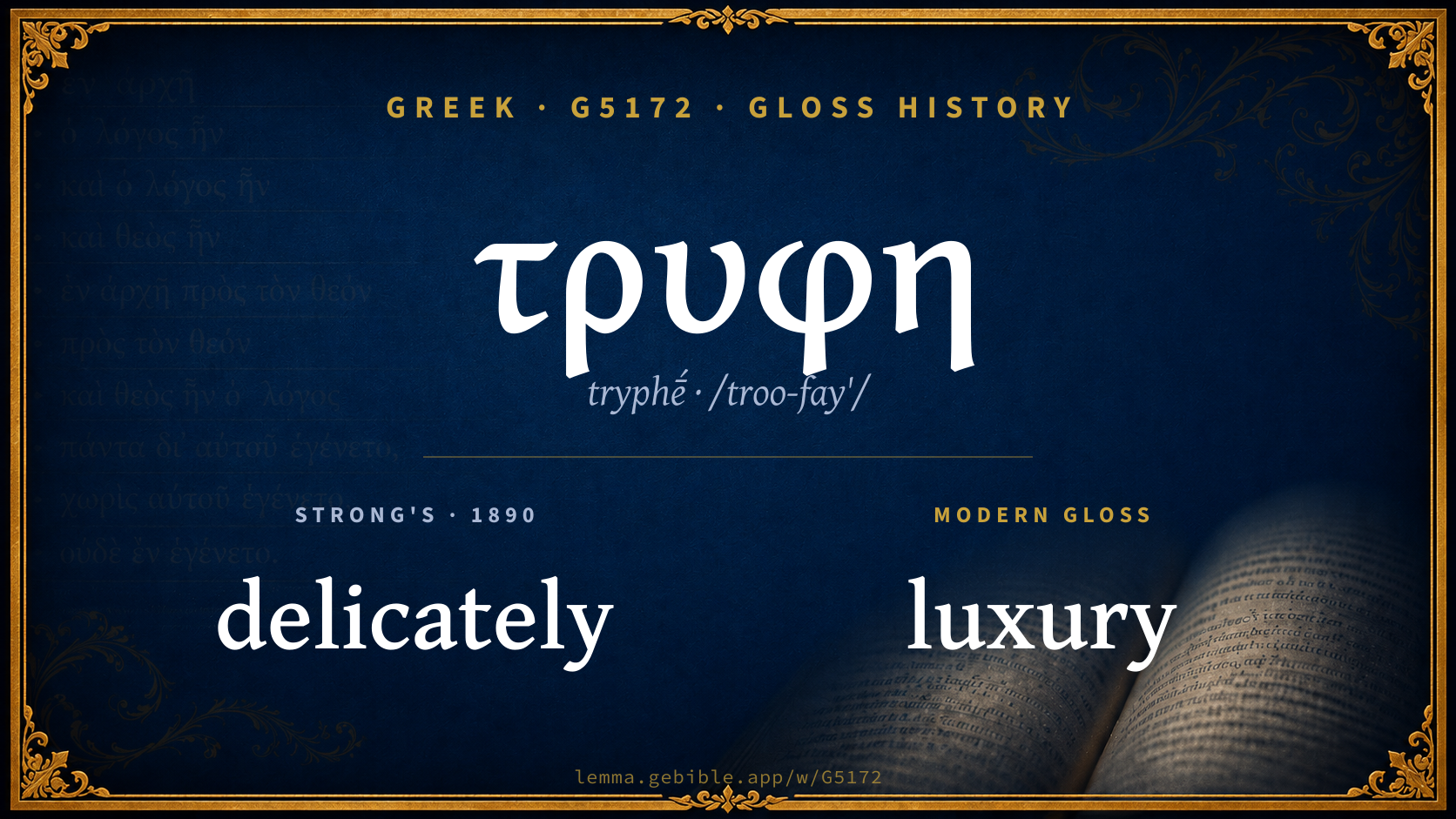
Gloss history
Strong's 1890 vs modern scholarship
About this word
Strong's G5172 catalogs a Greek word from the Greek New Testament.
These counts are not copied from any lexicon or concordance. They are computed here, from the morphology-tagged Greek New Testament. What Lemma adds →
- 2
- distinct verses
- The word appears in 2 distinct verses.
- 2 / 27
- NT books
- The word appears in 2 of 27 New Testament books.
- #2,678
- by frequency
- Top 5000 most frequent Greek words (rank 2,678 of 5,347 Greek words by occurrence).
View all 2 occurrences in the concordance →
By traditional corpus
Conventional, traditional groupings — biblical authorship is debated, so this is a traditional corpus grouping, not an authorship claim. Some books belong to more than one corpus (Luke is in both the Gospels and the Lukan corpus, and so on), so these shares overlap and need not total 100%. Each figure is a share of the word’s 2 distinct verses.
- Gospels 1 verse · 50%
- Lukan (Luke–Acts) 1 verse · 50%
- General (Catholic) Epistles 1 verse · 50%
How translations render this word
Counts come from each version’s own published word-to-Strong’s tagging or interlinear alignment — an approximate guide to how each version renders this word, not a word-level alignment the data otherwise carries. Because each total is that version’s own tagged count, the per-version totals vary from one another and need not match the appearance or distinct-verse counts above. These counts may also differ from a printed concordance because Lemma counts each distinctly tagged rendering and does not collapse phrase taggings into a single head-word total. This is a fixed set of word-tagged versions (KJV, ASV, BSB, ULT) and does not change with the reading translation you choose elsewhere. Each version’s license is shown beside its name below (and on Sources).
- King James Version: Delicately 1×, Riot 1×
- American Standard Version: Delicately 1×, Revel 1×
- Berean Standard Bible: Carouse 1×, Luxury 1×
- unfoldingWord Literal Text: Luxury 1×, Reveling 1×
King James Version Public Domain
Renders G5172 across 2 tagged occurrences — most commonly:
American Standard Version Public Domain
Renders G5172 across 2 tagged occurrences — most commonly:
Berean Standard Bible Public Domain
Renders G5172 across 2 tagged occurrences — most commonly:
unfoldingWord Literal Text CC BY-SA 4.0
Renders G5172 across 2 tagged occurrences — most commonly:
Senses in Thayer's
The 1 sense Thayer's distinguishes for this word, in lexicon order (not ranked by frequency or importance). The full entry — with sub-senses — is in the Lexicon Entry tab.
- softness, effeminate, luxurious living
Word origin
Origin: from thrupto (to break up or [figuratively] enfeeble, especially the mind and body by indulgence)
From θρύπτω thruptō̄ (to break up or [figuratively] enfeeble especially the mind and body by indulgence); effeminacy that is luxury or debauchery : - delicately riot.
— Strong’s Exhaustive Concordance (1890), public domain.
Forms in the corpus
The 2 distinct written forms G5172 takes in the Greek New Testament, most frequent first — each parse links to that case’s occurrences in the concordance.
| Form | Parsing | Example | Uses |
|---|---|---|---|
| τρυφήν tryphḗn | Noun, Accusative, Singular, Feminine | 2 Peter 2:13 | 1 |
| τρυφῇ tryphē̂ | Noun, Dative, Singular, Feminine | Luke 7:25 | 1 |
Same root — word family
Other Thayer's entries built from the same root as G5172, grouped by Strong’s listed origin. These share a root / origin per the lexicon — not necessarily a shared meaning. Each links to that word’s own entry.
Derived from this word
Proper names from this root
People and places named from this root — a name, not an additional meaning of the word.
Compare all same-root words → 2 of the same-root words are proper names (people or places). They share a root, not necessarily a meaning.
Septuagint usage
The same Greek word τρυφη appears 20 times in the Greek Old Testament (Septuagint), across 20 verses in 10 books.
- 20
- LXX occurrences
- Tagged occurrences of this Greek word in the Septuagint.
- 20
- verses
- Distinct Septuagint verses containing this word.
- 10 / 39
- OT books
- The word appears in 10 of the 39 Old Testament books.
Sample Septuagint occurrences
- Genesis 3:23 τρυφή
- Psalms 35:9 τρυφή
- Proverbs 4:9 τρυφή
- Song of Solomon 7:7 τρυφή
- Jeremiah 28:34 τρυφή
- Lamentations 4:5 τρυφή
- Ezekiel 28:13 τρυφή
- Daniel 4:24 τρυφή
- Joel 2:3 τρυφή
- Micah 2:9 τρυφή
Septuagint occurrences (same lexeme)
Every verse where the same Strong’s number (G5172) appears in the Greek Septuagint. Verse text shown in the World English Bible for context; the Greek form is the matched word — the English is not keyword-highlighted.
- Genesis 3:23 τρυφή Therefore Yahweh God sent him forth from the garden of Eden, to till the ground from whence he was taken.
- Genesis 3:24 τρυφή So he drove out the man; and he placed Cherubs at the east of the garden of Eden, and the flame of a sword which turned every way, to guard the way to the tree of life.
- Genesis 49:20 τρυφή Out of Asher his bread will be fat, He will yield royal dainties.
- Psalms 35:9 τρυφή My soul shall be joyful in Yahweh. It shall rejoice in his salvation.
- Psalms 138:11 τρυφή
- Proverbs 4:9 τρυφή She will give to your head a garland of grace. She will deliver a crown of splendor to you."
- Proverbs 19:10 τρυφή Delicate living is not appropriate for a fool, Much less for a servant to have rule over princes.
- Song of Solomon 7:7 τρυφή This, your stature, is like a palm tree, Your breasts like its fruit.
- Jeremiah 28:34 τρυφή
- Lamentations 4:5 τρυφή Those who did feed delicately are desolate in the streets: Those who were brought up in scarlet embrace dunghills.
- Ezekiel 28:13 τρυφή You were in Eden, the garden of God; every precious stone adorned you: ruby, topaz, emerald, chrysolite, onx, jasper, sapphire, turquoise, and beryl. Gold work of tambourines and of pipes was in you. In the day that you were created they were prepared.
- Ezekiel 31:9 τρυφή I made it beautiful by the multitude of its branches, so that all the trees of Eden, that were in the garden of God, envied it.
- Ezekiel 31:16 τρυφή I made the nations to shake at the sound of his fall, when I cast him down to Sheol with those who descend into the pit; and all the trees of Eden, the choice and best of Lebanon, all that drink water, were comforted in the lower parts of the earth.
- Ezekiel 31:18 τρυφή To whom are you thus like in glory and in greatness among the trees of Eden? yet shall you be brought down with the trees of Eden to the lower parts of the earth: you shall lie in the midst of the uncircumcised, with those who are slain by the sword. This is Pharaoh and all his multitude, says the Lord Yahweh.
- Ezekiel 34:14 τρυφή I will feed them with good pasture; and on the mountains of the height of Israel shall their fold be: there shall they lie down in a good fold; and on fat pasture shall they feed on the mountains of Israel.
- Ezekiel 36:35 τρυφή They shall say, This land that was desolate is become like the garden of Eden; and the waste and desolate and ruined cities are fortified and inhabited.
- Daniel 4:24 τρυφή this is the interpretation, O king, and it is the decree of the Most High, which is come on my lord the king:
- Daniel 4:25 τρυφή that you shall be driven from men, and your dwelling shall be with the animals of the field, and you shall be made to eat grass as oxen, and shall be wet with the dew of the sky, and seven times shall pass over you; until you know that the Most High rules in the kingdom of men, and gives it to whoever he will.
- Joel 2:3 τρυφή A fire devours before them, And behind them, a flame burns. The land is as the garden of Eden before them, And behind them, a desolate wilderness. Yes, and no one has escaped them.
- Micah 2:9 τρυφή You drive the women of my people out from their pleasant houses; From their young children you take away my blessing forever.
These are occurrences of the same Greek lexeme (G5172) in the Septuagint — not a translation of any one Hebrew word. The store carries no word-level Hebrew↔Greek alignment, so no Hebrew original is asserted here. Counts come from the recovered LXX Strong's tagging — high-frequency vocabulary is well covered, while rare or late forms may be untagged — so they reflect tagged occurrences and may slightly undercount.