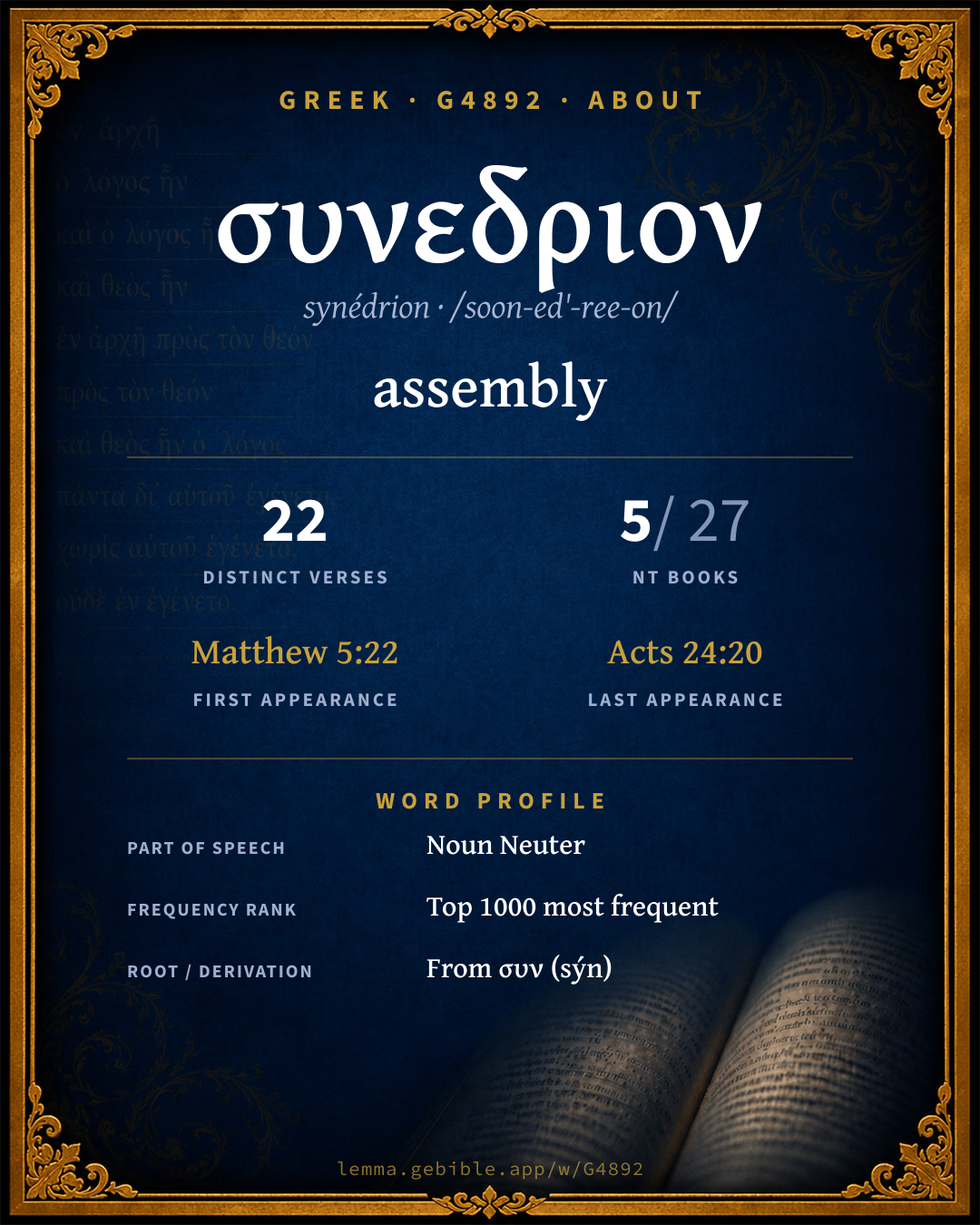
συνέδριον
assembly
‘assembly’ is one of 2 main senses fuller range ↓
Full lexicon entry — Thayer's Greek Lexicon
From Thayer's Greek Lexicon
Where this word appears
See every Accusative-case word in the Greek New Testament →
Grammar key — what these labels mean
Part of speech
- Noun
- A naming word — a person, place, thing, or idea.
Case
- Accusative
- The case of the direct object and of extent.
- Dative
- The case of the indirect object, means, or location — “to / for / with / in.”
- Genitive
- The case of source, possession, or “of” — answers “whose / from what.”
- Nominative
- The case of the subject (and the predicate nominative).
Gender
- Neuter
- Grammatically neuter.
Number
- Singular
- One.
- Plural
- More than one.
Grammatical forms
- Noun, Accusative, Singular, Neuter 7 times (32%)
- Noun, Dative, Singular, Neuter 7 times (32%)
- Noun, Genitive, Singular, Neuter 3 times (14%)
- Noun, Nominative, Singular, Neuter 3 times (14%)
- Noun, Accusative, Plural, Neuter 2 times (9%)
Parsed forms decoded from the imported morphology (Robinson–Tischendorf, public domain), counted across 22 parsed occurrences — not distinct verses.
Every verse where G4892 appears — 22 distinct verses across 5 books. Click any verse to open its interlinear word-by-word view. Verse text shown in the World English Bible for context — . Each verse’s Greek form is shown with its reference; the English is not keyword-highlighted, since the data carries no word-level English alignment. Use “Compare translations” on any verse to read it across multiple English versions. This concordance covers the Greek New Testament; Septuagint (Greek Old Testament) occurrences of this word are not indexed here.
Matthew 3 verses
- Matthew 5:22 συνεδρίῳ n dat sg neut But I tell you, that everyone who is angry with his brother without a cause shall be in danger of the judgment; and whoever shall say to his brother, 'Raca!' shall be in danger of the council; and whoever shall say, 'You fool!' shall be in danger of the fire of Gehenna.
- Matthew 10:17 συνέδρια n acc pl neut But beware of men: for they will deliver you up to councils, and in their synagogues they will scourge you.
- Matthew 26:59 συνέδριον n nom sg neut Now the chief priests, the elders, and the whole council sought false testimony against Jesus, that they might put him to death;
Mark 3 verses
- Mark 13:9 συνέδρια n acc pl neut But watch yourselves, for they will deliver you up to councils. You will be beaten in synagogues. You will stand before rulers and kings for my sake, for a testimony to them.
- Mark 14:55 συνέδριον n nom sg neut Now the chief priests and the whole council sought witnesses against Jesus to put him to death, and found none.
- Mark 15:1 συνέδριον n nom sg neut Immediately in the morning the chief priests, with the elders and scribes, and the whole council, held a consultation, and bound Jesus, and carried him away, and delivered him up to Pilate.
Luke 1 verse
John 1 verse
Acts 14 verses
- Acts 4:15 συνεδρίου n gen sg neut But when they had commanded them to go aside out of the council, they conferred among themselves,
- Acts 5:21 συνέδριον n acc sg neut When they heard this, they entered into the temple about daybreak, and taught. But the high priest came, and those who were with him, and called the council together, and all the senate of the children of Israel, and sent to the prison to have them brought.
- Acts 5:27 συνεδρίῳ n dat sg neut When they had brought them, they set them before the council. The high priest questioned them,
- Acts 5:34 συνεδρίῳ n dat sg neut But one stood up in the council, a Pharisee named Gamaliel, a teacher of the law, honored by all the people, and commanded to put the apostles out for a little while.
- Acts 5:41 συνεδρίου n gen sg neut They therefore departed from the presence of the council, rejoicing that they were counted worthy to suffer dishonor for Jesus' name.
- Acts 6:12 συνέδριον n acc sg neut They stirred up the people, the elders, and the scribes, and came against him and seized him, and brought him in to the council,
- Acts 6:15 συνεδρίῳ n dat sg neut All who sat in the council, fastening their eyes on him, saw his face like it was the face of an angel.
- Acts 22:30 συνέδριον n acc sg neut But on the next day, desiring to know the truth about why he was accused by the Jews, he freed him from the bonds, and commanded the chief priests and all the council to come together, and brought Paul down and set him before them.
- Acts 23:1 συνεδρίῳ n dat sg neut Paul, looking steadfastly at the council, said, "Brothers, I have lived before God in all good conscience until this day."
- Acts 23:6 συνεδρίῳ n dat sg neut But when Paul perceived that the one part were Sadducees and the other Pharisees, he cried out in the council, "Men and brothers, I am a Pharisee, a son of Pharisees. Concerning the hope and resurrection of the dead I am being judged!"
- Acts 23:15 συνεδρίῳ n dat sg neut Now therefore, you with the council inform the commanding officer that he should bring him down to you tomorrow, as though you were going to judge his case more exactly. We are ready to kill him before he comes near."
- Acts 23:20 συνέδριον n acc sg neut He said, "The Jews have agreed to ask you to bring Paul down to the council tomorrow, as though intending to inquire somewhat more accurately concerning him.
- Acts 23:28 συνέδριον n acc sg neut Desiring to know the cause why they accused him, I brought him down to their council.
- Acts 24:20 συνεδρίου n gen sg neut Or else let these men themselves say what injustice they found in me when I stood before the council,
About this entry
At a glance — auto-summarized from this page’s data, not written by a person. Every figure links to its source below. This summary describes the numbers; it doesn’t interpret them.
συνεδριον — transliterated synédrion — is a Greek noun carrying the sense “assembly.” More than half of its appearances fall in Acts. It appears 22 verses across 5 books of the Greek New Testament, among its uncommon vocabulary. Its lexical range runs to 2 senses. Where the King James Version says “council,” newer translations reach for “sanhedrin” (Berean Standard Bible); the renderings breakdown has the detail. Each statement above links to its evidence; the full detail follows below.
Gloss history
Strong's 1890 vs modern scholarship

About this word
Strong's G4892 catalogs a Greek word from the Greek New Testament.
These counts are not copied from any lexicon or concordance. They are computed here, from the morphology-tagged Greek New Testament. What Lemma adds →
- 22
- distinct verses
- The word appears in 22 distinct verses.
- 5 / 27
- NT books
- The word appears in 5 of 27 New Testament books.
- #586
- by frequency
- Top 1000 most frequent Greek words (rank 586 of 5,347 Greek words by occurrence).
View all 22 occurrences in the concordance →
By section of the New Testament
By traditional corpus
Conventional, traditional groupings — biblical authorship is debated, so this is a traditional corpus grouping, not an authorship claim. Some books belong to more than one corpus (Luke is in both the Gospels and the Lukan corpus, and so on), so these shares overlap and need not total 100%. Each figure is a share of the word’s 22 distinct verses.
- Lukan (Luke–Acts) 15 verses · 68%
- Gospels 8 verses · 36%
- Johannine 1 verse · 5%
How translations render this word
Counts come from each version’s own published word-to-Strong’s tagging or interlinear alignment — an approximate guide to how each version renders this word, not a word-level alignment the data otherwise carries. Because each total is that version’s own tagged count, the per-version totals vary from one another and need not match the appearance or distinct-verse counts above. These counts may also differ from a printed concordance because Lemma counts each distinctly tagged rendering and does not collapse phrase taggings into a single head-word total. This is a fixed set of word-tagged versions (KJV, ASV, BSB, ULT) and does not change with the reading translation you choose elsewhere. Each version’s license is shown beside its name below (and on Sources).
- King James Version: Council 20×, Councils 2×
- American Standard Version: Council 19×, Councils 2×
- Berean Standard Bible: Sanhedrin 20×, Councils 2×
- unfoldingWord Literal Text: Sanhedrin 19×, Councils 2×
King James Version Public Domain
Renders G4892 across 22 tagged occurrences — most commonly:
American Standard Version Public Domain
Renders G4892 across 22 tagged occurrences — most commonly:
Plus 1 rendering that appears only once — usually multi-word phrases or single function words the recovered tagging swept in, not distinct renderings.
Berean Standard Bible Public Domain
Renders G4892 across 22 tagged occurrences — most commonly:
unfoldingWord Literal Text CC BY-SA 4.0
Renders G4892 across 22 tagged occurrences — most commonly:
Plus 1 rendering that appears only once — usually multi-word phrases or single function words the recovered tagging swept in, not distinct renderings.
Senses in Thayer's
The 2 senses Thayer's distinguishes for this word, in lexicon order (not ranked by frequency or importance). The full entry — with sub-senses — is in the Lexicon Entry tab.
- any assembly (esp. of magistrates, judges, ambassadors), whether convened to deliberate or pass judgment
- any session or assembly or people deliberating or adjudicating
Word origin
Derived from συν (sýn) (G4862) — with.
Forms in the corpus
The 4 distinct written forms G4892 takes in the Greek New Testament, most frequent first — each parse links to that case’s occurrences in the concordance.
| Form | Parsing | Example | Uses |
|---|---|---|---|
| συνέδριον synédrion | Noun, Accusative, Singular, Neuter | Luke 22:66 | 10 |
| συνεδρίῳ synedríō | Noun, Dative, Singular, Neuter | Matthew 5:22 | 7 |
| συνεδρίου synedríou | Noun, Genitive, Singular, Neuter | Acts 4:15 | 3 |
| συνέδρια synédria | Noun, Accusative, Plural, Neuter | Matthew 10:17 | 2 |
Same root — word family
Other Thayer's entries built from the same root as G4892, grouped by Strong’s listed origin. These share a root / origin per the lexicon — not necessarily a shared meaning. Each links to that word’s own entry.
Derives from
Shares the same root
- κοινος koinós G2839 common
- συγγενης syngenḗs G4773 related by blood
- συγγνωμη syngnṓmē G4774 pardon
- συγκαθημαι synkáthēmai G4775 to sit together
- συγκαθιζω synkathízō G4776 to sit together
- συγκακοπαθεω synkakopathéō G4777 to suffer together
- συγκακουχεω synkakouchéō G4778 to be ill-treated together
- συγκαλεω synkaléō G4779 to call together
- συγκαλυπτω synkalýptō G4780 to cover completely
- συγκαμπτω synkámptō G4781 to bend together
- συγκαταβαινω synkatabaínō G4782 to go down with
- συγκατατιθεμαι synkatatíthemai G4784 to deposit together
- συγκαταψηφιζω synkatapsēphízō G4785 to vote against
- συγκεραννυμι synkeránnymi G4786 to mix together
- συγκλειω synkleíō G4788 to shut up
- συγκληρονομος synklēronómos G4789 joint heir
- συγκοινωνεω synkoinōnéō G4790 to share together
- συγκοινωνος synkoinōnós G4791 joint partner
- συγκομιζω synkomízō G4792 to collect together
- συγκρινω synkrínō G4793 to join together
- συγκυπτω synkýptō G4794 to bend together
- συγκυρια synkyría G4795 by chance
- συγχαιρω synchaírō G4796 to rejoice with
- συγχεω synchéō G4797 to disturb
+125 more words share this root (not shown).
Compare all same-root words → Showing 4 of 151 — not the complete family. They share a root, not necessarily a meaning.
Septuagint usage
The same Greek word συνεδριον appears 10 times in the Greek Old Testament (Septuagint), across 9 verses in 3 books.
- 10
- LXX occurrences
- Tagged occurrences of this Greek word in the Septuagint.
- 9
- verses
- Distinct Septuagint verses containing this word.
- 3 / 39
- OT books
- The word appears in 3 of the 39 Old Testament books.
Sample Septuagint occurrences
- Psalms 25:4 συνέδριον
- Proverbs 11:13 συνέδριον
- Jeremiah 15:17 συνέδριον
Septuagint occurrences (same lexeme)
Every verse where the same Strong’s number (G4892) appears in the Greek Septuagint. Verse text shown in the World English Bible for context; the Greek form is the matched word — the English is not keyword-highlighted.
- Psalms 25:4 συνέδριον Show me your ways, Yahweh. Teach me your paths.
- Proverbs 11:13 συνέδριον One who brings gossip betrays a confidence, But one who is of a trustworthy spirit is one who keeps a secret.
- Proverbs 15:22 συνέδριον Where there is no counsel, plans fail; But in a multitude of counselors they are established.
- Proverbs 22:10 συνέδριον Drive out the mocker, and strife will go out; Yes, quarrels and insults will stop.
- Proverbs 24:8 συνέδριον One who plots to do evil Will be called a schemer.
- Proverbs 26:26 συνέδριον His malice may be concealed by deception, But his wickedness will be exposed in the assembly.
- Proverbs 27:22 συνέδριον Though you grind a fool in a mortar with a pestle along with grain, Yet his foolishness will not be removed from him.
- Proverbs 31:23 συνέδριον Her husband is respected in the gates, When he sits among the elders of the land.
- Jeremiah 15:17 συνέδριον I didn't sit in the assembly of those who make merry, nor rejoiced; I sat alone because of your hand; for you have filled me with indignation.
These are occurrences of the same Greek lexeme (G4892) in the Septuagint — not a translation of any one Hebrew word. The store carries no word-level Hebrew↔Greek alignment, so no Hebrew original is asserted here. Counts come from the recovered LXX Strong's tagging — high-frequency vocabulary is well covered, while rare or late forms may be untagged — so they reflect tagged occurrences and may slightly undercount.